


Snow on the ground. Feeder topped off. Chickadees working it all morning.
And not one cardinal.
It’s the most frustrating thing in winter bird feeding, because cardinals don’t migrate. They’re out there right now, within a few hundred yards of your house, roosting in somebody’s spruce. They just picked a different yard than yours.
Usually it comes down to something small and fixable — a perch that’s two inches too short, a bag of seed that’s mostly filler, a security light that flips on at 4:45. None of it is obvious until someone points it out.
Here are 29 things that quietly keep cardinals away all winter, and what to do about each one.
1. The Skinny-Perch Tube Feeder

Start here, because it explains most empty-yard mysteries.
A cardinal is a heavy, broad-chested bird with a thick conical beak. The stubby two-inch perch on a standard tube feeder gives it nowhere to put its feet, and the seed port sits so close that the bird can’t get its head in at a workable angle.
Chickadees and finches thrive on that design. Cardinals physically can’t use it.
The fix costs about fifteen dollars. Bolt a wide seed tray under the tube, or switch to a hopper or platform feeder with a landing ledge at least three inches deep. Cardinals show up within days.
2. Bargain ‘Wild Bird Mix’ Packed With Milo

Twenty pounds for twelve dollars should be a warning, not a bargain.
Those mixes are bulked out with milo, red millet, cracked wheat and oats — cheap grain that cardinals flick straight onto the ground to get at the few sunflower seeds buried in it. Your feeder looks full for a week while the actual food ran out on day two.
Black-oil sunflower is the documented favorite across nearly every feeder species, cardinals included. Project FeederWatch ranks it as the single most attractive seed you can put out.
Buy straight black-oil. Thin shell, high fat, nothing wasted.
3. A Feeder Stranded In The Middle Of The Lawn

A bright red bird on open snow is a flying target.
Cardinals won’t cross forty feet of bare lawn to a pole with no escape route, because Cooper’s hawks hunt feeders all winter and cardinals know it. They need something to dive into within a second or two.
Ten to fifteen feet from a shrub line or tree is the window most ornithologists recommend. Close enough to bolt for cover, far enough that a cat can’t launch from the branches.
Move the pole. That’s the whole fix.
4. An Empty Feeder At First Light And Last Light

Cardinals run on a different clock than the rest of your yard.
They’re typically the first birds at the feeder in the gray light before sunrise and the last ones there at dusk, often feeding after every other species has gone quiet. Those two windows are when they do most of their eating.
If you top off at noon, you’re feeding chickadees and juncos and missing cardinals completely.
Fill it at night instead. Loaded feeder, 7 a.m., still half dark — that’s when they come.
5. Squirrels Emptying It By Mid-Morning

A feeder cleaned out by 9 a.m. is an empty feeder for the entire dusk shift. Which is the shift cardinals actually work.
Hanging a feeder from a tree branch is handing squirrels a ladder. They’ll drop in from above, hang upside down, and drain a hopper in two sittings. Baffle it from below and they come from the limb overhead. Hang it from a wire and they walk the wire.
The setup that actually holds is a free-standing steel pole, nothing within ten feet in any direction — no fence rail, no deck post, no low limb, no snowdrift piled high enough to change the math. Squirrels can jump roughly ten feet horizontally and about four to five feet straight up from a standing start.
Mount the feeder so the base sits five feet off the ground. Then slide a stovepipe baffle — the long cylindrical kind, not the little dome — onto the pole so its top edge is around four and a half feet up. A squirrel climbing the pole hits the inside of the tube, can’t get purchase, and slides back down. Torpedo baffles work the same way.
Skip the cheap plastic domes. Squirrels learn to grab the rim and swing around them in about a week.
Don’t forget winter changes the geometry. Two feet of packed snow under the pole effectively shortens your baffle clearance, and squirrels notice before you do.
6. Skipping Safflower Entirely

The small white seed in the corner of the bird aisle that nobody buys.
Safflower is bitter. Cardinals don’t care — they love it. Squirrels, grackles and starlings mostly refuse it.
So one purchase both feeds your target bird and thins out the crowd that drives it off. There’s no other seed on the shelf that does both jobs at once.
Mix it half and half with black-oil for a few weeks. Once the cardinals are regulars, run safflower straight and watch the grackle traffic collapse.
7. The Caged ‘Squirrel-Proof’ Feeder

Plenty of people solve their squirrel problem and create a cardinal problem in the same afternoon.
Those wire-cage feeders work by sizing the mesh so only small birds get through. Chickadees, titmice, nuthatches, goldfinches — all fine. A cardinal can’t fit its body through a one-and-a-half-inch grid, and it won’t try twice.
You didn’t buy a squirrel baffle. You bought a cardinal exclusion device.
Keep it if you like, but hang a second open hopper nearby. Different birds, different hardware.
8. Nothing Offered At Ground Level

Watch cardinals in a woodlot sometime. They’re down low, hopping through leaf litter under the shrubs, kicking at debris.
That’s their natural feeding posture, and a yard with nothing but hanging tubes gives them no place to do it.
A low platform feeder a foot off the ground, or just a scattering of sunflower and safflower on a cleared patch near the shrub line, pulls them in fast.
9. A Neighborhood Cat On Patrol
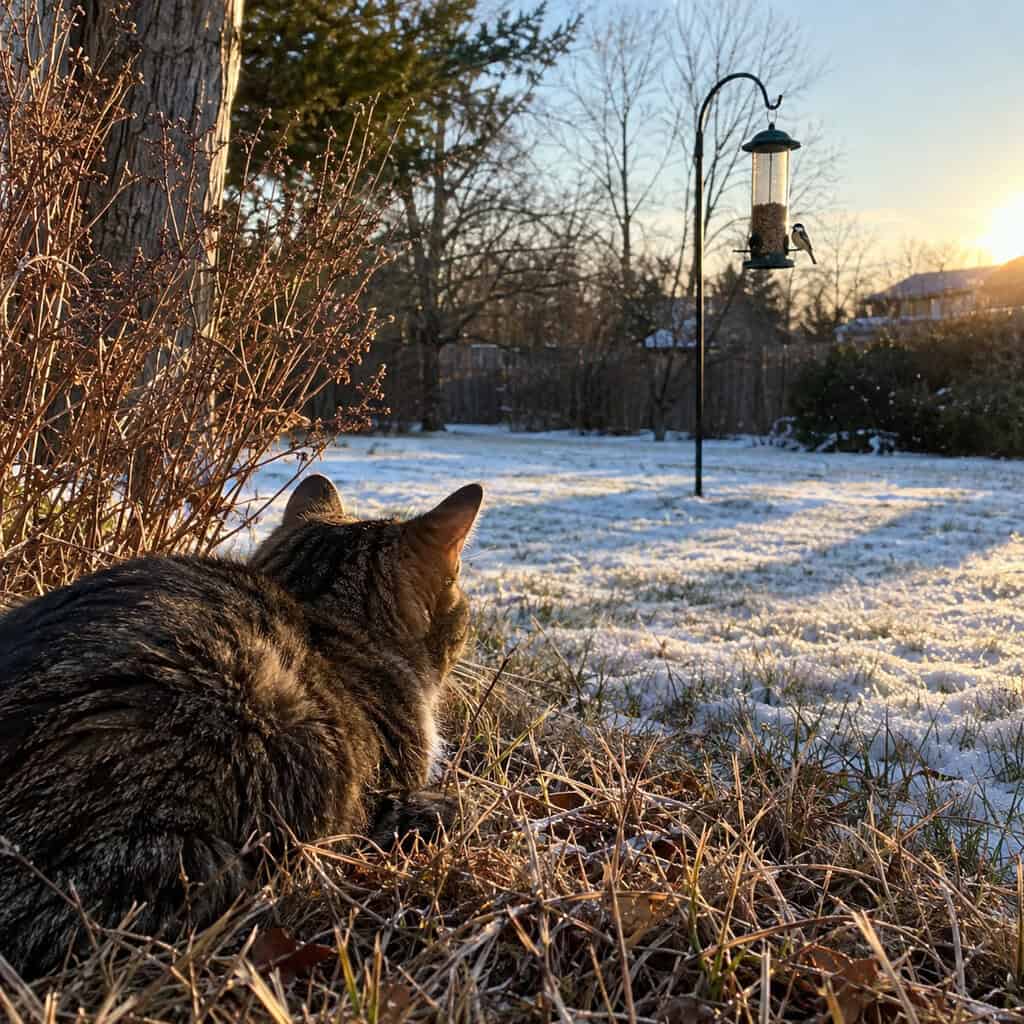
One outdoor cat on a regular route will empty a feeding station of cardinals for weeks.
Ground-feeders are the most exposed birds in the yard, and they remember exactly where the ambush happened. They don’t come back and test it.
Keep five feet of open, visible ground under every feeder. No dense low shrubs right beneath the pole, nothing a cat can lie flat in.
Prickly plantings at the base of the pole — barberry, a low juniper — make the approach miserable. It’s a small thing that works.
10. No Roof Over The Seed
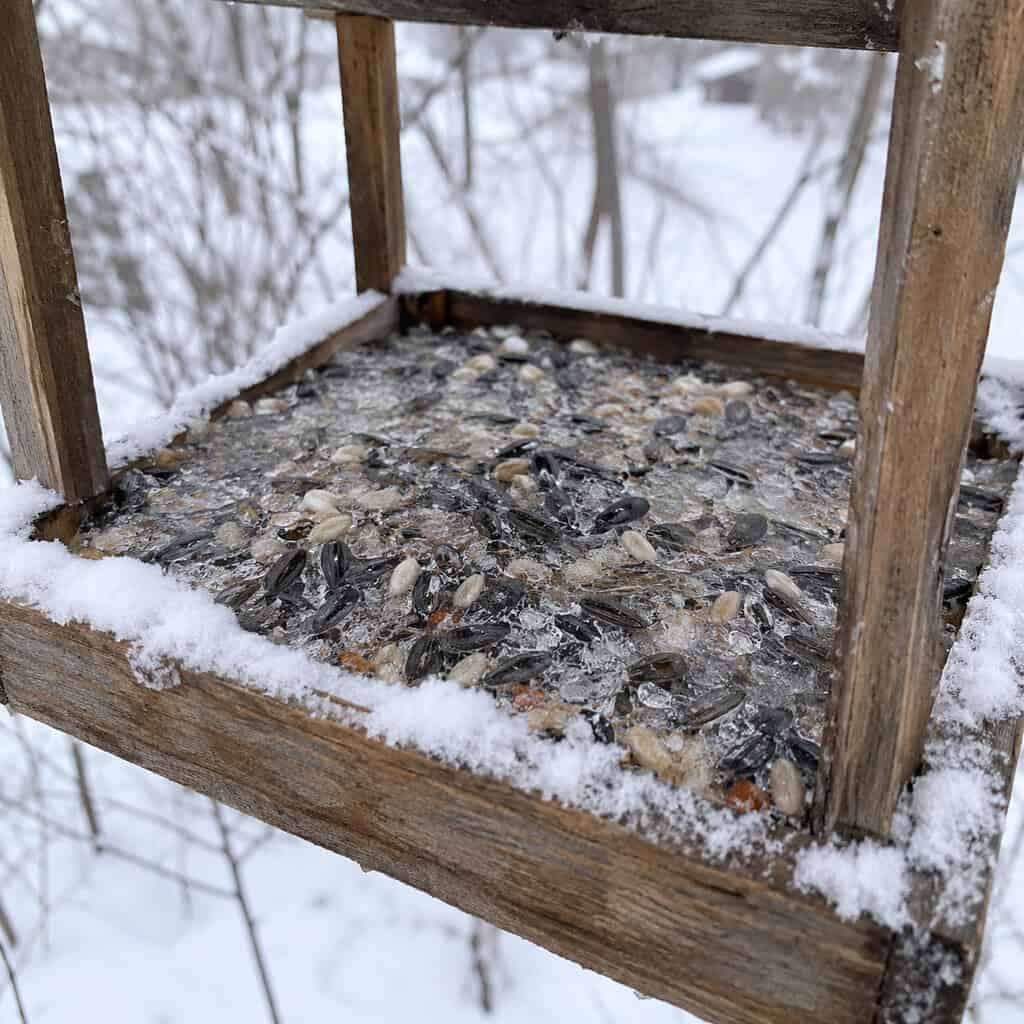
Open tray feeders are perfect right up until the first freezing drizzle.
Then the seed takes on water, freezes into a solid cake, and no bird on earth can pry it apart. Snow does the same thing more slowly.
Hopper feeders with a wide overhanging roof keep the seed dry and loose, which is exactly why the old wooden barn-style hopper is still the classic winter cardinal feeder.
If you love your tray, build it a roof. Even a scrap of cedar on two standoffs changes everything.
11. Shrubs Sheared Into Bowling Balls
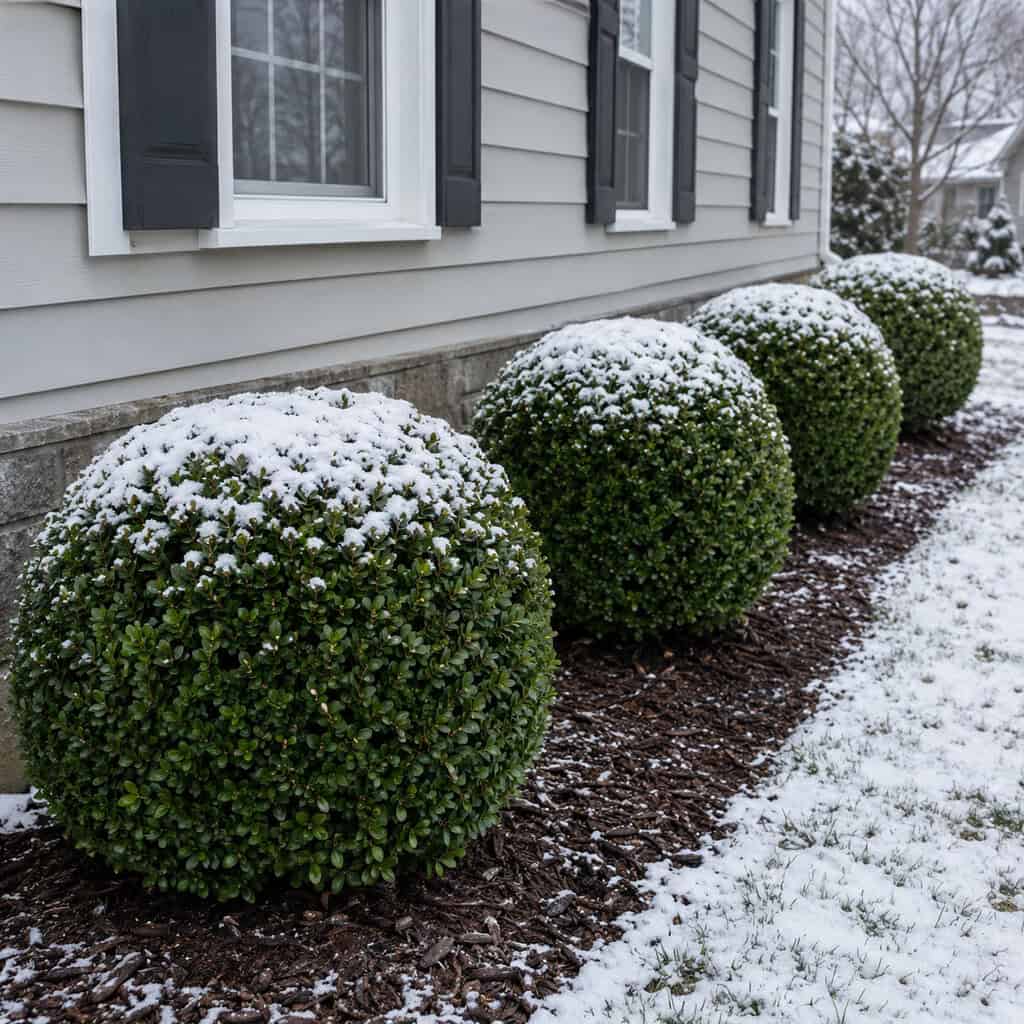
The landscaper look is actively hostile to cardinals.
A boxwood pruned into a tight sphere has a dense outer shell and a hollow, twiggy, unusable interior. A cardinal can’t slip inside and sit hidden, which is the entire point of a shrub from a bird’s perspective.
They want loose, dense, branchy growth they can disappear into at chest height. Think unsheared viburnum, holly, forsythia left alone for a season.
Stop shearing one or two shrubs near the feeder. Let them get shaggy.
12. Hung In The 3-To-30-Foot Window Zone

This one has real stakes beyond attendance.
Feeders placed in the middle distance from a window produce the worst collisions. Inside three feet, a startled bird can’t build up enough speed to hurt itself. Out past thirty feet, it has room to see the reflection and correct.
The zone between those two numbers is where birds die.
Move the feeder to within three feet of the glass or well beyond thirty. If neither works, break up the reflection with exterior screening or closely spaced decals.
13. A Lightweight Feeder That Swings In The Wind

Cardinals feed braced and still. They don’t like moving platforms.
A plastic feeder dangling from a thin branch tips when they land, spins in January wind, and dumps seed in gusts. The bird makes one attempt, gets rattled, and goes to the neighbor’s steady hopper.
Pole-mount it or use a heavy wooden hopper on a short, stiff hanger. Weight is a feature here.
14. A Hopper That’s Never Been Cleaned

This is the entry most people skip, and it’s the one that empties a yard fastest.
Seed settles in the bottom of a hopper, absorbs moisture through the vents, and sits there. Within a few weeks you’ve got a damp layer growing mold — and feeders are documented transmission points for salmonellosis, aspergillosis, trichomoniasis and avian conjunctivitis.
When sick birds show up at a station, healthy birds stop coming. Cardinals in particular hold back from a feeder where something’s off.
The working standard is cleaning seed feeders roughly every two weeks, and more often in wet weather or whenever you see a bird looking lethargic, fluffed up, or crusty-eyed. Penn State Extension recommends pulling feeders entirely for a couple of weeks if you spot sick birds, to break the cycle.
Here’s the routine. Empty it completely — don’t top off over old seed. Scrub with hot soapy water and a bottle brush, getting into the corners where seed packs. Soak for ten minutes in a nine-to-one water and bleach solution. Rinse hard, then dry it all the way before refilling, because a damp hopper just restarts the mold.
Wear gloves. Wash your hands after. Don’t do it in the kitchen sink.
Two feeders in rotation makes this painless. One hangs, one dries.
15. Letting Starlings And Grackles Own The Feeder
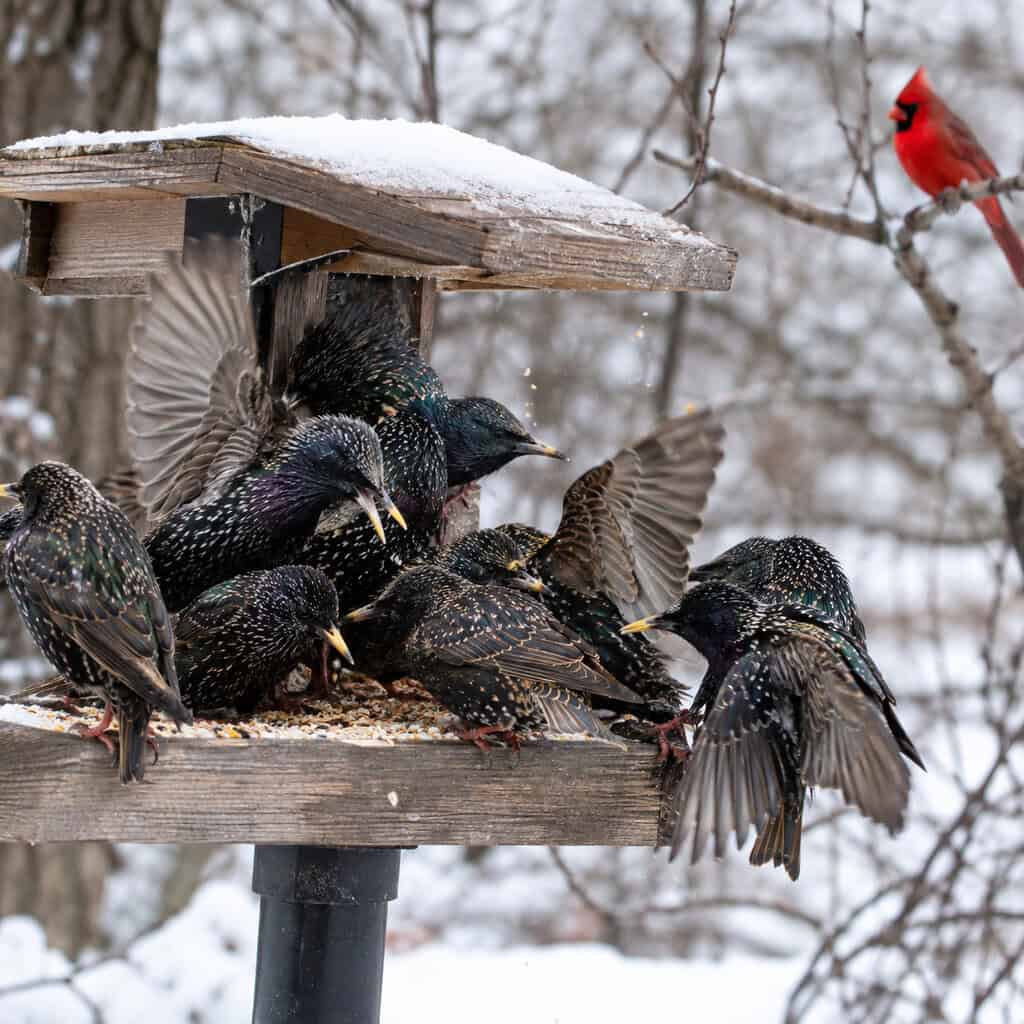
Cardinals don’t fight. That’s the whole problem.
When a mob of starlings or grackles drops in, a cardinal doesn’t contest the perch — it waits in a nearby shrub, and if the mob is there every day, it quits waiting and finds another yard. You never see the displacement happen. You just notice the red is gone.
Three fixes, stacked.
Switch the main feeder to safflower. Starlings and grackles mostly won’t eat it, cardinals will, and the mob thins out within a week or two.
Second, pull cracked corn, bread, cheap mixed grain and suet with corn filler out of the rotation entirely. Those are blackbird magnets, and every bag you put out trains a bigger flock to check your yard daily.
Third, use a weight-sensitive hopper or a feeder with short perches and no landing rail. Starlings are clumsy and need a broad platform to settle on. Take the platform away and most of them give up.
Suet is the hardest one. Switch to an upside-down suet feeder, where birds have to hang and feed from below — woodpeckers and nuthatches manage fine, starlings can’t.
16. A Yard Full Of Nyjer Socks And Nothing Else

Mesh sock, fine thistle seed, goldfinches all winter. Looks like a thriving operation.
It’s a finch-only system. Nyjer is a tiny, oily seed built for small, fine-tipped beaks, and the sock requires a clinging grip cardinals don’t have.
Wrong seed, wrong grip, wrong bird. Plenty of people feed birds faithfully for years and offer cardinals absolutely nothing they can physically eat.
Keep the sock. Add a hopper.
17. No Open Water When Everything’s Frozen

Seed is everywhere in a suburb in January. Liquid water isn’t.
Birds need to drink daily, and in a hard freeze they’re burning energy eating snow to get it. A heated birdbath solves a scarcity nothing else in your yard addresses.
It’s often the single fastest upgrade for winter cardinal traffic — faster than changing seed, faster than moving the pole.
Plug-in heated baths run $50 to $90, or you can drop a $30 de-icer into the basin you already own. Keep it shallow, two inches at the deepest point.
18. Letting It Run Dry During A Cold Snap

Winter cardinals move in loose flocks and work a daily feeding circuit — same yards, roughly the same order, every day.
Go empty for three days during a hard freeze and the route reroutes. The birds don’t starve; they just find the next reliable stop and fold it into the loop.
Getting back on that circuit takes weeks.
Keep a sealed can of seed in the garage so a refill is a two-minute job, not an errand.
19. A Weight-Triggered Feeder Set Too Light

Nobody thinks to check this.
Squirrel-proof hoppers work on a spring-loaded perch that drops and closes the seed ports under weight. Set the tension for squirrels only and you’ve also set it for anything over an ounce and a half.
A northern cardinal weighs around 1.5 ounces — heavy for a songbird. It lands, the shutters slam, and it leaves.
There’s an adjustment screw or dial on nearly every model. Back it off a turn or two, watch for a day, repeat until cardinals feed and squirrels don’t.
20. Bagging Every Leaf And Hauling Off The Brush Pile

The immaculate yard is a food desert with a feeder standing in the middle of it.
Leaf litter holds overwintering insects, spiders, and larvae that cardinals pick through all winter — real protein that a seed hopper doesn’t provide. A brush pile in a back corner gives them somewhere to vanish when a hawk crosses the yard.
Rake the leaves into the shrub beds instead of the curb. Stack your fall prunings in a loose pile behind the garage and leave it until spring.
It’s the same instinct behind what grandma did in October — leave the yard a little rougher going into winter and everything in it does better.
21. A Carpet Of Hulls And Droppings Under The Feeder

Look under your pole right now. If there’s a two-inch mat of sunflower shells pressed into the mud, you’ve got a problem building.
That layer holds moisture. Under it, old seed sprouts and rots, droppings accumulate, and the whole drop zone turns into a bacterial culture — exactly the ground surface cardinals are supposed to forage on.
Then come the rodents. A steady spill of seed under a feeder is a reliable food source for mice and rats, and once they establish a run, they’ll feed at dusk and dawn — the same windows cardinals use. Ground-feeding birds abandon a spot with rodent traffic fast.
Clean it in stages. Rake the hull layer out every two or three weeks through the winter and bag it; don’t compost seed waste near the house. Scrape the compacted mat down to bare soil a couple times a season. Clemson Cooperative Extension flags accumulated seed and droppings beneath feeders as a disease risk on par with the feeder itself.
The easier version is a wide catch tray mounted under the feeder. It intercepts most of the hulls, lifts off, dumps in ten seconds, and keeps the ground underneath clean enough to be useful.
Moving the pole eight or ten feet every couple of seasons also resets the ground, which is worth doing if you’ve fed in the same spot for years.
22. One Lonely Feeding Station

Cardinals arrive in pairs, and in deep winter in loose flocks of six or eight.
One feeder with two ports means a queue, and cardinals won’t jostle for a spot. The dominant bird eats and the rest drift off.
Run two or three stations spread across the yard — a hopper near the shrubs, a platform on the other side, a tray on the ground. Timid birds get a second choice, and the whole operation stops bottlenecking.
23. A Motion Floodlight Blasting The Feeder At Dusk

Nobody connects their garage light to their missing cardinals.
But 4:45 p.m. in January is peak cardinal time, and a 2,000-lumen motion floodlight snapping on over the feeding station ends the visit instantly. Every time the dog goes out, every time a car pulls in.
Point the fixture away from the feeder, narrow the sensor zone, or move the feeder outside the sweep.
It’s a five-minute adjustment that people live with for years.
24. Seed That Sat In A Hot Garage All Summer

Half a bag left over from March, rolled shut, shoved behind the mower. Reopened in November.
Sunflower is high in oil, and oil goes rancid in summer heat. Pantry moths and weevils find it within weeks, and by fall you’ve got webbing through the top few inches and a sour smell when you open it.
Birds reject it well before you notice anything’s wrong. You just see a full feeder nobody touches.
Buy smaller bags more often. Store it in a sealed galvanized can somewhere cool — a metal trash can with a locking lid also stops mice cold.
25. Ripping Out The Berry Shrubs

Cardinals eat a lot of fruit in winter, not just seed.
Winterberry holly, staghorn sumac, gray dogwood, viburnum, hackberry — these hold fruit into February and give cardinals a reason to stay in your yard between feeder visits. That’s what turns a visiting bird into a resident one.
Trade them for lawn and fresh mulch and you’ve removed the anchor.
Plant one winterberry this spring. It needs a male pollinator nearby to fruit, which the tag won’t always tell you.
26. Not A Single Evergreen To Roost In

Cardinals don’t migrate. They have to survive a fourteen-hour January night somewhere within a short flight of where they feed.
That somewhere is dense evergreen cover — spruce, eastern red cedar, arborvitae, a thick juniper. The interior of a mature spruce can run several degrees warmer than open air and blocks the wind entirely.
Yards with that cover get dawn cardinals for a simple reason: the birds slept there.
A deciduous-only yard gets visitors. An evergreen in the back corner gets residents.
27. Taking The Feeder Down Mid-Winter

Late January and February are the hardest stretch of the year for birds — natural seed stores exhausted, insects gone, nights longest and coldest.
It’s also precisely when most people quit. Holiday travel, a cold snap, general burnout, and the feeder sits empty on the deck rail until March.
Keep it going through the worst of it and you become the reliable yard. That’s the whole game.
Going away for a week? Hang an extra hopper and fill both to the top.
28. Moving It Around — And Quitting Before They Find It

A brand-new feeder in a brand-new spot can take two to six weeks to get discovered. That’s normal.
What kills it is impatience. Week three with no action, people move the pole to a better-looking spot, and the clock resets to zero. Do that three times and you’ve spent a whole winter being undiscovered.
Pick a decent spot using everything above — cover ten feet off, out of the window strike zone, baffled pole, right seed — and then leave it alone for two solid months.
Cardinals pay that patience back. They’re non-migratory, strongly site-faithful, and a pair that adopts your yard will work it for years, bringing fledglings through every summer and showing up in the snow every January.
29. A Cooper’s Hawk Working The Feeder

Sometimes the cardinals vanish overnight and nothing you changed explains it.
Check the trees. A feeding station is a concentrated food source, and Cooper’s and sharp-shinned hawks hunt them deliberately all winter — one resident hawk can shut down a busy yard in a day and keep it quiet for a week or more.
You’ll find evidence: a ring of feathers on the snow, or a crow-sized bird with a long banded tail sitting unusually still in a bare maple.
Take the feeders down for a few days and the hawk moves on to the next yard. When you rehang them, pile brush near the pole so there’s instant cover.
It’s legal and it’s natural — hawks are federally protected and they’ve been doing this longer than we’ve been hanging feeders.
None of this requires a bigger budget. The whole list is seed choice, placement, timing, and not giving up in February.
Start with the two that fix the most yards: real black-oil sunflower in a feeder with a wide ledge, placed about a dozen feet from cover. Then add safflower and a heated bath when you’re ready.
Cardinals are the one bird that stays. Build the yard they need and they’ll be standing out there in the snow, bright as a stoplight, for the next ten winters.