


You know the spot. That patch under the old maple where the grass thins out every summer, no matter how much seed you throw down.
By August it’s bare dirt and moss and a few sad blades hanging on. You reseed in fall. It fails again by July.
There was a time when every yard had a corner like this, and nobody worried about it. Ferns grew there. A little periwinkle. Maybe a bench nobody sat on.
Somewhere along the way we all decided the whole yard had to be lawn, edge to edge, and shade became a problem instead of a place. But grass never wanted to grow in deep shade. It’s a sun crop. Fighting that is a losing hand.
The plants below actually want what that bare patch offers — filtered light, cool roots, competition from tree roots. Some carpet the ground like a lawn you never mow. A few are toxic to pets, and those get a plain warning.
Here are 26 shade plants that thrive exactly where your grass keeps giving up.
1. Japanese Pachysandra
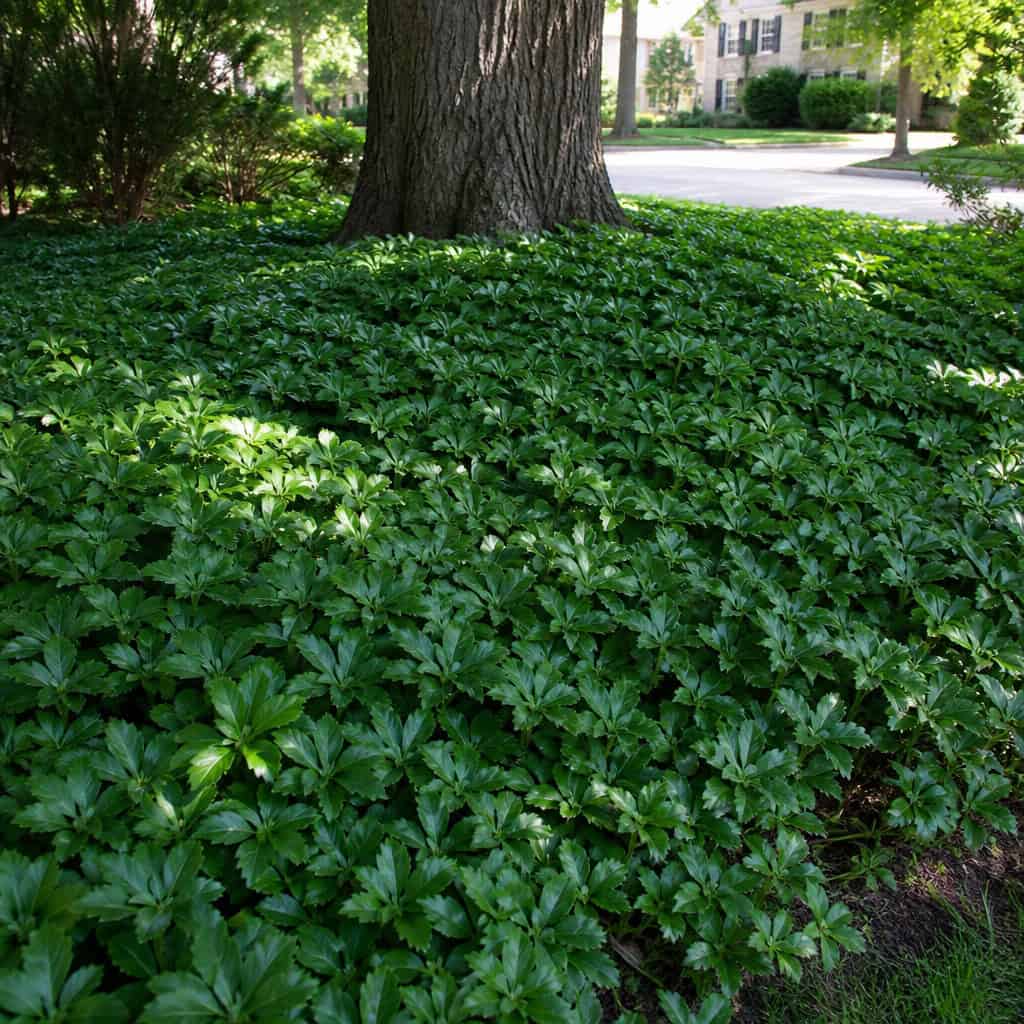
Start here, because you’ve probably already seen it. That glossy green carpet under trees in half the older neighborhoods in America — that’s pachysandra.
It spreads into a dense evergreen mat about eight inches tall and stays green through winter. Full sun actually scorches the leaves yellow, so the shade under your tree is a feature, not a compromise.
It handles dry to average shade in Zones 4 through 9 and asks for almost nothing once established.
One caution for the pet owners. Pachysandra is mildly irritating if a dog or cat chews it — not deadly, but enough to cause drooling or an upset stomach. Worth knowing before you plant it near a chewer. LawnStarter ranks it among the most reliable shade covers for exactly this bare-under-the-tree job.
2. Bugleweed (Ajuga)
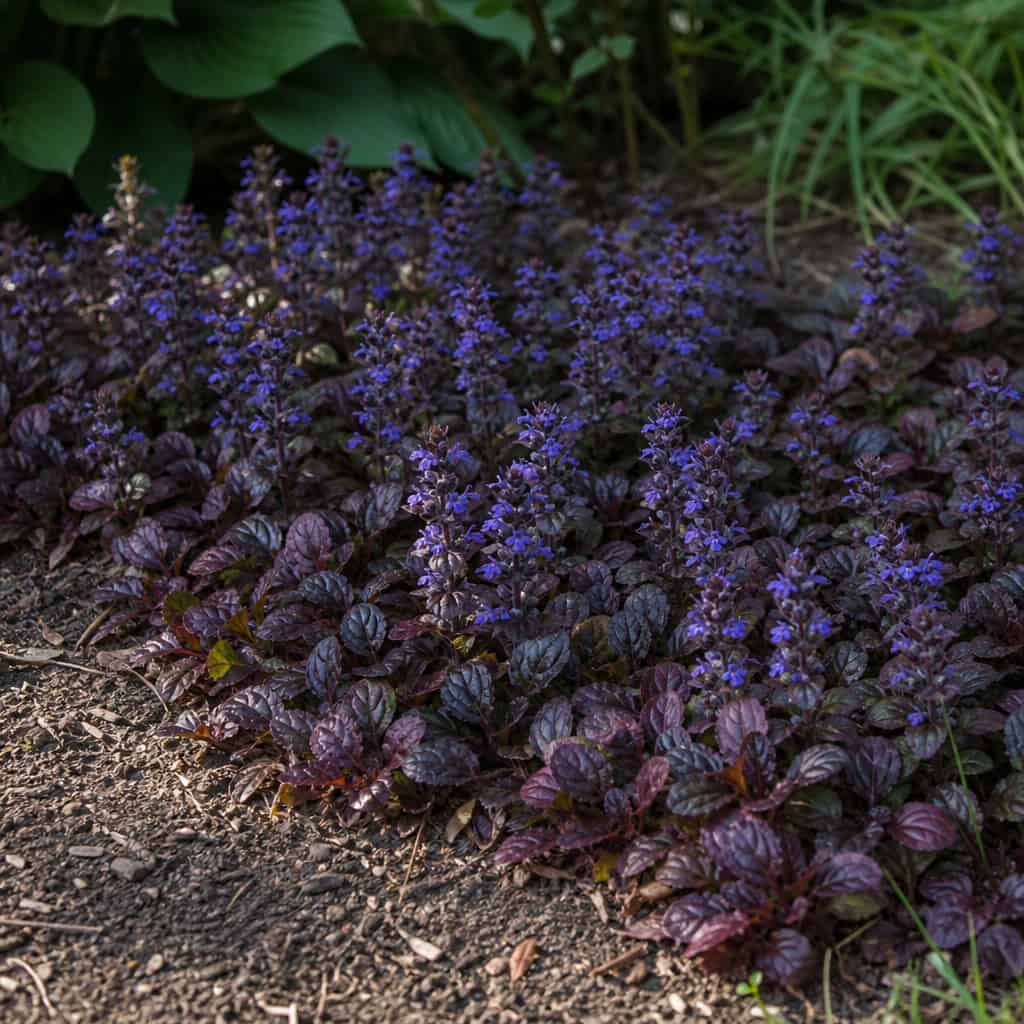
Want a big bare patch filled fast? Ajuga is the one.
It creeps by runners into a low carpet, and the good cultivars bring bronze and burgundy foliage instead of plain green. In spring it throws up violet-blue flower spikes that draw bees.
Set your expectations honestly. In the very deepest shade it thins out and gets patchy, so it’s happiest in partial shade where a little light still reaches the ground.
It spreads aggressively — into lawns, into beds, wherever it can reach. Plant it where you want coverage and don’t mind it wandering. Zones 5 to 9.
3. Sweet Woodruff

This one was built for the job. Sweet woodruff evolved to grow among tree roots on the shady forest floor, which is exactly the situation under your maple.
It forms a soft, low mat of whorled leaves topped with tiny white flowers in spring. Crush a handful and it smells like fresh-cut hay — old-timers used to dry it and tuck it into linen drawers.
Deer and rabbits leave it alone. It’s friendlier around pets than a lot of this list, too.
Full to partial shade, Zones 4 through 8. According to Michigan State University Extension, it’s a solid lawn alternative for the shaded ground where turf just quits.
4. Lilyturf (Liriope)
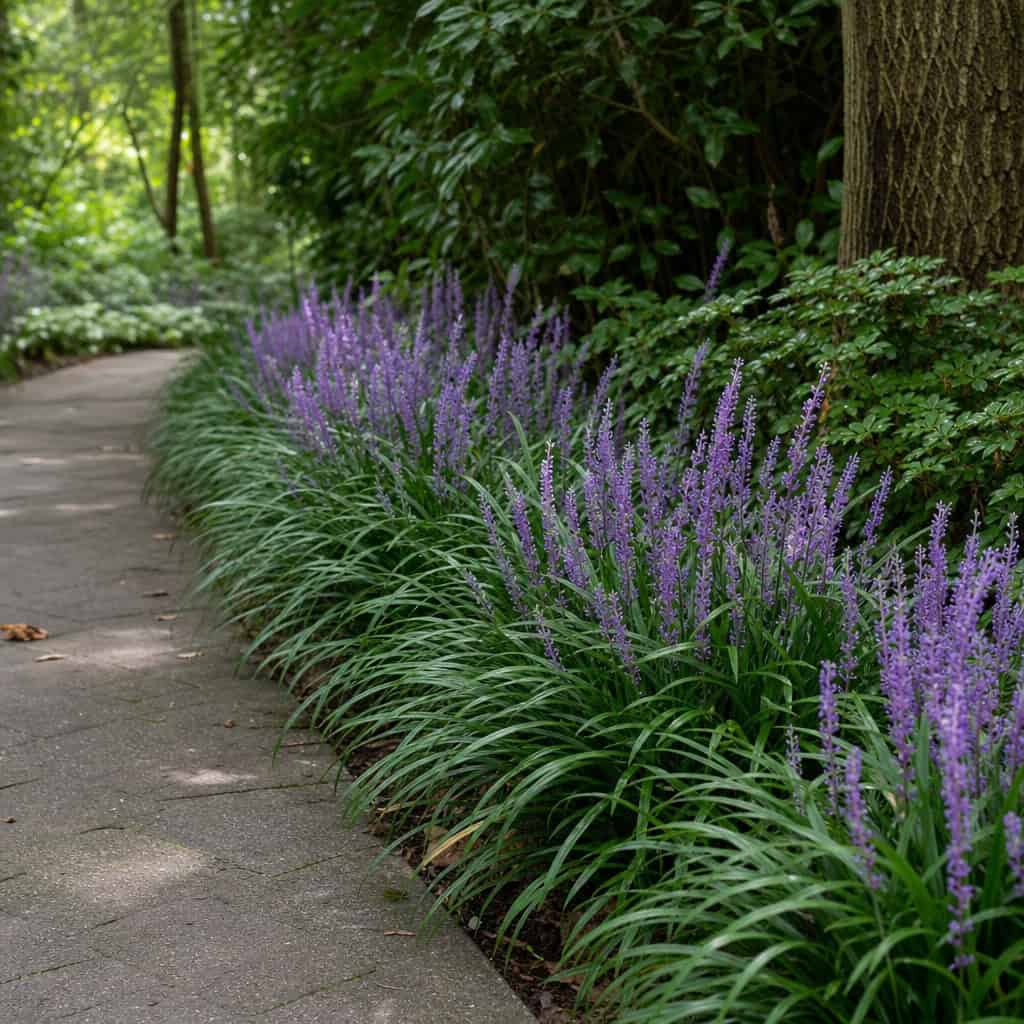
Liriope reads as a lawn from a distance. Strappy, grass-like blades in a tidy clump, with lilac flower spikes in late summer.
Here’s the split that matters. Liriope spicata creeps and spreads to cover a whole area — good for a slope you want blanketed. The clumping muscari type stays put in a neat mound and won’t run.
Pick the creeper to cover ground. Pick the clumper for edging and borders.
It holds a shady slope well and shrugs off partial to full shade in Zones 6 to 10.
5. Mondo Grass
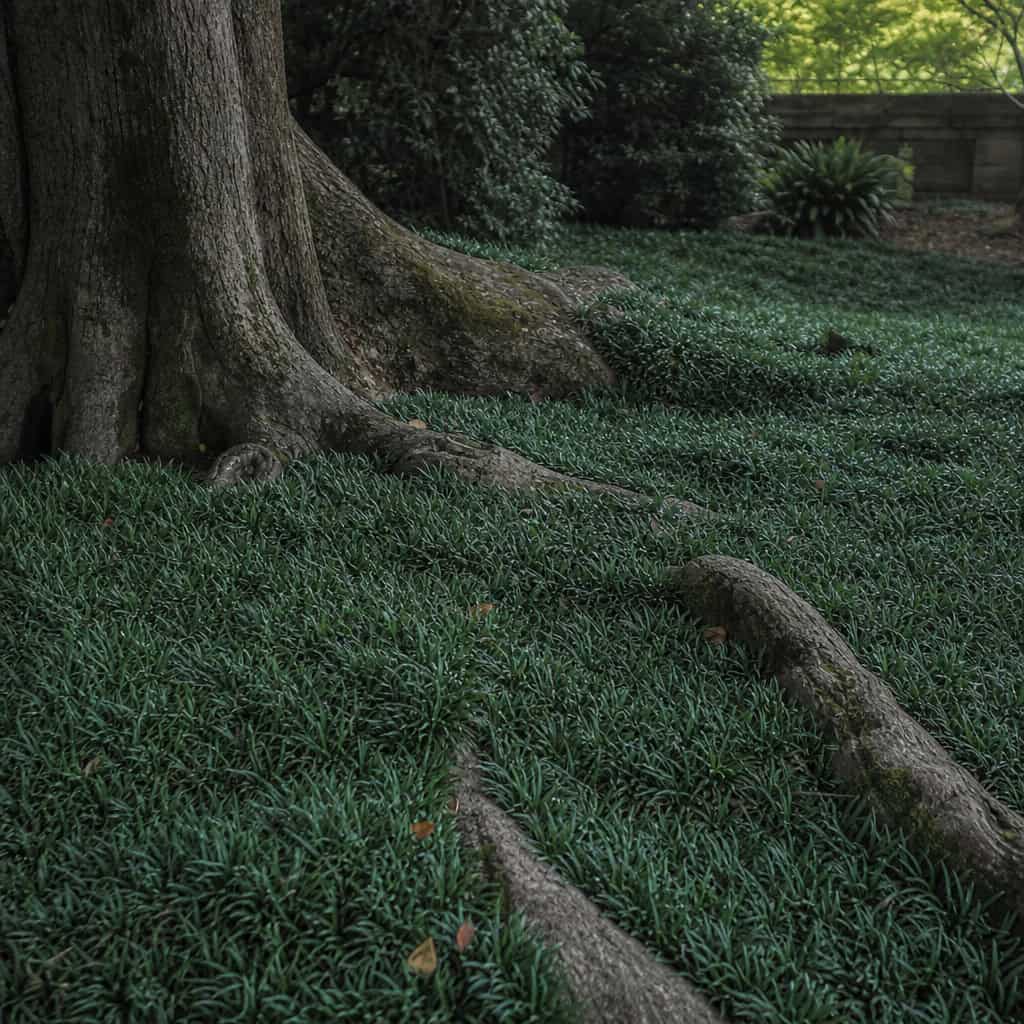
If you’re chasing the look of a mowless lawn in shade, this is the closest you’ll get. The blade-like leaves curve down to the ground and top out around three or four inches.
Dwarf mondo goes even lower and reads as turf you never have to cut. It’s perfect draped over the exposed tree roots where nothing else will take.
It’s slow to fill but nearly indestructible once it does. Zones 7 through 11.
6. Sedge (Carex)

Sedge is the real deal — a grass alternative that actually prefers the shade where true turfgrass fails.
The foliage flows and moves in the wind, fine-textured and soft, and more nurseries sell it every year as a genuine no-mow lawn substitute for shade. Some varieties never need cutting at all.
Choose a native sedge and you get a pollinator-friendly, pet-friendlier ground layer instead of a chemical-fed monoculture.
Part to full shade, with the right species for nearly any region.
7. Hosta
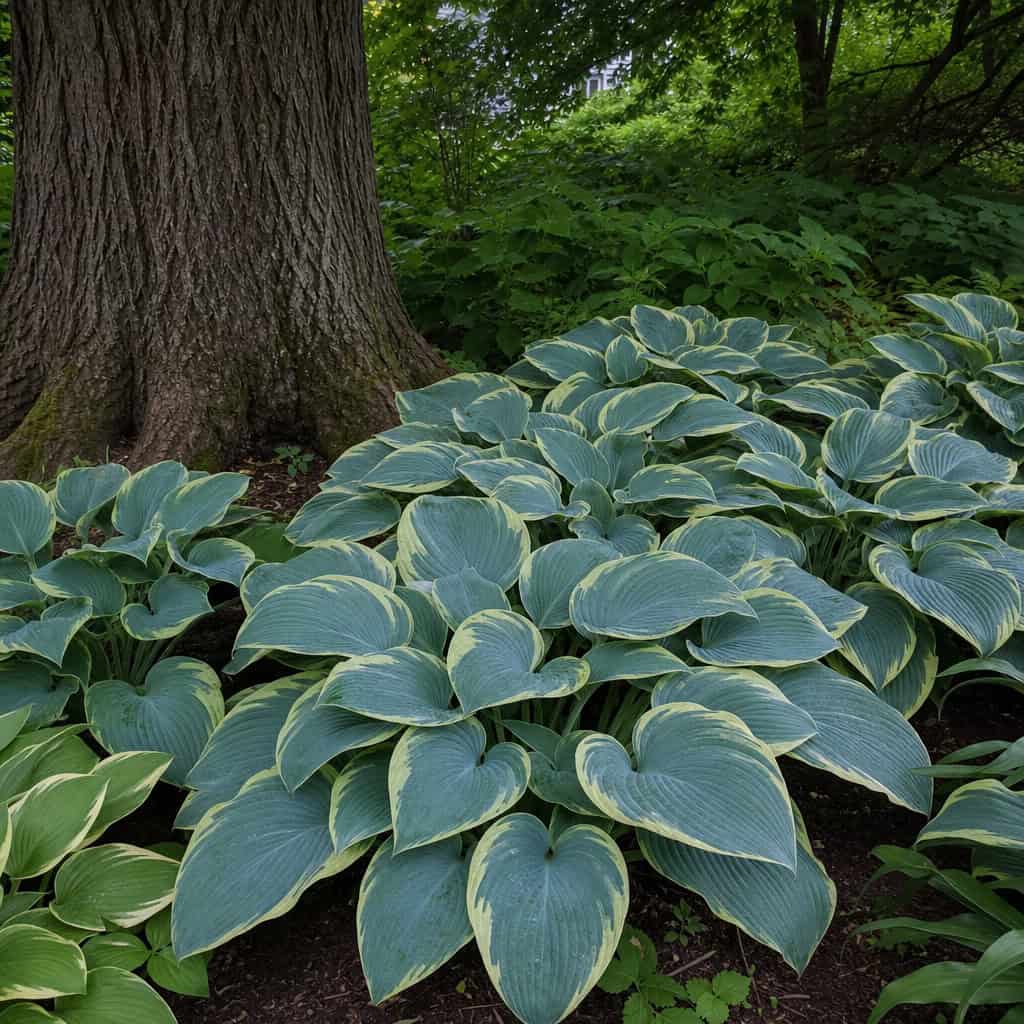
The queen of the shade garden. Nothing else gives you this much bold foliage for this little effort, and hostas return faithfully every spring even in the dark under a mature tree.
There are hundreds of cultivars — blue-gray, chartreuse, cream-edged, some the size of a dinner plate and some no bigger than your palm. Plant a few together and the bare zone under your tree becomes the best-looking bed in the yard.
They take partial to full shade in Zones 3 through 9 and want ordinary, decently moist soil. That’s it. That’s the whole care sheet.
But this is where the pet owners need to stop and read.
Toxic to pets. Hostas contain saponins, and per the ASPCA they’re toxic to dogs, cats, and horses. A pet that chews the leaves can develop vomiting, diarrhea, and general depression or lethargy.
It’s rarely fatal, but it’s a genuinely miserable afternoon for the animal and a vet bill for you. If you’ve got a dog that grazes the garden or a cat that nibbles greenery, either skip hostas entirely or site them where paws don’t go.
For everyone else, they’re as easy and as beautiful as shade gardening gets.
8. Ferns (Christmas & Autumn Fern)

This is where grass throws in the towel completely — deep, cool shade under mature trees — and ferns just keep going.
Autumn fern brings coppery new fronds that age to deep green. Christmas fern stays evergreen right through winter, so you get structure when everything else has gone flat and brown.
The dry version of deep shade defeats most plants. Christmas fern and marginal wood fern handle even that, tucking in among tree roots where a garden hose rarely reaches.
And they’re generally non-toxic to pets — a quiet relief on a list with a few hazards. Zones 3 to 9 depending on the species.
9. Astilbe

Color in the shade is rare, and astilbe delivers it in feathery plumes of red, pink, and white that rise above ferny foliage.
It succeeds under maples where hostas get dug up and gnawed by squirrels, and it self-seeds gently around tree roots rather than trying to muscle them out.
One firm condition. Astilbe wants consistent moisture — let it dry out repeatedly and the plumes crisp and the plant sulks. Give it a spot that stays damp, or plan to water in dry spells.
Light to full shade, Zones 4 through 9.
10. Coral Bells (Heuchera)

Grown for the leaves, not the flowers. Heuchera comes in burgundy, amber, near-black, and electric chartreuse — colors that light up a dark corner all year.
The airy flower spikes are a bonus, and hummingbirds work them all summer.
Here’s the honest bit that’ll save you a plant. Coral bells need sharper drainage than a hosta does. Sit them in soggy ground over winter and the crowns rot right out.
Plant them a touch high, give them soil that drains, and they’ll reward you. Partial to full shade, Zones 4 to 9.
11. Foamflower (Tiarella)
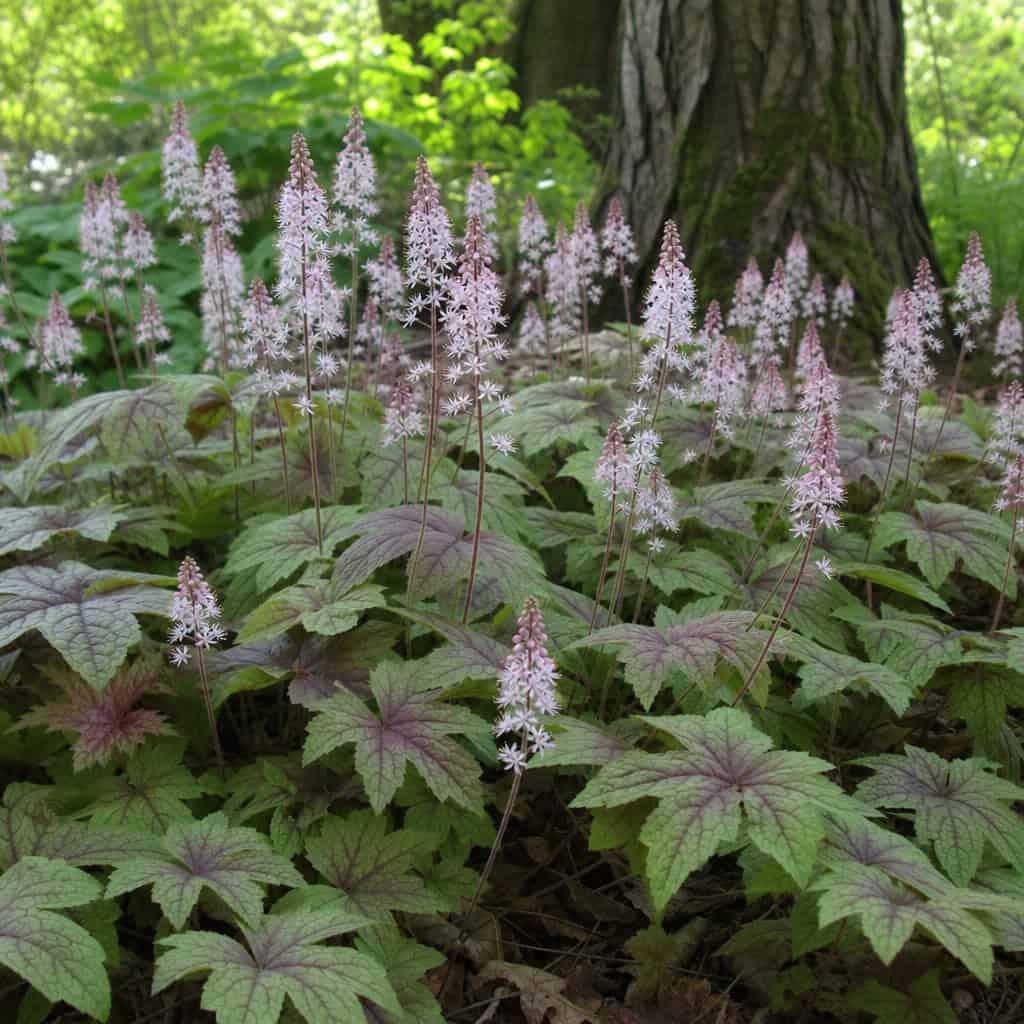
A North American native, and it looks the part. Maple-shaped leaves, often marked with dark burgundy along the veins, and frothy pink-white flower spires in spring.
It spreads by stolons — surface runners — into a true groundcover that knits together over a season or two.
Pair it with trillium and other woodland natives and you’ve rebuilt a little piece of forest floor under your trees.
Dappled to full shade, Zones 3 through 8. The Iowa State University Extension lists it among the reliable native covers for shade.
12. Barrenwort (Epimedium)

If there’s a hero on this list, it’s this one. Barrenwort thrives in the single hardest spot in most yards — dry, deep shade directly under trees.
Its shallow rhizomes actually coexist with tree roots instead of losing to them, and once established it shrugs off drought. Over a few years it forms a mat so dense that weeds can’t get a foothold.
The heart-shaped leaves take on a burgundy tint in cold weather and hold semi-evergreen through winter. Delicate little flowers dangle above them in spring.
This is the plant for the spot where you’ve already killed three other things. Zones 4 to 9.
13. Lungwort (Pulmonaria)
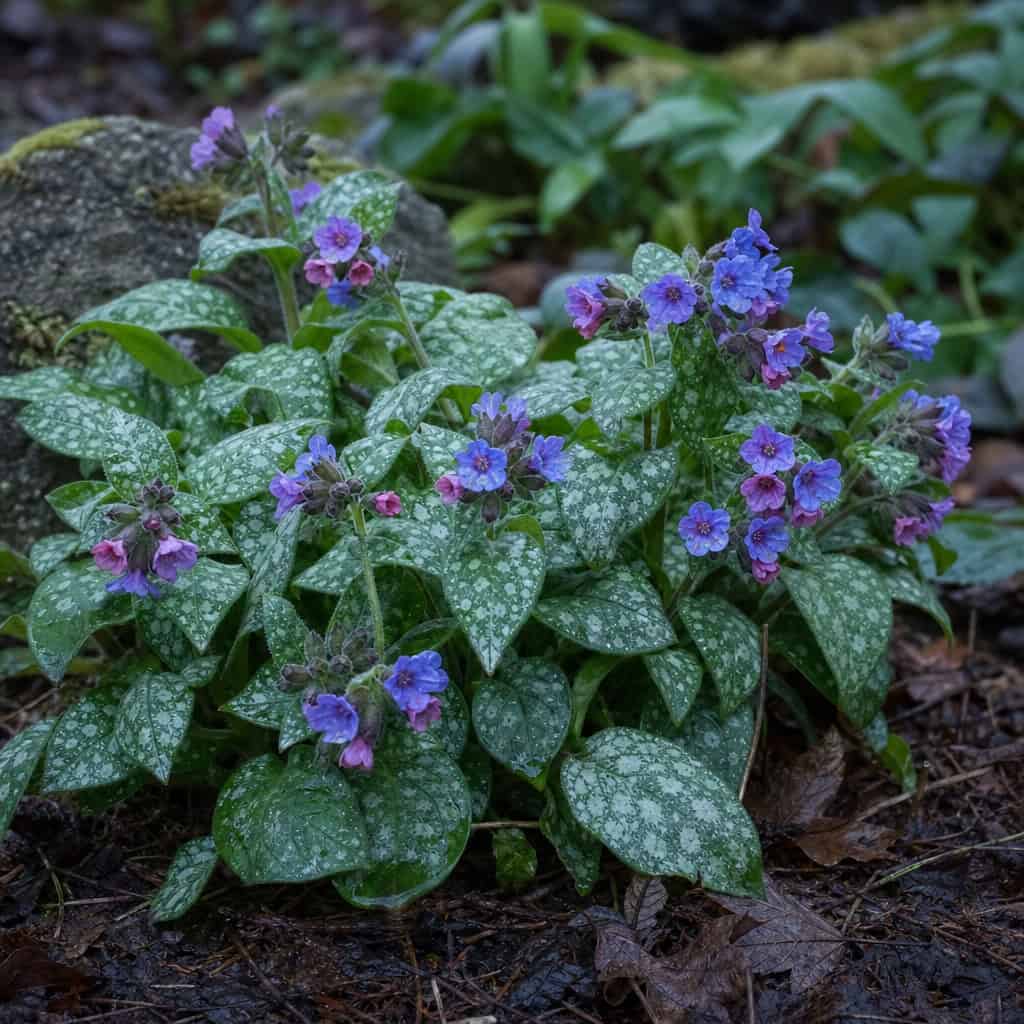
Lungwort earns its place on foliage alone. The leaves are splashed and spotted with silver, and they brighten a gloomy bed the way a shaft of light would.
The early flowers do a neat trick — they open pink and shift to blue as they age, so a single plant shows both colors at once.
It’s a clumping former that reads as a foliage groundcover, and it makes lovely contrast against the strappy liriope and ferny astilbe nearby.
Partial to full shade, Zones 3 through 8.
14. Lamium (Spotted Deadnettle & Yellow Archangel)
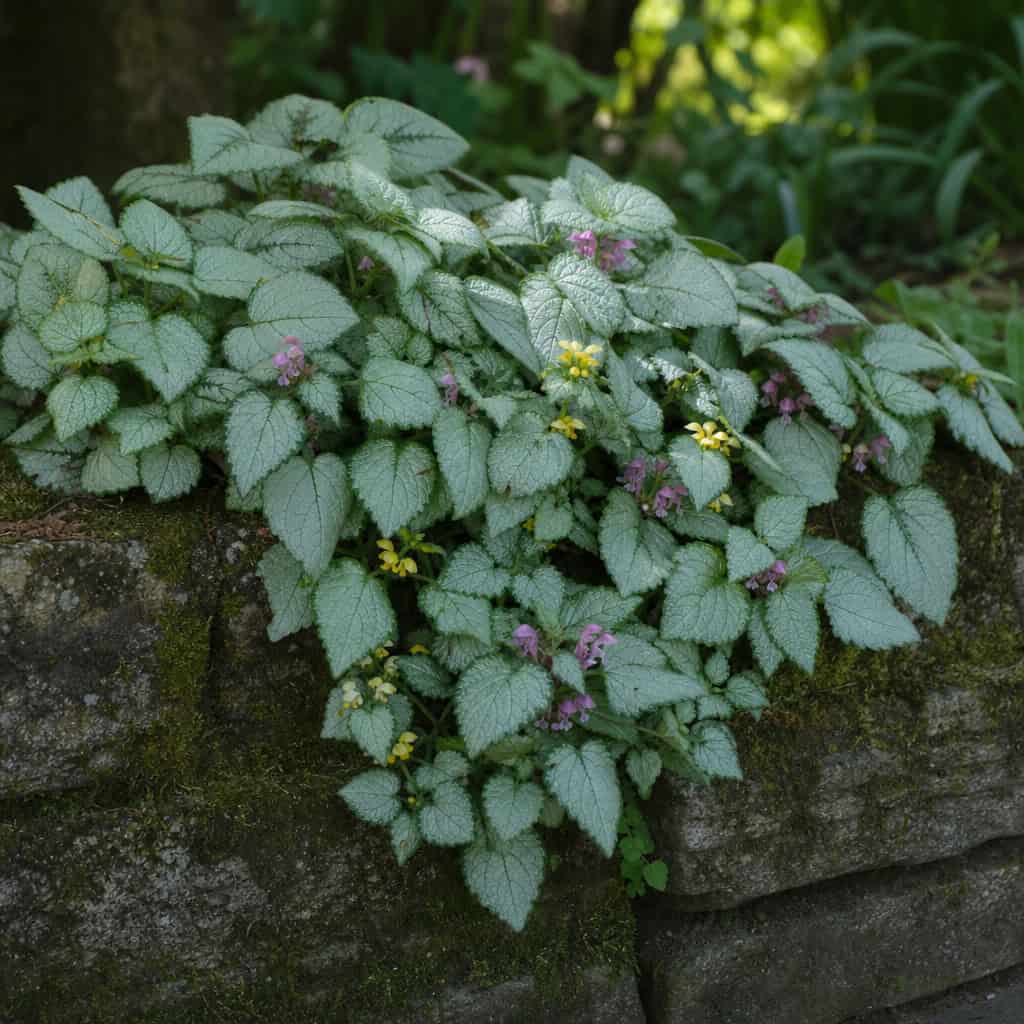
Silver-marbled leaves that seem to glow in deep shade, spilling over the edge of a bed or a wall. Spotted deadnettle brings pink or white flowers; yellow archangel brings yellow ones and is specifically adapted to dry shade.
It’s beautiful and it’s tough. But read this before you buy.
Yellow archangel is a known spreader and is listed as invasive in parts of the Pacific Northwest and beyond. Check your region before planting it, and choose a better-behaved spotted deadnettle cultivar if you’re anywhere near natural woodland.
Dry to moist shade, Zones 3 to 9.
15. Periwinkle (Vinca minor)
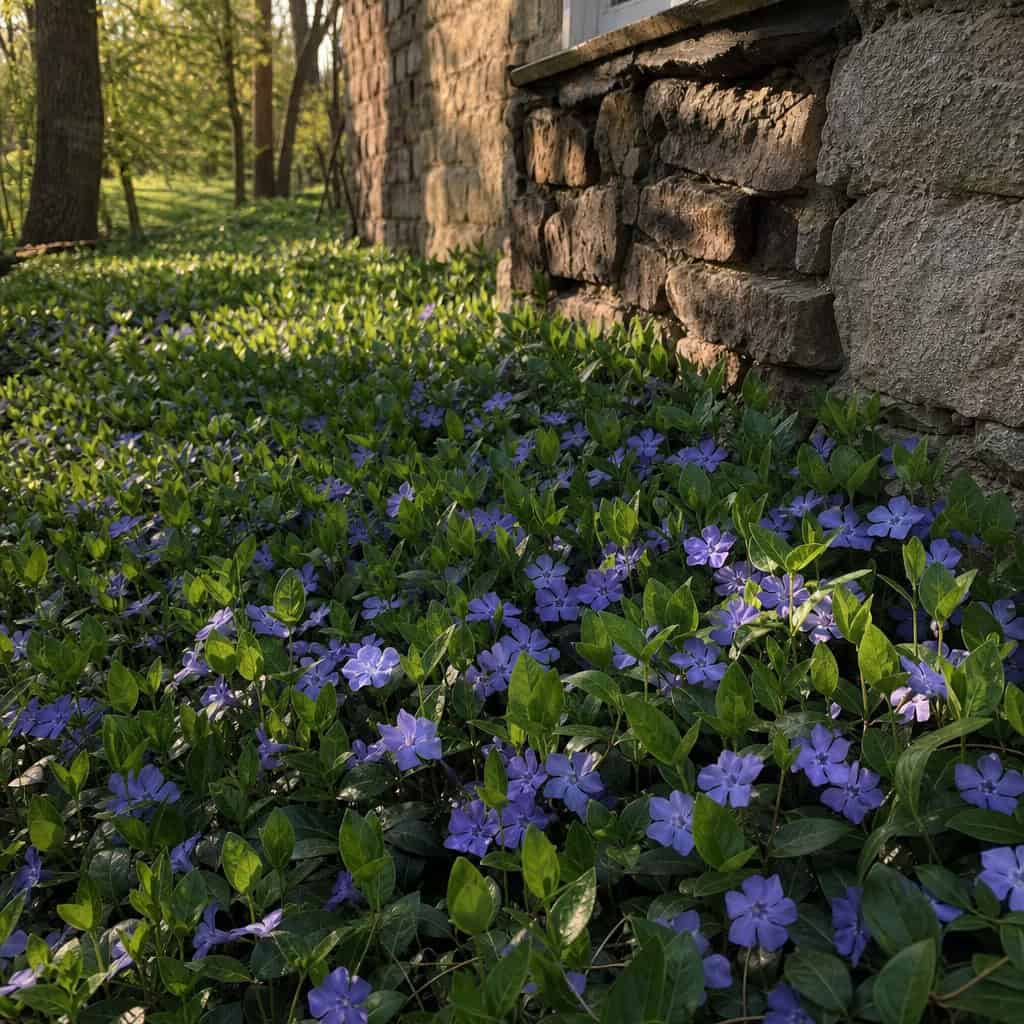
The old reliable. Periwinkle has been blanketing shady slopes and dry banks in American yards for generations — evergreen leaves, violet-blue flowers, and a habit of covering ground nothing else will touch.
Grandmothers planted it. It outlived the houses. You still see it running wild along old foundations and cemetery edges where it was set out decades ago.
That toughness cuts both ways, and this is a plant-with-your-eyes-open pick.
First, it’s toxic to pets. The ASPCA lists Vinca as toxic to dogs and cats, and ingestion can cause vomiting, tremors, and other neurological signs. On a pet-focused property, that matters.
Second, it’s invasive in many regions — it escapes gardens, smothers native wildflowers, and is genuinely hard to pull back once it’s loose in the woods.
Plant with caution. If you have chewers or a woodland edge, choose something else off this list. If you’ve got a contained, sunless bank and no browsing pets, few things cover it faster.
16. Hellebore (Lenten Rose)

Hellebore blooms in late winter, when the ground is still hard and nothing else dares. Nodding cups of white, plum, green, and speckled rose open while snow still lingers.
It thrives in dry shade with tree-root competition and keeps handsome evergreen foliage all year. On paper it’s a shade gardener’s dream.
But the wow factor comes with a warning.
Toxic to pets. Every part of the hellebore is poisonous to dogs and cats, and ingestion can cause drooling, vomiting, diarrhea, and even a drop in heart rate. This isn’t a plant to hand an unqualified recommendation.
The sap can also irritate human skin, so wear gloves when you cut it back. If your yard is a pet-free zone, plant it and enjoy those February flowers. If it isn’t, weigh it carefully. Zones 4 through 9.
17. Wild Ginger (Asarum)
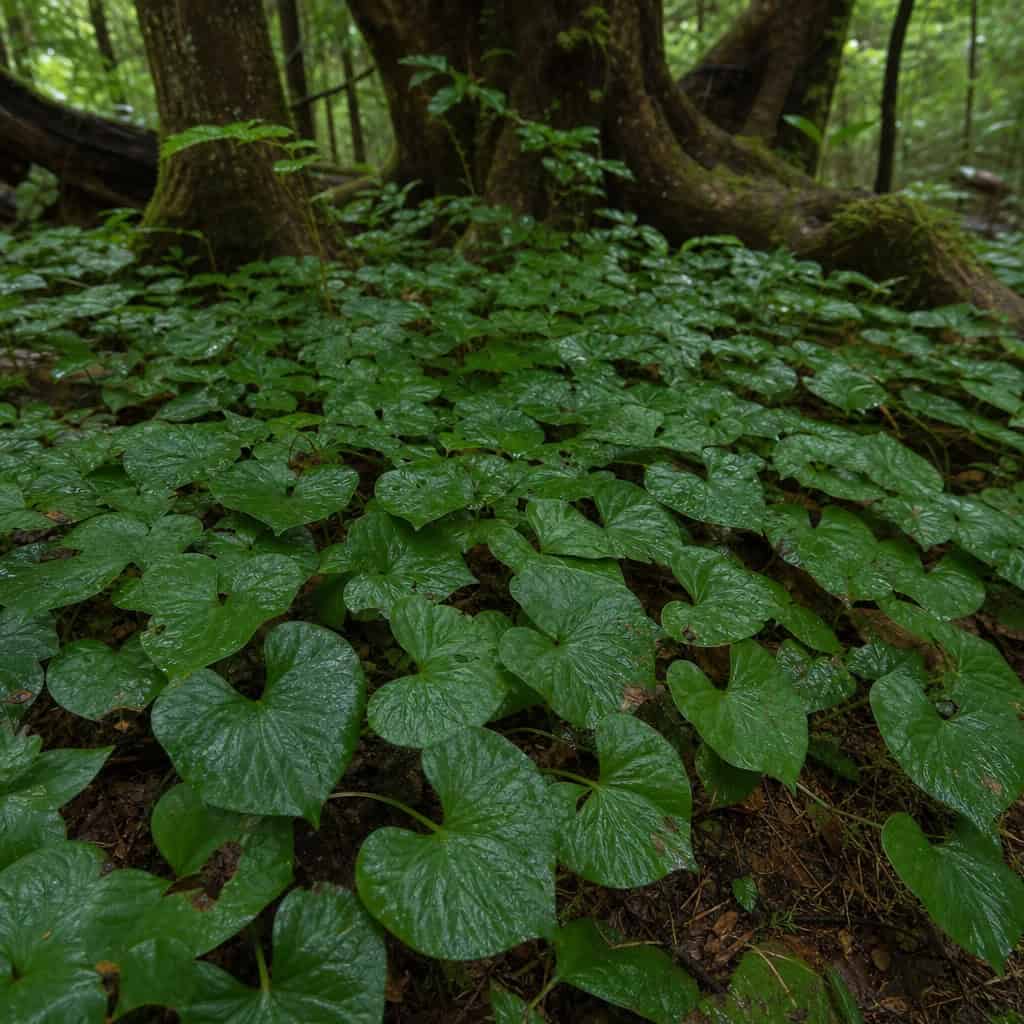
Low, native, and quietly excellent. Wild ginger spreads into mats of glossy, heart-shaped leaves that suppress weeds and tolerate serious shade plus heavy tree-root competition.
The Shuttleworth’s type is evergreen and about as close to no-care as a groundcover gets once it settles in.
Woodland gardeners love it because it looks like it belongs — because it does. This is what grew there before the lawn arrived.
Moist to dry shade, Zones 4 to 9 by species.
18. Solomon’s Seal

For height and rhythm among all these low carpets, plant Solomon’s seal. Arching stems hang with rows of little white bells in spring, all dangling in the same graceful line.
It naturalizes into slow colonies under trees, coming back a little wider each year.
You may have to hunt for it at a good nursery — it’s not always on the box-store shelf. It’s worth the hunt. Dropped in among ferns and foamflower, it gives the whole shade bed a vertical spine.
Full to partial shade, Zones 3 through 8.
19. Bleeding Heart (Dicentra)

The sentimental one. Rows of little heart-shaped blooms dangle from arching stems in spring, pink or white, and there’s no plant that says old-fashioned shade garden quite like it.
The native fringed type, Dicentra eximia, keeps its ferny foliage looking good all season instead of quitting early.
Siting is everything. Too much sun and it sulks. And the classic old-fashioned bleeding heart often goes dormant and vanishes in summer heat — that’s normal, not death, so don’t dig it up.
Partial to full shade, Zones 3 to 9.
20. Virginia Bluebells
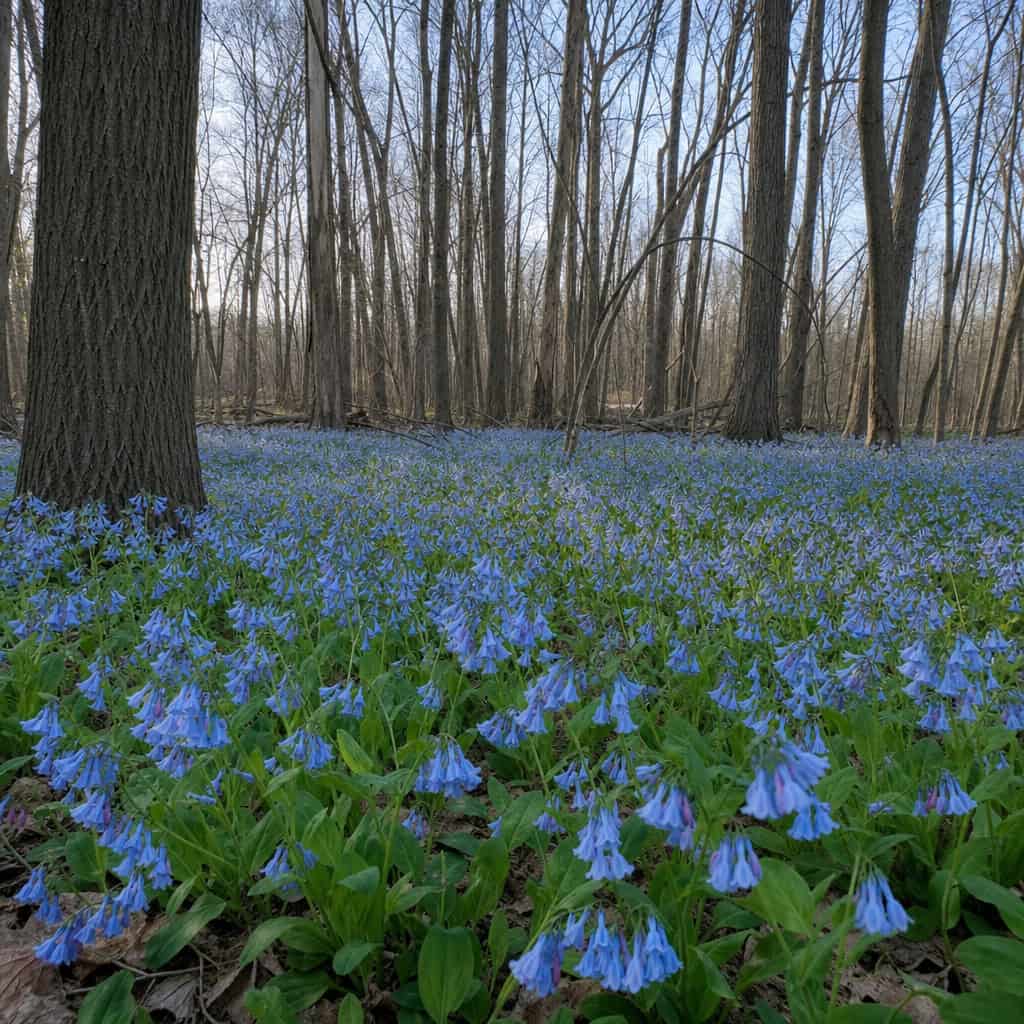
A spring ephemeral, which is a fancy word for a plant that shows up, dazzles, and politely leaves.
Virginia bluebells carpet the bare ground under trees in a haze of sky blue before the canopy leafs out and steals the light. Then, as summer comes on, the whole planting fades away and goes dormant for the year.
Bees and early pollinators depend on it. It fills the exact stretch of the season that grass never manages under trees.
Native, Zones 3 through 8. Interplant it with ferns to cover the ground after it disappears.
21. Creeping Oregon Grape (Mahonia repens)
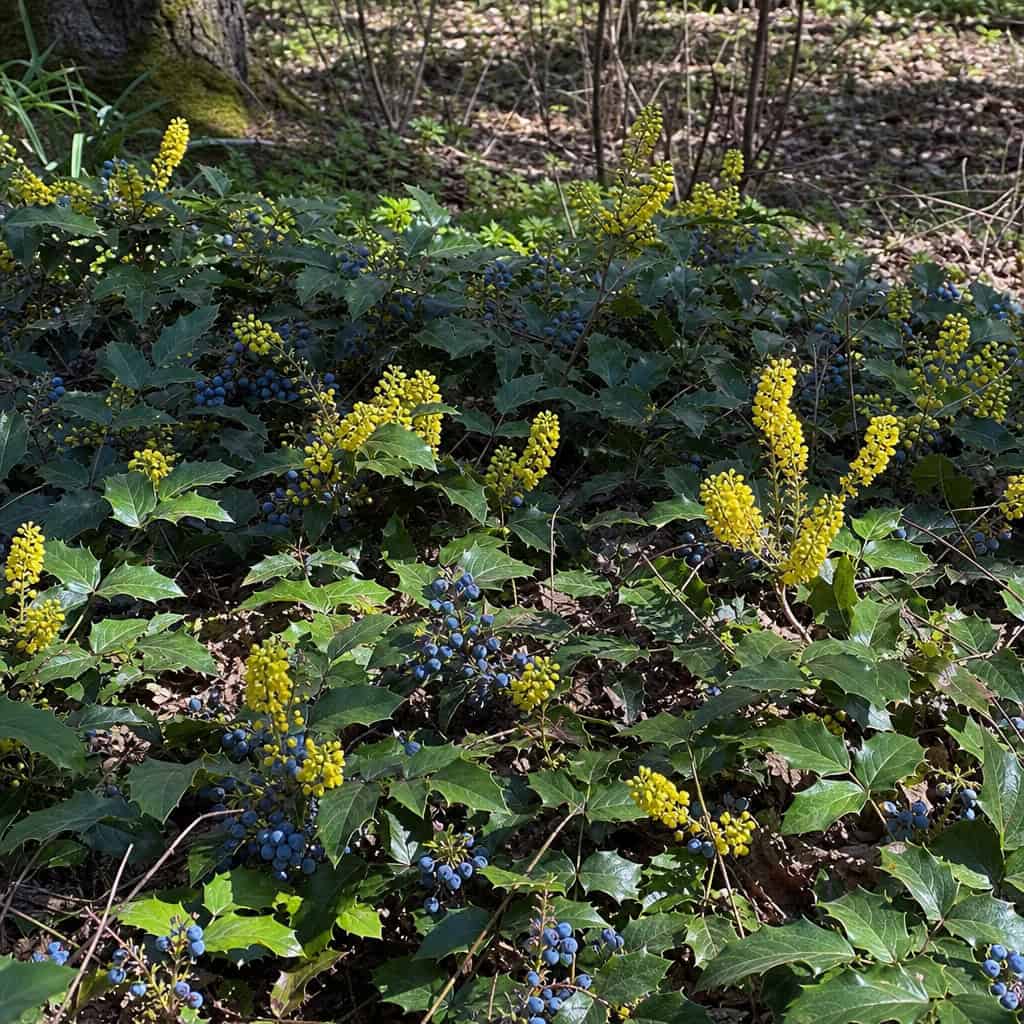
A broadleaf evergreen shrub that behaves like a groundcover, and a tough one. Holly-like leaves, clusters of yellow flowers in spring, blue berries in summer, and a red winter tint when the cold sets in.
It thrives in dry shade under trees and brings year-round structure that most groundcovers can’t.
It’s a Western native, which makes it a welcome break from the usual East Coast suspects. Zones 5 to 8.
22. Moss (Sheet & Carpet Moss)

Here’s the answer for the darkest, dampest corner of all — the spot where grass has never grown and never will. Let it be moss.
No mowing. No fertilizer. No sun required. It greens up year-round and thrives in the exact nutrient-poor, acidic soil that starves out turfgrass.
It’s soft underfoot, safe for kids and pets, and needs no chemicals at all. A moss lawn in deep shade looks like something out of an old Japanese garden.
Stop fighting the shade there. Rake off the leaves, keep it damp, and let the moss take over. Moss & Stone Gardens has good guidance on establishing a moss lawn where grass keeps failing.
23. Bunchberry (Creeping Dogwood)

For the cold-climate readers, this is your payoff. Bunchberry is a low native groundcover that carries the classic white dogwood flower — in miniature, right down at ankle height — followed by bright red berries.
It fills bare shade in cooler regions where warm-zone plants won’t survive, and deer and rabbits leave it be.
It wants cool, moist, full-to-partial shade and acidic soil. Zones 2 through 6 — far enough north that most of this list would freeze out.
24. Cast Iron Plant (Aspidistra)

The name is the review. Cast iron plant is nearly impossible to kill, and it takes the deep shade of warm zones where almost nothing else will stand up straight.
The broad upright leaves give a lush, tropical look to a dim corner that had nothing going for it.
Southern and warm-climate gardeners lean on it for exactly that. Zones 7 through 11.
25. Bearberry (Arctostaphylos)
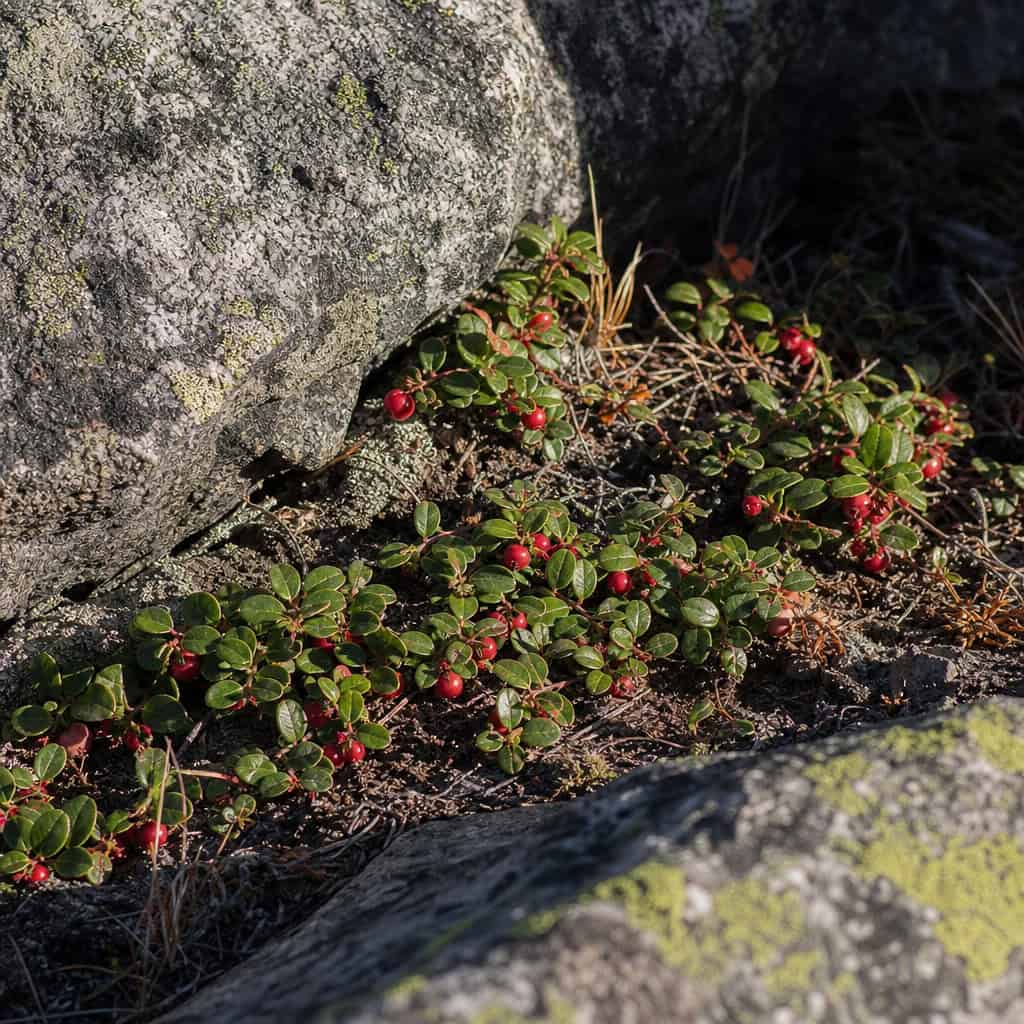
A native broadleaf evergreen that hugs the ground, with small leathery leaves and red berries the wildlife works over in fall.
It handles dry shade and serious cold, which makes it a strong regional pick for Western and Northern yards where you want a tough, low, native mat.
It’s slow to establish but built to last once it does.
26. English Ivy (Hedera helix)

This one’s here as a warning, not a recommendation. For a century English ivy was the default answer to shade — you saw it climbing brick and blanketing every shaded bank in town.
Then the bill came due.
It’s invasive across huge swaths of the country, climbing and killing trees, smothering native ground layers, and refusing to leave once it’s in. Several regions now treat it as a noxious weed.
Skip this. It’s also toxic to dogs and cats. With two dozen better options above — most of them tougher, safer, and better behaved — there’s no reason to plant ivy in a modern yard. Admire it on the old university walls and choose something else at home.
The bare spot was never the problem
Grass was the wrong crop for that corner all along. It’s a sun plant, and you’ve been asking it to do a shade plant’s job for years.
Stop reseeding the same failure every fall. Pick two or three of these — a fern, a drift of barrenwort, a little sweet woodruff — and let the shade grow what it actually wants to grow.
Just check the pet list before you dig. Hosta, hellebore, periwinkle, and ivy all bite back.
The prettiest part of a lot of old yards was never the lawn. It was the cool green corner under the trees where the grass gave up and something better moved in.