

Your yard might be aging your house faster than any peeling paint job.
Not in a dramatic way. In the quiet, cumulative way that makes a buyer slow down, glance, and decide the place is “tired” before they’ve even parked.
Most of these habits felt right when you learned them. A crisp edge. A neat row of shrubs. A pop of color by the mailbox. They were the curb-appeal gospel of a different decade.
But landscape style moves the same way kitchen style does — and the 2026 designer roundups keep flagging the same offenders over and over. The good news: almost every one of these is cheap to fix and fast to undo.
Here are 31 yard habits that read as dated, and what to do instead.
1. Bright Red (and Dyed Black) Mulch
It’s the first thing designers name, every single time.
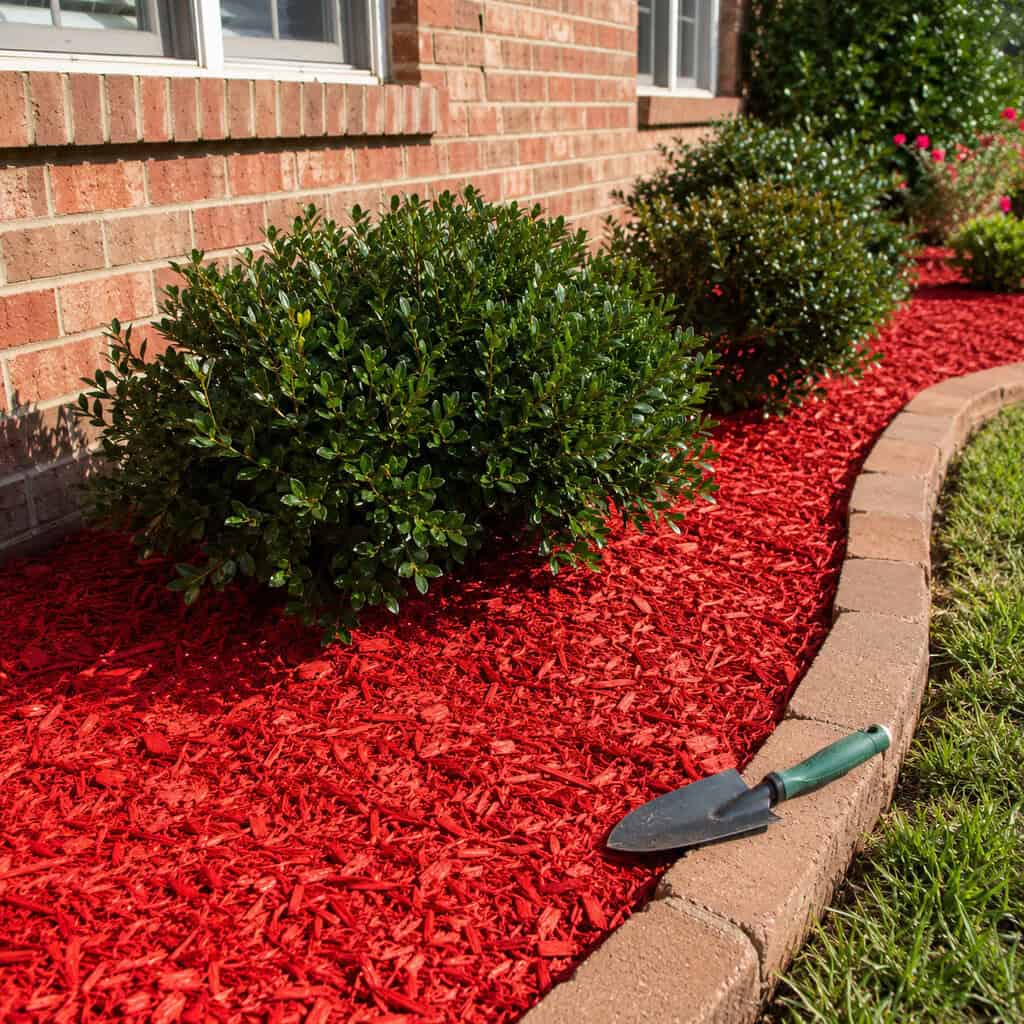
That candy-red and inky-black mulch you see bagged at the big-box store isn’t a natural color. It’s hardwood dyed with iron oxide or carbon, and the eye knows. The unnatural tone reads “store special” and fights your plants for attention instead of framing them.
The dye also fades unevenly by midsummer, so you get a patchy magenta crust by August.
Switch to natural shredded hardwood or a fine pine bark. It costs about the same, settles into a warm brown, and disappears behind your plants the way good mulch should. Easiest fix on this list.
2. White Marble Chips and Pea Gravel Walkways
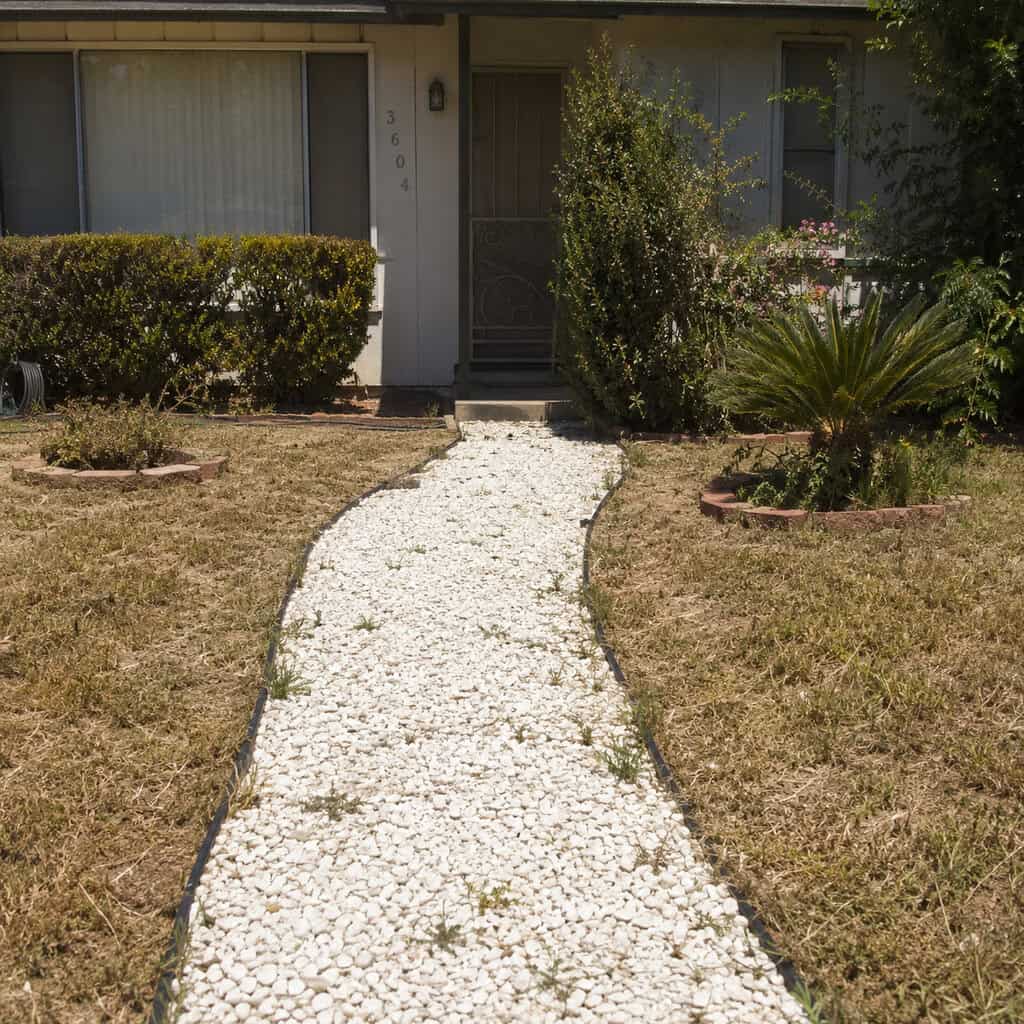
Designers have a blunt phrase for an expanse of white marble running up to the front door: Grandma and Grandpa’s house.
The bright stone was everywhere from the 1950s through the ’70s, and it still reads that way. It glares in sunlight, turns gray and weedy over time, and feels cold the moment it becomes your main groundcover.
Pea gravel has the same problem — it migrates into the lawn and never stays put.
If you want stone underfoot, go with a flagstone path or a tighter crushed aggregate in a natural tone. Save the white chips for a small, contained accent, if at all.
3. Gravel Covering Every Surface
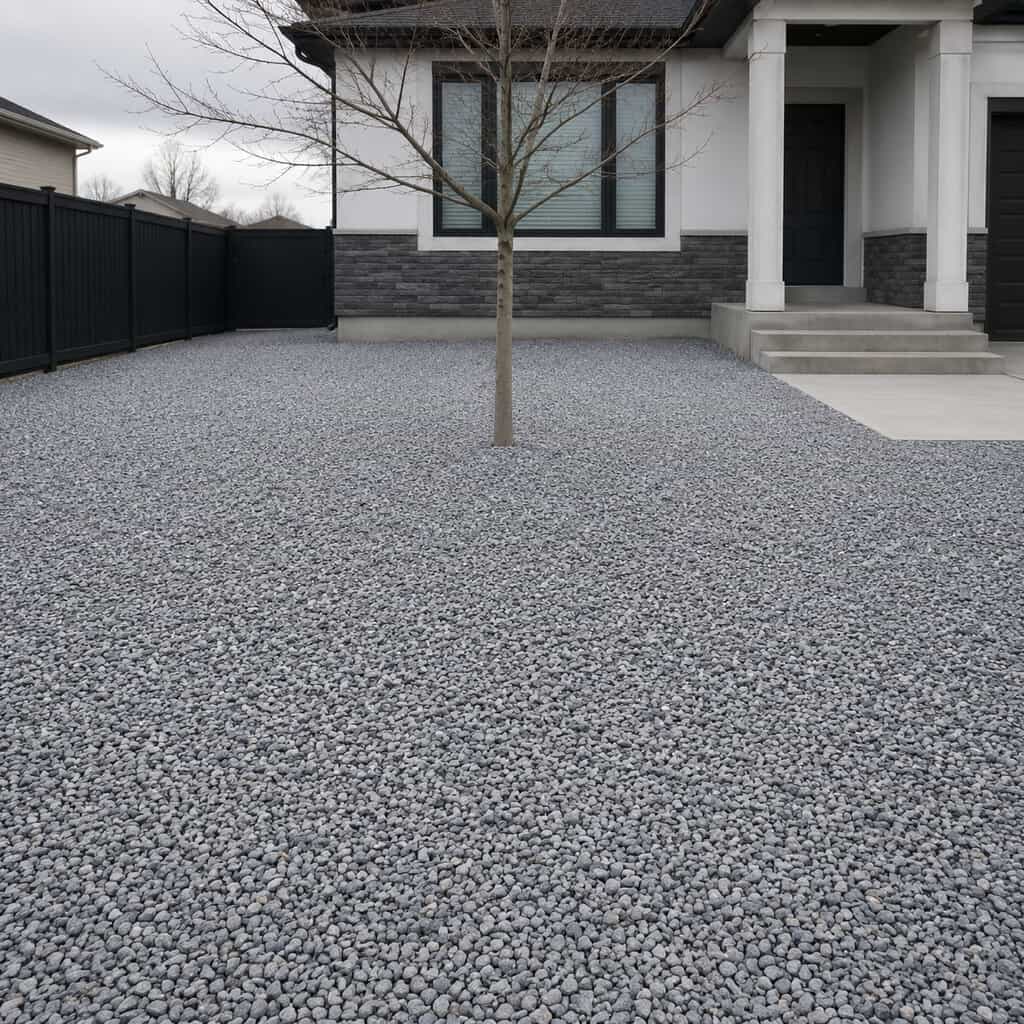
Gravel-everything started as the affordable minimalist move around 2012.
Rip out the grass, lay landscape fabric, dump three inches of crushed rock, call it low-maintenance. For a while it looked clean.
Now it reads cold and repetitive, and the maintenance promise never held — weeds push through the fabric, leaves rot into the gravel, and cats find it.
Homeowners are paying to soften these yards back up. Carve out planting beds, bring in some groundcover, and let the gravel be one material among several instead of the whole show.
4. Overgrown Evergreen Foundation Shrubs

This is the single biggest age-giveaway on a house, and pulling them is the highest-impact fix a yard can get.
The yews, junipers, and arborvitae planted tight against the wall were a builder default from the 1950s straight through the ’90s. They went in small. Nobody planned for what they’d become.
Forty years later they’ve swallowed the lower windows, crowded the front door, and turned the whole facade heavy and dark. The house looks shorter and older than it is.
There’s a problem you can’t see, too. Shrubs jammed against the foundation hold moisture against the wall and block the airflow that lets brick and siding dry out. Their roots loosen and lift soil right where you need it sloping away from the house, and dense evergreen cover keeps that zone damp for days after rain.
That constant moisture is exactly what a foundation doesn’t want. It feeds mildew on siding, rots the bottom course of wood, and over years contributes to the kind of seepage that ends in a wet basement and a five-figure repair.
Pull the overgrown shrubs entirely — don’t try to prune a 40-year-old yew back into shape. Replant smaller, well-mannered shrubs at least three feet off the wall, and check that the ground slopes away from the foundation while everything’s exposed. Do this one first.
5. The Skinny Four-Foot ‘Mustache’ Foundation Bed

One designer nicknamed it the mustache, and you can’t unsee it.
It’s the narrow strip of shrubs hugging the base of the wall, four feet deep at most, marooned in a wide ocean of lawn. Postwar builders ran this formula on millions of houses.
The problem is proportion. A thin band of green pinned to the wall makes the house look like it’s floating with no roots in the landscape.
Modern beds push out toward the street — eight, ten, twelve feet deep, with curves and layers. Pull your front bed forward into the lawn and the whole house suddenly feels grounded.
6. Rows of Clipped Boxwood Hedges

Boxwood was the dependable workhorse of the mid-century ranch, and it came roaring back in the 2000s.
A row of identical sheared green cubes used to signal order and care. Now it reads plain, rigid, and repetitive.
There’s a practical reason to rethink it, too: boxwood blight has spread across much of the country since the 2010s, and it can wipe out a whole hedge in a season.
Buyers respond to variation. Mix heights, textures, and a few flowering shrubs instead of one cloned line. If you love the structure, inkberry holly and dwarf yaupon give you a similar shape without the blight risk.
7. Junipers and Shrubs Pruned Into Balls

Nothing says 1980s like a juniper nipped into a perfect sphere.
The whole front-yard topiary look — globes, cones, theme-park poodle cuts — was the decade’s signature, and it’s aged hard.
Pros call it high-maintenance and stiff. You’re fighting the plant’s natural shape every few weeks just to keep the geometry.
Let shrubs grow into their relaxed natural forms with a light, selective trim instead of an all-over shear. The yard instantly looks calmer and more current.
8. The Perfectly Striped, Weed-Free Lawn

The flawless golf-green lawn was a 20th-century status symbol. Now it reads artificial.
Those crisp mower stripes signal effort, sure. But the stiff, uniform carpet feels disconnected from the house — too perfect to be real.
Striping also compacts the soil under the wheel lines and flattens the grass blades, which isn’t doing your turf any favors.
A softer, slightly looser lawn — varied, green, alive — feels more in tune with the rest of the landscape. Ease up on the stripe kit and let it breathe.
9. A Front Yard That’s All Lawn and Nothing Else

Wide open turf from the sidewalk to the door was the suburban ideal for decades.
It once read as elegant breathing room. Today it reads empty and unfinished, like the landscaping never got done.
The shift toward layered, planted yards — beds, grasses, native perennials, trees — has made the blank turf look wasteful, both visually and environmentally.
You don’t have to tear up the whole lawn. Carve out generous beds along the edges and the foundation, plant in layers, and let turf be one element instead of the entire front.
10. Scalping the Lawn Every Mow
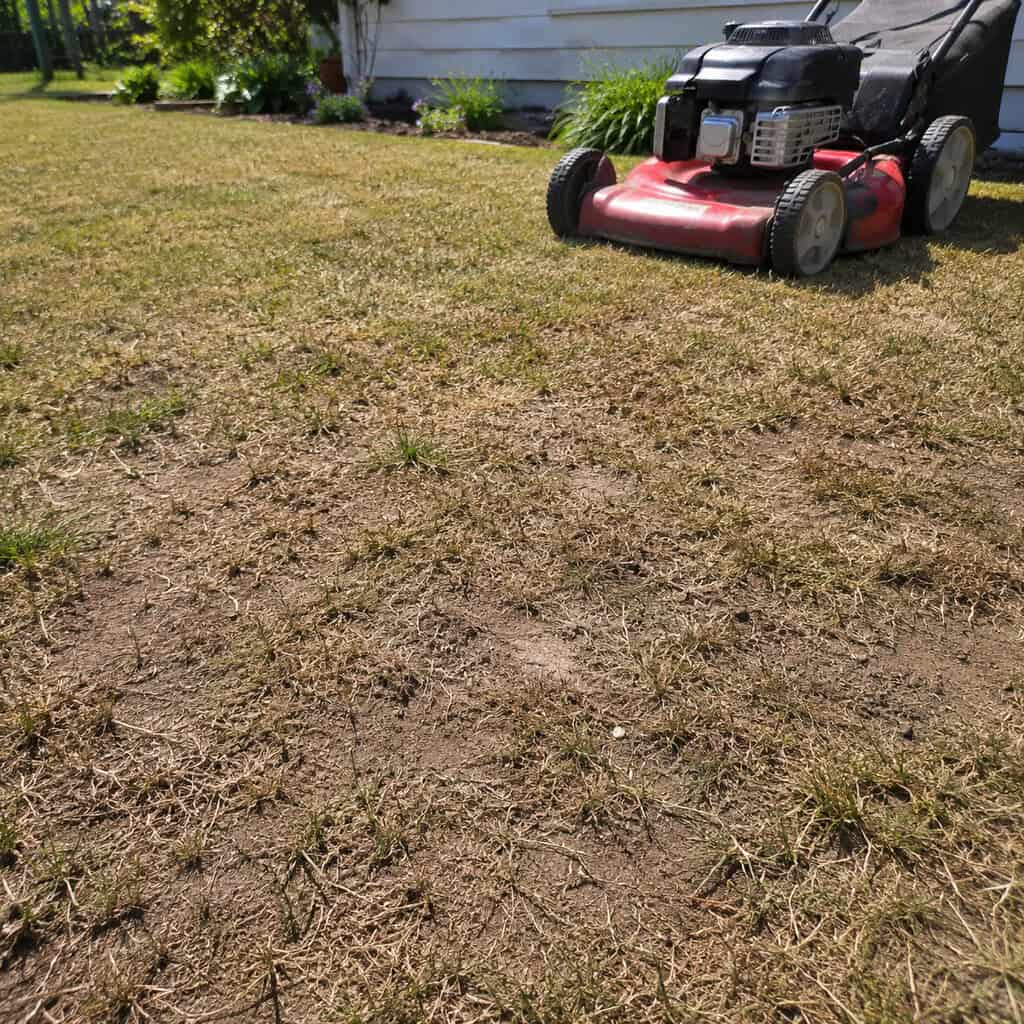
Cutting it short so you can mow less often feels efficient. It’s the fastest way to wreck a lawn.
Scalping stresses the grass, exposes the roots and soil to sun, and rolls out the welcome mat for crabgrass and bare patches. You get the opposite of the lush look you were after.
Most cool-season grasses want to sit at 3 to 4 inches. Tall grass shades out weeds and grows deeper roots that survive drought.
Raise the deck a notch and never remove more than a third of the blade in one pass. Your lawn fills in thicker on its own.
11. Bagging Clippings and Raking Up Every Leaf

The stripped-bare yard, every clipping bagged and every leaf hauled to the curb, was a mid-century badge of tidiness.
You’re throwing away free fertilizer.
Grass clippings left on the lawn break down fast and return nitrogen to the soil — enough to cut your feeding by a quarter. Leaves shredded by the mower do the same and feed the worms underneath.
Mulch-mow instead of bag. Let the clippings fall, chop the leaves into the turf, and skip a fertilizer round. The lawn looks better and you’ve saved an afternoon.
12. Calendar-Spraying Weedkiller on Clover and Dandelions
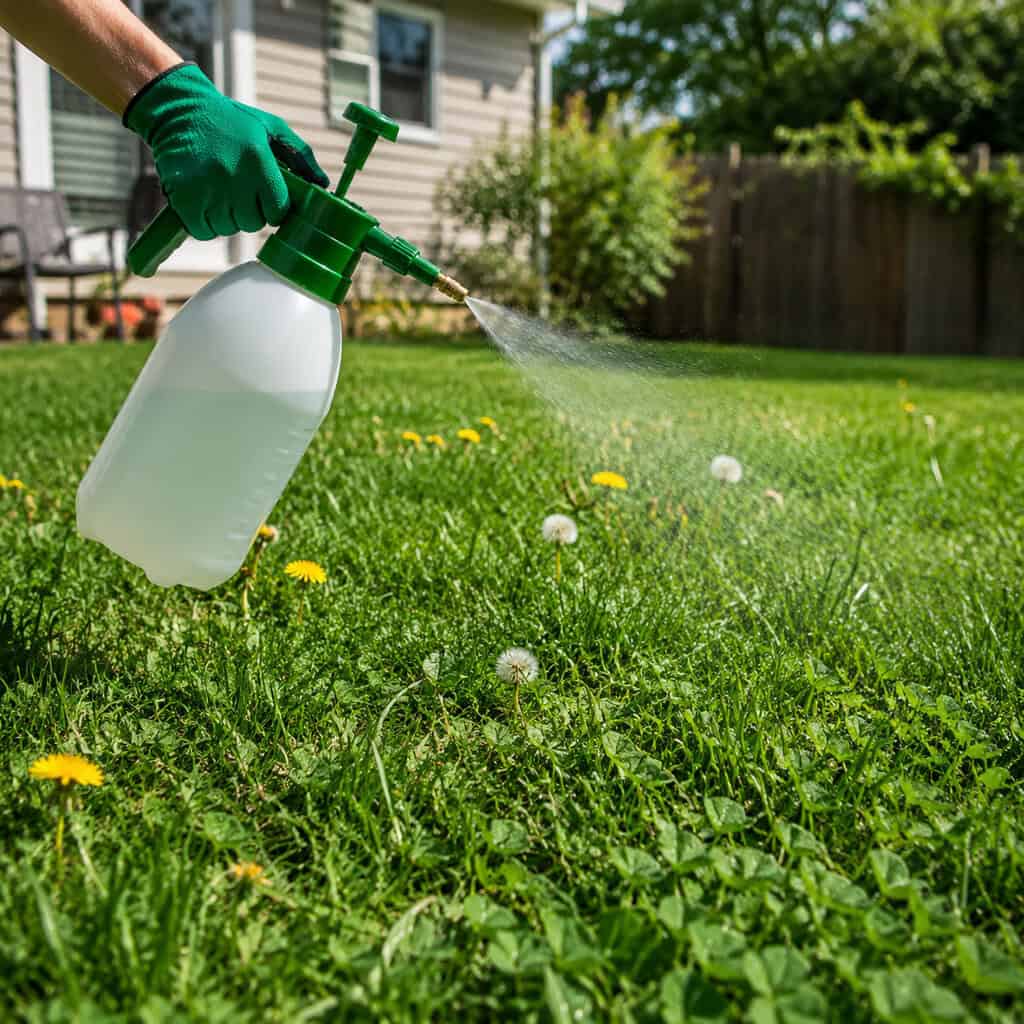
Blanket-spraying the lawn on a fixed schedule, four times a year whether it needs it or not, is a holdover from the postwar perfect-lawn era — and it’s the habit modern lawn care has moved away from hardest.
The mindset that treated clover, daisies, and dandelions as enemies is exactly backwards now. Clover was a standard part of lawn seed mixes until the 1950s, when broadleaf herbicides arrived that couldn’t spare it. People started seeing it as a weed only because the chemical killed it.
Clover fixes its own nitrogen, stays green in drought, and feeds bees. Homeowners are deliberately seeding it back in, along with bee-friendly micro-clover and flowering lawn mixes.
Before you reach for any spray, test your soil. A $15 kit or a county extension test tells you what the lawn actually lacks — and weak, weedy grass is almost always a soil or mowing problem, not a problem you can spray your way out of.
When you do have a real weed outbreak, spot-treat it instead of carpet-bombing the whole yard. Pull what you can by hand, overseed the bare spots so grass crowds weeds out, and feed with compost or a slow-release organic fertilizer. The lawn gets thicker, the bees come back, and you stop paying for chemicals you didn’t need.
13. Cutting Every Perennial Down in Fall

The rush to hack every perennial to the ground at the first sign of yellowing is a formal, mid-century tidy-up ethic.
We know better now. Those hollow stems and dried seed heads aren’t mess — they’re winter habitat.
Coneflower and black-eyed Susan seed heads feed finches through January. Hollow stems shelter native bees and beneficial insects until spring.
Leave the standing perennials through winter and cut them back in early spring instead. The garden has structure in the cold months, and the birds will thank you.
14. Flimsy Black Plastic Bed Edging
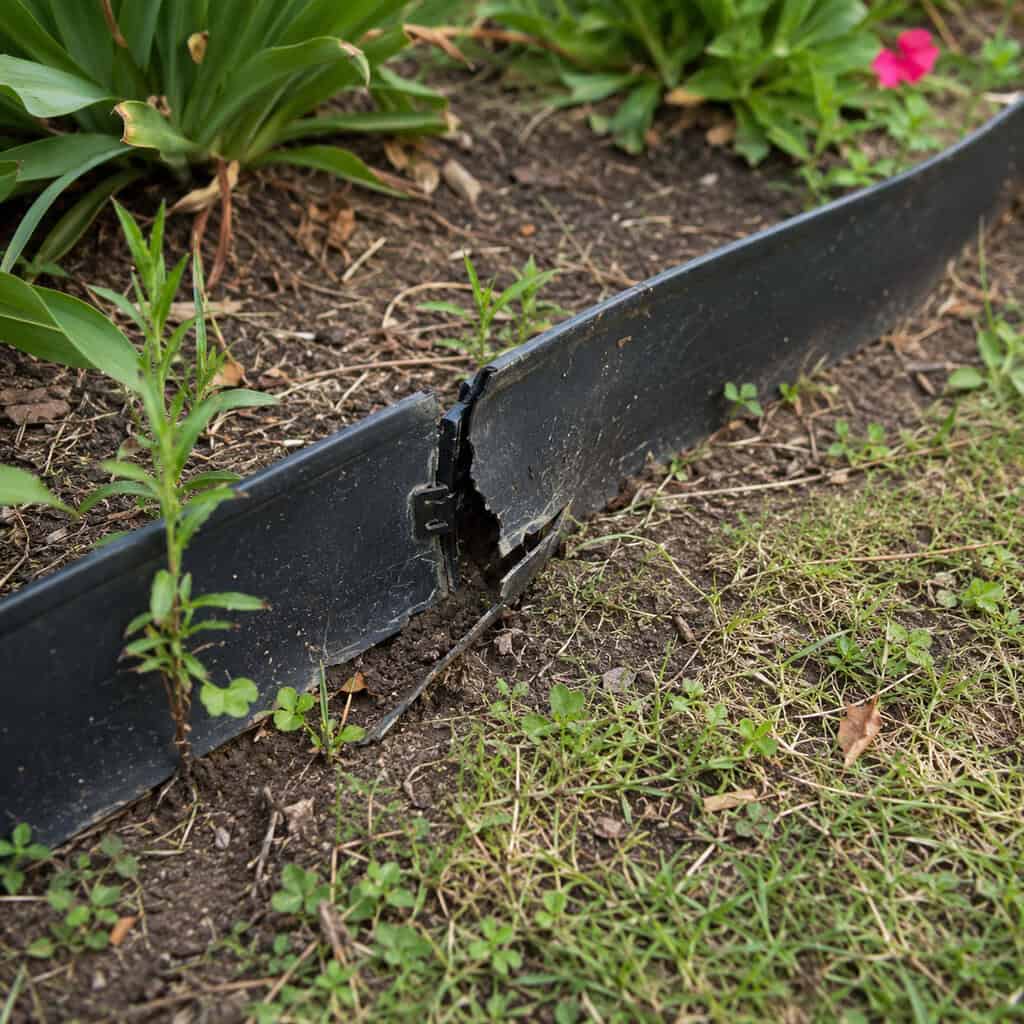
Curling, cracking black plastic edging working its way out of the soil is a dead giveaway of cheap, dated work.
It went in across the 1990s and 2000s as a temporary fix that somehow became permanent. Then the freeze-thaw cycle heaved it up, the connectors popped, and now it snakes along your bed like a flat black worm.
Nothing dates a yard faster than edging that’s actively escaping the ground.
Pull it. Swap in steel edging for a clean modern line, or set a row of stone or brick. Even a sharp, hand-cut spade edge looks more intentional than plastic.
15. Fake Molded ‘Stone’ Edging Blocks

The scalloped concrete and molded plastic “stone” blocks from the home center fool no one.
They were the 2000s answer to wanting a stone border on a budget. Up close, the seams and the too-uniform texture give them away immediately.
They fade, they crack, and they shift out of line as the soil moves under them.
Real materials read completely different. Belgian block, fieldstone, or steel cost more up front but make the whole bed look custom instead of thrown together.
16. Symmetrical, Mirror-Image Flower Beds

Two identical box-shaped beds, one on each side of the walk, planted as exact reflections.
It was a formal-garden holdover that peaked in the ’80s and ’90s, and it reads stiff and uninspired now.
Perfect symmetry tells the eye there’s nothing to discover. Everything’s already accounted for.
Loosen the lines. Free-flowing, asymmetrical beds with curves and varied planting shift a yard from sterile to welcoming without costing a dime more.
17. Mass-Planted Ornamental Grasses

Ornamental grasses were the biggest landscape trend of the 2000s, and that’s the problem.
Designers loved them, so they went in by the dozen, until every yard had the same wall of feathery plumes. Now they read like a garden-center display rather than a design choice.
Maiden grass and fountain grass are still good plants. They’ve just been overused into a cliché.
Use them in moderation, tucked among mixed perennials and shrubs where their texture stands out instead of repeating endlessly down the bed.
18. Hostas as the Default Shade Filler

Got a shady spot? For thirty years the automatic answer was hostas.
Experts say they’ve had their heyday. Their sheer ubiquity now reads dated, and reaching for them by reflex reads lazy.
They’re also a deer buffet and a slug magnet.
Fresher shade fillers do the job with more interest — ferns for movement, carex and sedges for fine texture, heuchera for color. Mix a few and the shade bed stops looking like every other shade bed on the block.
19. Out-of-Zone Palms and Tropical Plants
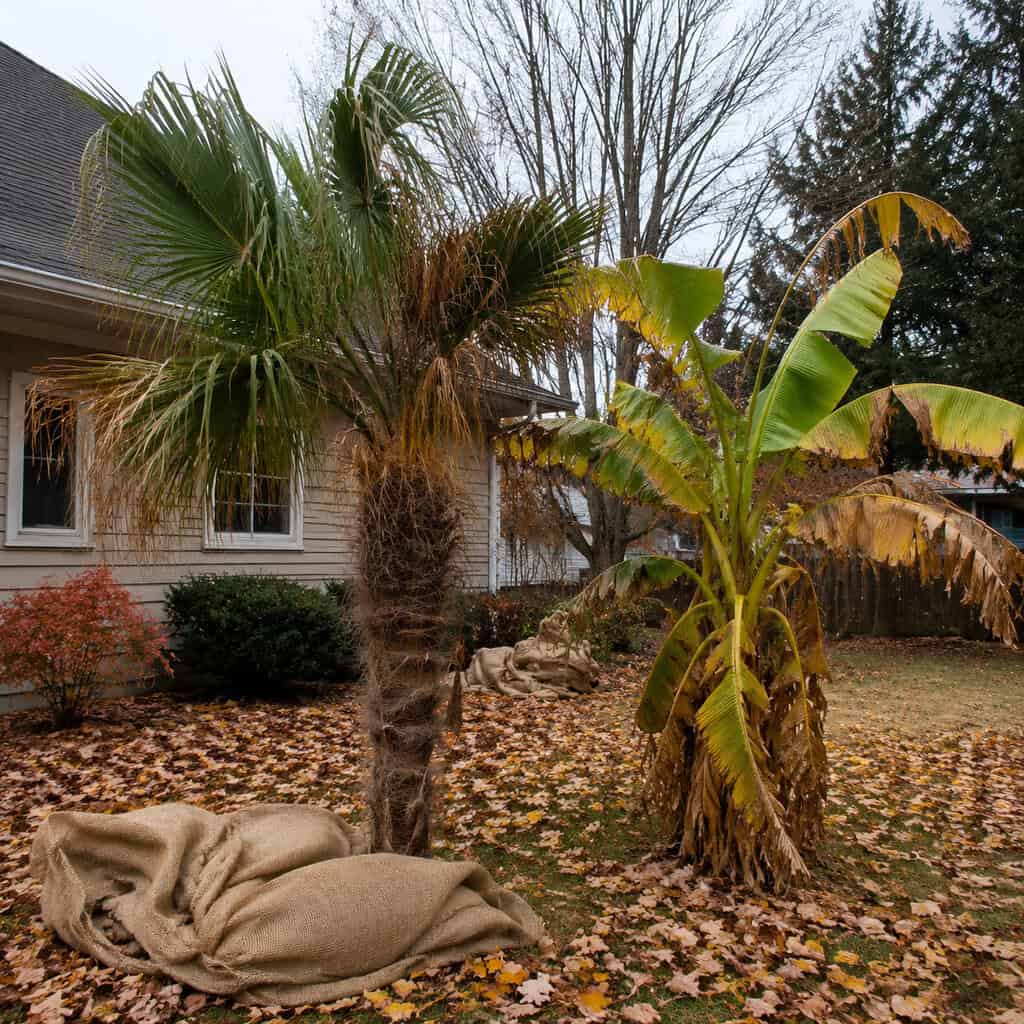
Palms in Ohio. Banana trees in Pennsylvania. Elephant ears struggling through a New England summer.
The instant-resort look has staying power, but forcing tropicals into a temperate climate reads as trying too hard. The plants spend the season looking stressed and the winter needing rescue.
You’re wrapping trunks in burlap and dragging pots into the garage every October. It’s a lot of babysitting for a plant that never looks quite right.
This isn’t a ban — if you garden in zone 9 or warmer, palms belong there. Everywhere else, regionally appropriate natives create a stronger, more authentic sense of place and take care of themselves.
20. A Ring of Annual Flowers Around the Tree Trunk
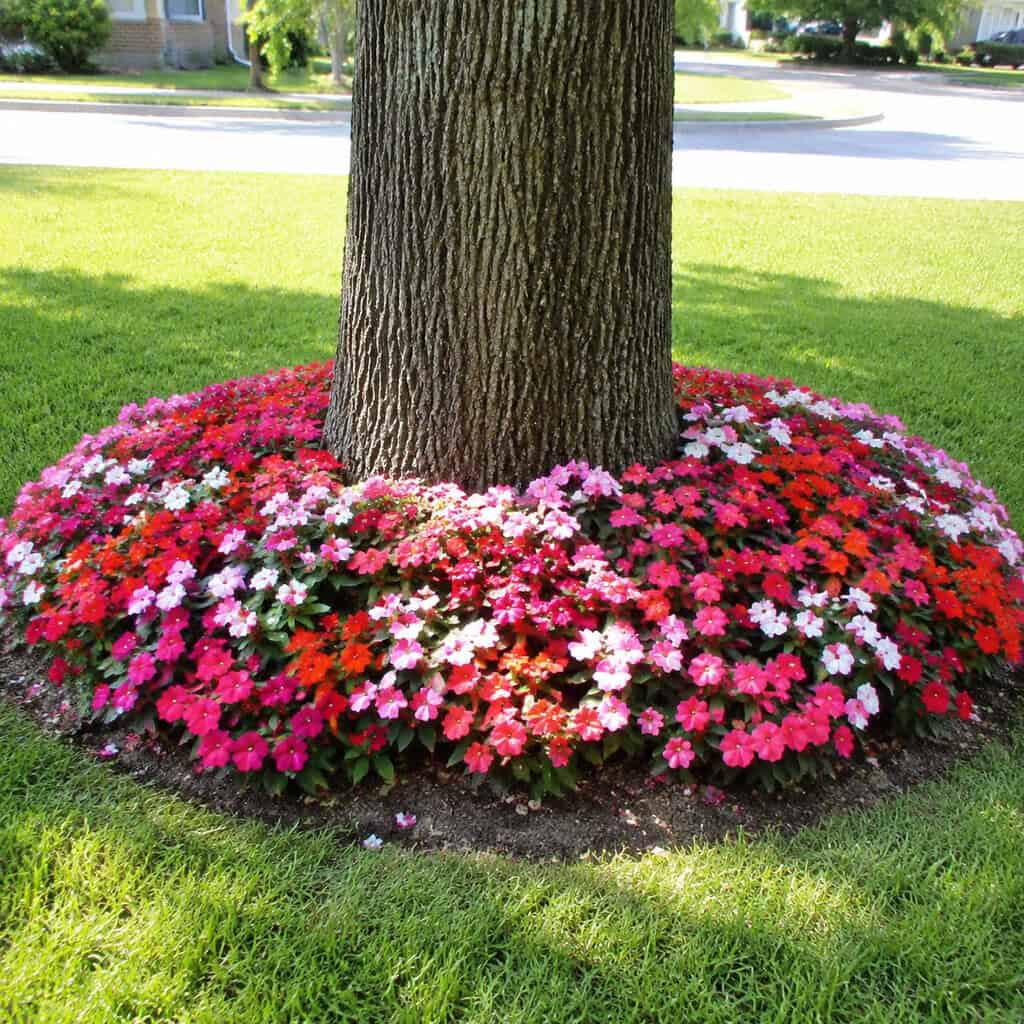
The donut of bright impatiens circling a tree trunk was a suburban fixture in the ’80s and ’90s.
It rarely looks the way people picture it. And it puts the annuals in direct competition with the tree for water and nutrients, right at the root flare where the tree needs them most.
Digging in that ring year after year also chops the surface roots that keep the tree healthy.
Designers see it as a tired formula. A clean ring of natural mulch — kept off the trunk — or a low planting of shade natives reads far cleaner.
21. Volcano Mulch Piled Against the Trunk
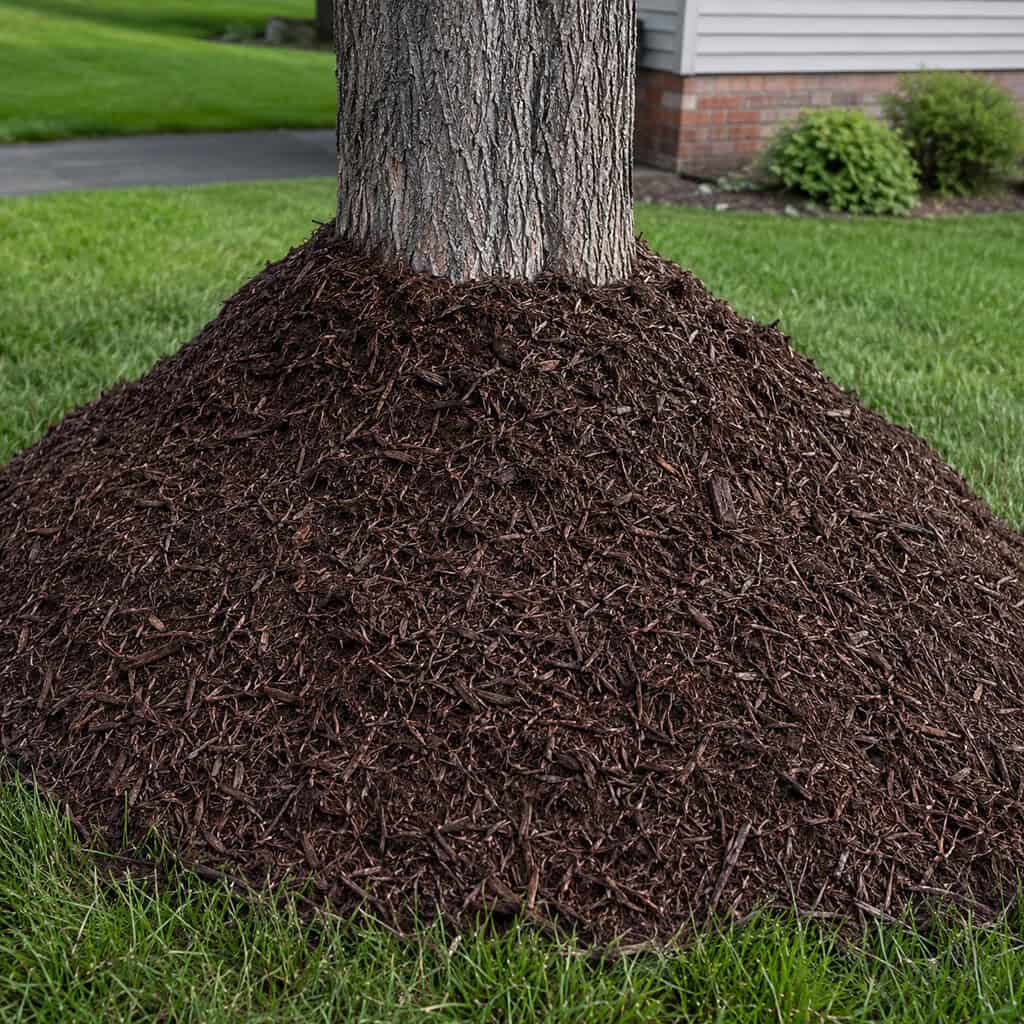
Mounding mulch a foot up the trunk like a little volcano is one of the most common yard mistakes there is — and almost nobody realizes it’s both ugly and actively harmful.
Tree bark isn’t built to be buried. It’s meant to be exposed to air. Pile mulch against it and you trap moisture right against the trunk, and that constant dampness rots the bark from the outside in.
Once the bark softens, the trouble starts. Fungus moves in. Borers and other boring insects drill into the weakened wood. Rodents tunnel through the loose mulch in winter and chew the bark hidden underneath, sometimes girdling the tree completely.
The tree responds to the buried trunk by sending roots up into the mulch instead of down into the soil, and those roots eventually circle and strangle the trunk years later. A mature shade tree killed this way can cost well over a thousand dollars to remove.
Pull the mulch back so you can see the root flare where the trunk widens into the ground. Two to three inches of mulch, spread wide in a flat ring and kept a few inches off the bark, is all a tree wants. Think donut, not volcano.
22. Random Boulders Dropped in the Lawn

A single big rock plonked in the middle of the lawn was a 1990s “add dimension” move.
It almost never works. A lone boulder sitting on flat turf looks like it fell off a truck, because nothing about it matches the ground around it.
Boulders read as natural only when they’re placed the way they’d actually occur.
Group them in odd numbers, set them partly into the ground so they look anchored, surround them with gravel or low plants, and match the stone type to your region. One rock alone in the grass never reads right.
23. The Massive Overbuilt Retaining Wall

When the first thing you see is the wall instead of the house, the whole front feels heavy and wrong.
Big timber and block retaining walls went up everywhere from the 1980s through the 2000s, often far taller and more imposing than the grade actually required. Landscaping is supposed to frame the home, not compete with it.
The timber versions have a shorter clock than people think. Pressure-treated landscape timbers rot from the soil side, bow outward under the weight behind them, and start leaning within 15 to 20 years.
And a failing wall isn’t only an eyesore. A wall that’s bulging or tipping is telling you that water pressure is building up behind it because the drainage failed. That same trapped water has to go somewhere, and it often ends up sheeting toward the house or pooling against the foundation below.
Standing water near the foundation is the root of most wet-basement problems. If your wall has no weep holes, no gravel backfill, and no drain pipe behind it, it’s holding water against your soil — and your house — every time it rains.
Where a wall is structurally needed, a lower, well-drained stone or modern block wall with proper backfill reads cleaner and lasts decades longer. Where it isn’t, regrading into a gentle planted slope often looks better and solves the drainage at the same time.
24. Tiny Pots Flanking the Front Door

Two little eight-inch pots beside a wide front door look like an afterthought.
The scale is the problem. Small containers next to a big entry make the whole doorway feel smaller and unstyled, like you started decorating and stopped.
Bigger reads as intentional.
Swap in oversized planters, 18 to 24 inches across, with a substantial plant in each — a boxwood ball, a hardy fern, a seasonal arrangement that spills over the edge. The entry instantly looks grand, and it’s one of the cheapest upgrades you can make.
25. Lined-Up Solar Stake Path Lights

A row of dollar-store solar stakes marching up the walk, half of them dim and a couple knocked sideways by the mower.
They were the 2000s quick-fix for landscape lighting, and they create clutter instead of atmosphere. The light is weak, the color is a sickly blue-white, and the cheap plastic yellows in a season.
Nothing signals “temporary” like a lighting setup that’s slowly dying in public.
Low-voltage LED lighting is the upgrade — warmer light, even spacing, and fixtures that last. Even a handful of quality path lights beats a dozen failing solar stakes.
26. Lawn-Ornament Clutter: Flamingos, Gnomes and Concrete Geese

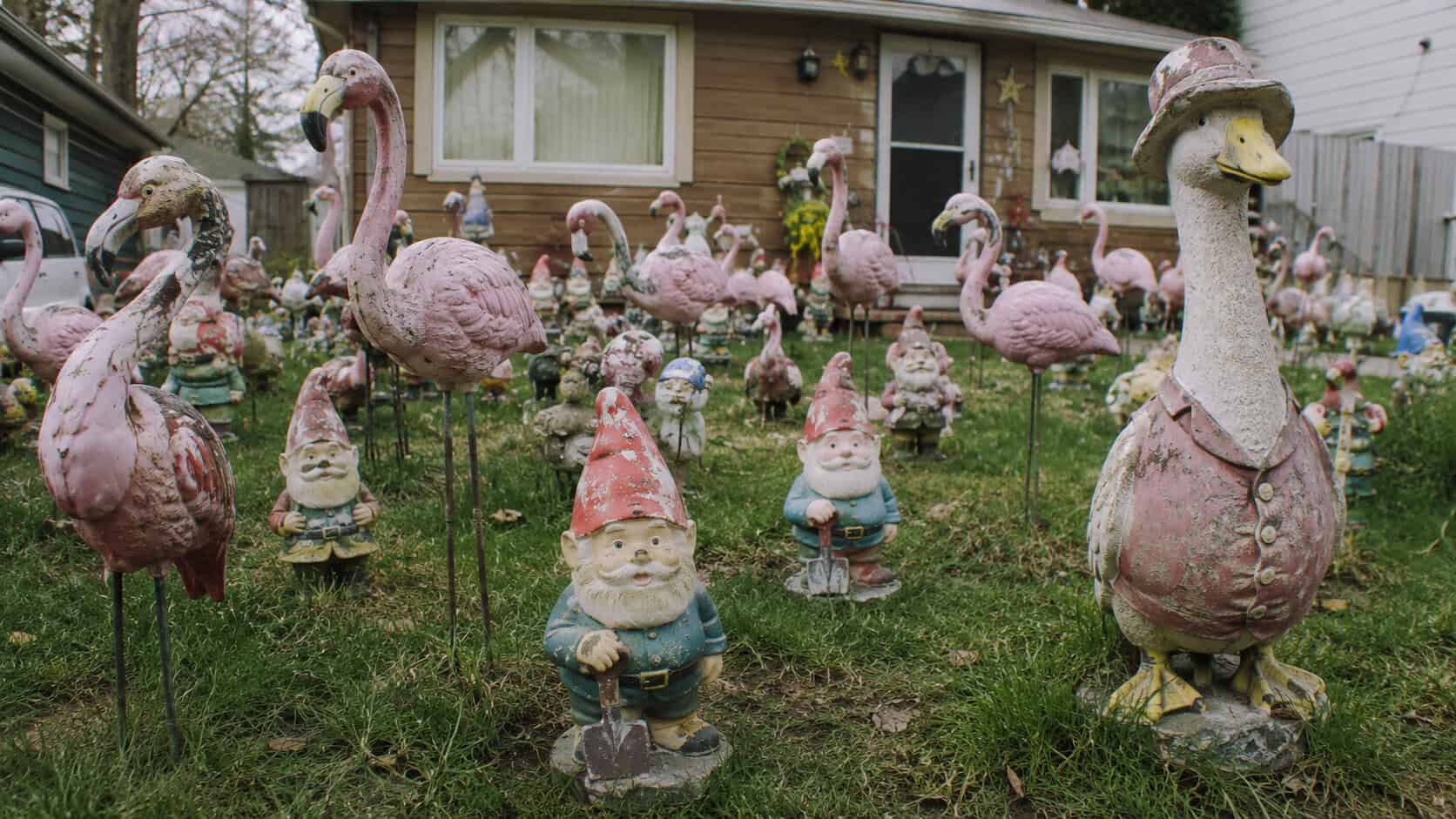
Pink flamingos. A concrete goose in a seasonal outfit. A faux deer. And gnomes that seem to multiply.
The kitsch was charming from the mid-century through the ’90s, and a little of it still can be. The trouble is volume — and what time does to it.
Paint cracks. Colors sun-fade to chalky pastels. A flamingo that’s lost its pink just looks abandoned.
Designers preach restraint. Pick one piece you genuinely love, give it room, and clear out the rest. One good statement reads as personality; a crowd of them reads as clutter.
27. Fake Flowers and Artificial Turf

Plastic blooms in the window boxes and a carpet of synthetic grass out back.
Both look fine for about a season. Then the fake flowers fade and gather dust, and the turf seams start to lift and the edges curl.
High-end buyers increasingly read them as cheap. Artificial turf bakes hot in summer, traps pet odor, and around a pool the surface gets uncomfortable underfoot fast.
Real materials age with character instead of just wearing out. A few real plants you can actually keep alive beat a season of convincing fakery every time.
28. The Matching Patio Furniture Set

The whole patio bought in one box — sofa, chairs, table, all matching, all from the same big-box aisle.
It was the easy 2000s move, and it makes your patio look like everyone else’s. The matched set has no personality because nobody chose any of it individually.
Designers favor collected, mixed pieces now.
You don’t have to start over. Add a different chair, a vintage side table, a textured rug, a few real plants — break up the set so the space feels gathered over time instead of unboxed in an afternoon.
29. DIY Pallet Furniture

The pallet couch had its Pinterest moment around 2014, and the moment is over.
The rustic vibe looked clever for one summer. Then the wood grayed and splintered, the cushions got soggy, and the whole thing started to wobble apart within a season or two.
There’s a real safety catch, too. Shipping pallets are often treated with chemicals or fumigants, and unless it’s stamped “HT” for heat-treated, you don’t know what you’re sitting on.
Skip it. Custom cedar pieces or a built-in bench cost more but last for years and read as deliberate rather than improvised.
30. Ornate Tiered Fountains and Oversized Water Features
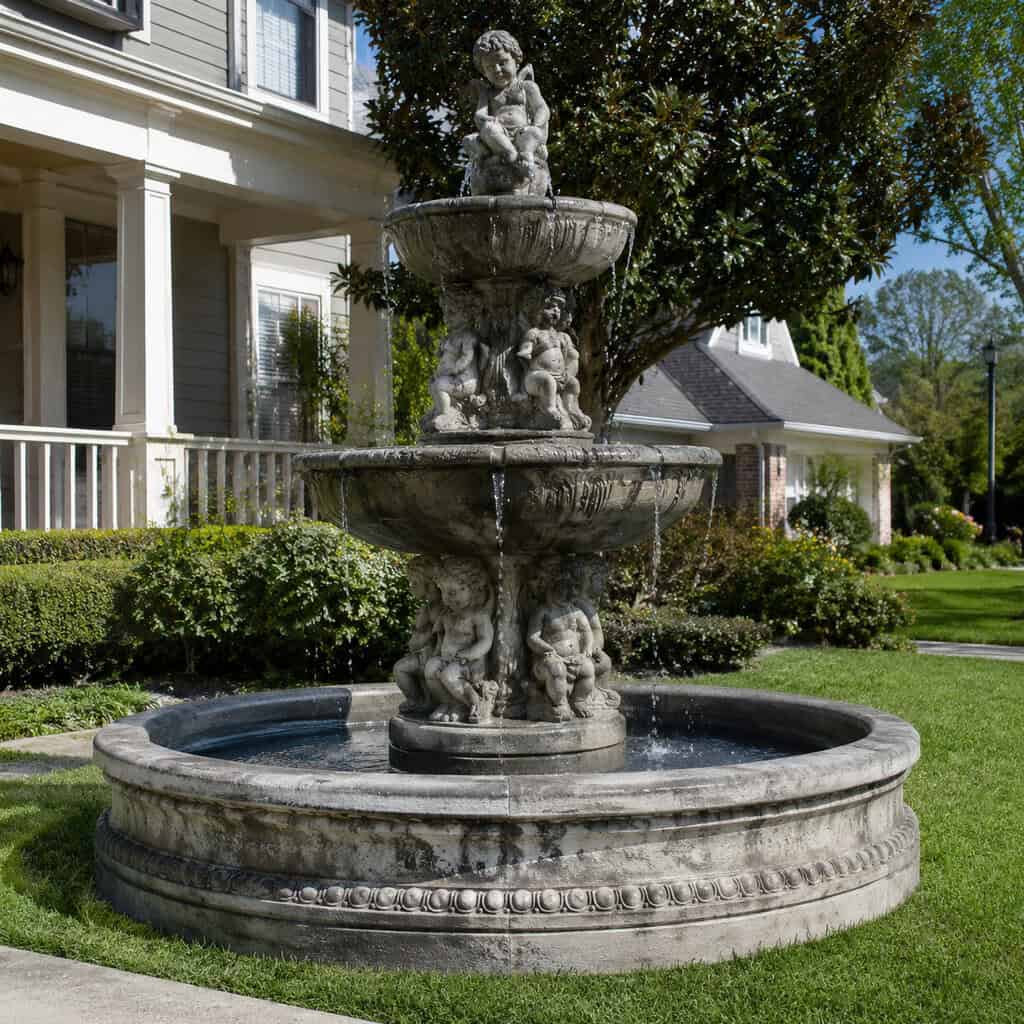
A triple-tiered concrete fountain with cherubs, dropped into a suburban front yard.
The formal mafia-villa look reads as dated overstatement now. And an oversized pond in a small yard never looks natural — it looks installed.
The scale and the fussiness are both working against you.
Modern water features go simpler: a pondless bubbling boulder, a basalt column, a small recirculating basin. The sound of water without the statuary, and far less to maintain.
31. Seasonal Decor That Never Comes Down

A weathered Easter wreath in July. Faded fall pumpkins in December. Christmas lights still hanging in March.
Discount-aisle seasonal pieces left up long past the holiday cross from charming to cluttered, and nothing dates a facade faster than decor that’s clearly stuck in the wrong month.
The eye keys on it immediately. Out-of-season decor signals neglect more than any single faded item could.
Use the one-day rule: anything you put out, you should be able to take down and store out of sight in a single afternoon. If it lives outside year-round, it isn’t seasonal decor — it’s just clutter with a theme.
None of this means your yard has to look like a magazine spread.
It means the defaults you inherited — the red mulch, the sheared globes, the marble chips, the lone boulder — are quietly telling everyone who drives by that the house is stuck in another decade.
The fixes are mostly cheap and mostly fast. Pull the overgrown shrubs, swap the mulch, push the beds out, kill the plastic edging. A weekend’s work can pull a house forward twenty years.
Walk to the curb this weekend and look at your yard the way a stranger would. You’ll spot at least three of these before you reach the mailbox.