


The shed at the back of her yard smelled like twine, rust and old coffee grounds, and not one thing inside it had come from a garden center.
You’d find a coffee can full of nails, a hoe worn down to a sliver on one edge, a leaning stack of newspapers, and jars — endless jars. A folded feed sack sat by the door for kneeling. No plastic clamshells anywhere, no bags of anything store-bought.
Still, that garden fed four people clear through August.
Almost everything she relied on wasn’t a cheaper stand-in for the modern version — it worked as well or better, which is why buying the “upgrade” would have seemed foolish to her. Plenty of it has since been confirmed by university trials and field research she never had reason to read.
Here are 30 things she never once bought, and the household stand-ins she used instead.
1. Skip the Velcro Ties and Garden Clips

She reached for worn-out pantyhose, cut into strips, and torn bedsheets once the pantyhose ran short. Nylon stretches as a stem thickens, so it never girdles a tomato vine the way a rigid clip does, and it’s soft enough to knot around a fruiting branch without bruising it. A drawer of dead pantyhose counted as garden supply, not trash.
2. Forget New Seed Packets Each Spring

Coin envelopes filled a coffee can, shelved in the cool back of a closet. Beans, tomatoes, dill, zinnias, marigolds — all of them returned year after year from seed she’d saved herself, and some of those bean lines had outlasted the house they grew beside.
One rule you can’t skip: this only works with open-pollinated and heirloom varieties. Save seed from an F1 hybrid and you’ll get a scattered, disappointing mess the following June.
3. No Greenhouse Required
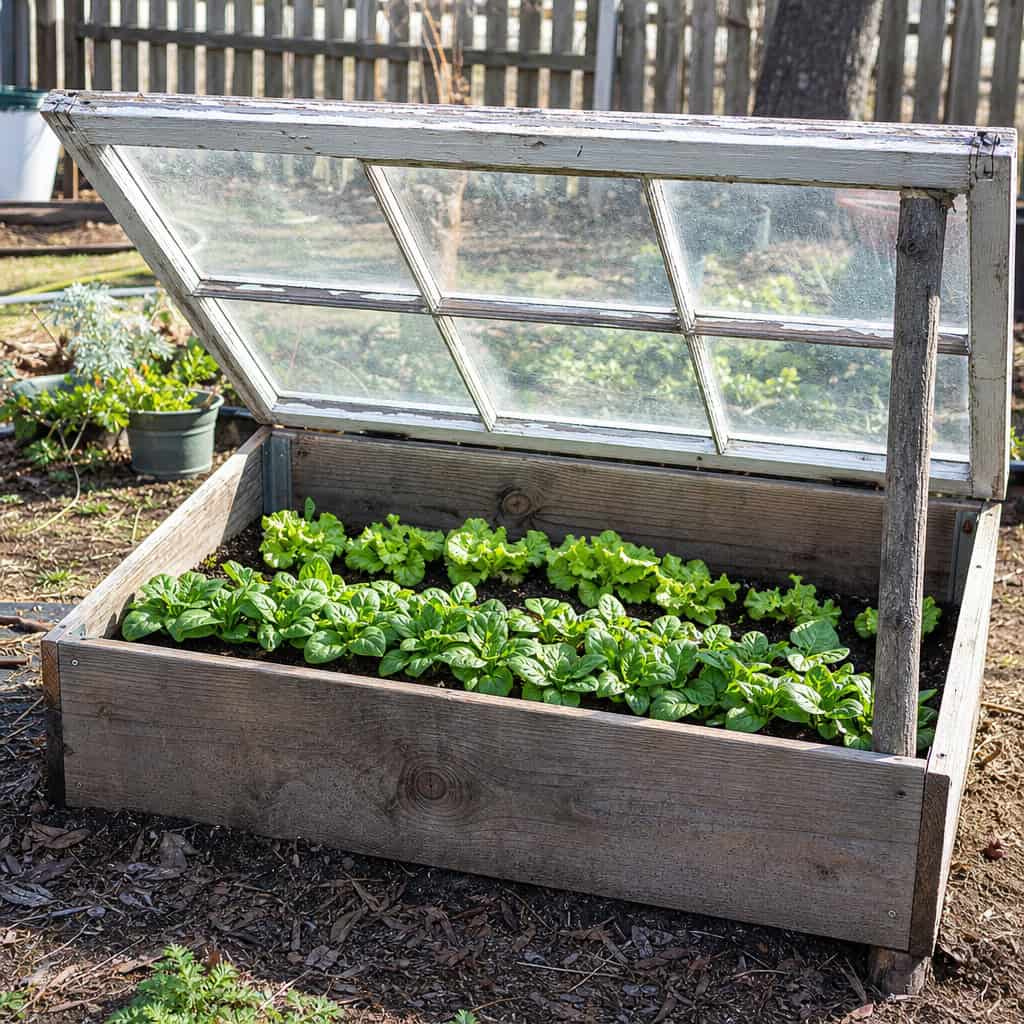
Four boards nailed into a box — back edge taller than the front, an old storm window sash laid on top as a lid — made a cold frame that did the job instead.
It bought three to five weeks on each end of the season, for nothing, if there were spare windows leaning in the garage — and in 1950 there always were.
Prop the lid open on warm afternoons. A closed frame in April sun will cook lettuce by two o’clock.
4. Plastic Nursery Pots Weren’t Necessary

Terracotta pots, scrubbed with a stiff brush each fall and stacked under a board in the shed, outlasted her in some cases — while black plastic goes chalky and brittle within two summers of UV exposure, then cracks the moment you lift it by the rim. Clay breathes, so roots dry faster and rot less; you’ll water more often, but the plants come out healthier, a trade she’d have made without a second thought. Honestly, she’d have found the idea of paying money for a pot at all a little strange.
None of it was philosophy so much as necessity — there wasn’t money, so there was ingenuity, and the ingenuity outperformed most of what eventually replaced it.
Pick three to try: newspaper under the mulch, a coffee can on the fence post, pantyhose in the drawer. You’ll see the difference by August.
The rest is probably already sitting in your garage, waiting for someone to remember what it was for.
5. Cloches and Frost Covers, Homemade

Quart canning jars went upside down over each pepper transplant, a gallon pickle jar covered something bigger, and galvanized buckets came out when a real freeze threatened.
Glass traps heat beautifully — that’s also the catch. Lift the jars by mid-morning, or you’ll steam the very seedling you were trying to protect.
6. Bird Netting Isn’t the Only Option
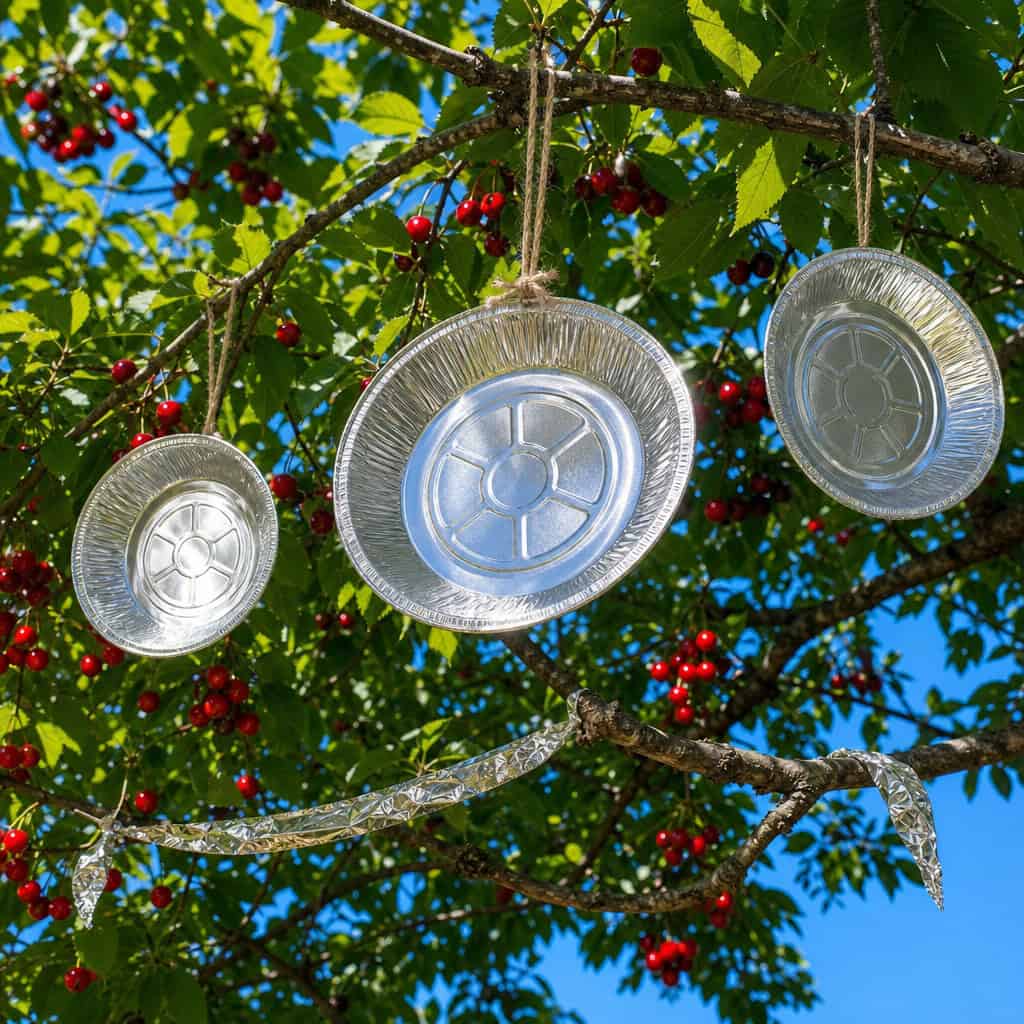
Aluminum pie tins strung on kitchen twine through the cherry tree, foil strips twisted onto tomato stakes, and an old lace curtain thrown over the strawberries did the deterring.
Birds react to flash and movement, and static objects stop working within days — so she moved the tins every week or so to keep the trick alive.
There’s a genuine safety argument here too: loose plastic netting tangles songbirds, garter snakes and box turtles, and most don’t survive it. A pie tin has never trapped a single thing.
7. A Compost Tumbler Wasn’t the Answer
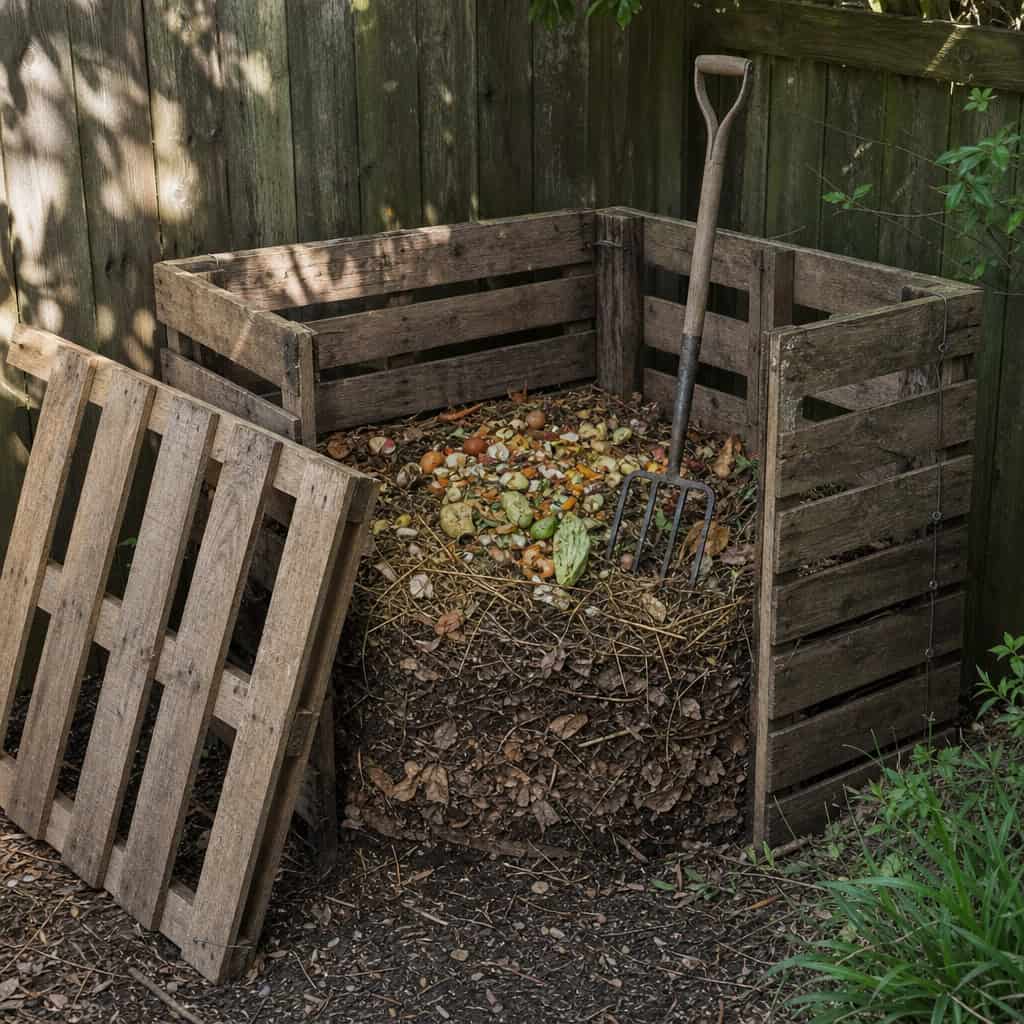
Four shipping pallets stood on end and wired at the corners made the bin, with the front pallet pulled off whenever it was time to turn the pile.
Her real go-to, though, was trench composting: dig a furrow between rows, drop in kitchen scraps, backfill with six inches of soil, and plant right over it the next season. No turning, no smell, no crank handle — and buried scraps stay out of reach of rodents (skip meat and dairy regardless).
8. Bagged Mulch Never Entered the Picture
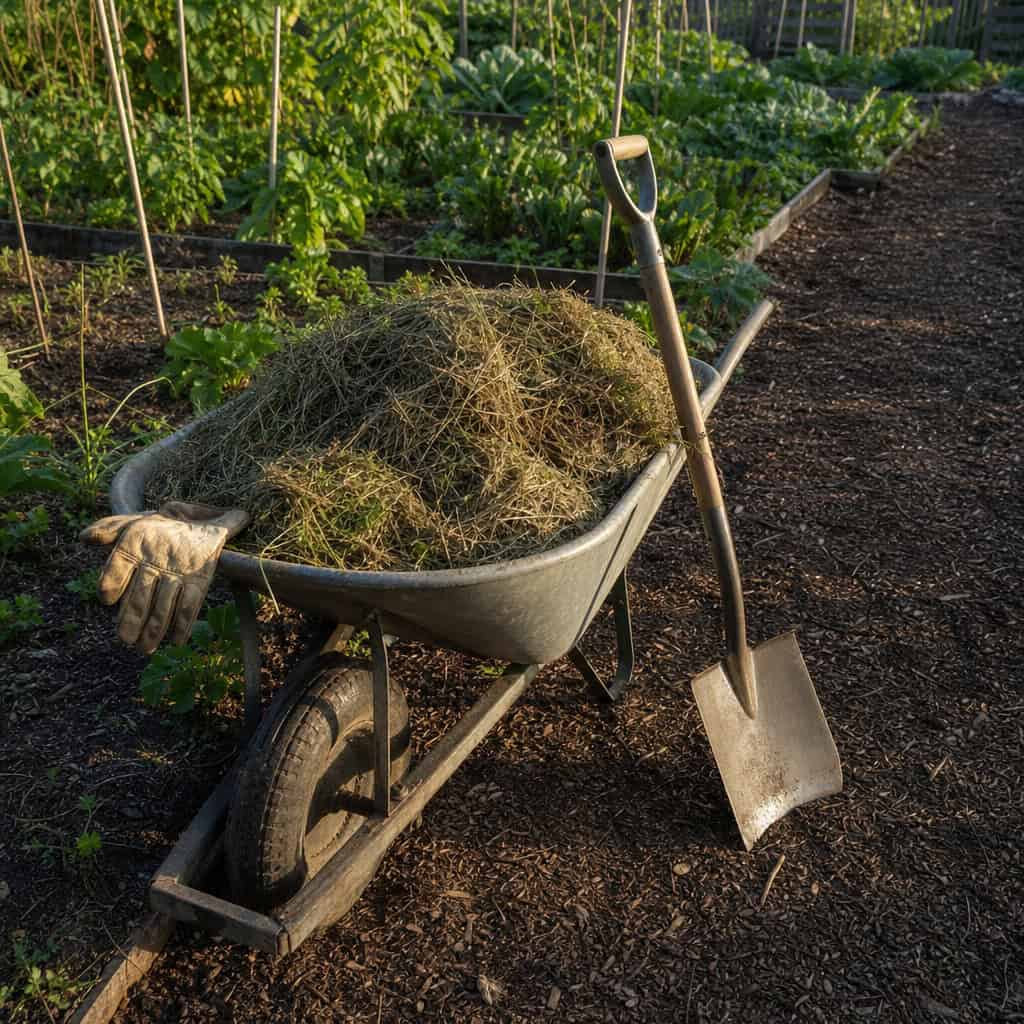
Grass clippings, straw, pine needles and shredded leaves went on by the wheelbarrow load, all of it already sitting on the property.
It’s a funny loop: homeowners now bag that exact material at the curb every October, then drive to a store the following May and buy it back in plastic sacks for $4 apiece.
Just spread clippings thin — an inch, dried a day first — or they’ll mat and sour.
9. Drip Irrigation Kits Weren’t in Her Shed
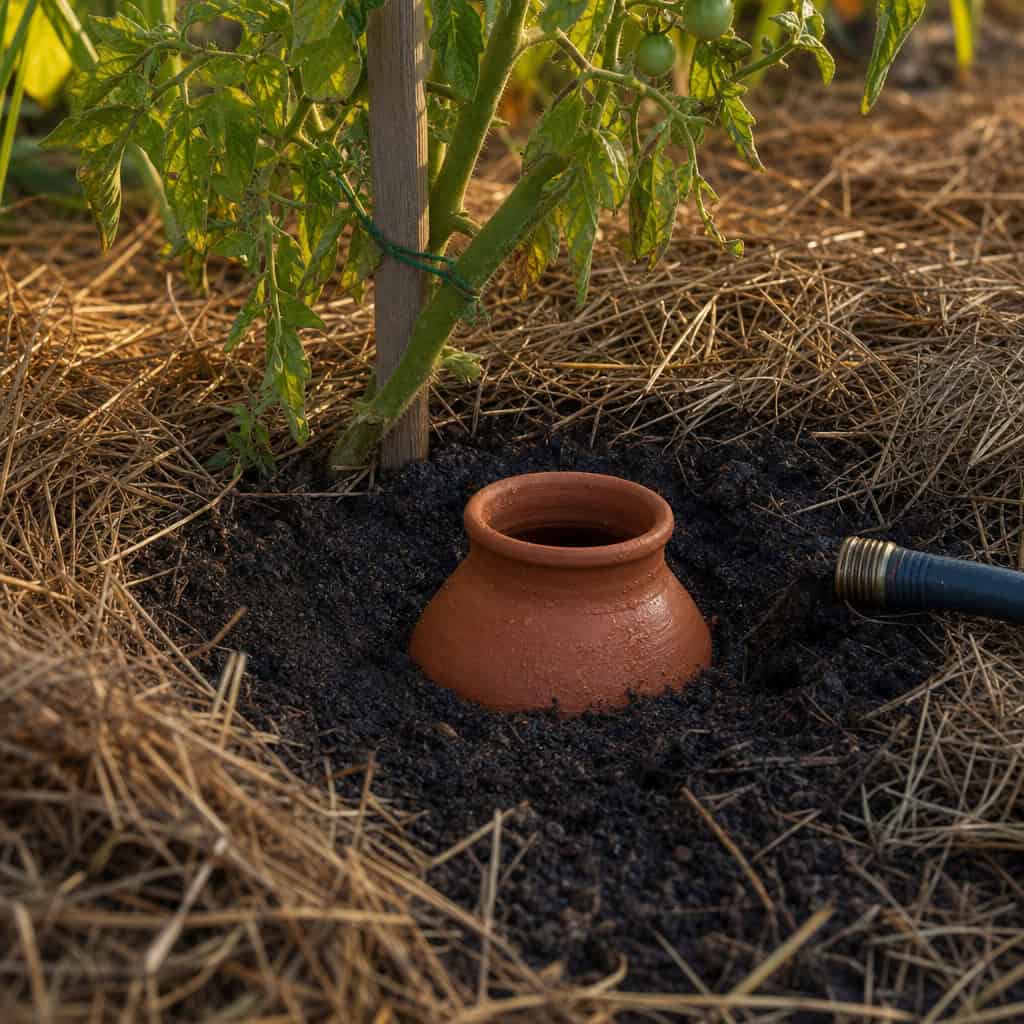
An unglazed clay pot buried to its rim beside each tomato, topped off with the hose every few days, handled it — and a nail-punched coffee can gave a rougher version of the same effect.
Water seeps through the porous clay walls straight into the root zone, pulled outward by the dryness of the surrounding soil, with nothing lost to evaporation or runoff. This is olla irrigation, thousands of years old as a technique, and research in Agricultural Water Management found buried clay pots dramatically more water-efficient than surface irrigation, outperforming drip lines in some trials.
10. Weed Killer Took the Form of a Sharp Hoe
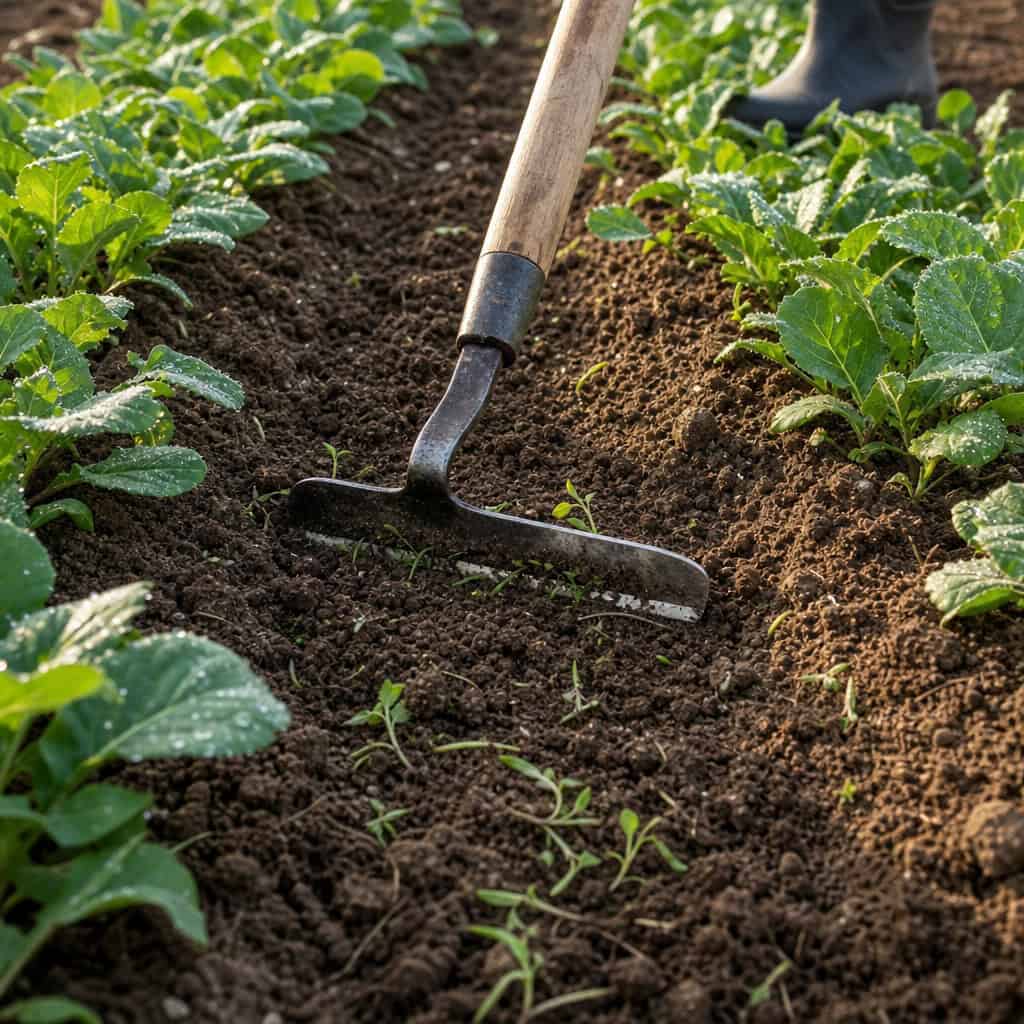
Ten minutes with a scuffle hoe kept sharp enough to shave with, walked down the rows before breakfast, replaced any bottle of spray.
The technique isn’t chopping — you push and pull the blade a half-inch under the surface, slicing seedlings off at the neck while they’re still hair-thin. They don’t regrow from that, and the soil never gets disturbed deep enough to bring a fresh crop of dormant weed seed to the surface.
Timing mattered more than technique. She hoed weekly, always before anything could set seed, since a single flowering pigweed drops upward of 100,000 seeds into a bed you just cleaned — skip three weeks in June and you’ve bought five years of extra work.
For sidewalk cracks and gravel paths, she used a tea kettle: boiling water poured straight onto the crown kills annual weeds outright and cooks the shallow roots. It won’t finish a taprooted dandelion in one pass, but three trips will.
She’d file the hoe sharp every few sessions, because a dull hoe turns a pleasant chore into a fight — and that fight is the real reason people quit hoeing and start spraying.
11. Store Cages Lost to a Simple Wooden Stake
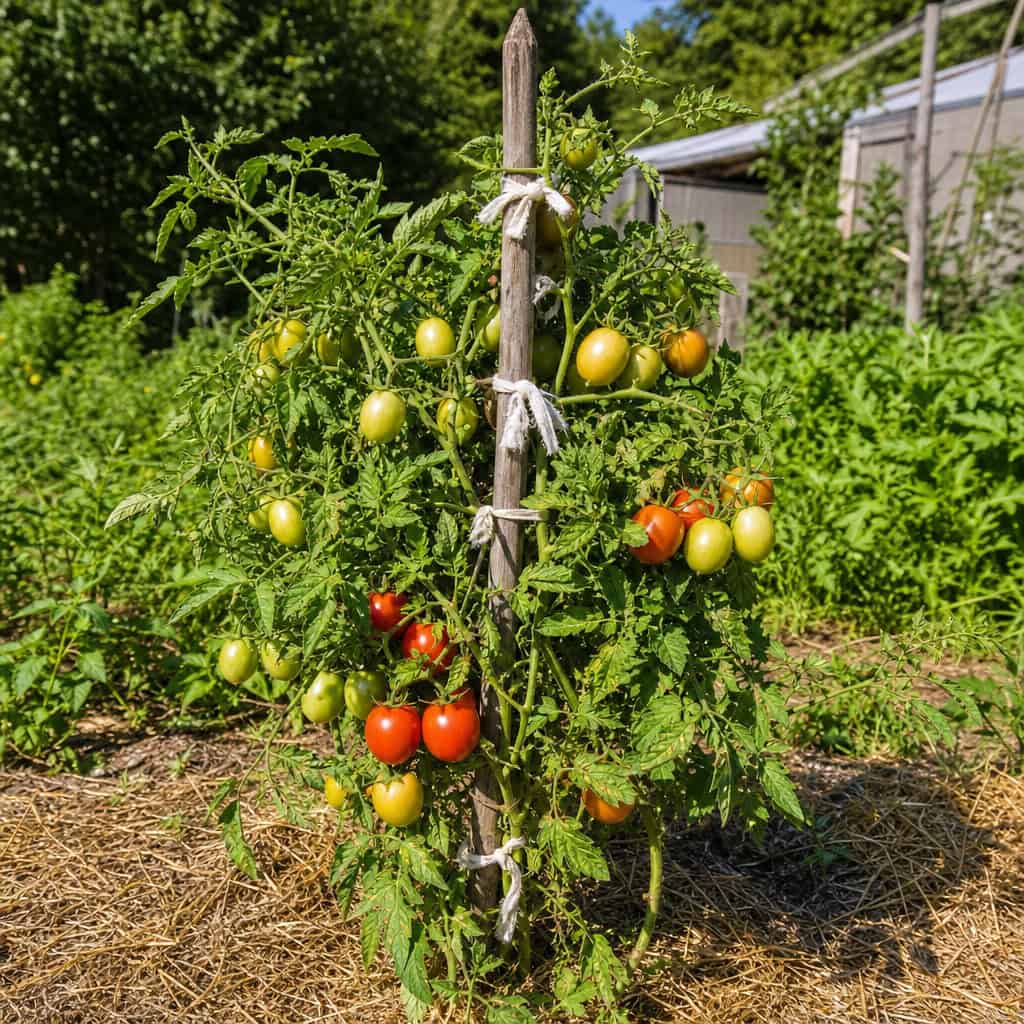
A sharpened wooden stake driven a foot into the ground, tied off with rag strips as the plant climbed, did what a cage couldn’t. Those cone-shaped wire cages were built for determinate patio tomatoes, and a six-foot indeterminate planted in one will pancake in the first August thunderstorm. Stake it once, properly, tie it every eight inches, and it’ll still be standing in September.
12. Slug Pellets Swapped for a Can of Beer

A tuna can sunk to its rim and filled with the cheapest beer in the fridge lured slugs in for the yeast, where they fell in and drowned — no metaldehyde pellets scattered where a curious dog or toddler might find them, and metaldehyde poisoning in dogs moves fast and hard, with tremors and seizures inside an hour.
The folk method holds up under real scrutiny: a two-year field study published in Agriculture compared beer types and trap layouts and found the traps genuinely effective, with spacing being the thing most people get wrong.
A few things that make the difference:
- Set traps roughly every three feet, not one per bed
- Sink the rim flush with the soil so slugs walk in, not up
- Refill after rain — diluted beer stops pulling them
- Empty every couple of days, before it turns into a smell you’ll remember
Pair it with a flashlight walk after dark. Slugs feed at night, and ten minutes of hand-picking beats any bait.
13. Plant Labels Made from Whatever Was Around

Popsicle sticks and broken teacup shards pressed into the soil marked the end of each perennial row, but the best version was cut-up venetian blind slats, snipped at an angle and labeled in ordinary pencil. Pencil graphite doesn’t fade in UV; permanent marker turns to a ghost by July.
14. Seed-Starting Trays, the Egg Carton Way

Egg cartons lined a south windowsill every March — twelve free cells that went straight into the compost once the seedlings moved out.
Tin cans with a nail hole in the bottom held bigger starts, and milk jugs sliced in half made mini-domes over the whole setup.
You lose nothing but the uniform look.
15. Reading Rainfall with a Coffee Can

A straight-sided coffee can nailed to the fence post, checked with a ruler from the junk drawer, told her everything a gauge would.
Straight sides are the whole trick — a tapered can gives a useless number — and she’d check it after a storm to know whether the garden had actually gotten its inch or just a loud fifteen minutes. Most people now water entirely blind, guessing from how the surface looks, and the surface lies.
16. Lime and Potash, Straight from the Woodstove

A scoop of hardwood ash from the woodstove, broadcast over the vegetable patch in late winter, raised pH and supplied potassium and calcium — and in a wood-heated house, a fresh bucket showed up every week from November through March.
Two cautions she learned by feel that you should learn by reading: ash works fast and is easy to overdo, so use no more than a couple of pounds per 100 square feet, and only if a soil test shows acidity. Keep it entirely away from blueberries, azaleas and rhododendrons, which need the opposite of what ash provides.
17. Trellises Cut Straight from the Hedgerow
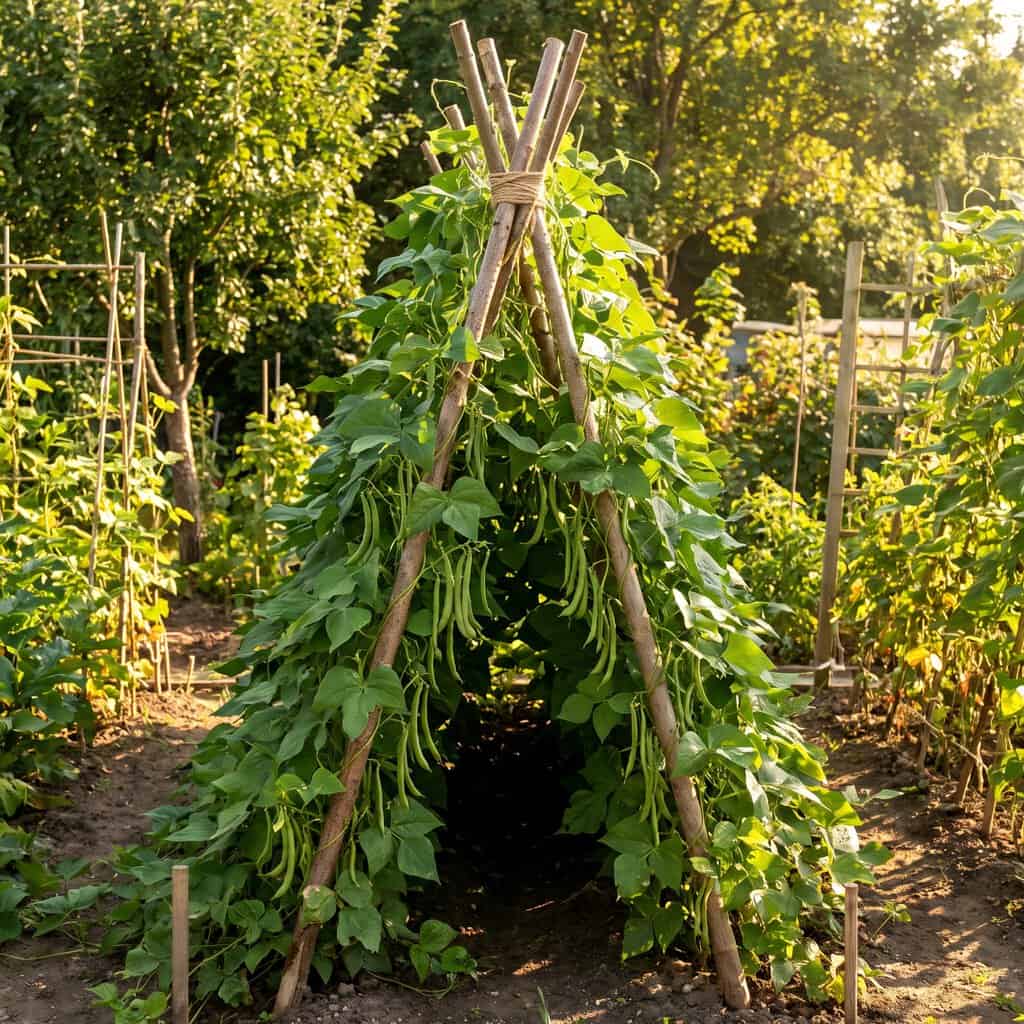
Six saplings from the hedgerow, or bamboo canes if someone had a stand growing, lashed together at the top with twine into a tepee, stood in for any metal obelisk. Pole beans covered it by July, and underneath was a green room with a dirt floor that every kid who grew up with one still remembers sitting in. Sink the legs six inches — a loaded bean tepee catches wind like a sail.
18. Landscape Fabric Gave Way to Wet Newspaper
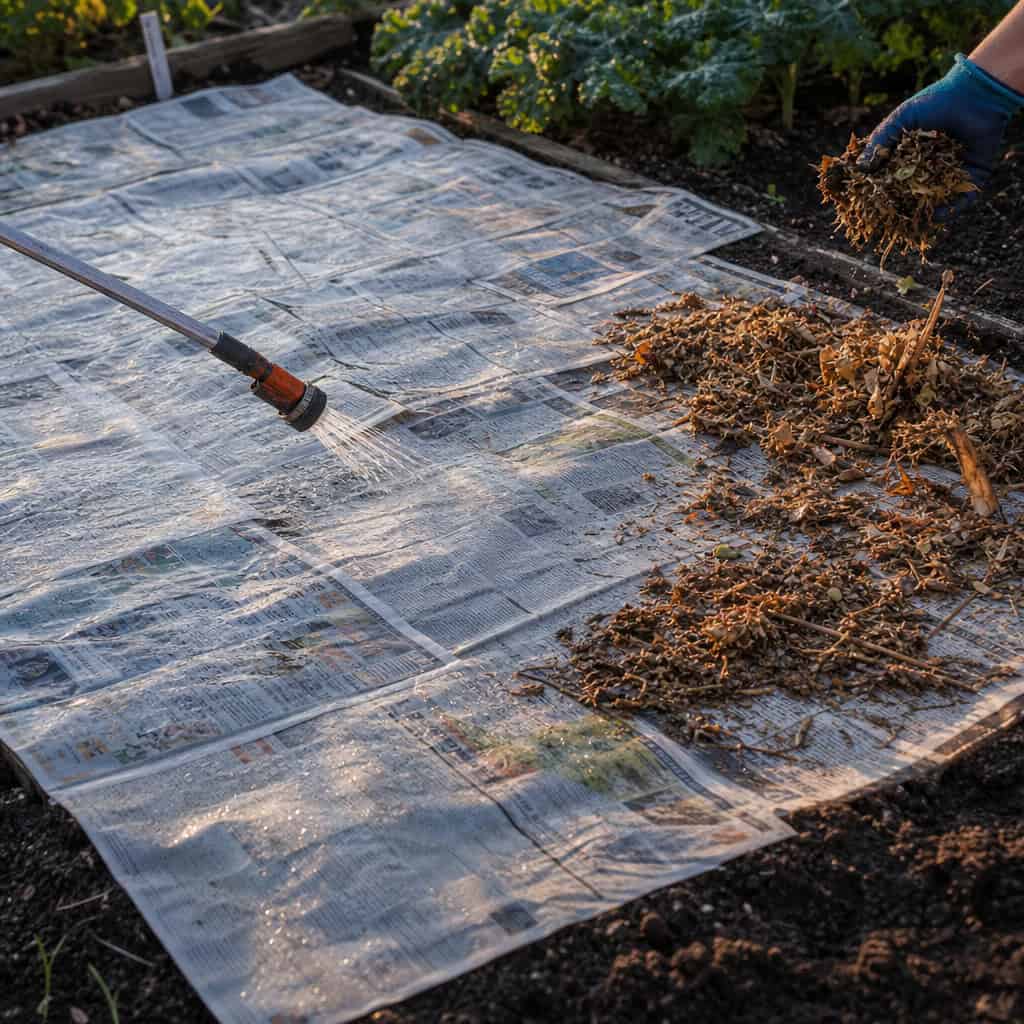
Newspaper, laid six sheets thick and wetted down with the hose, then mulched over with whatever was free that week, smothered weeds just as well as fabric ever could.
Flattened feed-store cardboard handled bigger beds the same way. Both smother weeds for a full season, then rot into the soil and feed the worms.
Woven fabric does the opposite: weeds root in the mulch layer above it and thread down through the weave, soil life underneath declines, and five years later you’re pulling up shredded black plastic in strips. Illinois Extension lists the downsides plainly enough that it’s hard to read and still buy a roll.
19. Nursery Six-Packs Couldn’t Compete with Passalongs
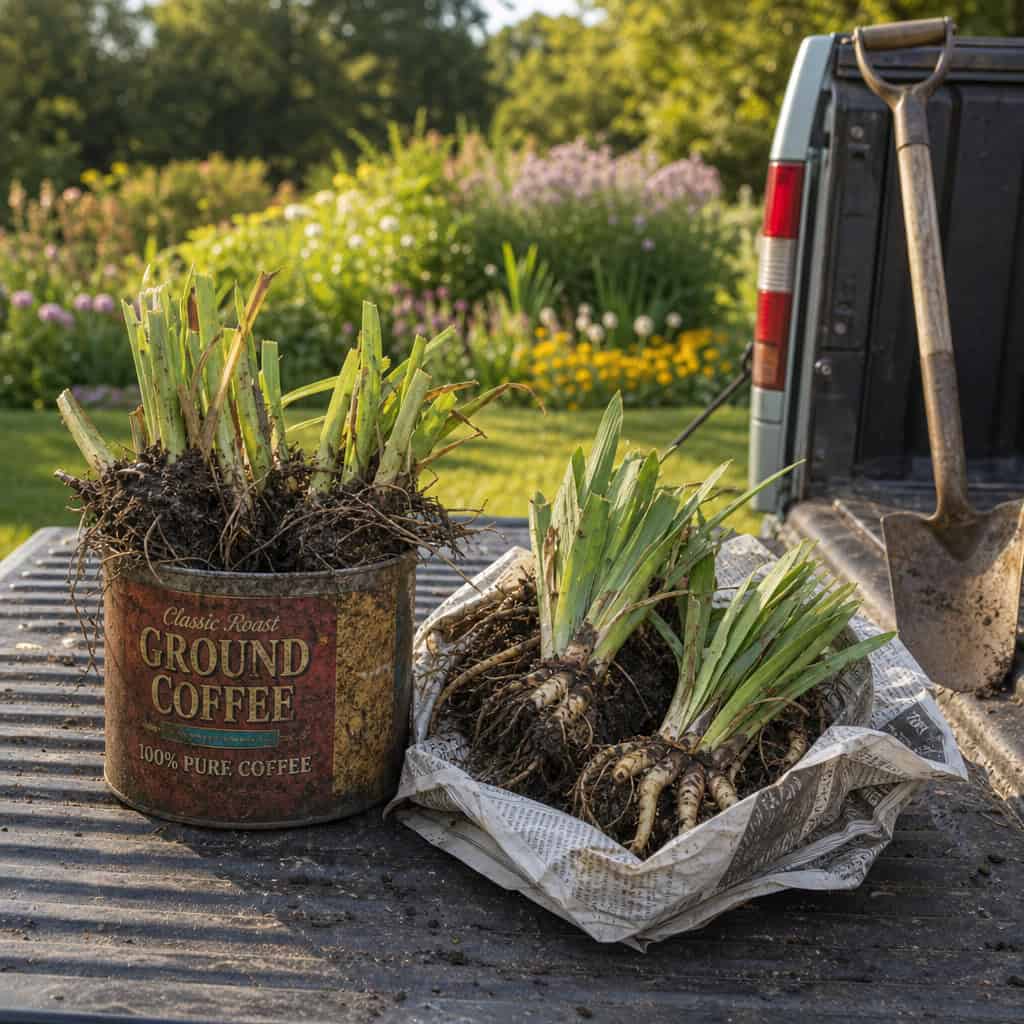
Almost nothing in her beds ever arrived in a pot — it came in a coffee can from somebody’s trunk instead: daylilies from the woman across the road, iris divisions from a cousin, peonies dug from her own mother’s yard in 1948 and still blooming, hostas, a snake plant, and a Christmas cactus started from three broken segments a church friend handed over in a napkin.
Passalong plants come with names attached — you don’t say “the orange daylily,” you say “Ruth’s daylily,” and forty years later you still do. That’s the one thing a garden center can never put a price tag on.
20. Insecticide Spray Lost to a Thumb Over the Hose

Her whole aphid program was a thumb over the end of the hose — a hard jet under the leaves, twice a week, and the colony never got a foothold.
Hornworms got hand-picked into a coffee can of water; you spot them by the dark pellets on the leaves below, then work upward until the green shape resolves out of the stem. Squash bugs got the tape treatment — she’d flip leaves each morning and scrape the bronze egg clusters into the can before anything hatched. Japanese beetles got knocked into soapy water at dawn, while they’re too cold to fly.
Soft-bodied pests that made it past all that got mild soapy water, at roughly one to two teaspoons of plain liquid soap per gallon. Go stronger and you’ll strip the leaf’s protective coating and burn it, especially on squash, and you should never spray in full afternoon sun.
The real method, though, was the morning walk. Fifteen minutes down the rows with a can in hand meant nothing ever reached the scale where spraying makes sense, and knowing which bugs are helping and which are destroying everything was most of the job — she left every ladybug and every fat green lacewing larva exactly where it sat.
21. No App Needed to Track the Last Frost
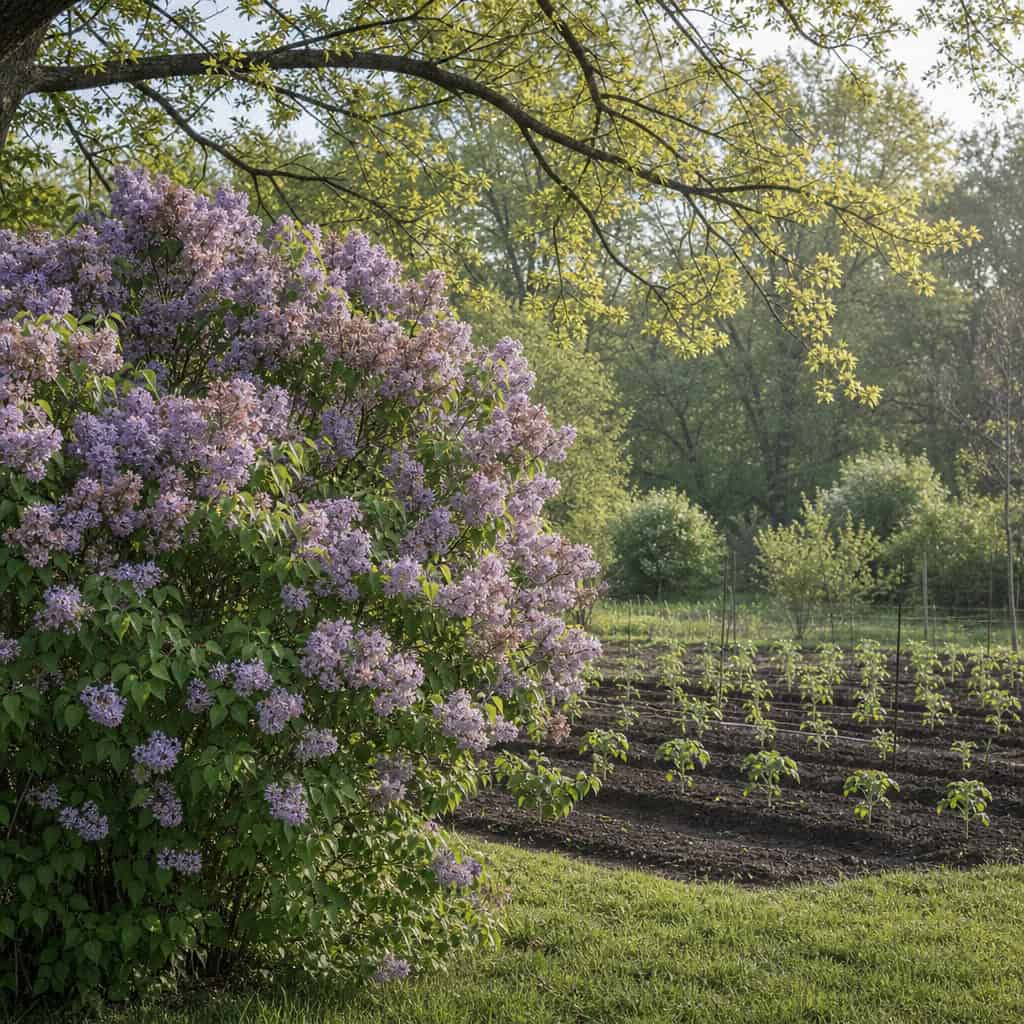
She planted corn when oak leaves reached the size of a squirrel’s ear, set tomatoes out when the lilacs finished blooming, and sowed peas when the forsythia went gold.
This is phenology, and it’s studied science — plants and insects respond to accumulated heat, the same signal your crops respond to. A frost-date chart only gives you a 30-year average; the lilac tells you about this specific spring. She also put a hand straight into the soil — cold and heavy meant wait, no matter what the calendar claimed.
22. The Eggshell Slug Trick, Debunked

This one’s included to be corrected, not recommended.
The eggshell barrier is the most repeated garden tip of the last century, yet controlled trials by the RHS and university researchers found it offers no meaningful protection — slugs cross crushed shell without hesitation, and some evidence suggests the shells actually draw them in.
Crush them into the compost instead, where the calcium does some real good, and go back to the beer trap.
23. Rooting Hormone, Brewed from Willow

Willow branches, snapped into pieces and steeped in a jam jar of water for a day or two, made her rooting solution.
Willow bark releases indolebutyric acid — the same compound sold as the active ingredient in commercial rooting powder — along with salicylic acid, which suppresses rot in the jar. Half her houseplants never got any hormone at all; a coleus cutting in a jelly jar on the kitchen sill roots in ten days on plain water and stubbornness.
24. Bagged Fertilizer Traded for the Compost Pile
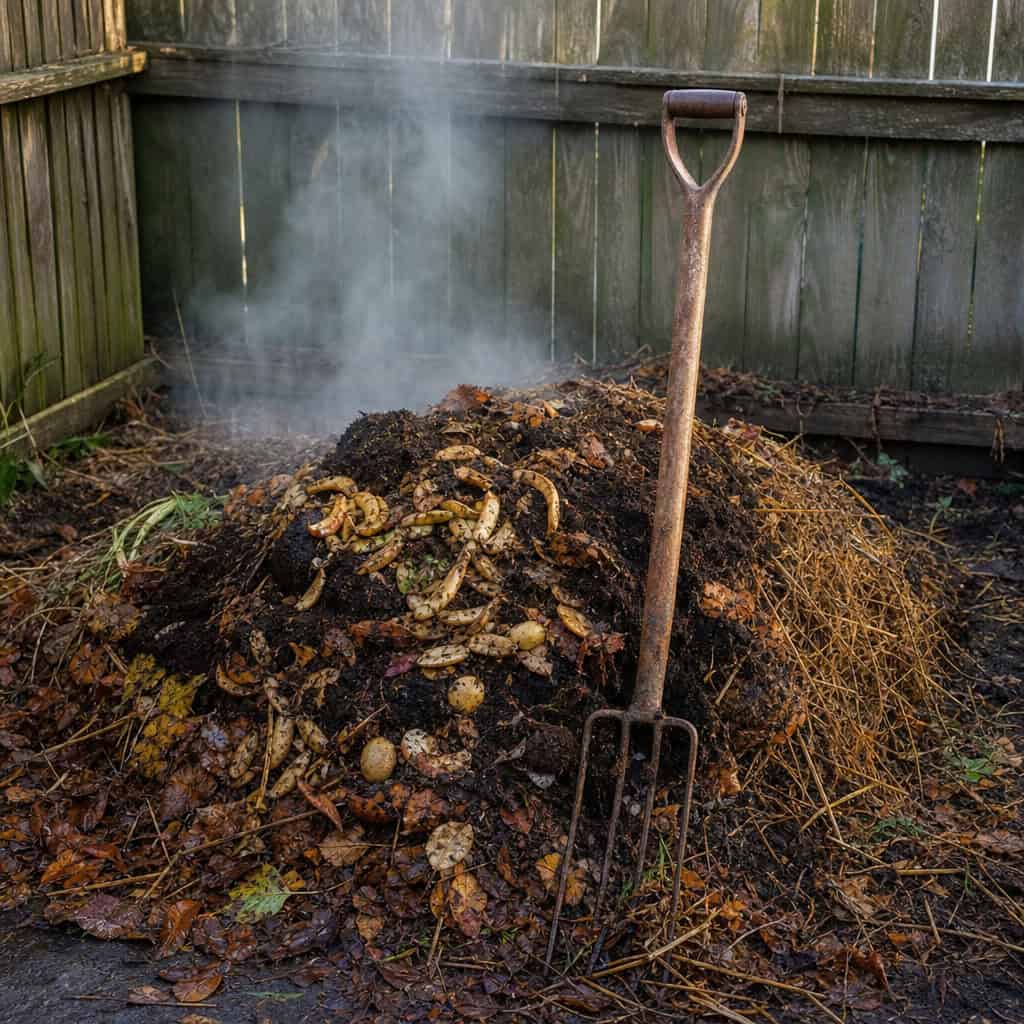
The pile in the corner — coffee grounds, potato peels, raked leaves, aged manure from whoever had a horse — did the feeding.
She wasn’t feeding tomatoes so much as feeding dirt, and the dirt fed the tomatoes, which is the whole difference between a garden that improves every year and one that needs a fresh bag each spring. If you’ve never built a pile, starting a compost heap costs nothing but a corner of the yard.
25. Rain Barrels Instead of a Sprinkler System

A wooden barrel or galvanized washtub sat at the corner of the porch, positioned right under the downspout, and did the watering. One inch of rain on a 1,000-square-foot roof yields more than 600 gallons — she wasn’t measuring it, she just knew the barrel filled and the bean rows drank.
A few modern details matter before you set one out. Screen the top with fine mesh, since an open barrel becomes a mosquito nursery within a week and standing water is exactly what Aedes species want. Route the overflow with a hose that empties at least six feet from the house, downhill, because a barrel that backs up against the foundation trades a water bill for a wet basement.
Check your state’s rules, too. Rainwater harvesting is regulated in parts of the arid West, with Colorado capping residential collection at two barrels and 110 gallons total; most states encourage or even rebate it, but the rules aren’t uniform.
And never use barrel water on leafy greens you’ll eat raw — roof runoff carries bird droppings and shingle grit, which is fine for tomatoes and flowers but not for lettuce.
26. Leaf Mold in Place of Bagged Peat Moss
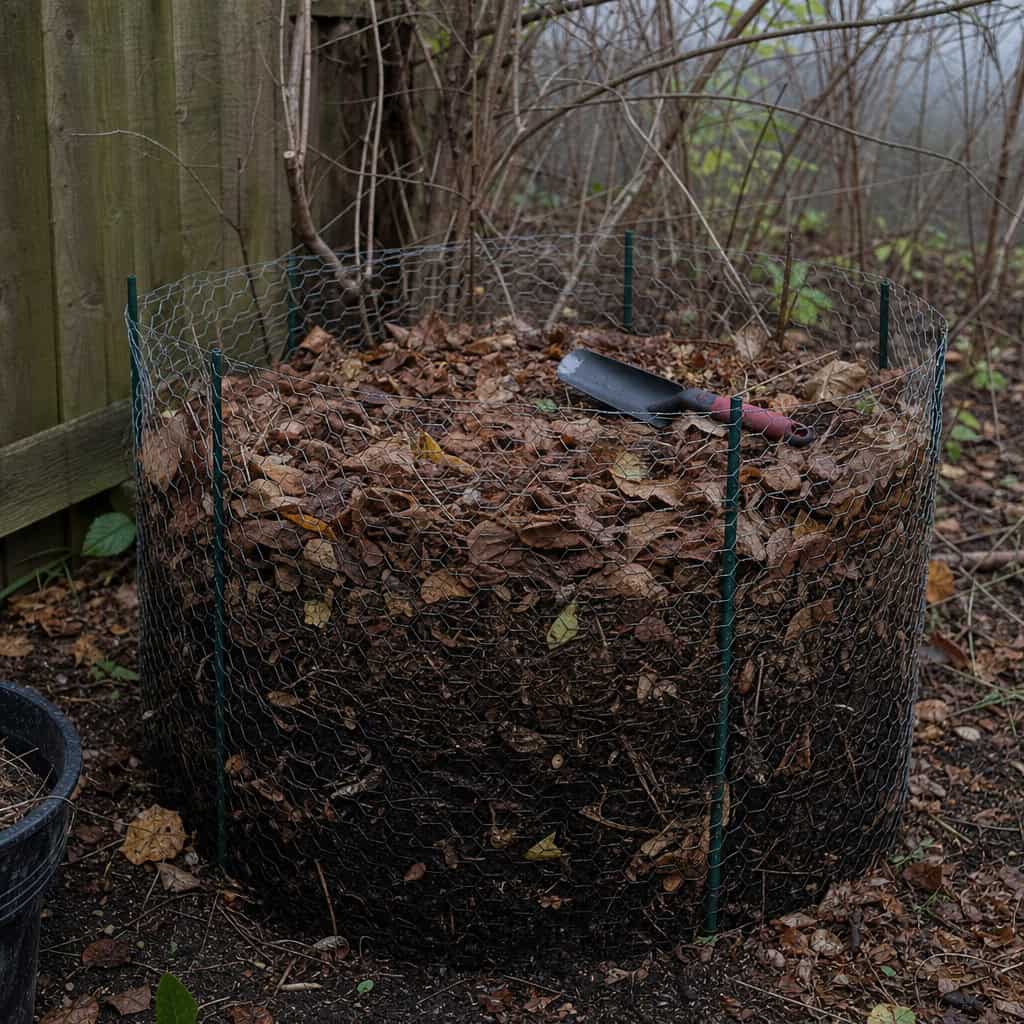
A ring of chicken wire, three feet across, stuffed with raked leaves and left alone for twelve to eighteen months, turned into leaf mold — dark, crumbly, and able to hold water like a sponge, the original soil conditioner and entirely free.
Peat has since become a climate argument, since harvested bogs release carbon stored for millennia, and gardeners now pay good money for peat alternatives that grandma had rotting quietly behind the garage.
27. Milk and Baking Soda Stood In for Fungicide
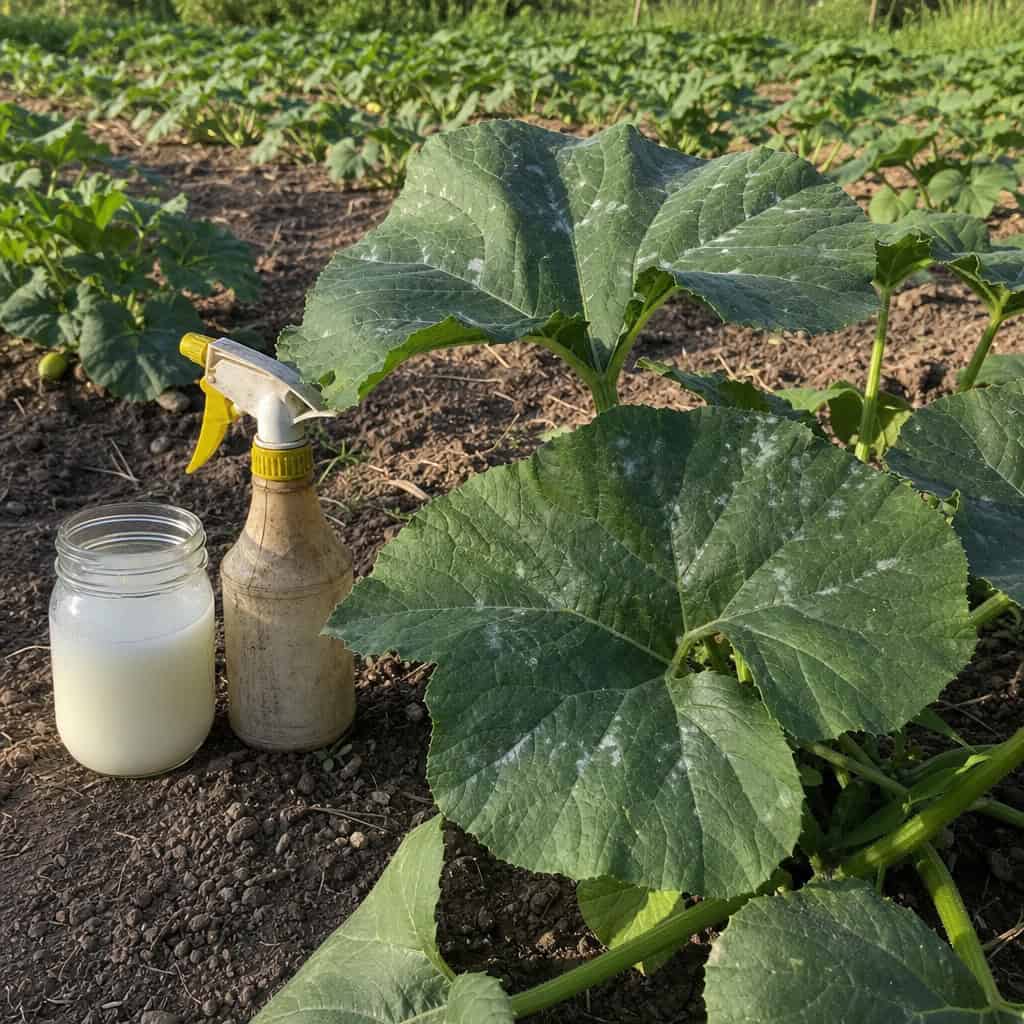
Milk, diluted roughly one part to nine, went on squash and cucumber leaves at the first white dusting, while a baking soda solution handled the roses.
Trial results on both are genuinely inconsistent — sometimes real suppression, sometimes nothing — and baking soda also builds sodium in soil with repeated use, a slow problem you won’t notice for a few seasons. Treat both as prevention, not cure. What actually kept powdery mildew down in her garden was spacing: wide rows, morning watering at the base only, and pinching out interior growth so air could move through.