


Drive your street on the first cold night in December. You’ll know within three houses which displays were planned and which ones were dumped out of a bin.
It’s rarely about money. The guy with four strands and a timer usually beats the guy with twelve strands and no plan.
Most of what reads as “cheap” comes down to a handful of repeatable errors — mismatched color, crooked lines, dead bulbs nobody replaced. Every one of them is fixable in an afternoon.
Here are 27 Christmas light mistakes the neighbors absolutely notice, even if they’d never say a word about it.
1. Two Different Whites on the Same House

This is the fastest giveaway on the list.
Put a 2700K warm-white strand next to a 5000K pure-white strand and the whole facade looks broken. One side glows like a candle. The other looks like a dentist’s office. People who couldn’t name a Kelvin temperature if you paid them will still squint at your house and think something’s off.
The trap is labeling. Two boxes both stamped “warm white” can land hundreds of Kelvin apart depending on the brand and the year. Lighting designers treat mixing color temperatures as a cardinal sin for exactly this reason, and CE Pro lays out why a mismatched scheme never settles.
Buy one brand, one Kelvin rating, all at once. Write it on the storage bin lid.
2. The Sagging Roofline Swoop

At noon it’s invisible. At night it’s the only thing anyone sees.
The human eye is brutally good at reading a straight line, and a roofline strand that dips three inches between clips turns into a series of sad little smiles across the front of the house. One droop is forgivable. Four in a row looks like the lights gave up.
The cause is almost always spacing. Clips every 18 to 24 inches hold a line; clips every four feet let gravity and wind do whatever they want. C9 bulbs are heavier than minis and need tighter spacing — 12 inches is common on a long run.
Measure before you climb. Run a tape along the fascia, mark your clip points with a pencil, and count how many clips you need per side. Pros do this on the ground because fixing a crooked line from a ladder means moving the ladder eleven times.
Ladder rules that keep this from becoming an ER trip: set the base one foot out for every four feet of height, keep both feet on solid ground, and never lean past the side rails to reach “just one more clip.” Move the ladder. Every single time.
If your gutters are full, clean them first. A clip hooked over a gutter packed with wet leaves and ice doesn’t hold, and the whole run slumps by week two.
3. An Army of Inflatables

One good inflatable is charming. Seven is a parking lot.
Designers tend to agree that a single well-placed blow-up — a snowman beside the walk, a reindeer anchored near the porch — gives a yard personality. Crowd the lawn with them and nothing gets to be the focal point. Homes & Gardens puts clutter at the top of the tacky list for the same reason.
Then there’s the daytime problem nobody plans for. Five deflated nylon puddles sagging on a soggy lawn, tether straps showing, fans off until dusk.
Cap it at two. Give each one breathing room.
4. The Burned-Out Gap Nobody Fixed

You know the house. Ten feet of perfectly good roofline, then a black hole, then lights again.
That gap says the display went up once in late November and hasn’t been touched since. It’s the most universally recognized mistake on this list because every street has one.
Carry a spare strand and a fuse kit in the bin. On LED runs, a single dead section usually means a popped fuse in the plug or one loose bulb pulling the circuit down — a five-minute fix with a pair of pliers and a bulb tester.
Walk the street side of your own house once a week. That’s the whole maintenance plan.
5. Cool-White LEDs That Read Like a Hospital

Cool white runs about 6000K and up. The bargain versions skew blue, sometimes faintly purple.
That’s parking-garage light. Stadium light. It’s the exact opposite of the warm glow people associate with December, and a whole facade of it turns cozy into clinical in one strand.
Cool white isn’t useless — it can look sharp on a modern house with crisp white trim, or as a deliberate accent against warm tones. But as the main event on a brick colonial? Harsh.
Check the Kelvin number on the box, not the marketing word.
6. Lights That Stop Where the Ladder Stopped

Two-story houses tell on their owners.
You can read the exact reach of a 20-foot ladder on a lot of facades — lights across the garage and the first floor, then a dark upper story like the display ran out of nerve. Which, honestly, it did.
What the eye catches isn’t the missing footage. It’s the asymmetry.
Better to light one complete element — the whole porch, the whole garage face, the full width of the lower roofline — than to start something you can’t finish. A finished small display beats a half-finished big one every time.
7. The Controller Left on Strobe

Eight-function controllers ship set to “combination.” Nobody ever changes it.
So half the block gets chase, flash, twinkle and slow-fade cycling through your front yard every four seconds. It’s exhausting to look at and it’s the single fastest route to tacky in almost every designer’s book.
Press the button until it reads steady-on. Then put the controller somewhere the dog can’t reach it.
8. C9s, Minis, and Icicles All on One Facade

Accumulated-box syndrome. Three different bulb styles on one elevation because that’s what was in the garage.
Pros call this out constantly: mismatched bulb sizes on the same plane read as inventory, not design. The big fat C9s look great alone. The minis look great alone. Together they look like a yard sale.
One bulb style per plane. Vary it between the roofline and the shrubs if you want contrast — just don’t mix within the same sightline.
9. The Orange Extension Cord Across the Lawn
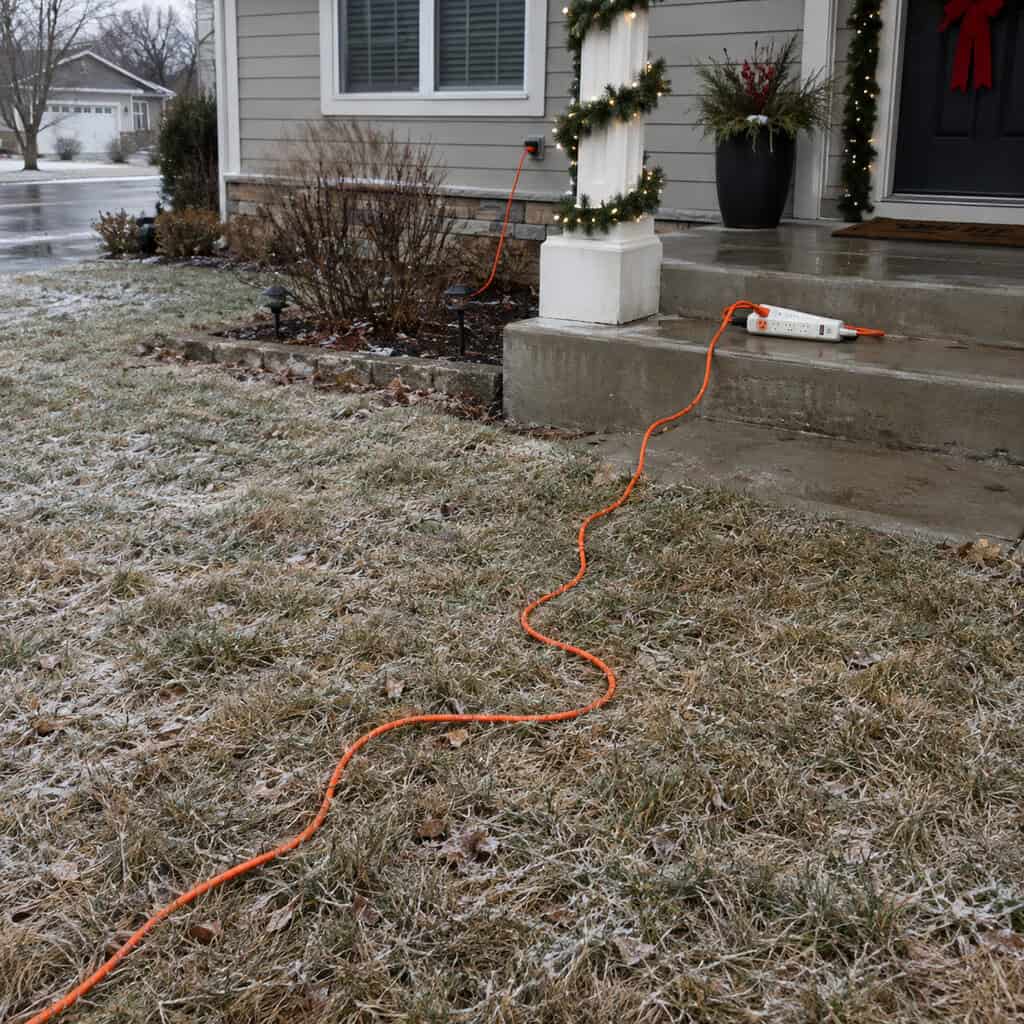
Safety orange is engineered to be seen from a hundred yards away. That’s the entire point of the color.
Which makes it the worst possible cord for a display that’s supposed to look effortless. Add a plug dangling halfway up the wall and a power strip sitting out on the porch steps, and the whole thing looks temporary.
Buy green or brown outdoor-rated cord. Run it along the foundation line, tuck it under mulch edges, and get the connections up off the ground in a weatherproof box.
10. Net Lights Thrown Over Shrubs Like a Hairnet

Net lights work on one kind of shrub: the kind shaped like a rectangle.
Throw a grid over an irregular boxwood and it bunches at the top, sags at the shoulders, and leaves the bottom half completely dark. From the street it’s a glowing lump with a shadow underneath.
Fit the net to the plant’s actual shape, pinning the edges underneath, or skip the net and wrap the shrub by hand. Wrapping takes longer and looks three times better.
If your foundation planting is a row of identical cheap shrubs, net lights only emphasize it.
11. Staples and Roofing Nails Instead of Clips

Walk up to a lot of older houses in July and you can still see exactly where last year’s lights hung.
That’s the real cost of staples. A line of pockmarks across the fascia, visible for all twelve months, each one a little entry point for water into painted wood. Roofing nails are worse — driving one through a shingle to hold a strand punches a hole in the only thing keeping water out of your attic.
Then there’s the electrical side. A staple driven tight across the wire can pinch through the insulation and bridge the conductors. Sometimes it blows a fuse immediately. Sometimes it sits there arcing quietly inside the jacket until something gets hot.
The clip aisle solves all of it for about eight bucks:
- Gutter clips — hook over the lip of the gutter, no fastener in anything
- Shingle tabs — slide under the shingle edge without puncturing it
- All-in-one clips — flip to work on gutter or shingle, hold C9s upright or minis flat
- Adhesive-back hooks — for brick, stucco and trim where nothing else grips
Pull every staple that’s already up there, dab the holes with exterior caulk, and prime before you paint. If you leave them, you’re handing the next ten winters a path straight into the wood.
12. Icicle Lights With Missing Teeth

Icicle strands live or die on rhythm. Long drop, short drop, long drop — that pattern is the whole effect.
Lose a third of the drops to dead bulbs and tangles and the rhythm collapses. What’s left is a ragged fringe that looks like it’s been hanging since the Clinton administration.
They’re also the least forgiving style for age. Minis fade gracefully. Icicles just look broken.
Three seasons is about the honest lifespan on a budget set.
13. LEDs and Incandescents on the Same Run

The 2008 to 2018 changeover left most garages with mixed inventory, and it shows on a lot of eaves.
Half the run glows amber-orange and soft. The other half is crisp and cold. On one continuous line it doesn’t read as variety — it reads as a repair.
Separate them by element. Incandescents on the porch railing, LEDs on the roof, if you must. Never on the same continuous run.
14. The Barber-Pole Trunk Wrap

A tree trunk is a straight vertical line. That makes it the single most unforgiving surface in your yard for spacing errors.
Four inches between wraps down low, fourteen inches up top where you got tired — the eye catches it instantly, because it has a perfect reference line to compare against.
Pick a spacing and hold it. Three inches is tight and expensive, six is standard, eight is sparse but even. Even beats dense every time.
Wrap from the base up, keeping tension consistent, and stop at the same height on every trunk in the yard.
15. Laser Projector Dots Sprayed on Vinyl Siding

A plastic box staked in the mulch, throwing green speckles across the entire front of the house.
It covers the most surface for the least money, and that’s exactly why it looks cheap. The dots land on siding, windows, shutters and gutters with no regard for any of them — architecture erased and replaced with static.
Good landscape lighting works by picking out features and letting the rest fall into shadow. The Kichler design fundamentals come back to that over and over: light the thing worth seeing, not the whole wall.
If you love the projector, aim it at one gable or a blank side wall. Not the face of the house.
16. No Timer, So the Lights Burn at Noon

Lights on in flat daylight look like gray wire and dead plastic. There’s nothing festive about it.
And lights still blazing at 3 a.m. aren’t impressing anybody except the raccoons. The glow stops feeling special when it never turns off.
A photocell plug costs about $12. A programmable outdoor timer runs $20 to $30 and lets you set dusk-to-11 so the display has a beginning and an end.
That one purchase does more for your curb appeal than another $200 of decorations.
17. Faded Pink and Purple LEDs

Cheap LEDs don’t burn out. They drift.
The phosphor coating and the dyed plastic lens both break down under UV, so by season four the whites have gone faintly pink and the blues have wandered toward violet. One aged strand next to a new one makes both look worse.
It’s the clearest argument for buying commercial-grade sets with molded lenses instead of painted ones. They cost roughly double and last three times as long.
Replace by the strand, not the bulb.
18. Everything Lit at One Height

Roofline lit, yard pitch black. Nothing happening between zero and twenty feet.
That’s why a lot of displays look flat even when the roofline is perfect. There’s no middle layer — no shrubs, no path, no wrapped tree, no porch glow to carry the eye up.
Add just two more levels and the whole front gains depth. A pair of lit shrubs at ground level and something at six feet — a wreath, a railing wrap, a small tree — does it.
Layering is the single biggest difference between a professional install and a homeowner one. The Lumens landscape lighting guide frames it the same way for year-round lighting, and the logic doesn’t change in December. The same thinking drives most front yard ideas that make neighbors slow down.
19. The Ground Floodlight Aimed at the House

One harsh flood pointed straight at the facade does two bad things at once.
It flattens every shadow, so the brick texture and the trim detail disappear. And it washes out the string lights it’s supposedly supporting — your $300 roofline turns into faint dots against a bright wall.
It also tends to dump glare across the street into somebody’s living room window.
Aim low and across, not straight on. Grazing light at a shallow angle picks up texture instead of erasing it.
20. The Full-Rainbow Palette

Red strand, green strand, blue strand, multicolor strand, a run of white — all on one elevation.
Nothing wrong with any one of them. Together they fight, and the eye has nowhere to land. This is the clutter problem again, just in color form.
Pick two, maybe three, and commit. Warm white plus red. Warm white alone. Classic multicolor by itself with no white anywhere.
Intentional always reads more expensive than abundant.
21. Indoor Lights Pressed Into Outdoor Duty

Skip this — it’s the one genuinely dangerous mistake on the list.
Indoor-rated strands use thinner insulation and non-sealed sockets. They’re built for a dry living room, not for 20-degree nights, freezing rain and wind loading.
What happens is predictable. Cold makes the insulation brittle, moisture gets into the sockets, and by the second week of December you’ve got discolored plugs and half-dark runs. That corrosion at the socket is a resistance point, and resistance points get hot.
Dry evergreen garland, a warm socket and a December wind is a combination fire investigators see every year. It’s not a theoretical risk.
Check the tag before anything goes outside:
- Marked “indoor/outdoor” or “outdoor use only” — fine
- UL or ETL listing on the tag, not just on the box
- Heavier jacket, sealed rubber sockets
- Plugs with a gasket or flap over the pass-through
Everything outdoors goes on a GFCI outlet, no exceptions. If the receptacle by your front door doesn’t have a test button, that’s a $25 part and a worthwhile Saturday.
22. Too Many Strands Chained End to End

Every box has a max-connect number printed on the tag. Almost nobody reads it.
Incandescent minis usually top out around three to five strands in series. LEDs are far more forgiving — 20 to 40 strands is common — but the limit exists either way, and the tag is the only place it’s stated.
Blow past it and you get voltage drop. The first strand glows bright and white, the last one looks dim and yellow, and the gradient across your roofline is obvious from the curb. It looks like half your lights are dying, because electrically, they’re being starved.
The other outcome is worse: you trip the breaker and a whole side of the house goes dark at 7 p.m. on the night you’re hosting.
Fix it by splitting the load. Run a cord out to the midpoint of a long eave and feed the run from two directions instead of chaining from one corner. Spread across two separate circuits if your front porch and garage outlets are on different breakers — and they often are.
A 15-amp circuit gives you about 1,800 watts, and you shouldn’t load past 80 percent of that. Incandescent C9s eat roughly 7 watts per bulb, so a single long run of them can hit the ceiling fast. LED C9s pull under a watt.
23. Green Wire on White Trim

Your display is visible for about nine daylight hours and five dark ones. Guess which one most people decorate for.
Green cord zigzagging across white fascia is the tell. It was designed to disappear into a Christmas tree, not a painted soffit, and in flat December light it reads as a long green scribble across the front of the house.
White wire on white trim. Brown wire on brick and cedar. Green wire only in the shrubs and the tree.
It costs the same. Nobody thinks about it.
24. Sun-Bleached Blow Molds

A genuine 1970s Empire Santa on the porch is fantastic. A chalky, yellowed, UV-cooked one with a cord stapled to the base is sad.
The difference isn’t age — it’s storage. Blow molds left out all year, or stacked in a hot attic, go brittle and lose their color in about five summers. Ones kept in a dark basement look nearly new after forty.
You can bring a faded one back with a light scrub and plastic restorer. Chalky and cracked is past saving.
25. Lights Still Up in March

Nothing flips a house from festive to neglected faster.
A dark roofline strand in April, clips still hooked on the gutter in July, a cord looped around a downspout all summer — it’s the same signal as a lawn that stopped getting mowed. The street reads it the same way, and it lands right alongside the other yard habits that make a house look dated.
Pull them by mid-January if the weather cooperates. Coil each strand onto a piece of cardboard, label it by which side of the house it covers, and next December takes half the time.
It’s the cheapest curb-appeal move available. It costs one Saturday morning and zero dollars.
26. The Lone Wreath Over the Garage

A 24-inch wreath on a 40-foot two-story facade isn’t minimalism. It’s scale failure.
Minimal can look wonderful — but minimal means one element sized correctly, not one element lost on a wall. A single oversized wreath, 36 inches or more, with a warm spotlight on it, does more than four small ones scattered around.
Go bigger than feels right. From the street it’ll look just about right.
27. Dollar-Store Solar Stakes That Die by 8 p.m.

Six plastic candy canes down the walkway, glowing bravely at 5:30 and fully dark by the time anyone drives home from dinner.
Cheap solar stakes use tiny panels and the smallest battery the manufacturer could get away with. A short December day gives them maybe two hours of charge, and the amber LED they use is so dim it barely registers against a streetlight.
Low-voltage path lights on the same timer as everything else cost more up front and actually stay lit.
Or leave the walkway dark and put the money into the porch.
None of this requires a bigger budget. Most of it requires buying one brand instead of five, measuring before you climb, and plugging the whole thing into a $12 timer.
The houses that stop traffic aren’t the ones with the most lights. They’re the ones where somebody made a decision and stuck to it.
Fix three things off this list this year. Your neighbors won’t say anything — but they’ll notice.