

Some yards just stop you in your tracks.
The mulch is a deep, natural brown. The plants are spaced with intention. The entrance draws you in. Nothing feels accidental, and the whole picture radiates a quiet, polished confidence that most people associate with a serious budget.
But here’s what’s actually going on: the yards that look like money are rarely the ones that cost it. The gap between a yard that reads as designed and one that doesn’t almost always traces back to a set of habits — specifically, a set of things that homeowners with great-looking yards simply refuse to do. The cheap tells are right there in the open: a wrong color, an untrimmed edge, a dead shrub, a light fixture from the checkout aisle.
Here are 24 things homeowners with expensive-looking yards never do.
1. Leave the yard without a defined focal point

A yard needs somewhere for the eye to land. Without it, everything feels flat.
You’ve felt this even if you couldn’t name it. A yard that’s all evenly spread out, with nothing pulling your attention, reads as unfinished — pleasant, maybe, but forgettable. There’s no there there.
Expensive yards give the eye an anchor. A specimen tree. A striking urn. A single dramatic bed or a water feature. One deliberate thing the whole composition organizes around.
Pick one moment worth looking at and let the rest of the yard support it. That’s the difference between a yard that’s maintained and a yard that looks designed.
2. Use plastic or artificial flowers as a substitute for real ones

Blooms that never change look wrong at a level you can’t quite put your finger on.
Real blooms open, peak, and drop. When something in a bed stays exactly the same for months, the brain flags it before you consciously notice why. And artificial flowers don’t age well outside — sun bleaches them, they take on a plasticky sheen, and they collect dust and cobwebs in the folds.
Nothing says budget faster than a faded silk geranium in a window box in August.
If you can’t keep something alive in that spot, plant a tough evergreen or a hardy grass instead. Real and low-maintenance beats fake every time.
3. Combine mismatched hardscape materials without a unifying theme

Commit to one design language and carry it throughout the space.
Expensive yards commit to one design story across the paths, the patio, the furniture, and the pots. Everything belongs to the same family. A yard that mixes modern black steel, boho macramé, Tuscan terracotta, and industrial pipe reads as a pile of unrelated clearance finds.
You don’t need everything to match. You need everything to relate — a shared color, a shared material, a shared mood running through it all.
Before you buy the next patio piece, ask whether it speaks the same language as what’s already out there.
4. Collect one of every plant and abandon any sense of repetition
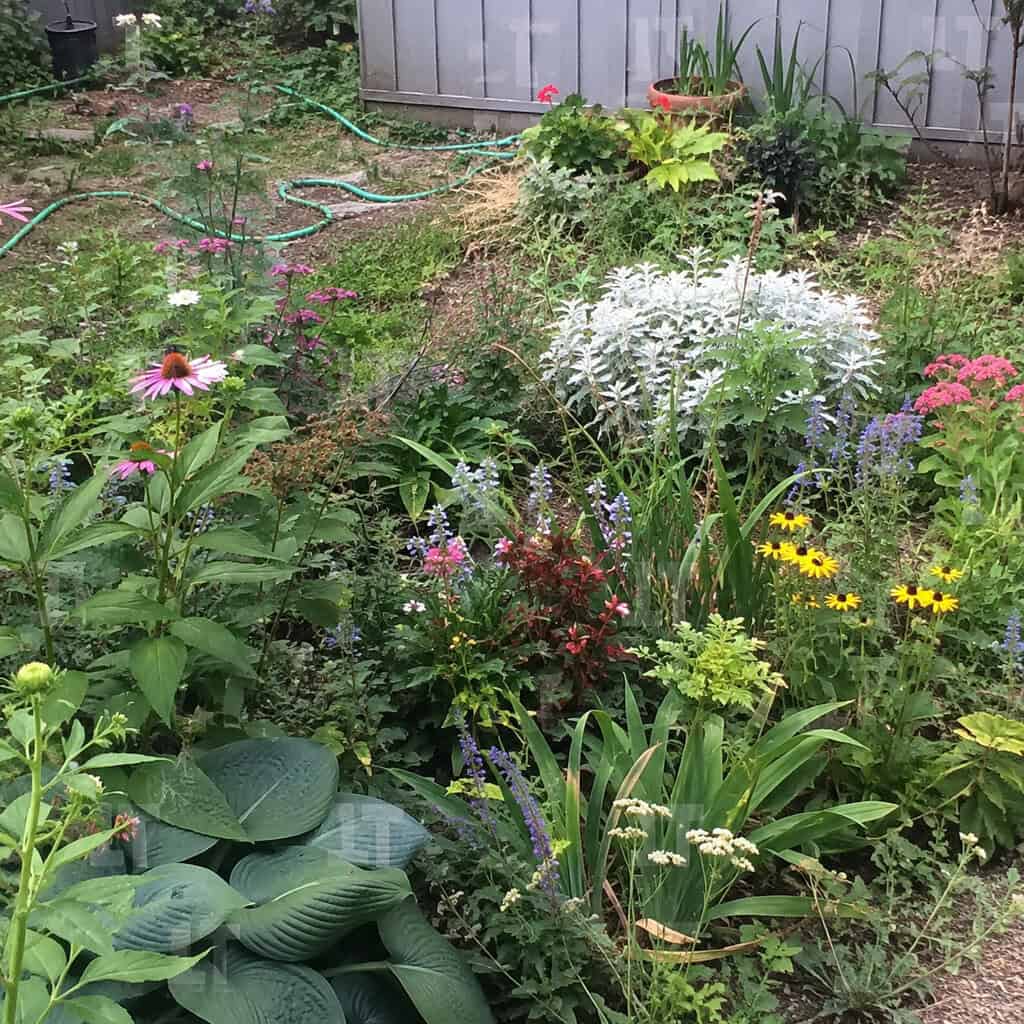
Every garden center is engineered to make you grab one of everything. That’s the trap.
A yard with fifty different plants and no repeats feels chaotic even when every plant is nice. There’s no rhythm, nothing for the eye to follow, no thread tying the front bed to the side bed to the back.
Expensive yards repeat. One anchor plant, or one color, shows up again and again across the whole landscape. That repetition is what reads as designed rather than accumulated.
Pick one or two workhorse plants and use them everywhere. Let them carry the yard, and treat the fun stuff as accents between them.
5. Spread gnomes and ornaments all over the lawn
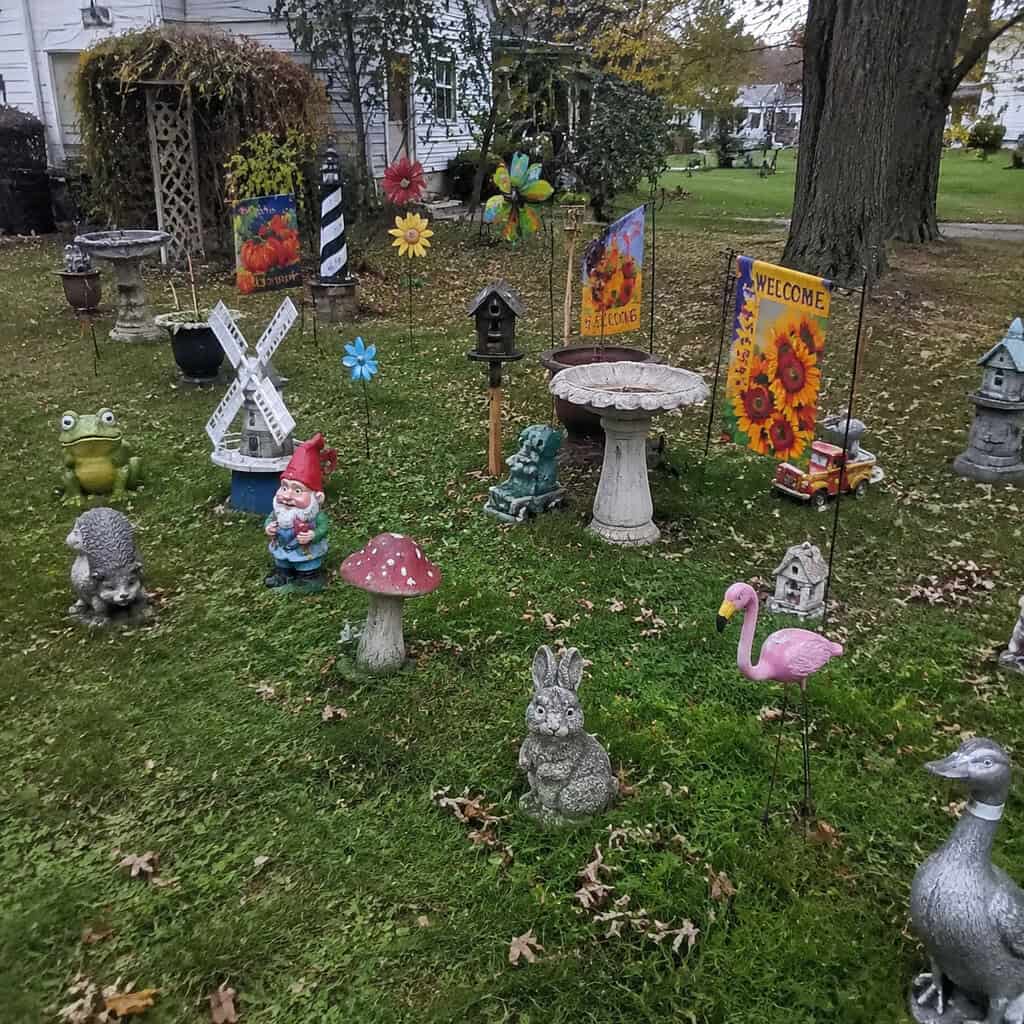
A single gnome has charm. A dozen of them turns the yard into a yard sale.
Windmills, wishing wells, garden flags, resin animals, a birdbath, three signs about wine — scattered across a yard, they create visual noise with nothing to anchor it. The eye has nowhere to rest.
Expensive yards do the opposite. One well-chosen piece, correctly scaled, placed where it matters. A single good urn beats a dozen bargain trinkets.
Edit ruthlessly. Keep the one thing you love and rehome the rest.
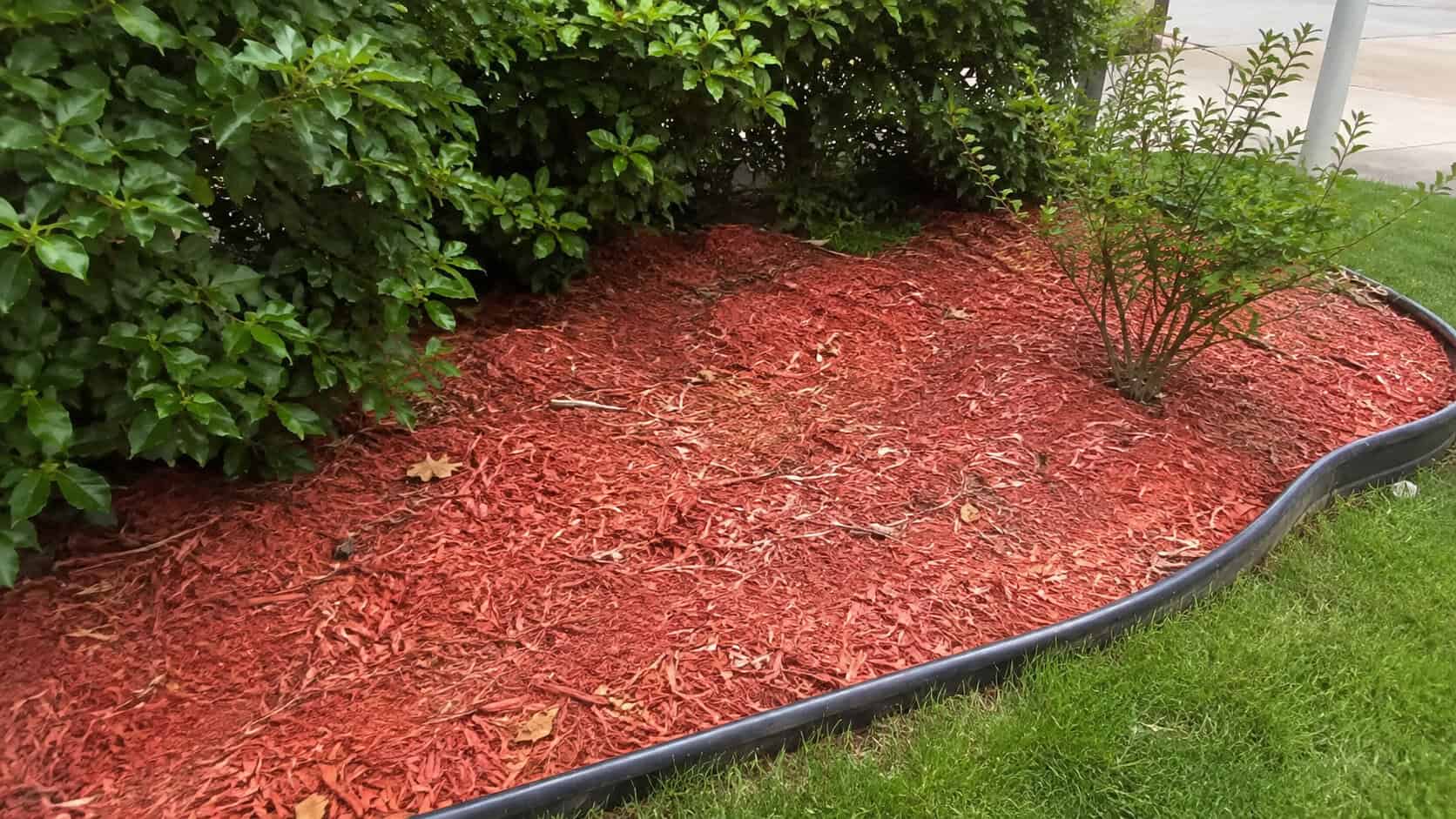
6. Reach for dyed jet-black or rusty-red mulch
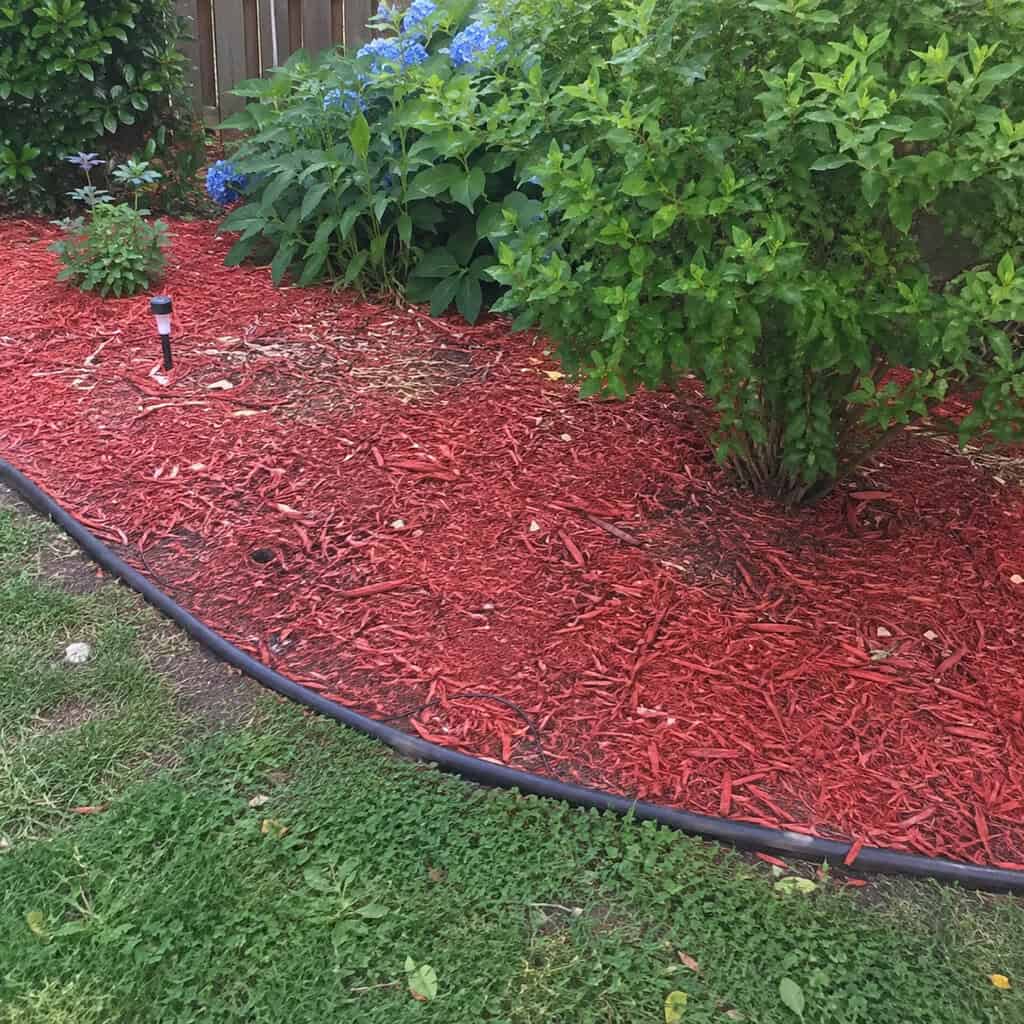
Tour any well-regarded landscape and you will not find red mulch — or jet black, either.
Those colors don’t exist in nature, and the eye knows it. Dyed red reads as a gas-station flowerbed. Dyed black looks like someone spray-painted the dirt, and it fades to a chalky gray by midsummer.
Natural dark-brown mulch reads rich. It recedes and lets the plants be the show, which is the entire point of mulch in the first place.
Shredded hardwood or pine bark in a natural brown tone costs the same as the dyed stuff. Skip the color.
7. Overlook the front entrance and the path leading to it

Your front door is the first thing anyone’s eye settles on — polished yards treat it accordingly.
The walkway gets framed. A matched pair of large pots flanks the door. The path to the entrance is planted on both sides so the approach feels deliberate, like the yard is walking you in.
It’s also the cheapest place to get a big return. You’re improving a small, high-traffic zone instead of the whole yard.
Two generous matching planters and a clean, symmetrical approach to the door do more for curb appeal than almost anything else you can buy.
8. Stuff beds full of plants without accounting for mature size
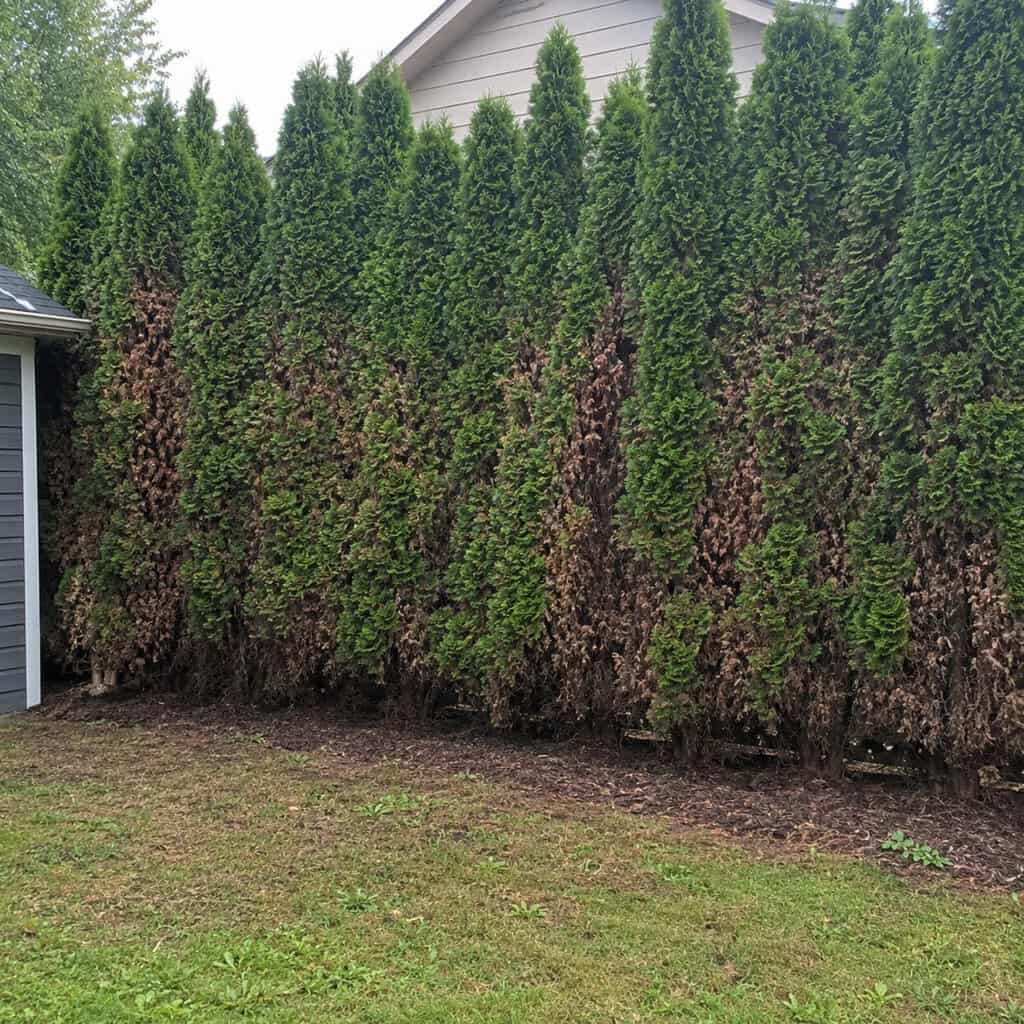
The shrub in that gallon pot is barely out of infancy — check the tag before you plant it.
The number that matters is mature size, and it’s the number nobody checks. A row of little arborvitae planted a foot apart looks great for two seasons, then turns into a green wall smashed against itself with dead brown interiors where no light gets in.
Landscape architects space for the plant it becomes, not the plant in the pot. Beds with breathing room look more expensive, not less.
It feels wrong at planting time. The bed looks sparse. Mulch the gaps and wait — the plants fill in, and you never have to rip half of them out.
9. Leave garden beds without a crisp, cut edge

This is the one. If you fix nothing else, fix this.
A designer can look at two identical beds and tell you which one cost money — and it’s almost always the one with a clean, spade-cut trench between the lawn and the mulch. That dark, defined line reads as intentional. It frames the planting the way a mat frames a print.
Plastic scalloped edging doesn’t do it. A hand-cut trench does.
Grab a half-moon edger or a flat spade, cut a shallow V-shaped groove along the bed, and pull the loose soil back into the bed. It costs an afternoon and nothing else. The mulch sits lower than the turf, water stays put, and grass stops creeping in.
Do this once and the whole yard jumps a tier.
10. Go all-hardscape and skip any layered planting

A yard that reads as luxurious has abundance — bare spaces read as budget.
A backyard that’s all pavers, all gravel, all patio and no plants feels hard and empty. It photographs like a parking lot. The eye wants something soft, layered, and green to land on.
The expensive move is balance — generous planting against the hard surfaces, layered from tall trees down through shrubs to groundcover. Lush beats sparse every time, and mature plantings genuinely add to what a home is worth.
If a corner of your yard feels bare and hard, the fix isn’t more concrete. It’s a layered bed of plants stacked from tall to short.
11. Put in artificial turf and consider the job finished

Blunt truth: fake grass may carry a real price tag, but it rarely carries a real look.
Designers are hard on artificial turf for a reason. It doesn’t change with the seasons, it heats up in the sun, and there’s a uniform, carpet-like flatness that the eye reads as fake even from across the street. Money spent doesn’t buy the look you were after.
A real lawn breathes. It has variation, it responds to light, and it feels right underfoot.
If the reason you’re eyeing turf is a lawn that won’t grow, the answer is usually soil and grass choice, not plastic. A full lawn renovation gets you real grass that looks like money instead of a rug.
12. Ignore scale and choose pieces that are too small for the space

Open sky shrinks everything — and that’s the detail most people never account for.
A statue that looked substantial in the store vanishes in the open yard. A skinny two-foot path looks stingy. A dinky planter by the door reads as an afterthought. Under the open sky, small things disappear.
Expensive yards over-scale on purpose. The planter is bigger than feels reasonable indoors. The path is wide enough for two people. The focal piece has real presence.
When you’re deciding on size outside, go one notch bigger than your gut says. It’ll look right.
13. Scalp the lawn by mowing it too short

The fairway fantasy leads more homeowners astray than almost anything else in lawn care.
Cutting your grass down to an inch and a half doesn’t give you a golf course. It gives you exposed brown stems, scorched patches, and an open invitation to crabgrass. Scalped turf grows shallow roots, dries out fast, and stresses in the first heat wave.
The University of Minnesota Extension recommends mowing most lawns at three to four inches. Taller grass shades out weed seeds and looks lush instead of stubbled.
Never remove more than a third of the blade in one pass. If your lawn thins out anyway, the habits people with great lawns follow start with mowing height, not fertilizer.
14. Pile mulch into ‘volcanoes’ against tree trunks

The mulch volcano looks like good stewardship. That’s precisely what makes it so dangerous.
A cone of mulch mounded up the trunk feels maintained, like someone cared enough to tuck the tree in. It’s slowly killing the tree. Piled mulch buries the root flare, holds moisture against the bark, and rots the wood — which invites borers and disease right into the trunk.
University extension programs have been fighting this one for years. The University of Illinois Extension flat-out calls the practice a slow killer, and the University of Vermont Extension warns about the same buried root flare.
Spread mulch in a flat, wide ring instead — two to three inches deep, pulled back a few inches from the trunk so you can see where the tree flares into the ground. Think doughnut, not volcano.
15. Let weeds creep into beds and cracks
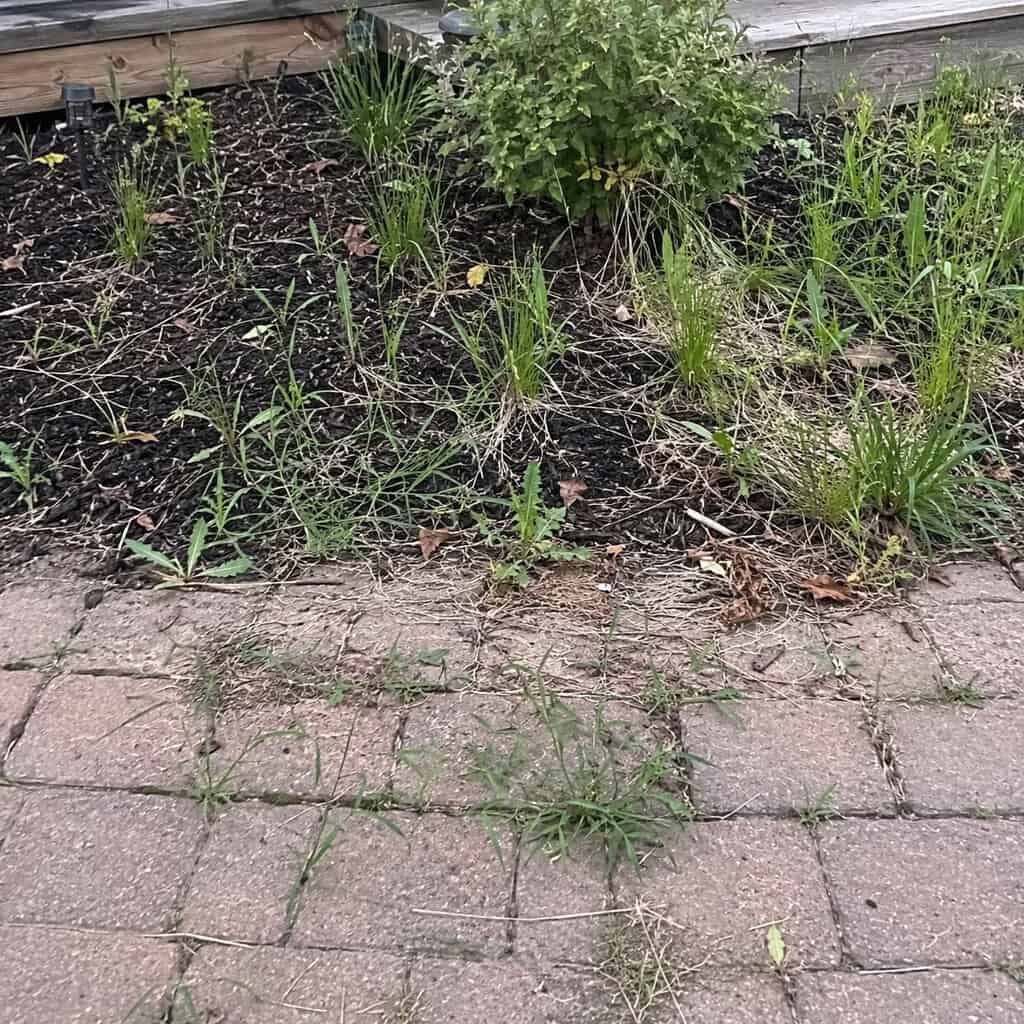
All the work you’ve done elsewhere can be undone the moment weeds move in.
You can nail the edging, the mulch color, and the plant spacing, and a bed full of crabgrass and creeping charlie will still drag it all down. Weeds in the paver joints and driveway cracks send the same message — nobody’s tending this.
Expensive yards stay on top of it. Not obsessively, just consistently — a quick pull through the beds every week or two before anything sets seed.
Pull them while they’re small and stay ahead of the seed. For the joints and cracks where pulling never lasts, keep after the weeds coming up in driveway cracks before they take hold. A weed-free bed reads as cared-for, which reads as expensive.
16. Select pavers that will fade to pink or salmon over time

Not all pavers hold their color — and you often won’t know the difference until it’s too late.
Brown and red concrete pavers that are only surface-colored — dyed on top of a gray core — fade. Sun and weather wear the color off and leave behind a washed-out salmon-pink that looks dated fast. It’s one of the most common regrets designers see in aging hardscape.
Full-body-color pavers hold up because the color runs all the way through. Gray tones and warm yellow-tan undertones age far more gracefully than red.
Ask whether a paver is through-body colored before you buy a pallet of it. That one question saves you a patio you’ll resent in five years.
17. Line the path with cheap plastic solar stake lights

Nothing signals a budget yard at night quite like a perfectly straight runway of plastic solar stakes along the walkway.
Cheap solar stakes fade within a season. The plastic clouds, the batteries weaken, and by the second summer half of them glow a dim, sickly blue while the others don’t come on at all. Lined up in a stiff, evenly spaced row, they read as budget even on night one.
Expensive yards use low-voltage systems instead of solar. Low-voltage landscape lighting runs off a transformer wired to a handful of quality fixtures — brass or copper that develops a patina instead of cracking. The light is consistent, warm, and bright enough to actually do something, because it isn’t rationing power from a tiny panel that spent the day under a tree.
The placement matters as much as the fixtures. Pros stagger path lights instead of soldiering them into a straight line, and they layer the light — a little on the path, a little washing a wall, a little up into a tree — so the yard has depth after dark instead of a single flat runway. Fixtures get tucked into beds so you see the glow, not the hardware.
A low-voltage system is one of the few upgrades where paying a pro to design and bury the lines genuinely earns its cost. Done right, it makes a modest yard look like money the moment the sun goes down. Done with a bag of solar stakes from the checkout aisle, it does the opposite.
18. Blast the entire house front with floodlights at night

A facade washed in floodlights is one of the clearest signs that a yard’s nighttime lighting was never really planned.
A wall of floodlights flattens everything. There’s no depth, no shadow, no drama — just a bright facade and a black void around it. It reads like a used-car lot, not a home.
Tasteful yards accent instead of flood. They pick one thing — a specimen tree, a textured stone wall, a single bed — and light just that, with a restrained low-voltage fixture. The rest stays in shadow, which is exactly what makes the lit thing feel special.
This pairs with the path-lighting fix. The same low-voltage system that stagger-lights your walkway can up-light a magnolia or graze a wall, all on one transformer. Uplights hidden at the base of a tree, a soft wash on the entrance, a couple of warm path lights — layered, dim, and deliberate. Less light, placed well, always looks more expensive than more light thrown everywhere.
If your house is lit like a stadium, turn most of it off and let one good feature shine.
19. Fill beds with a clashing rainbow of competing colors

Packing in more colors doesn’t read as more luxurious — it usually reads as less.
A bed with red, orange, purple, yellow, and hot pink all fighting for attention has an everything-but-the-kitchen-sink energy. It looks busy and unplanned, no matter how healthy the plants are.
High-end gardens restrain the palette. Whites and greens with one accent color. Cool blues and purples with silver foliage. A tight color story reads as a decision.
Pick two or three colors and commit. Say no to the rest at the garden center, even when they’re pretty.
20. Plant trees and shrubs tight against the foundation

It’s a mistake that goes into nearly every new build — and it creates problems that compound for decades.
The landscaper drops a row of shrubs eighteen inches off the wall because it looks finished on move-in day. Fast forward a few years and those plants are leggy, overgrown, blocking the windows, and trapping moisture against the siding. That’s the cosmetic problem.
The expensive problem is underground.
Trees and large shrubs planted too close to the house send roots straight toward the foundation. Over years, those roots can heave sidewalks, crack driveways, and work into the small gaps around a foundation footing. In clay soils, big roots pull moisture out of the ground unevenly, and uneven soil moisture is one of the things that makes a foundation settle and crack. A shade tree that belongs thirty feet from the house, planted eight feet away, becomes a repair bill nobody budgeted for.
Root damage to foundations and hardscape is not cheap to fix. Foundation repair routinely runs into five figures. A cracked walkway or a lifted driveway apron isn’t far behind. All of it traces back to one plant put in the wrong spot on day one.
The fix is boring and permanent. Give large plants room — a general rule is to plant a tree at least as far from the house as half its mature spread, and keep big shrubs several feet off the wall. For the foundation line itself, choose dwarf and compact varieties bred to stay small: dwarf boxwood, compact holly, a slow-growing Japanese maple, low mounding grasses. They stay in scale, never swallow the windows, and their root systems stay shallow and polite.
Match the plant to the space and you plant once. Cram a full-size species against the wall and you’re either pruning it into a stump every year or paying to undo it later. Extension programs like the University of Minnesota Extension build their whole design guidance around this — right plant, right place, starting with mature size.
21. Arrange plants in rigid single-file rows

Take a look at your plantings — are they grouped in even numbers?
Even rows read as institutional. Think parking-lot landscaping, three shrubs marching in a straight line at equal spacing. The eye splits them evenly and the arrangement looks static and cheap.
Pros plant in odd numbers — threes, fives, sevens — and cluster them. The eye can’t divide an odd group cleanly, so it reads the mass as natural, the way plants actually grow in the wild. This is the rule of odds, and it’s the closest thing landscaping has to a cheat code.
Group three of the same plant in a loose triangle instead of a line. The difference is immediate.
22. Leave trash cans, hoses, and tools out in plain sight

There’s an upgrade that costs absolutely nothing but ten minutes of your time — and it’s one of the most effective ones on this list.
Hide the eyesores. A garbage can by the garage, a hose sprawled across the lawn, a rake leaning on the fence, a stack of empty pots by the shed — none of it is a big deal on its own, and all of it together makes a yard look cluttered and cheap.
Expensive yards edit. Bins go behind a screen or a fence. Hoses coil onto a reel or disappear into a pot. Tools go away when the job’s done.
A tidy hose alone changes the whole read of a yard — one of the reasons a good garden hose reel pays for itself in looks. It’s the little details that make a space read as more valuable than it actually is.
23. Plan a yard that only shines during one season

If your yard peaks for two weeks in spring and fades into nothing the other fifty, that’s a landscaping plan with no real backbone.
Expensive landscapes have bones. Something holds the structure in January — evergreens, ornamental grasses left standing, a tree with good winter bark or berries. Then layers of interest arrive across the seasons instead of all at once.
Serviceberry gives you spring flowers, summer fruit, and fall color on one plant. Ornamental grasses go golden and stay upright through the cold. Evergreens anchor everything year-round.
If you want the yard to earn its keep in every season, start with plants that come back on their own year after year and build the seasonal layers around them.
24. Leave dead or dying plants standing in the beds
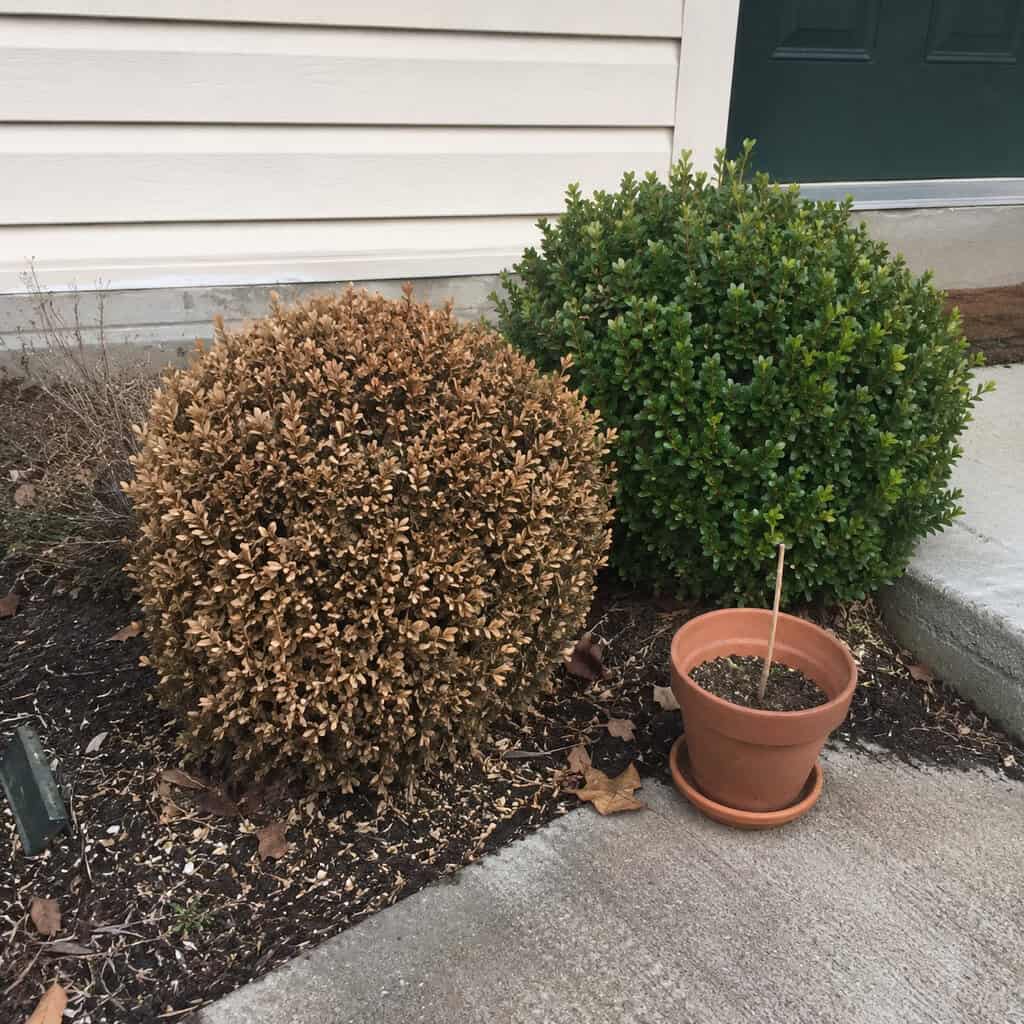
A single half-dead shrub by the front step can quietly undermine an otherwise polished yard.
A brown boxwood. An empty container with a stick in it. A hydrangea that gave up two summers ago and never got pulled. Designers say these say more about a home than any amount of money spent elsewhere — one dead plant can drag down an entire expensive facade.
Pull it. If it’s brown to the core, it’s not coming back.
An empty spot in a bed looks better than a corpse. Fill it later, or don’t. Just get the dead thing out.
The takeaway
Most of what separates an expensive-looking yard from a forgettable one has nothing to do with how much you spent. It comes down to restraint and a handful of consistent choices.
Cut a clean edge. Kill the mulch volcano. Skip the red dye, the plastic flowers, the fake grass, and the row of dying solar lights. Repeat a plant. Frame the door. Hide the hose.
Work through even a few of these and your neighbors will start slowing down in front of your house — and quietly assume you hired someone. You’ll know the truth.