


The first cold night in October does something to a mouse. It starts looking for a wall.
And your garage is the easiest wall in the neighborhood. Warm concrete, a door that doesn’t quite seal, boxes to chew, bags of seed to eat, and nobody walking through it between 9 p.m. and 7 a.m.
Exterminators see the same garage over and over. Same bags on the floor. Same tarp. Same stack of cardboard. They’ll tell you the mice didn’t pick your house because you’re messy — they picked it because you accidentally built them a studio apartment with a food court.
What’s interesting is what those same people do in their own garages. It’s not fancy. It’s mostly totes, a can, a tape measure, and a dozen snap traps set the first week of October.
Here are the habits that turn a garage or shed into a mouse hotel every winter — and the fix a pro uses at home.
1. Grass Seed Left in the Paper Sack on the Floor
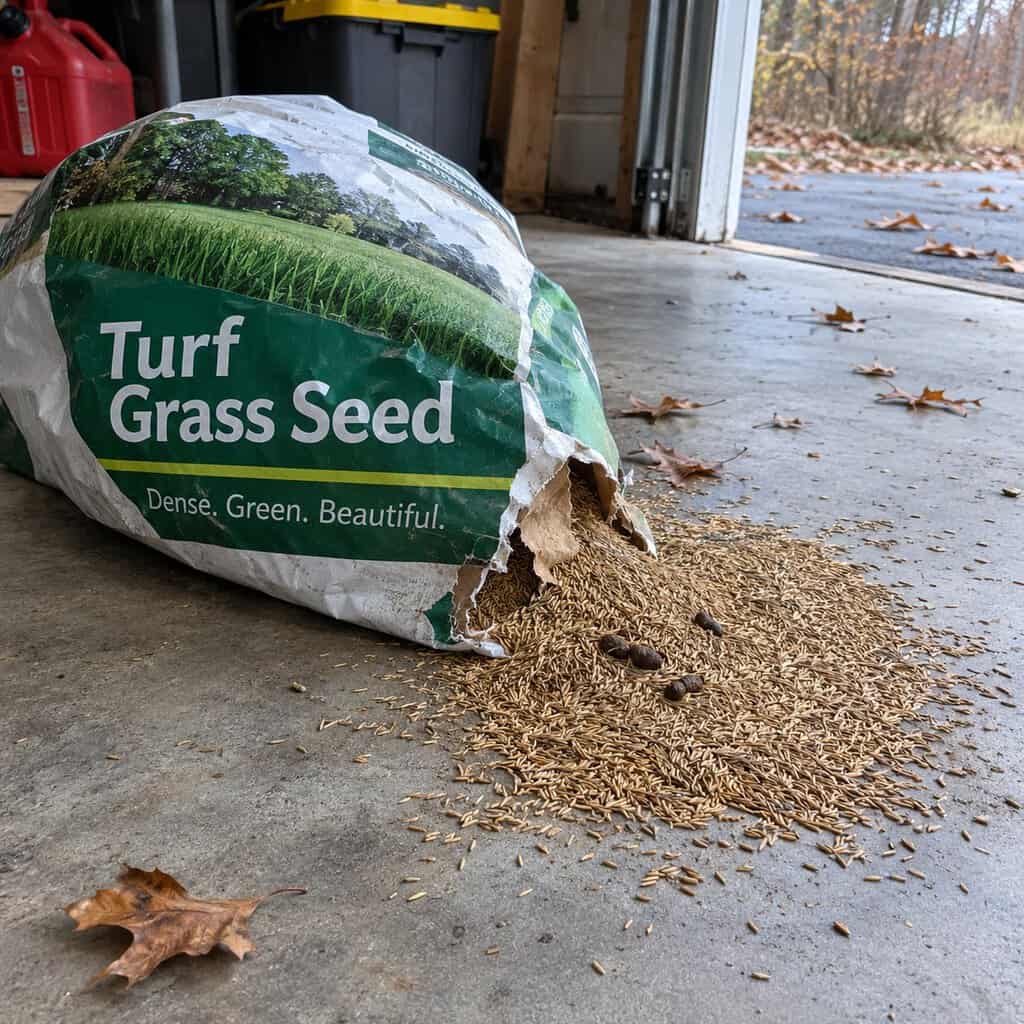
A paper seed bag is a vending machine with no glass. Mice don’t even have to gnaw hard — the woven poly or kraft paper gives in one night.
You’ll find a cone of seed on the floor and a chewed corner at the bottom seam. Sometimes a hollowed-out tunnel inside the bag itself, lined with shredded paper.
Seed is the single best mouse food in the average garage. Dense calories, no water needed, stores for months. One leftover half-bag can feed a family all winter.
The fix in a pro’s garage: a galvanized trash can with a tight lid, seed bag and all, up on a shelf or at least off the slab. Metal, not plastic — plastic bins get chewed through at the rim. It also keeps the seed dry, which matters because grass seed loses germination fast once it’s damp.
2. Bone Meal and Fertilizer Still in Their Sacks

Bone meal smells like dinner to anything with a nose. Blood meal is worse. Both sit in paper sacks at the back of half the garages in America.
Organic fertilizers are made from ground-up protein. Mice, rats, raccoons and the neighbor’s dog all find them. Synthetic granular is less appealing but the bag still makes great bedding.
The sign: a crusty spill in the corner, plus droppings right in it. Mice will nest in a torn fertilizer bag the way they’d nest in a sock drawer.
Pros do the same thing they do with seed — latching totes or metal cans, nothing on the floor. If you can’t lift the bag, at least set it on a pallet-free shelf and tape the top shut.
3. The Mower Bagger Still Full of October Clippings

Nobody means to leave clippings in the bag. You finish the last cut, it’s getting dark, and the mower goes in the corner, bag and all.
By December that bag is a damp compost pocket with seed heads in it — food, moisture, and soft nesting fiber in one container. The pile even runs a little warm as it breaks down, which is exactly what a mouse shopping for winter quarters wants. Mice love it. So does mold.
You’ll know because the bag smells sour and there’s a tunnel worn into the matted grass, usually near the chute opening.
Dump the bag the same day, every time. Then hose it and hang it to dry, off the floor, so the mesh doesn’t hold a damp smear all winter. It’s also part of a decent fall mower inspection, which you’re probably skipping anyway.
4. The Snow Blower and Mower Under a Loose Tarp

A tarp draped over equipment makes a tent. Dark, still air, no drafts, nobody looks under it until the first snow. The loose edges puddle on the floor, so mice just walk in.
That’s four months of undisturbed real estate. Mice nest in the auger housing, the bagger chute, the engine shroud, under the seat of a riding mower. Seat foam doubles as ready bedding.
The giveaway is chewed foam on the seat, acorn shells in the deck, or wire insulation stripped off in strands. Rodent damage to small-engine wiring runs $150 to $400 at a shop, and it’s rarely covered.
Exterminators don’t tarp anything indoors. If gear needs covering, they use a fitted cover and pull it off once a month to look. Better yet, leave the machine bare and set two traps behind it, along the wall where mice actually travel.
5. The Car or Boat Parked for the Season Under a Cover

A vehicle that doesn’t move is a building to a mouse. Warm engine bay at first, then a hollow box full of insulation and fabric. The cover helps them: it blocks light, holds in heat and gives them a dark tunnel straight up the tire to the frame.
Modern soy-based wire coatings make it worse — rodents genuinely eat them. Nests show up on the air filter, under the cowl, on top of the battery.
Signs: a sweet rotten smell from the vents, shredded cabin filter, acorns in the intake box. Sometimes a check-engine light out of nowhere in spring, usually a wire chewed months ago.
What pros do: start the stored vehicle every couple weeks, prop the hood for a few minutes so the heat and movement break the habit, and put two snap traps on the floor at the front tires. Not peppermint. Traps.
6. The Chest Freezer’s Warm Compressor Nook

That coil pocket at the back of a chest freezer runs warm all winter. Dry, humming, 80-some degrees against the wall, with the compressor cycling on and off all night to keep it that way.
It’s the most comfortable square foot in the entire garage on a 20-degree night. A mouse that finds it has no reason to go looking anywhere else.
You’ll see droppings along the back edge, dust tracked into greasy trails, maybe a nest right on the compressor shelf, built from shredded paper and whatever they could drag in. Occasionally a chewed power cord, which is exactly as bad as it sounds.
Pull the freezer out eight inches from the wall, vacuum behind it, and set a trap at each back corner against the wall, where mice already travel. Check it in November and again in January.
7. Flattened Cardboard Stacked Against the Wall

Cardboard is the perfect nesting material. It shreds into warm fluff, it’s free, and a leaning stack creates a sheltered vertical runway. A mouse can travel the whole length of the wall behind it without stepping into the open.
Mice chew the corrugation into confetti and build in the hollow between the sheets and the wall. The layered paper traps heat, and the stack rarely gets moved, so a nest there can go undisturbed all winter.
Look for a fine brown dust at the base of the stack and ragged edges on the bottom two pieces. Tip the stack forward with a gloved hand before you assume it’s clean.
Nobody serious about mice stores cardboard indoors. Break it down, bag it, and get it out on recycling day. If it has to wait, stand it in the driveway or a closed bin outside.
8. Christmas Bins in Cardboard, Stockings Inside

A cardboard box of holiday decorations is a buffet of soft materials: felt, tinsel, cotton batting, a tree skirt, knit stockings. Mice aren’t eating most of it. They’re shredding it into nest lining, and a box that sits untouched for eleven months is the perfect place to raise a family.
Mice find those boxes by Thanksgiving. People find the damage the next December, which is why so many families have exactly one ruined stocking story. Cardboard is no barrier at all; a determined mouse gets through a box wall without much effort.
Signs: a quarter-sized hole in the box corner, black droppings in the tissue paper, a smell you remember.
Swap to latching plastic totes. Hard-sided, clamp lids, stored on a shelf. Same applies to anything fabric — tablecloths, linens, costumes. Wash anything from a chewed box before repacking it.
9. Potting Soil and Peat Bags Left Open
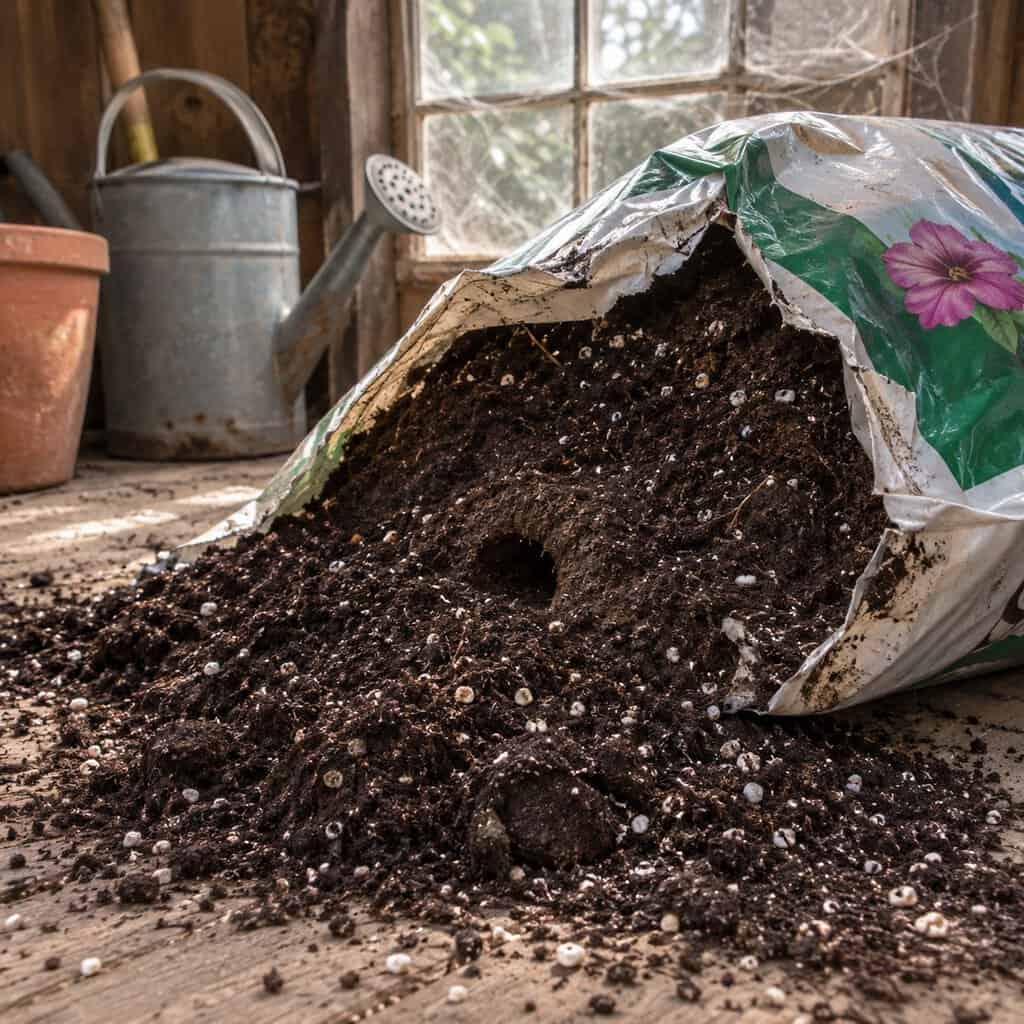
An open bag of potting mix is a heated nursery. Peat and coir hold warmth, stay slightly damp, and there’s usually perlite and slow-release fertilizer pellets mixed in. To a mouse, that’s loose digging, built-in insulation and nest fiber all in one sack.
Mice burrow straight into the middle of the bag and build there. The plastic walls block drafts, and the mix closes in behind them.
The tell is a scattering of soil around the bag mouth and little tunnels visible when you tip it. Sometimes there’s a tight ball of shredded coir near the center, too.
Roll the top down and clamp it, or pour the remainder into a lidded bucket. And keep bags off the concrete. They wick moisture and stay wet all winter. Set them on a scrap pallet or a shelf instead.
10. Unrinsed Cans and Bottles in the Recycling Bin

A can with a half inch of soda in it is water and sugar. A soup can is protein. A beer bottle is both plus a smell that carries. In winter, when puddles outside are frozen solid, that last swallow of liquid matters more to a mouse than the crumbs.
An open recycling bin in a garage runs as a feeding station from October to April. Mice climb in, lick the bottoms clean, and nest in whatever paper is underneath.
You’ll see smeared residue on the rim, droppings in the bottom of the bin, and sticky footprints on nearby containers.
Rinse everything, use a bin with an actual lid, and take it out weekly even in winter. A swish of hot water and a turn upside down to drain is enough. Pros keep recycling in the driveway or on the side of the house, never inside.
11. The Garage Door Bottom Seal With Daylight at the Corners

Stand inside with the door shut and the lights off. If you see daylight at either bottom corner, you have a mouse door. Try it on a sunny afternoon so every gap glows.
The rubber astragal compresses and hardens after five or six winters. The corners go first because concrete is never perfectly flat, so the door rests on the middle and the ends hang in the air.
A house mouse squeezes through roughly a quarter-inch gap — about the diameter of a pencil, per the exclusion guidance from the Museum Pests IPM Working Group. Young ones need even less. Their skull is the only part that has to fit.
Replace the bottom seal. It’s a $25 strip of rubber that slides into the track, maybe 20 minutes of work, and it’s the single highest-value thing in this whole list.
12. The Side Door With No Sweep

Service doors are worse offenders than the big door, because nobody ever looks at them. The big one gets grumbled about; the side door just swings shut behind you.
The gap under a standard garage service door is often three-eighths of an inch after the threshold wears. That’s wide open. A mouse can squeeze through something about the width of a pencil.
Droppings along the inside wall near that door, in a line, means they’ve been using it as a commute. Mice hug walls when they travel, so that trail points straight at the entrance.
Screw on an aluminum-and-rubber door sweep. Then check the hinge side and the strike side too, because gaps there matter just as much as the bottom. The easy test: close the door at midday, kill the lights and look for daylight.
13. The Gap Where the AC Line Set or Hose Bib Comes Through

Every penetration through a wall was drilled oversize so the installer could get the pipe through. Almost none get properly sealed.
Look where the refrigerant line set, the hose bib, the dryer vent, and the electrical conduit pass through. You’ll usually find a crescent of daylight. Check from inside the garage with the lights off; that’s when it shows.
Mice climb siding and brick without effort. A gap eight feet up is as good as one at ground level, and the line set itself makes a handy ladder.
The pro method: stuff the gap with coarse copper mesh or steel wool packed tight, then cap it with expanding foam or caulk. Foam alone gets chewed through in a week. Steel wool alone falls out. Together they hold, because the metal stops teeth and the foam locks the metal in.
14. The Shed Floor With a Knot Hole and a Soft Sill

Sheds rot from the bottom. The sill plate sits on gravel or dirt, wicks water, and goes punky in about eight years. Soft wood is easy chewing, so a mouse doesn’t have to find a gap; it can make one.
Add a knot that fell out of the plywood floor and you’ve got a hatch straight up from the ground into the shed, hidden under whatever’s parked on top of it.
Press a screwdriver into the sill. If it sinks in easily, that’s the problem. Look for fresh wood shavings and a worn-smooth hole edge, often with a dark, greasy smudge where oily fur rubs past.
Patch holes with hardware cloth: quarter-inch galvanized mesh, stapled and then covered with a scrap of plywood. Replace rotten sill sections before spring, and get the shed up on blocks or a gravel pad so it drains.
15. Patio Cushions and the Umbrella in the Shed

Outdoor cushions are foam wrapped in fabric. To a mouse that’s premium insulation, and it comes pre-cut. They chew in at a seam, pull out tufts of foam, and shred them into a soft cup that holds body heat all winter.
A rolled patio umbrella is even better: a dark vertical tube with folds. Open one in May and find a nest and a pile of seed husks. The canopy often comes away with chewed holes and droppings ground into the fabric.
Signs: fabric pilling and holes at the seams, a gritty black scatter when you unroll anything.
Store cushions in a latching deck box or a zippered bag inside a tote. Cinch the umbrella’s ties tight in fall so the folds stay closed. Stand the umbrella upright and shake it out in March before you open it over the table.
16. The Hose Coiled on the Floor Behind the Bins

A coiled hose on a shed or garage floor makes a nest ring. Concentric walls, a sheltered center, and it never gets moved between October and April. To a mouse, that’s a round room walled on every side.
The hose itself isn’t food, but what’s inside it sometimes is: standing water that freezes, splits the hose, and keeps a damp spot going. That puddle is a water source inches from the bedding.
You’ll find bedding in the center of the coil and droppings on the top loops. Shredded paper and leaf bits get hauled in to pad it out.
Drain it and hang it. Stretch it out downhill and walk the water out first. A wall hook or a hose reel mounted off the floor solves this one permanently and saves the hose from winter cracking.
17. The Old Couch or Recliner Nobody Will Admit To

Garage furniture is a mouse mansion. Foam, batting, springs, a fabric shell, and a dark cavity under the deck that nothing can reach into. A mouse can pull stuffing loose for a nest, raise a litter in the arm, and never set foot on the floor.
Once they’re in a couch, traps on the floor barely help. They’re already home, with bedding, cover and a short commute to whatever else you’ve stored.
Flip it and look at the dust cover on the bottom. A hole there means the whole interior is occupied. Chewed edges, shredded fabric and a musky smell confirm it. Wear gloves and a mask, since dried droppings and urine kick up dust when you move it.
Get rid of it. No exterminator keeps upholstered furniture in a garage, which is a sentence that should settle a lot of household arguments.
18. Workbench Drawers Full of Rags and Twine
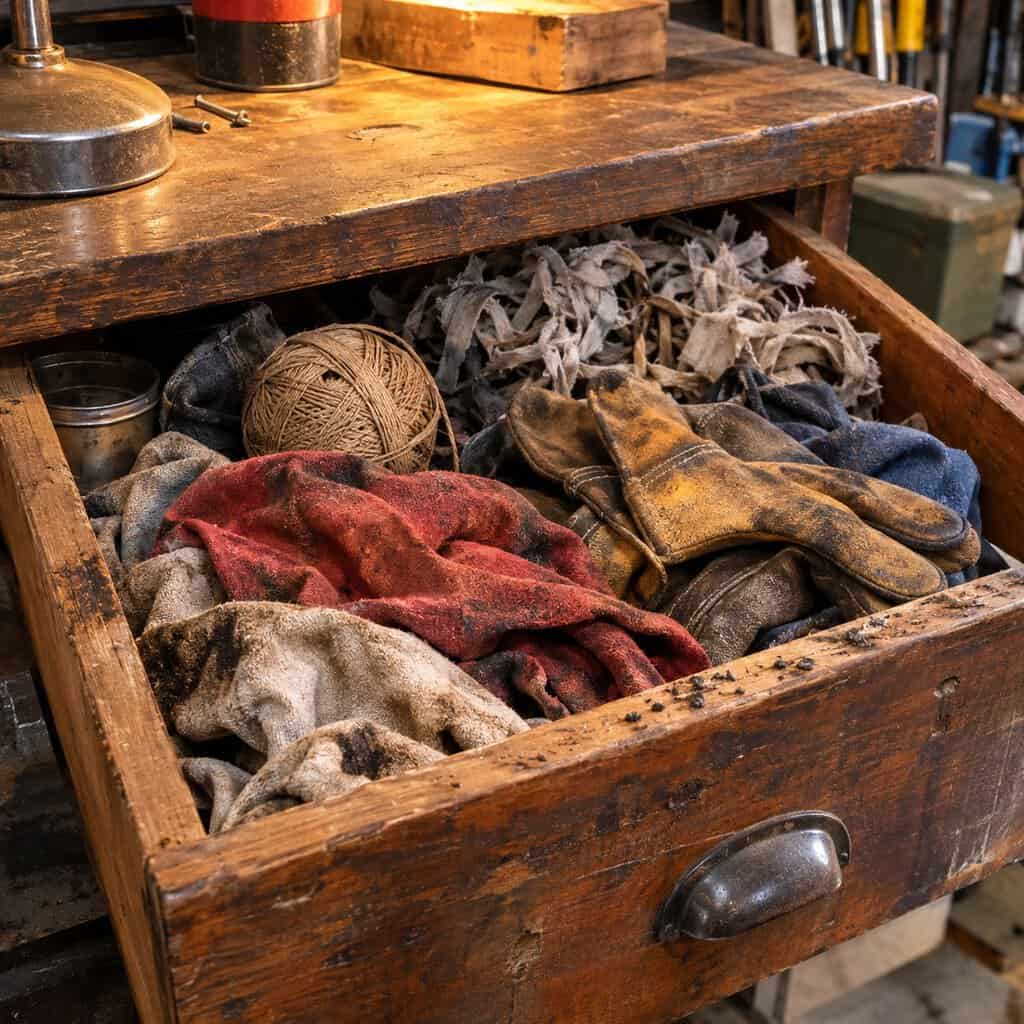
Rags, twine, masking tape, paper towels, old gloves: a drawer of that is a mouse supply closet. Everything in there is soft, dry and easy to shred, which is exactly what a mouse needs to build a nest that holds body heat.
Drawers also run warm and are never opened in winter. Perfect. Getting in is easy, too. Most benches have an open back or a gap behind the drawer runners, so a mouse climbs the wall side and drops right in.
Open one in March and you’ll find a tidy ball of shredded rag with the twine woven through it. Droppings in the corners, always. Toss everything in it; a mouse nest means urine too.
Consolidate rags into a metal can with a lid. Keep drawers closed and add a trap inside the bench cabinet, back against the side wall where they travel.
19. Mums and Fall Planters Overwintering With Seed Heads On
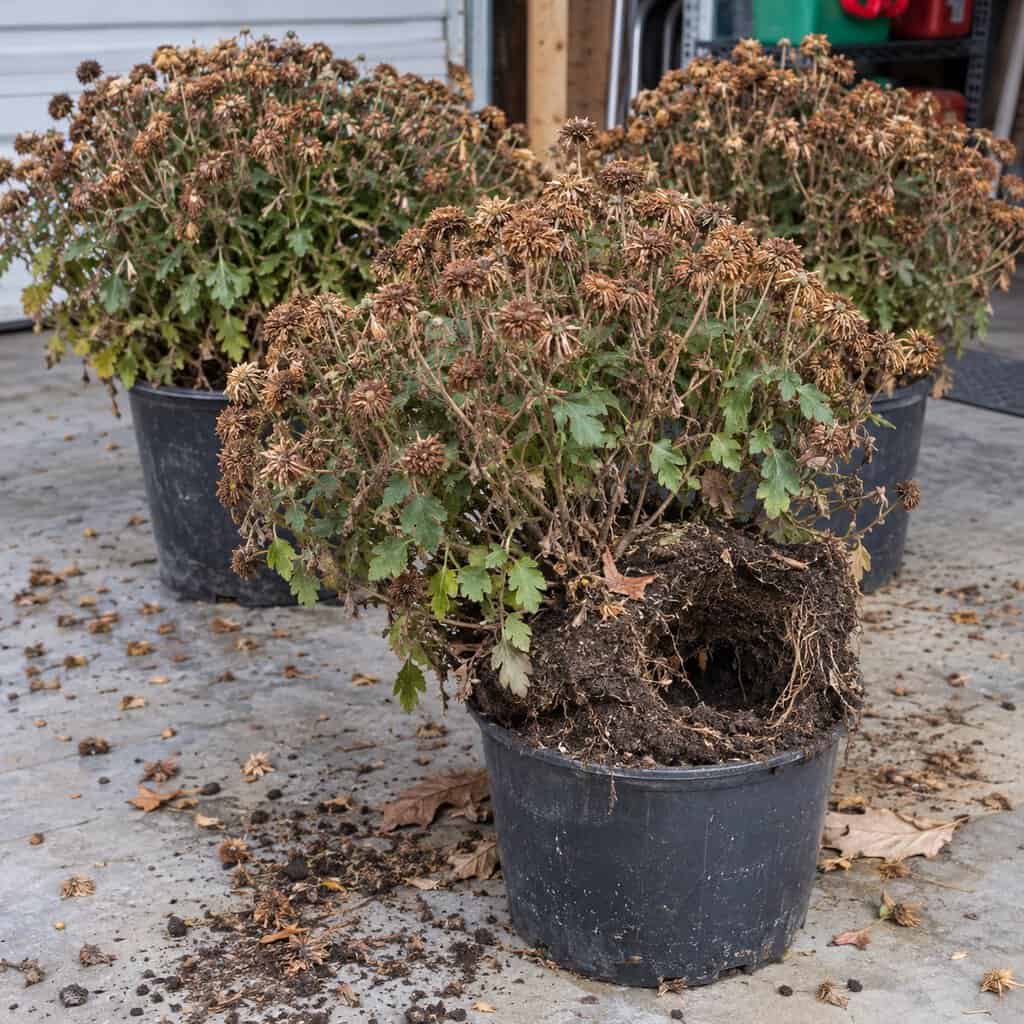
Bringing planters into the garage to overwinter is sensible. Bringing them in with the spent flower heads still on is feeding the mice.
Mum seed heads, coneflower heads, ornamental grass plumes: all of it is edible and all of it sheds into the pot. The seed drops onto loose potting mix, which is soft enough to dig in, so the planter turns into a pantry with a bedroom attached.
Look for the heads stripped bare and a nest dug into the root ball. You’ll usually spot little husks and droppings on the shelf around the pot first, and a hollow under the foliage where the mix has been pushed aside.
Cut everything back to a few inches before it comes inside. Do the trimming outside. Same reasoning as deciding about cutting perennials back for winter: less debris, fewer problems in spring.
20. Last Month’s Pumpkins and Gourds Set in the Garage

The pumpkins come off the porch after Halloween and go… in the garage. For a while. Until they don’t. Gourds too, the warty ones from the table centerpiece, tossed in a box by the door.
A softening pumpkin is water, sugar and seeds. Mice open a hole in the shoulder and empty it from inside. Once the rind gives, it’s a pantry with its own walls, and they’ll nest beside it rather than commute. The wet spot underneath turns any cardboard it sits on into bedding.
You’ll find a collapsed shell, a slick on the concrete, and hundreds of husked seeds. Usually in February, usually while you’re looking for something else.
Compost them the week they soften, or get them to the curb. Press the bottoms every few days; that’s where the give starts. Never store a pumpkin indoors past Thanksgiving. Nothing good happens.
21. Bags of Leaves and Mulch Kept Inside Until Spring

Paper leaf bags stacked in a garage are nesting material with a food layer of seeds and acorn bits mixed in. To a mouse, that’s a furnished room with the pantry already stocked, and the dry, shredded leaves are exactly what it would otherwise spend nights hauling in piece by piece.
Bagged mulch is slightly better but still holds moisture and warmth, and the plastic tears easily at the fold.
Signs: a gnawed hole low on the bag, leaf fragments trailing across the floor. Lift a bag that looks fine and check the side facing the wall, which is where they usually start.
Leave leaf bags outside for pickup, or better, run them over with the mower. Mulching leaves into the lawn is better for the turf and means no bags in your garage at all.
22. The Kids’ Bag of Acorns and Walnuts

Every fall some kid fills a bucket with acorns and it ends up on a shelf in the garage.
You’ve essentially stocked a pantry. Acorns and black walnuts are exactly what a mouse would hoard on its own, and now they don’t have to. Instead of foraging all night, a mouse can make trip after trip to one bucket, which is reason enough to move in.
The sign is unmistakable: neat piles of shell fragments in odd places — inside a boot, in the mower deck, in a toolbox tray. Those are caches, eaten wherever felt safe.
Admire the collection, then dump it in the woods. If the kid insists, a screw-top glass jar on a high shelf works fine; mice gnaw through plastic and paper. And if the yard is producing that many, clearing acorns off the lawn cuts the supply at the source.
23. The First Droppings in October, Ignored for a Week

You see three droppings by the step into the house. You think, huh. You sweep them up. You move on.
A female mouse can have her first litter at six weeks old and produce five to ten litters a year. A week of waiting isn’t nothing — it’s a generation.
Fresh droppings are dark and soft. Old ones are gray and crumble. If they’re dark, something walked there last night. Mice drop them along the routes they run, so that step is a highway, not a one-time stop.
Exterminators act the same day. Twelve traps, set that evening, before the population compounds. They go flush against the wall, trigger end facing it, because mice run the edges. Every pro will tell you the same thing: catching two mice in October is a different job than catching twenty in January.
24. Poison Bait Blocks as the Only Defense

Bait stations feel decisive. Put them out, mice eat, mice die.
They die in your wall cavity, usually. Anticoagulants take four to seven days, which is plenty of time for a mouse to go home first. The poison keeps blood from clotting, so the mouse gets weak and heads for the nest, which is behind the drywall. Then you get the smell for three weeks and there’s nothing to be done.
There’s also the secondary risk: a poisoned mouse that staggers into the open is exactly what a cat, a dog, or a hawk grabs.
Use snap traps indoors. You find the mouse, you know the count, nothing dies in the drywall. Set them in pairs along the wall, trigger end facing the baseboard, with a pea-sized dab of peanut butter. Pros reserve bait for exterior stations only, if they use it at all.
25. Glue Traps Set in the Middle of the Floor

Glue boards in open floor space catch dust, spiders, and almost no mice. Put one in the middle of the garage and it becomes a lint collector.
Mice travel with one side touching a wall — it’s called thigmotaxis, and it’s why nothing in the middle of the room ever works. Their whiskers brush the baseboard, so the open floor feels like crossing a parking lot. A glue board also loses tack below about 50 degrees, which is most of a garage in winter.
And the outcome is grim when it does work. Animals tear free and leave skin behind.
Skip them. Snap traps along the wall catch more in one night than a floor full of glue boards catch all season. Set them perpendicular, trigger end touching the wall, so a mouse running the edge has to cross it.
26. The Ultrasonic Plug-In

Plug it in, little light comes on, feels like you’ve done something. The box chirps away at a pitch you can’t hear, and that’s most of the appeal: no bait, no traps, no cleanup.
Mice habituate to steady ultrasound within days. A noise that never changes and never hurts them becomes background, the same way you stop hearing the fridge. The sound also doesn’t bend around corners or through boxes — the shelf two feet away is a dead zone. Multiple university trials have found no sustained reduction in rodent activity.
The sign it isn’t working: droppings on the shelf directly beneath the device. It happens constantly.
Spend the $30 on a door sweep and a roll of hardware cloth instead. Physical exclusion is the only thing that actually works, as outfits like Kodiak Pest Control spend every fall explaining.
27. Mothballs, Dryer Sheets and Peppermint Oil

The folklore trio. Every one of them has a cousin who swears by it, because the mice happened to move on the same week the cotton balls went down.
Dryer sheets get used as nesting material — mice shred them and build with them, and the fibers make a softer bed than shredded paper. Peppermint oil fades in a day or two and doesn’t beat the smell of food; a mouse that finds birdseed six inches away will tolerate a little mint. Mothballs are naphthalene, a registered pesticide that’s illegal to use this way and genuinely harmful to breathe in an enclosed garage, where the fumes hang around and you breathe them every time you grab a rake.
What you’ll see: a dryer sheet pulled into a nest, a droppings trail right over the peppermint cotton ball.
Smells don’t exclude. Hardware does.
28. Shelves Packed Tight Against the Wall

Shelving pushed flush to the wall creates a covered highway at floor level. Mice run that line all night, protected on one side and overhead. They’re edge-huggers, steering by whisker against a vertical surface, so a wall with a roof is their ideal route.
Same with stacks of bins, lumber, and totes crowding the perimeter. Every tote lid becomes more ceiling.
You’ll see a dark greasy smear along the baseboard or the bottom block course. That’s rub marks — body oil from repeated trips. Fresh ones smudge under a fingertip.
The pro rule: an 18-inch clear strip along every wall. Shelves pulled out, nothing stored in that band. It kills the covered runway and gives you a visible inspection lane. Walk it with a flashlight weekly, and set any traps in that strip, flat against the wall.
29. Exposed Fiberglass Insulation in the Garage Ceiling

Unfaced batts between joists, held up by nothing but friction. Half the garages built since 1990 look like this, and every open bay is a ready-made hallway.
Fiberglass is wonderful nesting material — warm, dry, and nobody disturbs it. Mice tunnel through it and travel the whole ceiling bay unseen, and whatever they leave behind soaks into the batts for good.
Look for sagging batts, dark staining on the paper facing, and bits of fiberglass on the floor underneath. Tufts on the car hood count too.
Cover the bays with drywall or at minimum sheet the ceiling. If that’s not happening this year, seal the top plate gaps where the bays connect to the house wall — that’s the route they take inside. Pack them with steel wool and caulk over it so they can’t pull it out.
30. Scrap Lumber Stacked Flat on the Floor

Every garage has the pile. Offcuts, trim scraps, a sheet of plywood, two deck boards, all laid flat in the corner, waiting for the project that’s always next spring.
Flat stacks create layered voids. Every board sits on a slightly warped one below it, leaving a gap a mouse can slip into, roofed, dark and out of the draft. It’s cordwood architecture for mice, and you can’t inspect any of it without taking the whole stack apart.
Signs you’ll only find when you move it: droppings between every layer and a nest in the middle, usually shredded from whatever insulation or rag was nearby.
Store lumber vertically against a wall, or on a rack up off the slab, so you can see behind it with a flashlight. Pros keep nothing — nothing — stored flat on garage concrete.
31. The Trash Can Stored Inside Without a Lid

The garage can with no lid, or a lid that sits on crooked, is the most reliable food source in the building. Unlike a seed sack, it gets restocked every single day.
It doesn’t take much. A pizza box, a bag of bird seed scraps, a coffee filter. Mice climb the outside of a plastic can easily — the ribbing is a ladder. Once one finds the gap under a crooked lid, it comes back every night.
Look for chew marks on the rim and crumbs on the floor in a ring around the base. Shredded paper towel tucked behind the can means someone is nesting, not just snacking.
Get a can with a latching or heavy lid, and run kitchen trash straight to the curb bin instead of parking it in the garage overnight. Hose it out once it starts to smell.
32. The Grill With Its Grease Tray Rolled in for Winter

A grill gets wheeled into the garage in November with a full grease tray and a burner box of drippings. Nobody wants to scrape it in the cold, so the summer’s cookouts come inside too.
That’s rendered fat — the highest-calorie thing on the property. Mice will cross a cold garage every night for it. They’ll also climb up through the open bottom of the cabinet and nest beside the burners, chewing the igniter wires.
The sign is small tracks through the grease film on the tray, and droppings on the lower shelf. Shredded paper or insulation tucked behind the burner tubes means they’ve moved in.
Empty and scrub the tray, burn off the grates, and let the grill overwinter outside under a fitted cover. The grill does better outdoors anyway, and the propane tank was never supposed to live in a closed garage.
33. Camping Gear With the Granola Bars Still in the Pack
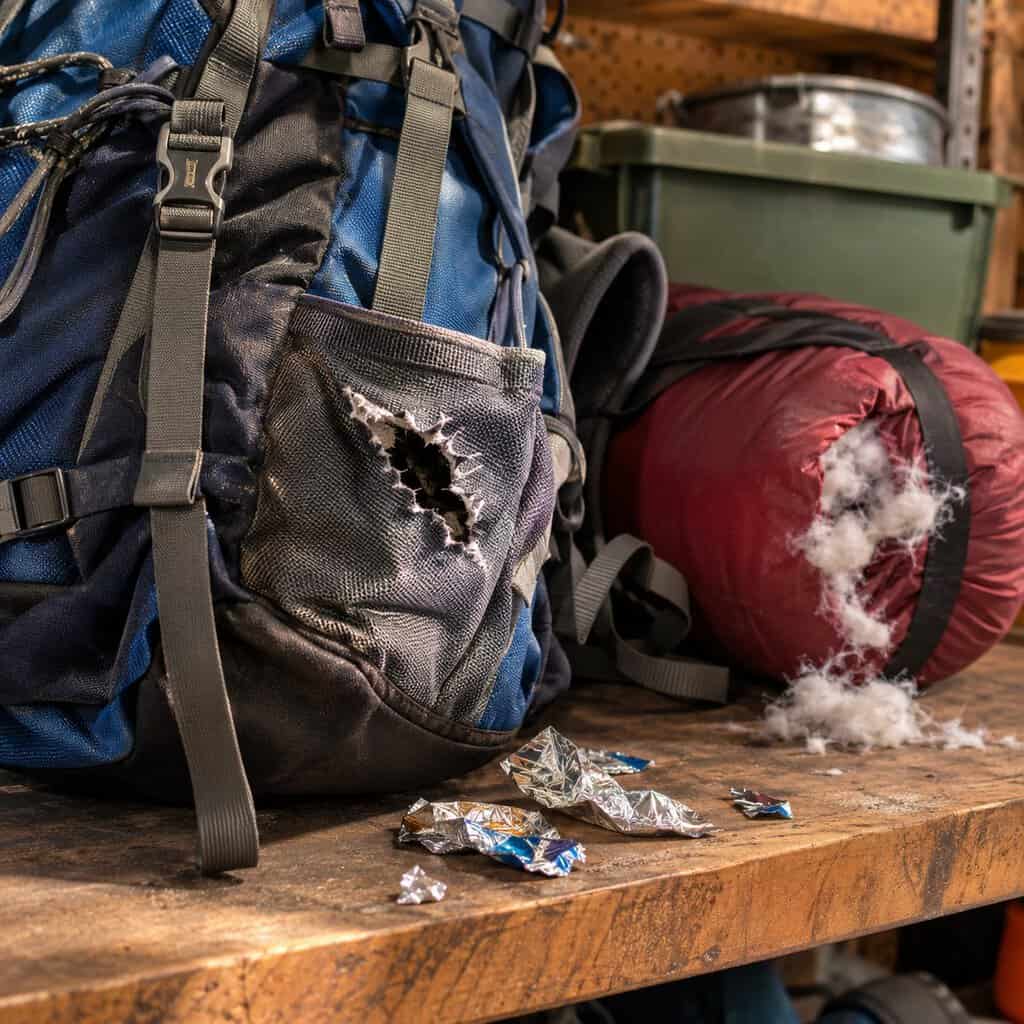
You got home from the August trip, put the pack on the shelf, and never unpacked the side pocket. It felt like a job for tomorrow, and tomorrow turned into Thanksgiving.
Two granola bars and a bag of trail mix are in there right now. So is, by February, a nest in the sleeping bag. A mouse can smell oats and peanuts through a zipper, and once it chews in for the food, the bag next to it is the softest bedding in the garage.
Signs: a hole chewed through the pack’s nylon at the pocket, foil wrapper confetti, and a sleeping bag that’s lost its loft because the fill got harvested.
Empty every pocket the day you get home, including the hip-belt pouches and the lid. Store bags and tents in latching totes, not stuff sacks on an open shelf.
34. The Garage Door Left Up at Dusk

Dusk is when mice move. It’s also when you’re finishing up outside — raking, blowing leaves, putting tools away with the big door wide open and the lights on. Warm light pouring out of an open bay is an invitation.
Thirty minutes of open door on a cold evening is all it takes. They come in along the wall line, not across the middle, so you’ll never see it. A mouse hugs a vertical surface, slips around the door track, and is behind the shelving before you’ve coiled the cord.
The tell is new droppings that show up the day after a yard-work evening, usually along the base of the wall or under the workbench.
Close the door when you’re not actively walking through it. Pros are almost comically strict about this between October and December. Bags out, door down; rake back, door down again.
35. The Downspout That Dumps Beside the Garage Slab
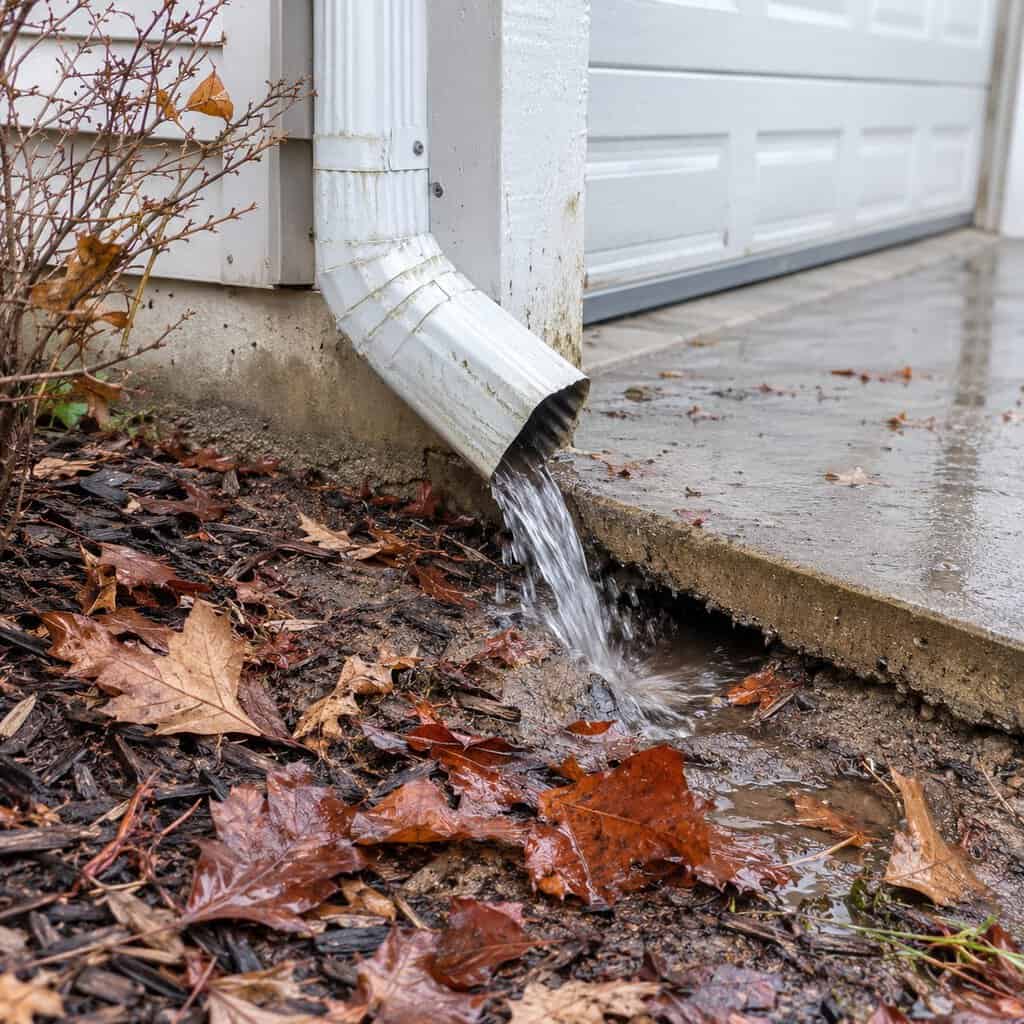
Water dumping at the corner of the slab does two things. It keeps a damp zone that stays warmer than frozen ground, and it slowly undercuts the concrete edge.
That eroded gap under the slab lip becomes a direct tunnel entrance, usually hidden by mulch or a shrub. Mice follow that void under the concrete to the sill plate or a floor crack, never touching your door seals.
Look for washed-out soil, a soft spot you can push a screwdriver into, and a smooth-edged hole about an inch across. Rake the mulch back after a hard rain. That is when the washout is easiest to spot.
Extend the downspout six feet out, regrade the soil to fall away, and pack any void with gravel and hardware cloth. Fixing drainage that pools against the foundation handles a long list of other problems too.
36. The Gap Behind the Garage Fridge

The old fridge in the garage is three things at once: a warm motor, a dark cavity, and a drip pan with standing water.
Food, warmth and water inside one appliance, tucked into a corner nobody moves.
You’ll find droppings on top of the compressor housing, a nest in the insulation behind the kick plate, and condensate pan residue tracked across the floor.
Pull it out twice a year, vacuum, empty the pan, and set traps at both back corners. While you’re there, check the wall behind it for the gap where the outlet was cut in. There usually is one.
A quarter inch is all they need — roughly the width of a pencil, as Clear Home Pest Solutions puts it.
Shutting the Hotel Down
None of this takes a weekend. The seed goes in a metal can, the cardboard goes to the curb, the bottom seal gets replaced, and the shelves move 18 inches off the wall.
Then a dozen snap traps, set perpendicular to the walls with the trigger end facing the baseboard, the first cold week of October. Before they move in, not after.
That’s the whole program. The people who do this for a living aren’t using anything you can’t buy for under a hundred dollars.
Mice aren’t choosing your garage because you deserve it. They’re choosing it because you left the door open and the food out — and both of those are yours to fix by Friday.