


Walk into the back room of any independent garden center and look at the windowsill.
You won’t find the plant on the front display. No fiddle leaf fig. No $90 variegated anything in a concrete pot.
You’ll find a chipped nursery pot with a pothos in it that somebody rooted in a coffee mug six years ago. A jade that’s been repotted twice since the 1980s. An orchid on a shelf above the cash register, reblooming for the ninth straight winter because nobody threw it out.
Pros buy differently than customers. They want plants that forgive a week of forgetting, root from a cutting, and still look good in a dim hallway in February.
Here are 33 houseplants that actually live in their homes — plus what they know about each one that never makes it onto the care tag.
1. Golden Pothos

Almost nobody on staff paid for theirs.
Pothos moves through a garden center like gossip. One mother plant in the break room supplies clippings for the whole crew, and a cutting with two nodes roots in a water glass in about two to three weeks. That’s the entire acquisition story for most pros.
It handles a north window, a bathroom with no window at all, and about three weeks of neglect. Yellow leaves mean you watered too much, not too little.
The one real headache is fungus gnats. Pothos likes to stay damp, and damp peat is exactly where gnat larvae hatch — those little black flies drifting up when you walk past the shelf are adults, and they’re laying eggs in the top inch of soil. The larvae chew fine roots. A heavy infestation will stall a plant’s growth before you ever connect the two.
Pros fix it in layers. Let the top two inches dry hard between waterings, because the larvae can’t survive dry soil. Lay down a half-inch of coarse sand or fine gravel as a top dressing so the females can’t reach the peat. Then hang yellow sticky cards right at pot level to knock down the flying adults, and if it’s bad, water once with a Bacillus thuringiensis israelensis mosquito-bit soak to kill the larvae outright. Two cycles usually ends it.
The pet note matters: the ASPCA lists pothos as toxic to cats and dogs thanks to insoluble calcium oxalate crystals. Chewed leaves cause burning, drooling, and mouth swelling.
So pros don’t skip it. They hang it high and let the vines trail where nothing can reach.
2. Snake Plant

This is the plant that gets left behind when the shop crew drives to a trade show for ten days.
Snake plant stores water in those stiff upright leaves and tolerates drafts, bone-dry winter air, and light levels that would flatten anything else. Water it monthly. Water it less than that in winter.
Here’s the trade quirk: botanists folded Sansevieria into Dracaena back in 2017, so the grower tag now reads Dracaena trifasciata while the hand-lettered sign over the bench still says Sansevieria. Both are right.
Saponins make it toxic to cats and dogs. Cats in particular like to chew those leaf tips.
3. Hoya Carnosa (Wax Plant)

Hoyas get handed down. People inherit them from a grandmother and keep them another forty years, and the plant gets better the whole time.
It blooms best when it’s potbound and slightly neglected — a hoya crammed into a small pot with roots circling the drain hole is a hoya about to flower.
The one thing that ruins them: cutting off the bare little stub after the flower cluster drops. That stub is the peduncle, and next year’s blooms come off the exact same spur. Snip it and you’ve thrown away years of flowering.
Non-toxic to cats and dogs, which is why it hangs in the kitchen instead of the spare room.
4. ZZ Plant

Ask an interiorscaper what goes in the windowless hallway and they’ll say ZZ without pausing.
Underground rhizomes the size of small potatoes store water, which is why a ZZ shrugs off a missed month. Overwatering is the only reliable way to kill one. If the stalks go yellow and soft at the base, you’ve been too generous.
Low light slows growth to a crawl but doesn’t hurt it. Iowa State University Extension groups it with the handful of genuinely forgiving choices in its Iowa State University Extension rundown of low-maintenance houseplants.
Now the part pet owners need. Every part of a ZZ — leaves, stems, rhizomes — carries insoluble calcium oxalate crystals. These aren’t a systemic poison. They’re microscopic needles that fire into the soft tissue of the mouth the instant a dog or cat bites down.
What you’ll see: sudden pawing at the face, heavy drooling, head shaking, a refusal to eat, sometimes vomiting. The pain is immediate and the animal usually stops chewing fast, which is the saving grace — most pets don’t swallow enough to cause worse than a miserable evening.
The real risk is swelling. If enough plant material gets chewed, the tongue and throat can swell enough to make breathing difficult. That’s an emergency vet visit, not a wait-and-see.
Rinse the mouth with cool water, offer milk or yogurt to bind the crystals, and call your vet or the ASPCA poison line. Then move the plant somewhere a cat can’t get leverage. A heavy ZZ on a low plant stand is an invitation.
5. Thanksgiving & Christmas Cactus

There’s one on the counter at half the independent garden centers in the country, and somebody can tell you exactly which employee’s mother it came from.
These things outlive their owners. Forty, fifty, eighty years in the same clay pot isn’t unusual.
Trade secret: nearly everything sold as a Christmas cactus is actually Schlumbergera truncata, the Thanksgiving type, with pointed hooked teeth along the leaf segments. True Christmas cactus has rounded, scalloped edges and blooms weeks later.
Bloom comes from long, cool nights — thirteen hours of darkness at around 55°F for six weeks. A spare bedroom in October does it.
Pet safe. That’s why it lives on the coffee table and not the top of the bookshelf.
6. Cast Iron Plant

Most “low-light” plants are really low-light tolerant. Aspidistra is the actual thing.
The Victorians called it the bar room plant because it survived gaslight fumes, coal soot, and cigar smoke in pubs where nothing green should have lived. Commercial installers still drop it into interior corners that get nothing but reflected ceiling light.
Slow grower. A new leaf every few weeks is a good year. In exchange it asks for almost nothing and gets virtually no pests.
Non-toxic to pets. If you’ve got a north-facing hallway and a dog, this is the honest answer.
7. Phalaenopsis Orchid

Pros love debunking this one, because the grocery store orchid is treated as a four-week bouquet and it’s actually a decade-long plant.
When the last bloom drops, cut the spike just above the second or third node from the base. Then give it a stretch of cool autumn nights — 60°F or so — and it’ll push a new spike.
It grows in bark chips, not soil, because the roots need air. Potting soil suffocates them within a season.
The ice cube trick is a marketing invention. Water it in the sink, let it drain fully, don’t let it sit in a saucer.
Non-toxic to cats and dogs.
8. Chinese Evergreen (Aglaonema)

Ask anyone who maintains plants in office buildings for a living which one they install and never think about again. It’s this.
Aglaonema reads a dim lobby as perfectly acceptable. It tolerates dry air, irregular watering, and being bumped by a vacuum cleaner twice a week.
The green-and-silver version was a 1970s shopping mall cliché. Then breeders released pink and red cultivars — Siam Aurora, Red Valentine — and a plant nobody looked at twice became a shelf centerpiece.
It’s an aroid, so calcium oxalates again. Toxic to cats and dogs.
9. Spider Plant

First plant staff recommend to anyone who walks in and says they have cats.
The ASPCA lists it as non-toxic to both dogs and cats, which puts it in a short club with real visual payoff. Cats do get a mild buzz off chewing the leaves, so expect some sampling.
Here’s the propagation trick most people miss: you don’t have to cut the babies off. Pin a plantlet onto the soil of a pot sitting next to the mother, leave it attached, and it roots in a couple of weeks while still being fed. Snip the runner after.
Brown leaf tips are almost never a care failure. They’re fluoride and dissolved salts from municipal tap water. Switch to rainwater or let tap sit uncovered overnight.
10. Rubber Plant (Ficus Elastica)

A garden center owner will cheerfully sell you a fiddle leaf fig and then drive home to a rubber tree.
Same family, completely different temperament. Ficus elastica takes noticeably lower light, doesn’t throw a leaf-dropping tantrum when you move it across the room, and grows thick and glossy instead of leggy. The burgundy cultivars — Ruby, Tineke, Abidjan — look expensive and cost a third of what a decent fiddle leaf does.
Cut a stem and it bleeds milky white latex. That sap stains fabric permanently and irritates skin, and the ASPCA lists the plant as toxic to pets.
The real maintenance issue is scale. Rubber plants attract soft brown scale insects, and they’re easy to miss because an adult scale doesn’t look like a bug at all — it looks like a flat tan bump on a stem or along a leaf vein, about the size of a sesame seed and firmly glued down.
You’ll usually notice the symptom before the insect. Watch for these:
- Sticky, shiny residue on leaves or the floor beneath the plant
- Black sooty mold growing on that honeydew
- Pale yellow stippling or general dullness on older leaves
- White cottony tufts in leaf joints — that’s mealybug, same treatment
Treatment takes persistence, not strength. Scrape off every bump you can find with a fingernail or a cotton swab dipped in 70% isopropyl alcohol, which dissolves the waxy shell on contact. Then wipe every leaf, top and bottom, and the stems.
Follow with horticultural oil or insecticidal soap, covering the undersides thoroughly. Repeat every seven days for at least three rounds, because the crawler stage hatches in waves and a single spray only catches whoever’s exposed that day.
Isolate the plant while you’re treating it. Scale crawlers walk to neighbors.
11. Peperomia

Tiny roots, thick water-holding leaves, and a pot that never needs upgrading.
Pros usually keep three or four kinds going — baby rubber plant (obtusifolia), ‘Hope’, watermelon, ripple. They stay under a foot, they fit a windowsill, and they don’t resent a small pot.
A single leaf with a bit of stem, stuck in moist mix, makes a whole new plant.
The entire genus is non-toxic to cats and dogs, which is the real reason it’s the standard recommendation for a small apartment with an animal in it. Several ASPCA-verified pet-safe plant lists put peperomias near the top.
12. Kentia Palm

Expensive. Worth it.
Interiorscape pros name Kentia as the best tall indoor palm there is, because it handles lower light than any competitor and doesn’t crisp its tips the second the furnace kicks on. Areca palms brown out in dry rooms. Kentia mostly doesn’t.
The price tag comes from time — growers raise them for years before they’re sellable, and they grow slowly their whole lives.
Non-toxic to pets, which hardly anyone realizes when they’re staring at the $200 tag.
13. Mistletoe Cactus (Rhipsalis)

Nobody walks in asking for one. Staff love them anyway.
It’s a leafless jungle cactus from Central and South American rainforests that grows into a trailing green curtain of pencil-thin stems. Hang one in a bright bathroom and it looks like something from a terrarium exhibit.
Care runs backward from what “cactus” implies. It wants shade or filtered light and regular water — bright sun bleaches it and drought shrivels the stems.
No relation to actual mistletoe, which is genuinely poisonous. The common name comes from the white berries.
14. Jade Plant

Thick trunk, peeling bark, a canopy that’s been shaped for thirty years. Jade is a slow-build heirloom, and plant people treat it that way.
It’ll live happily in a 4-inch pot for a decade. Root restriction is part of what thickens the trunk.
Water deeply, then let it go completely bone dry before the next drink. Dropping leaves means too much water — people read leaf drop as thirst and kill the plant with kindness.
Toxic to dogs and cats per the ASPCA, which is why it usually sits on a high shelf or a sunny mantle.
15. Monstera Deliciosa

Half the plants sold as “split-leaf philodendron” aren’t philodendrons. They’re Monstera, a different genus entirely, and shop staff correct this a dozen times a week.
The pro difference is the pole. A Monstera left to sprawl across the floor stays stuck in its juvenile form — small, solid, unsplit leaves forever. Give it a moss pole to climb and the aerial roots grab on, the plant reads it as a tree trunk, and the leaves start fenestrating.
Keep the moss pole damp. Dry sphagnum does nothing.
Toxic to pets, same calcium oxalate story as the rest of the aroids.
16. Bird’s Nest Fern

Plant pros will admit, if pressed, that they kill maidenhair ferns. Everyone does.
Asplenium nidus is the fern that actually survives a house. The fronds are leathery and wide instead of lacy, so ordinary indoor humidity doesn’t crisp them.
One rule decides whether yours lives: water the soil around the edge of the pot, never into the center rosette. Water pooling in that nest rots the crown from the inside and there’s no recovery.
ASPCA non-toxic. It’s the pet-safe pick for a steamy bathroom with a frosted window.
17. Dracaena Marginata

For a narrow corner that needs six feet of height and six inches of floor, pros grab marginata or a ‘Lisa’ cane.
Thin woody stems, spiky fountain of leaves, and it holds that shape for years.
Crispy brown tips are the universal complaint, and the cause is almost never humidity. Dracaenas are unusually sensitive to fluoride and dissolved salts in municipal water. Switch to collected rainwater or leave tap water standing in an open jug overnight, and flush the pot thoroughly every few months to wash out accumulated salt.
Toxic to cats and dogs — this one’s a known cat-chewing favorite.
18. African Violet

The grandmother plant that never actually went away. Walk through the back greenhouse and you’ll find a tray of them under a shop light.
Bottom-water through a saucer so cold water never touches the fuzzy leaves — those white rings people get are water spots that scar permanently.
Feed lightly and often with a diluted bloom fertilizer rather than full strength monthly.
A single leaf with an inch of stem, pushed into damp vermiculite, will root and throw a cluster of babies in two months. That’s how one plant becomes twelve.
Non-toxic to pets, and on a bright east window it flowers nearly year-round.
19. Ponytail Palm

Not a palm. Not even close.
Beaucarnea recurvata is a succulent in the asparagus family, related to agave. That swollen bulb at the base is a caudex, and it’s a built-in water tank.
Pros water it monthly in summer and maybe every six weeks in winter. Ask a shop owner what the hardest plant in their house is to kill by neglect, and a fair number say this one.
Bright light, gritty cactus mix, terra cotta. Rot from a soggy pot is the only real threat.
Non-toxic to cats and dogs.
20. Heartleaf Philodendron ‘Brasil’

When pothos still isn’t tough enough for a room, this is the next call.
It’s worth learning to tell them apart. Philodendron leaves are thinner, matte, perfectly heart-shaped with a small pointed drip tip, and new growth unfurls from a papery sheath. Pothos leaves are thicker, waxier, slightly asymmetrical, and new leaves emerge from the previous leaf’s base.
The practical difference: ‘Brasil’ holds its lime-green center stripe in genuinely dim rooms where a golden pothos fades back to plain green.
Same aroid, same calcium oxalate problem. Keep it out of reach of pets.
21. Clivia Miniata

This is the plant shop owners brag about, and they’ve usually got a division that came off a plant older than they are.
Clivias take three to five years from seed before they flower. Then they need a genuine rest: cool, dark, and almost completely dry from late fall through midwinter — no water for six to eight weeks at around 50°F.
That treatment would kill most houseplants. It’s the only thing that sets clivia buds.
The payoff is a trumpet cluster of orange in February, and the same plant doing it again every year for decades.
Contains lycorine. Toxic to pets.
22. Lady Palm (Rhapis Excelsa)

In the dimmest zone of a commercial building — interior conference room, elevator lobby, a corridor with borrowed light — installers reach for lady palm or cast iron plant. That’s basically the whole list.
Rhapis clumps slowly into a dense screen of fan-shaped fronds, which is also why it works as a sound buffer. Dense foliage scatters mid-range noise, and office designers have leaned on Work Design Magazine‘s take on sound-absorbing plants for exactly this.
Slow, long-lived, expensive, and non-toxic to pets. Rare to get nursery-grade toughness and genuine pet safety in the same plant.
23. Anthurium

Ask a garden center to name their hardest-to-kill blooming plant and anthurium wins.
That glossy red “flower” isn’t a flower. It’s a spathe — a modified leaf — which is why it holds color for six to eight weeks instead of three days. The actual flowers are the little bumps on the pale spike in the middle.
Pot it in chunky, bark-heavy aroid mix. Dense potting soil out of the bag will rot the roots inside a year, and that’s the single most common failure.
Toxic to pets.
24. Haworthia
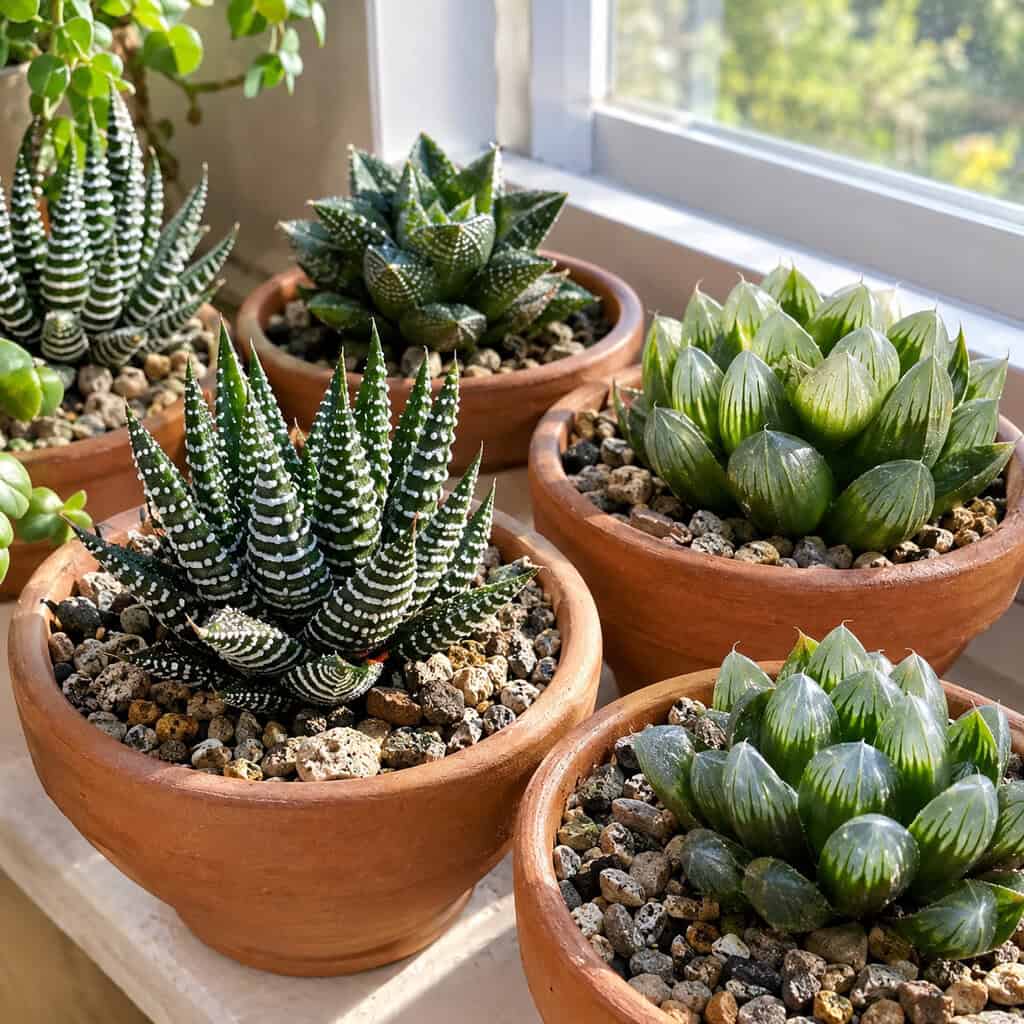
Most succulents are a lie indoors. Echeverias stretch into pale, floppy towers within three months of a windowsill because they want desert sun and your house doesn’t have it.
Haworthias evolved in the shade under South African shrubs. Bright indirect light keeps them tight and compact — exactly what an east window provides.
Zebra haworthia, window haworthia, the translucent-leaved cooperi types. All small, all slow, all forgiving.
They throw offsets at the base. Twist one off with a bit of root, pot it in gritty mix, free plant.
Non-toxic to cats and dogs.
25. String of Hearts

Hanging above the kitchen sink in more plant-pro houses than you’d guess.
Ceropegia woodii trails thin purple-backed vines strung with silver-marbled heart leaves, and along those vines it forms small beaded tubers that look like gray peas. Those are water storage — and propagation. Lay a vine across a pot of soil so a few tubers touch the surface, and they root where they sit. No cutting required.
Here’s why pros choose it specifically: it’s non-toxic to pets, while string of pearls — the plant everyone compares it to — is toxic to dogs and cats and causes vomiting and skin irritation.
Same look, same hanging spot, one of them is safe.
26. Prayer Plant (Maranta)

At dusk the leaves fold upward like hands. At dawn they flatten back out. It’s called nyctinasty, it’s driven by water pressure in a hinge at the base of each leaf, and it’s the single most charming thing in a plant person’s house.
You can hear a big one rustling at bedtime.
The trade-off is fussiness about water quality and humidity. Chlorine and fluoride brown the edges fast, so use distilled or rainwater and keep it away from a heat vent.
ASPCA non-toxic to dogs, cats, and horses.
27. Mounted Staghorn Fern

A staghorn on a cedar board is the closest thing to living wall art, and plenty of garden center owners have one hanging in the bathroom where the shower steam does half the work.
It’s an epiphyte. In the wild it clings to tree trunks, so it gets mounted on a board with a pad of damp sphagnum moss behind the root ball and fishing line or nylon cord holding it in place.
Watering means taking it off the wall. Carry it to the sink, soak the moss pad for ten to twenty minutes until it’s saturated and heavy, then let it drip until it stops before rehanging. Every week to ten days in summer, every two to three weeks in winter.
That weekly soak is also the part people get wrong, and it’s a drywall problem waiting to happen. A soaked moss pad sitting flat against painted drywall will wick moisture into it, and three months later you’ve got a dark halo and mold behind the board.
Mount it on an exterior-grade or sealed board, and hang it with a spacer — two small rubber bumpers or a strip of cork behind the top corners — so air can move between the board and the wall. Never rehang it while it’s still dripping. And if it’s going in a bathroom, make sure the exhaust fan actually runs, because a steamy room with no air exchange grows mold with or without a fern on the wall.
One more thing nobody tells new owners. The flat, round shield fronds at the base are supposed to turn brown and papery. They’re the plant’s root cover, not dying leaves. Don’t peel them off.
Non-toxic to pets.
28. Norfolk Island Pine

Sold by the thousands every December with glitter on the branch tips, and thrown in the trash by January 5th by everybody except plant people.
It isn’t a pine. Araucaria heterophylla is a tropical conifer from a tiny island in the South Pacific, and it’s a permanent houseplant that happens to be shaped like a Christmas tree. Pros keep theirs for twenty years in a bright window and let it hit the ceiling.
What kills them indoors is spider mites, not light or water. Dry winter air next to a heat register is a mite breeding ground, and on a needled plant you won’t see them until the damage is done.
Diagnosis first. Hold a sheet of white paper under a branch and tap it sharply — if tiny specks drop and then walk, that’s mites. Look for fine webbing in the branch crotches and a dull bronze or gray cast on needles that should be bright green. Lower branches going crisp and dropping from the inside out is the late-stage tell.
Treatment is physical and repetitive. Take the plant to a shower or outside with a hose and blast every branch, top and bottom, which knocks down the bulk of the population immediately. Follow with insecticidal soap or horticultural oil sprayed to full coverage, including the trunk and the undersides of every tier.
Then repeat in five days. And again five days after that. Mite eggs hatch on roughly a three- to five-day cycle at indoor temperatures, so a single application just resets the clock. Raise the humidity around the plant while you’re at it — mites hate it, and so does a dry Norfolk.
Brown lower branches never regrow. Catch it early or live with a bare bottom third.
29. Pilea Peperomioides

The pass-it-on plant.
A Norwegian missionary carried cuttings out of Yunnan province in the 1940s, and for the next forty years this plant spread across Scandinavia and Britain entirely through shared pups — handed over fences, mailed in envelopes, passed at church — before any nursery grew it commercially. Botanists in the UK spent years trying to identify it from photos sent in by people who had one and didn’t know what it was.
It still works that way. Pilea throws pups from the soil and off the stem constantly, and nursery owners dig them out and hand them across the counter to customers they like.
Bright indirect light, quarter turn weekly so it doesn’t lean, water when the top inch dries.
Non-toxic to cats and dogs. Give the pups away. That’s the point of the plant.
30. Tradescantia Zebrina (Wandering Dude)

Fastest cutting in the building. Snap a piece off, drop it in water, see roots in four days.
The purple-and-silver striping is better in bright light and washes out to dull green in a dim corner. Pinch it back hard every few weeks or it goes bald at the base and all the color ends up at the vine tips.
The sap irritates skin on contact for some people and causes dermatitis in dogs and cats that brush against it repeatedly.
Worth growing. Just not the one to hang over the dog bed.
31. Polka Dot Begonia (Begonia Maculata)
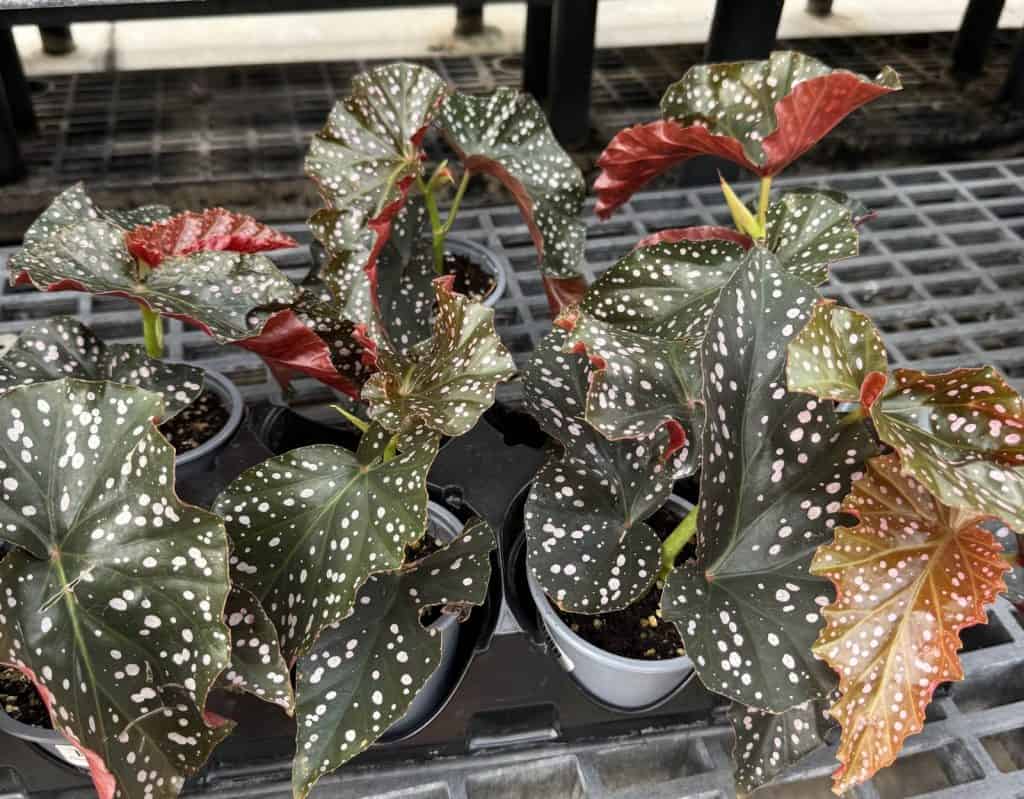
Silver-spotted angel wing leaves with deep red undersides. It’s the showoff on the shelf, and plant people grow it knowing full well it’s needier than everything around it.
Cane cuttings root easily, so one plant becomes a hedge.
But it wants humidity above 45% and sulks visibly below that — crisped edges, dropped leaves, stalled growth by February. A pebble tray helps. A humidifier helps more.
Toxic to pets. Grow it if you want the looks and you’ll accept the work.
32. Swedish Ivy (Plectranthus)

Not Swedish. Not ivy. A South African mint relative that Scandinavians hung in windows until the name stuck.
Old-school nursery plant through and through — scalloped glossy leaves, trailing habit, cuttings that root in a water glass inside a week.
Pinch the tips constantly. Unpinched Swedish ivy goes stringy fast.
Pet safe. Oklahoma State University Extension’s houseplant care fact sheet covers the light and watering basics that keep trailing plants like this full instead of leggy.
33. Aloe Vera

Kitchen windowsill, within arm’s reach of the stove. Break a leaf, squeeze the gel onto a burn.
Grow it in gritty cactus mix in a terra cotta pot and water it hard, then not at all for three weeks. Soggy aloe turns to mush at the base and there’s no coming back.
Pups come off the sides. Pot them up and give them to people who cook.
Toxic to cats and dogs. The saponins and anthraquinones cause vomiting and diarrhea, so a counter-surfing cat makes this a bad fit — which is exactly why so many pros keep haworthia instead.
Notice what’s missing from this list.
No rare variegated monsteras. No $300 anthurium hybrids. The plants that live in the homes of people who sell plants for a living are mostly the cheap ones, the inherited ones, and the ones that forgive a bad month.
That’s not an accident. People who handle thousands of plants a week don’t want another chore when they get home — they want something green in the window that’s still alive in twenty years.
The best houseplant you’ll ever own probably starts as somebody else’s cutting in a jar on your counter.