


The plant rack by the garden center exit is designed to catch you on the way out. Four dollars. Nine dollars. Nineteen for something that looks like it belongs in a magazine.
Most of those plants will be dead within ninety days. A few of them can hurt your dog first.
The problem isn’t that big box stores sell bad plants. It’s that they sell plants grown for a Florida shade house, decorated for a gift aisle, and priced for a shopper who won’t come back to complain.
Some of what’s on those shelves is genuinely dangerous. Some is structurally sabotaged before you ever pick it up. And some is simply a plant at the end of its life, marked up because it happens to be flowering.
Here are the ones to walk past.
1. Sago Palm
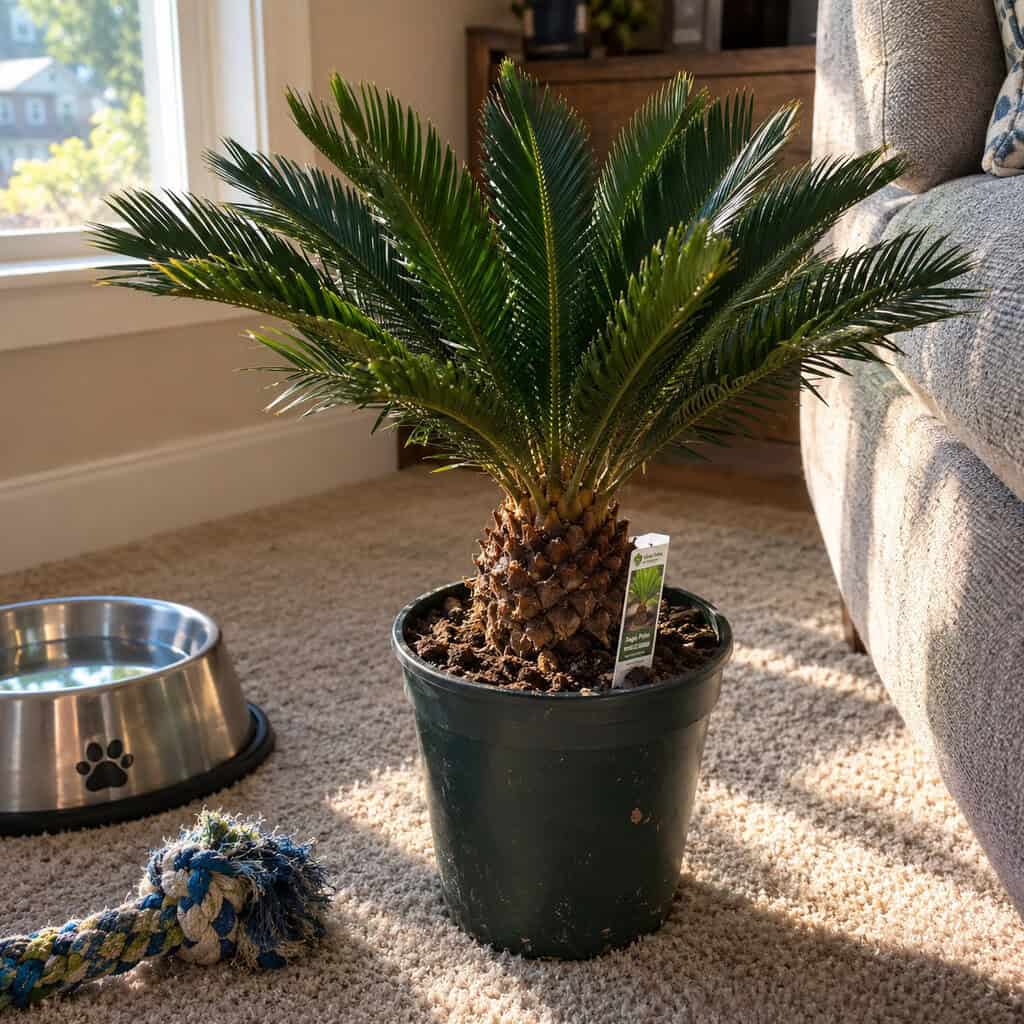
Under twenty dollars. Sold in the tropical aisle as a cute little palm.
It isn’t a palm, and it’s the most lethal plant in the building. Cycas revoluta contains cycasin, and every part of it is poisonous to dogs and cats — leaves, trunk, roots. The seeds are the worst by a wide margin.
One seed has killed dogs. Toxic — severe. Reported fatality rates in sago palm ingestions run around 50% even with aggressive treatment, and VCA Animal Hospitals notes that liver failure is the usual cause of death.
The tag says “Sago Palm. Bright light. Water when dry.” That’s all it says.
Watch for these signs if your dog has been near one:
- Vomiting, sometimes with blood, within 15 minutes to a few hours
- Black tarry stool or diarrhea
- Lethargy, weakness, loss of appetite
- Yellowing gums or eyes (liver involvement, often 2-3 days later)
- Seizures or tremors in serious cases
If you think your pet chewed any part of one, go now — don’t wait for symptoms and don’t try to induce vomiting at home. Bring a piece of the plant or a photo of the tag. Early decontamination and liver support make the difference, and the window is measured in hours.
Homes with pets should skip it entirely. A ponytail palm gives you the same sculptural look with none of the risk.
2. Cactus With a Glued-On Strawflower

You’ve seen it. A two-inch cactus wearing a lurid pink daisy that was never attached to anything living.
That’s a dried strawflower, and it’s hot-glued directly to the growing point. Peel it off and you tear the areole, leaving a scar the plant carries for the rest of its life.
The glue sits exactly where the cactus would have flowered on its own, given a few years and a cold dry winter. Succulent author Debra Lee Baldwin has been calling out this stuff for years.
Skip it. Buy the unglued cactus two bins over for the same price.
3. Fiddle Leaf Fig

The famous one. Still stacked at the front of the store every spring because people keep buying it.
Big box figs come out of a Florida shade house getting maybe 6,000 foot-candles of filtered light. The store gives them a fraction of that. Your living room gives them a fraction of the store’s.
The plant reads that as a crisis and drops leaves for months. Iowa State University Extension makes the point plainly in its guidance on selecting houseplants: match the plant to the light you actually have, not the light you wish you had.
The discount you got is the acclimation period somebody else skipped. A local greenhouse that held the plant for six weeks under lower light is selling you a fig that’s already survived the transition.
4. Marimo Moss Ball

Six dollars for a fuzzy green sphere in a jar. Nothing about it looks like a federal problem.
In March 2021, aquarium hobbyists started finding live zebra mussels inside moss balls bought at pet, aquarium, and garden retailers. The contamination turned up in at least 21 states. The U.S. Fish & Wildlife Service issued a destroy-and-dispose advisory — an official request that the public kill a product stores were still selling.
Zebra mussels clog municipal water intakes, strip plankton from lakes, and cost North American utilities and power plants hundreds of millions a year. A single female can release a million eggs in a season.
The disposal instructions matter because the wrong method spreads them. Never flush a moss ball, never pour tank water down a storm drain, and never toss one in a compost pile or a pond.
- Freeze the moss ball solid for at least 24 hours, or boil it for one minute
- Seal it in a plastic bag and put it in the household trash
- Disinfect the tank water with bleach — about a cup per gallon — and let it sit 10 minutes before draining
- Report the find to your state’s aquatic invasive species program
Recalls fade. Supply chains don’t get rebuilt. Moss balls have quietly reappeared on shelves, and nobody at the register is checking them.
5. Spray-Painted Succulent

Neon blue. Metallic gold. Glitter-crusted purple with a bow.
The paint is an opaque coating sitting on the leaf surface, which means it physically blocks photosynthesis. The plant survives only on whatever unpainted new growth manages to push out from the center.
It starves slowly, in a decorative pot, on a windowsill where it looks fine for a month.
You can rescue one occasionally — repot, bright light, wait for clean growth, then remove the painted leaves as they die. But you paid extra for the damage.
6. Dieffenbachia (Dumb Cane)

A big box staple since the 1970s, and often the cheapest large plant on the rack. Two feet of bold variegated foliage for twelve dollars.
The sap is packed with calcium oxalate raphides — microscopic needle-shaped crystals that fire into soft tissue on contact. A chewed leaf causes immediate burning, drooling, and swelling of the mouth and throat.
The common name is the warning. Dumb cane, as in loss of speech.
Toxic to pets and toddlers. Severe airway swelling is rare but documented. If you want the same dramatic leaf at the same price, a cast iron plant does it and is harmless.
7. Juniper ‘Mallsai’ Bonsai

Fifteen dollars, a glazed pot, pebbles glued across the soil surface, and a tag that says only “Bonsai.”
Junipers are outdoor conifers. They need cold winters, full sun, and real airflow. A desk under a ceiling light is a slow execution.
The glued gravel makes it worse — you can’t check the soil moisture or water properly, so it’s rot or drought with nothing in between.
Here’s the cruel part. Dead juniper needles stay green for weeks. By the time it browns, it’s been dead since last month.
8. Boston Fern From the Outdoor Garden Section

Gorgeous in a 10-inch hanging basket. Nineteen dollars in April. And grown outdoors under overhead sprinklers, inches from hundreds of other plants, for its entire life.
That’s how hitchhikers happen. Boston ferns from outdoor retail racks routinely come home carrying spider mites, mealybugs, scale, or fungus gnats — and the pests don’t stay on the fern.
Spider mites will move to your monstera in a week. University of Minnesota Extension puts inspection before purchase at the top of its indoor pest advice, and it’s the cheapest pest control there is.
Check before you put it in the cart. Turn the basket and look up into the crown, not just at the pretty outside fronds.
- Fine webbing where fronds meet the stem — spider mites
- White cottony tufts in leaf axils — mealybugs
- Small brown bumps you can scrape off with a fingernail — scale
- Tiny black flies rising when you tap the pot — fungus gnats
- Stippled, dusty-looking foliage held up to the light — mite feeding damage
If you buy one anyway, quarantine it. Thirty days in a separate room, away from every other plant, checked weekly. Colorado State University Extension recommends the same isolation period, and it catches almost everything before it spreads.
A shower rinse of the whole plant on day one helps too. Cold water, undersides of the fronds, two minutes.
9. Dyed Blue Phalaenopsis Orchid

There is no blue phalaenopsis. That color comes from dye injected under pressure into the flower spike.
The injection site is a puncture wound in living tissue, and it’s a common entry point for rot. Growers who do it keep the technique quiet for a reason.
Next bloom cycle, the flowers come back white. You paid a twenty-dollar premium for a damaged plant and one temporary color.
10. Florist Azalea in a Foil Pot

These show up on gift racks from late winter through Mother’s Day, wrapped in crinkled foil with a plastic bow.
Rhododendron simsii contains grayanotoxins, which interfere with cardiac and skeletal muscle. Pet ingestion can cause vomiting, drooling, weakness, an abnormal heart rhythm, and in serious cases collapse.
Toxic — keep out of reach of cats and dogs.
It’s also force-bloomed under greenhouse conditions to hit a holiday. Two weeks after it comes home, the flowers brown and the whole thing sulks. Nobody has ever made one bloom again on a windowsill.
11. Venus Flytrap in a Sealed Plastic Dome

Near the register, four dollars, sweating inside its own plastic bubble.
Flytraps are bog plants from a narrow strip of the Carolinas. They want blazing direct sun, distilled or rainwater only, and a genuine cold dormancy every winter.
What they get is a fluorescent-lit dome over peat that’s been soaking for six weeks. The traps blacken. The buyer assumes they overfed it.
They’re being sold as toys. Treat them as the specialty plants they are, or don’t bring one home.
12. Mass Cane / Corn Plant Log

Look at the top of the cane. That flat sawn end is the giveaway.
These are imported cane sections, cut and sprouted in a tub, sold as instant floor plants. Root systems are minimal relative to all that top growth, and the cut end is a standing invitation for rot once someone overwaters.
Dracaena fragrans is also toxic to cats and dogs. The tag almost never says so.
Cats in particular chew the strappy leaves. Vomiting, drooling, and dilated pupils are the usual result.
13. Mini Tabletop Gardenia

The most reliable heartbreak in the store.
Gardenias want 60% humidity, acidic water, and temperatures that don’t swing. Average indoor air gives them roughly none of that, and their response to any change is to drop every unopened bud at once.
Bought in full bloom, it has already peaked. What you’re taking home is the decline.
14. Alocasia ‘Polly’
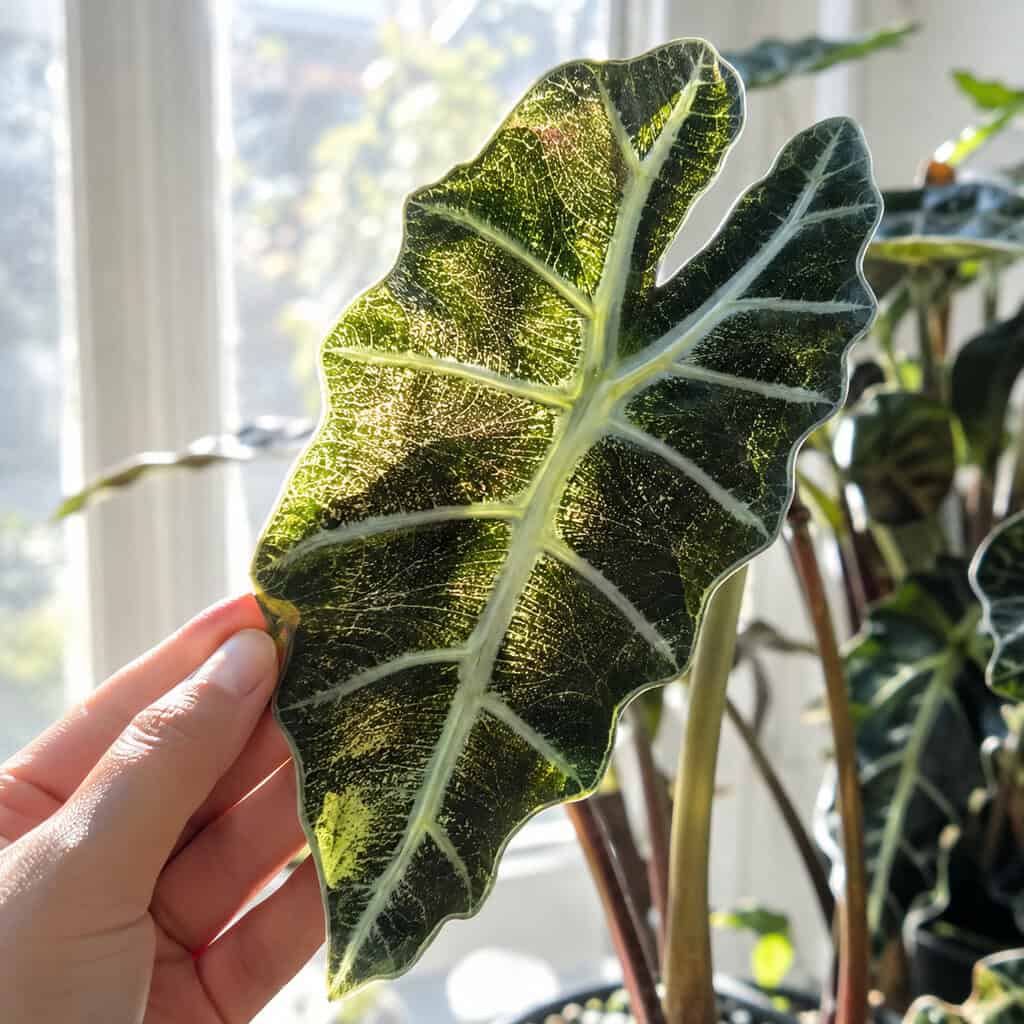
Those arrow-shaped leaves with white veining have been a trend plant since about 2018. They’re also the single biggest spider mite magnet on the shelf.
Alocasia leaves are thin, held flat, and grown in exactly the warm dry retail conditions mites love. An infestation can go from invisible to defoliating in three weeks.
Flip a leaf before you buy. Hold the underside toward a window and look for fine pale stippling — hundreds of tiny feeding dots — plus webbing where the leaf meets the petiole. Adults are barely a speck, and you’ll often see the movement before you see the mite.
If you find any, put it down and don’t buy its neighbors either.
Already own one with mites? Rinse every surface in the shower, then treat with insecticidal soap or horticultural oil every five to seven days for at least three rounds — you’re breaking the egg cycle, not killing adults. Raise the humidity while you’re at it; mites hate it.
The other Polly killer is winter. It slows down, drops leaves, and looks stone dead around February. That’s dormancy. The corm is alive under the soil, and thousands of perfectly healthy alocasias get thrown out every year by owners who didn’t know that.
15. Lucky Bamboo in Gravel and Water

It isn’t bamboo. It’s Dracaena sanderiana, and it’s toxic to cats and dogs.
Those leaf tips brown because fluoride and chlorine in tap water accumulate with nowhere to go. A sealed vase of gravel has no drainage, so salts just concentrate.
Flush it monthly with distilled water if you already have one. Otherwise it’s a countdown.
16. Croton (Petra)

Sunset-colored leaves splashed red, yellow, and green. Sold as a color plant, indoors and out.
Crotons are bred for full Florida sun. Move one into an average living room and it sheds the spectacular leaves within a few weeks, keeping only dull green new growth.
The milky sap irritates skin and stomachs — worth knowing with a dog that chews or a kid who grabs. For the same bold color with far less drama, a lot of tropical-looking plants handle northern light much better.
17. Cyclamen From the Seasonal Rack

November through February, that swept-back pink flower catches everyone.
The tuber is the most toxic part, containing saponins that can cause vomiting, diarrhea, and — with significant ingestion — cardiac effects in pets. Toxic. Cats digging in the pot are the usual route.
Culturally it’s a mismatch too. Cyclamen wants a 60°F room, which most houses aren’t, and then it goes dormant in late spring and dies back completely.
Most buyers assume they killed it. Into the bin goes a perfectly healthy tuber.
18. Prefab Succulent Bowl Arrangement

Six species with six different water requirements, wedged into one ceramic bowl with no drainage hole.
Then the surface gets topped with sheet moss or glued pebbles, so you can’t see or feel that the soil underneath is swamp. Echeverias rot while the haworthia next to them is still thirsty.
It’s a floral centerpiece priced like a plant collection. Buy the same succulents individually in nursery pots for a third of the cost.
19. Maidenhair Fern

Sold right beside the tough ferns, with the same generic care tag.
Maidenhair needs constantly moist soil and 60%+ humidity. One dry afternoon and every delicate frond crisps simultaneously — not gradually, all at once.
The tag says “water when dry.” That is precisely the instruction that kills it.
20. Air Plants Glued Into Shells and Magnets

Tillandsias absorb water through trichomes on their leaves and need a soak-and-dry cycle — twenty minutes submerged, then turned upside down to drain completely.
Hot glue on the base destroys the tissue at the plant’s core and makes draining impossible. Water pools in the shell and the center rots.
A glued tillandsia is a cut flower with a longer fuse. Buy them loose.
21. English Ivy Topiary

Shaped into a ball, a cone, a reindeer at Christmas. Trained over a wire frame that blocks airflow straight through the middle.
Mites and scale start deep inside where nobody looks, and by the time the outer leaves show damage the infestation owns the plant. Ivy is notoriously mite-prone indoors to begin with.
Toxic to dogs and cats — the leaves more than the berries, causing drooling, vomiting, and abdominal pain.
Planting the failed topiary outside is worse. English ivy is listed as invasive across much of the country, and it climbs and kills mature trees.
22. Bromeliad in Full Bloom

That neon pink or orange spike is the plant’s last act.
Bromeliads are monocarpic — they flower once, then decline over the following year while producing offsets at the base. Retail always sells them at peak color, which means always at the end.
You can keep the pups and grow them on. Takes two to three years to bloom.
Just know what you’re paying a premium for.
23. Glitter-Sprayed Norfolk Island Pine

Every December, stacked by the wrapping paper. A tabletop Christmas tree that will “grow with the family.”
Pull it out of the pot and you’ll usually find three or four separate seedlings crammed together so the silhouette looks full. They compete, and the weakest ones die.
The fake snow and glitter clog the needles and block light on a plant that already wants more than a living room offers. Branches drop from the bottom up starting around February.
Norfolk Island pines don’t regrow lost lower limbs. Ever. Whatever branch falls off is a permanent bare spot on the trunk for the next thirty years.
An unsprayed one in a bright east window can live for decades. The glittered one becomes a bare stick in a pot by Easter.
24. Oleander Patio Standard
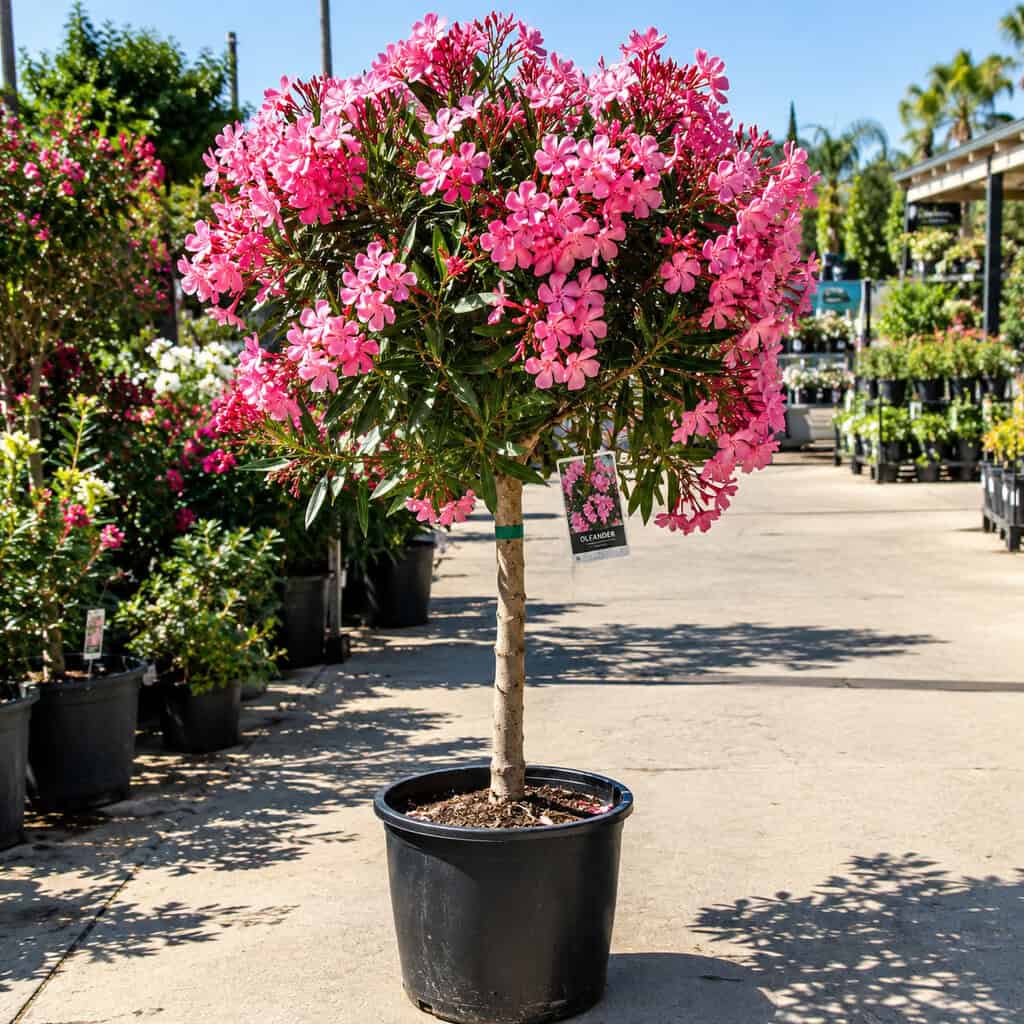
Trained into a lollipop shape, blooming pink, sold on southern garden center pavement every spring.
Oleander is among the most toxic plants in retail. Cardiac glycosides throughout the plant, dangerous to dogs, cats, horses, and children, and the smoke from burning clippings is toxic too.
Do not plant it where pets or kids roam. It’s a landscape shrub, not a houseplant — but it sits in the same impulse-buy zone, and the tag mentions sun exposure and nothing else. Plenty of common landscaping plants carry the same risk with no warning at all.
Here’s how the two buying paths actually compare.
| Big Box Rack | Local Greenhouse | |
|---|---|---|
| Price | Lower upfront | 20-50% more |
| Acclimation | Days, if any | Weeks under lower light |
| Pest inspection | On you | Routine |
| Toxicity info | Rarely on tag | Ask and get an answer |
| Replacement odds | High | Low |
Cheap stops being cheap the third time you buy the same plant.
None of this means big box garden centers are useless. Pothos, snake plants, ZZ plants, spider plants, philodendron — all fine, all hard to kill, all genuinely a bargain there.
The rule is simple enough to use in the aisle. If it’s been painted, glued, dyed, glittered, or arranged, someone decided the plant’s appearance mattered more than the plant.
And if the tag tells you about light but not about toxicity, look it up before it goes in the cart. Your dog can’t read the tag either.
You are so right, but I’ve known about the “do not buys” for years. I’m 88 yrs old and I’m addicted to plants. I only have pothos, philodendron and a couple snake plants. I live in Florida and I’ve had a large Peace Lily for about 30 years. It lives outside and loves it. And also Christmas Cactus, a couple outside and a few on the Lanai. For the first time in years I had a problem with aphids or mealy bugs on my pothos. So I put them outside and spray them with my homemade insect killer. Some I had to disgard because they kept coming back. I don’t have the patience anymore for sick plants.
Avoiding plants because they’re “toxic” means doing without some really nice house or garden plants.
Teach your kids not to eat stray things. Pets typically avoid bad-tasting, harmful plants.