

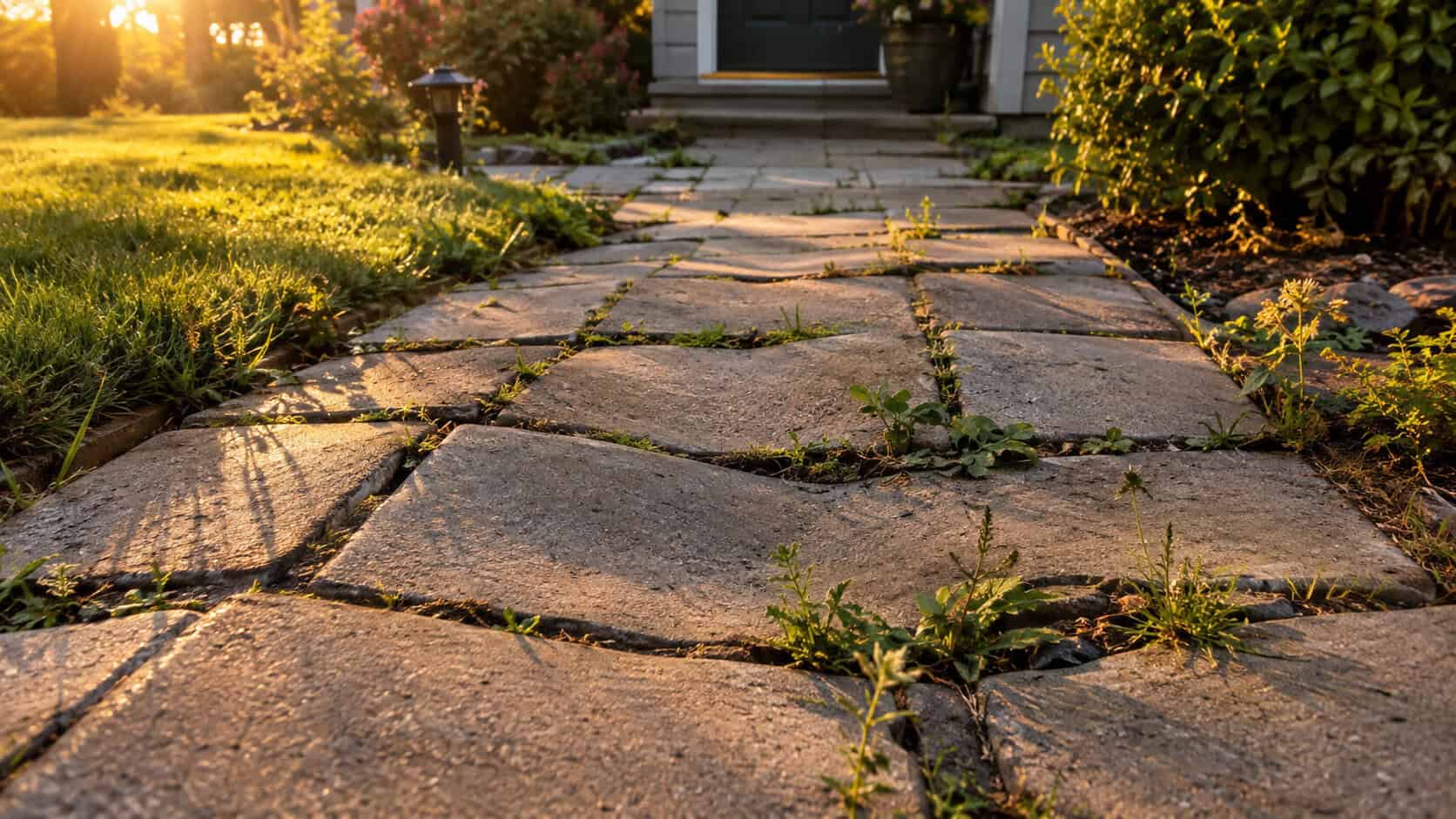
Fresh concrete looks incredible for about four days.
Then the first winter arrives, the ground moves, a delivery truck parks where it shouldn’t, and the surface you paid five figures for starts telling on itself. Hairline cracks. A paver that rocks. A path that’s three inches lower on one side than it was in May.
Hardscape is the most permanent thing in your yard and the easiest thing to get wrong. Plants you can rip out. A failed driveway you live with, or you pay to demolish.
Contractors who install this stuff for a living have strong opinions about what fails — and they’re usually the opposite of what sells well at the showroom.
Here are 31 walkway and driveway choices that look great on day one and turn into regret by year five, plus what the pros put down on their own properties.
1. Stamped Concrete Driveway
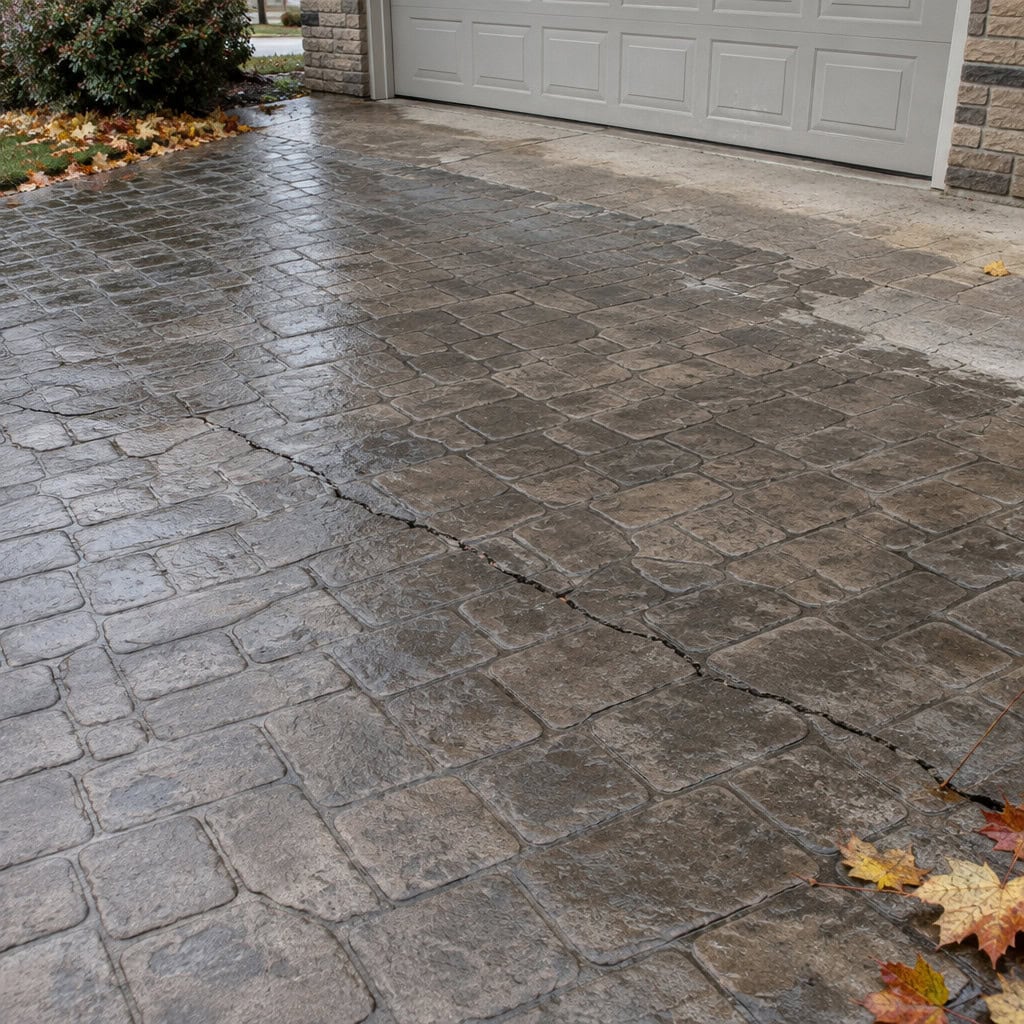
It photographs like tumbled stone and costs almost as much. It behaves like one giant slab, because that’s exactly what it is.
Freeze-thaw and ground settlement crack a monolithic pour — usually somewhere between year three and year five. The color is applied at the surface, so it weathers unevenly and fades fastest where the sun and tires hit hardest. Every repair is a visible scar, since you can’t replace one “stone.”
Installers who’ve done hundreds of these are candid about the long-term maintenance load: resealing every two to three years, and no good answer when a crack runs diagonally across your pattern.
Pros pick interlocking concrete pavers instead. Any damaged unit lifts out and gets swapped in twenty minutes. Exposed aggregate is the other honest choice — it ages into something instead of away from something.
2. A Pea Gravel Driveway
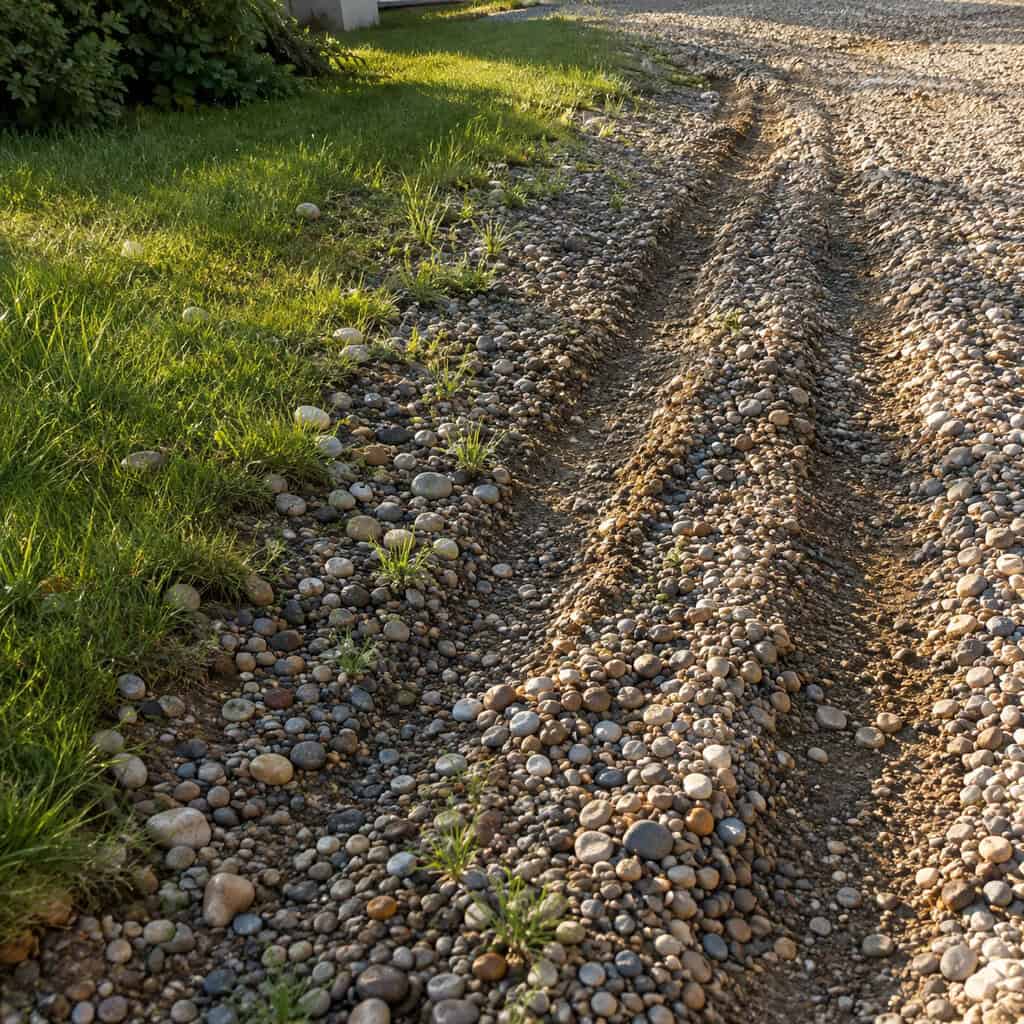
Round stones don’t lock. That’s the whole problem in three words.
Pea gravel has no angular faces to knit against its neighbors, so tires squirt it sideways. Within one season you’ll have ruts where you park, a berm along the edges, and a steady migration of stone into the lawn, the street, and your mower deck.
Crushed stone with fines — crusher run, or 3/4-inch minus — compacts into a semi-rigid mat that holds shape. Angular faces bite into each other under load.
3. Pavers Set Straight on a Sand Bed
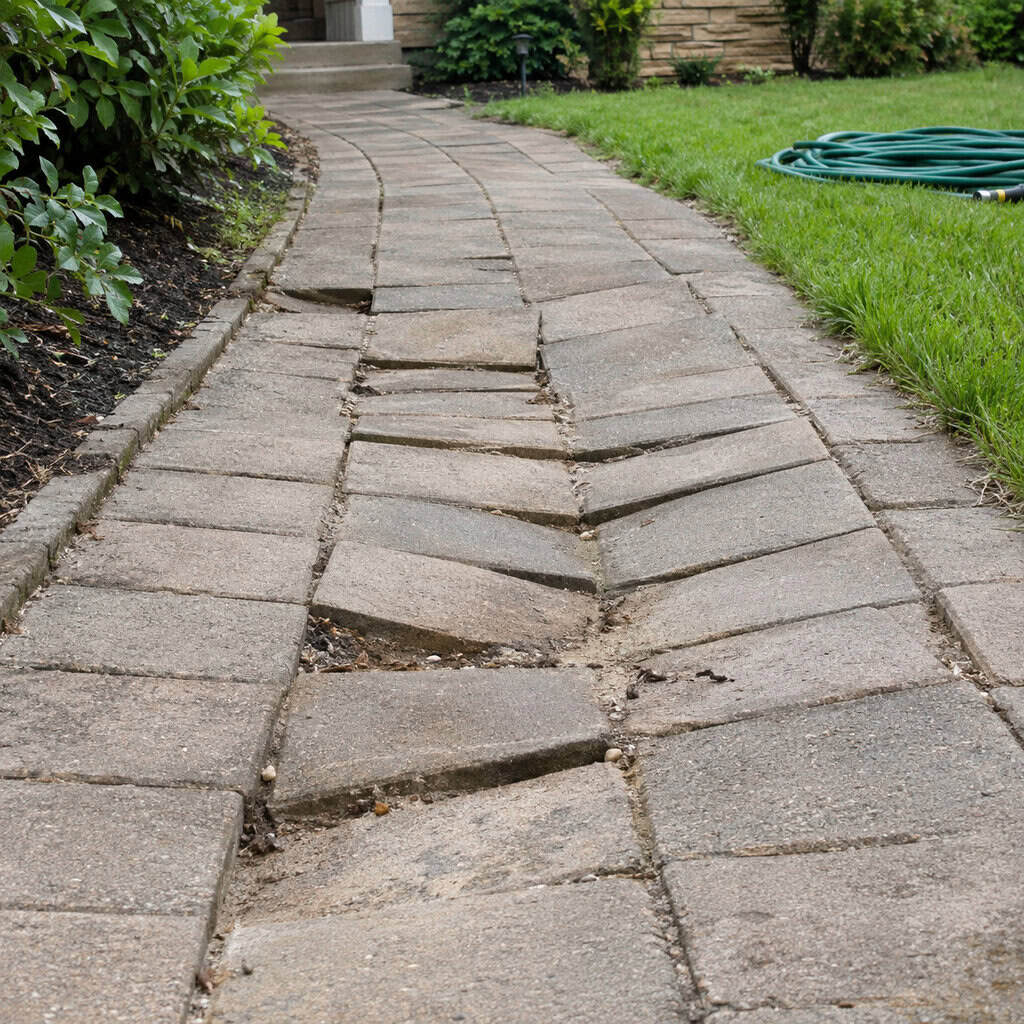
Nearly every paver failure is a base failure wearing a disguise.
An inch of leveling sand poured over native soil gives a beautiful result for about eighteen months. Then the waves start — low spots at the edges, a dip where the downspout hits, individual units tilting under foot traffic.
The spec isn’t glamorous: 4 to 6 inches of compacted crushed stone for a walkway, 8 to 12 for a driveway, compacted in 3- to 4-inch lifts with a plate compactor. Then a thin bedding course on top.
Laying the pavers is the last ten percent of the job. It’s also the only part most DIY videos show.
4. Stepping Stones Dropped Right on the Lawn
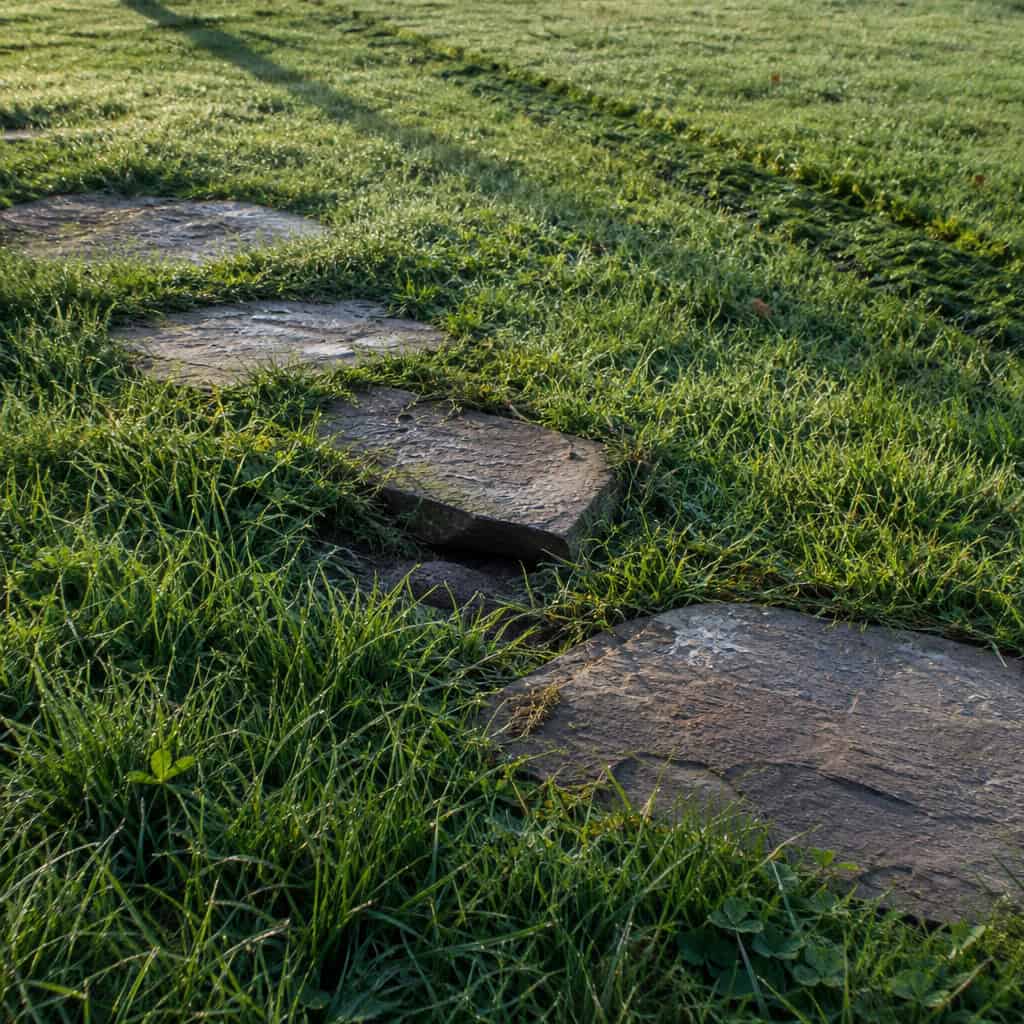
Set a flagstone on turf and gravity does the rest.
It rocks underfoot within weeks. Frost heave tips it into a trip hazard by the second spring. The mower blade scalps its high corner, and by year three the grass has grown over the edges and swallowed half the stone.
Cut the sod to the stone’s outline, dig three inches, compact stone dust in the hole, and set the stone just below mower height. Space them to a natural stride — roughly 24 inches center to center.
Done right, you mow straight over the top and never think about it again.
5. A Mulch Path Treated as a Permanent Walkway
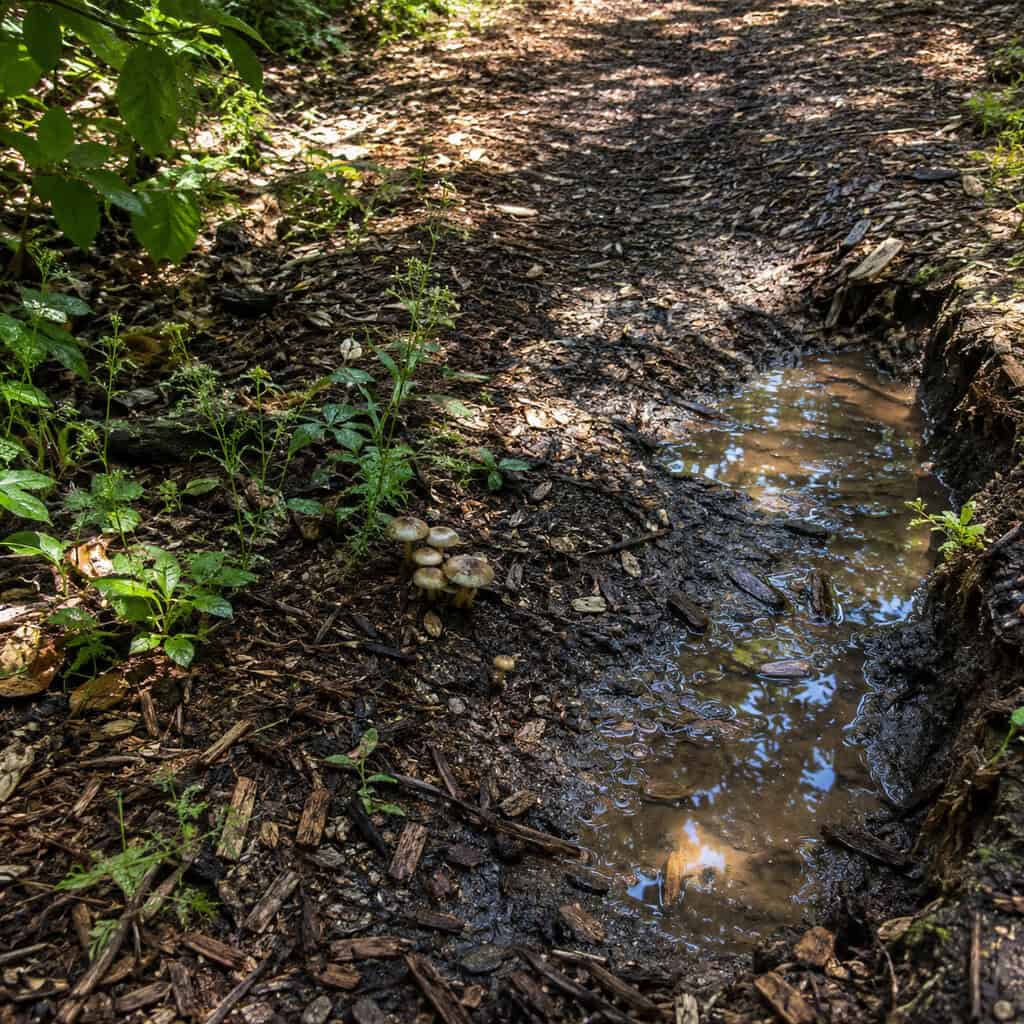
Bark mulch is organic matter. Organic matter’s job is to become soil.
It composts down, washes out of the path in any real storm, grows mushrooms and weeds in the damp middle, and rides indoors on wet shoe treads. Beautiful in April. Gone by the second October.
Stabilized crushed stone or decomposed granite, held by steel edging, gives the same soft informal look and stays put. Keep the mulch in the beds flanking the path, where decomposing is the point.
6. Rock Salt on a Brand-New Concrete Driveway
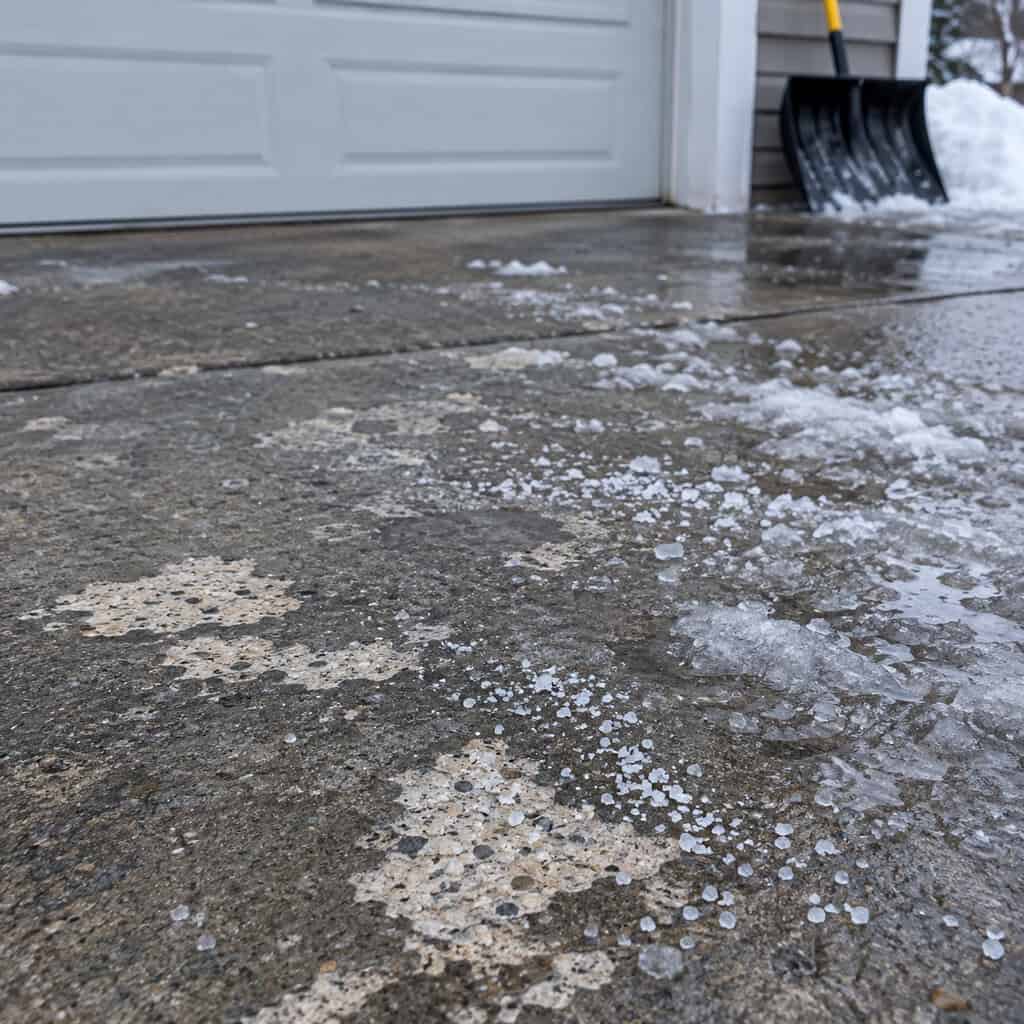
This one is permanent, it happens in the first winter, and almost nobody warns homeowners about it.
Fresh concrete hasn’t finished curing or fully drying when the first freeze arrives. Deicing salt pulls water into the surface pores, then repeated freeze-thaw cycles pop the top layer off in flakes and sheets. That’s scaling, and it does not grow back.
The Tennessee Concrete Association and most state concrete associations give the same instruction: use no deicing chemicals at all during the first winter after placement. Plain sand for traction, nothing else.
Two products deserve a permanent ban regardless of the slab’s age — ammonium sulfate and ammonium nitrate. They’re sold as fertilizer and sometimes marketed as deicers, and they chemically attack concrete rather than just stressing it.
Before that first winter, apply a penetrating silane-siloxane sealer. It soaks into the pores instead of forming a film on top, so it reduces water absorption without trapping moisture or turning the surface slick. Expect to reapply every three to five years.
After year one, calcium chloride and magnesium chloride are the gentler choices, but less is always better. Sweep the slush off instead of melting it when you can.
7. A Paver Walk With No Edge Restraint
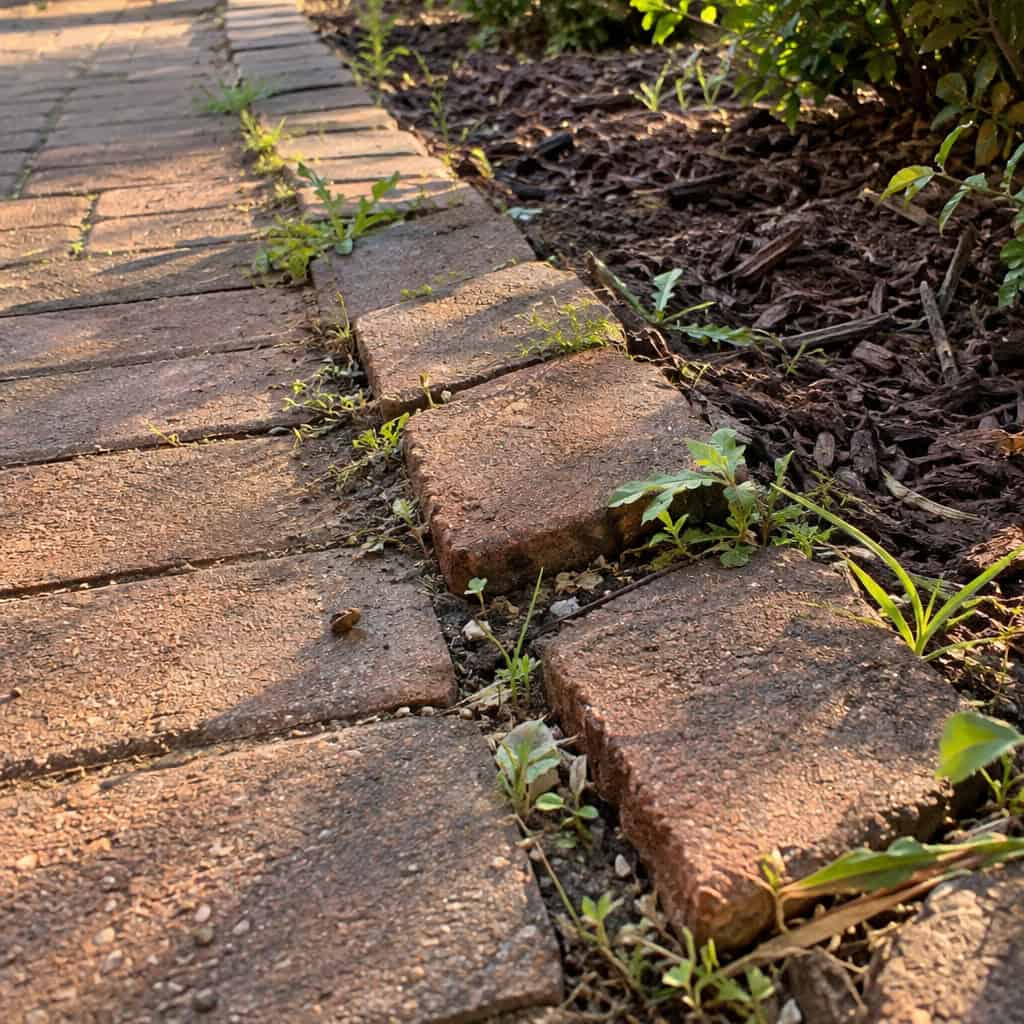
Pavers hold their pattern through interlock, and interlock only works if the outside course can’t move.
Skip the restraint and the perimeter walks outward a fraction every freeze and every footstep. Joints open. The pattern fans. Weeds and ants colonize the gaps, and the whole field goes slack.
Rigid polymer or aluminum paver edging, spiked into the compacted base and extending a few inches past the pavers, costs almost nothing against the total project. Driveways get a hidden concrete haunch poured along the outside edge instead.
8. Big-Box Weed Fabric Under Gravel
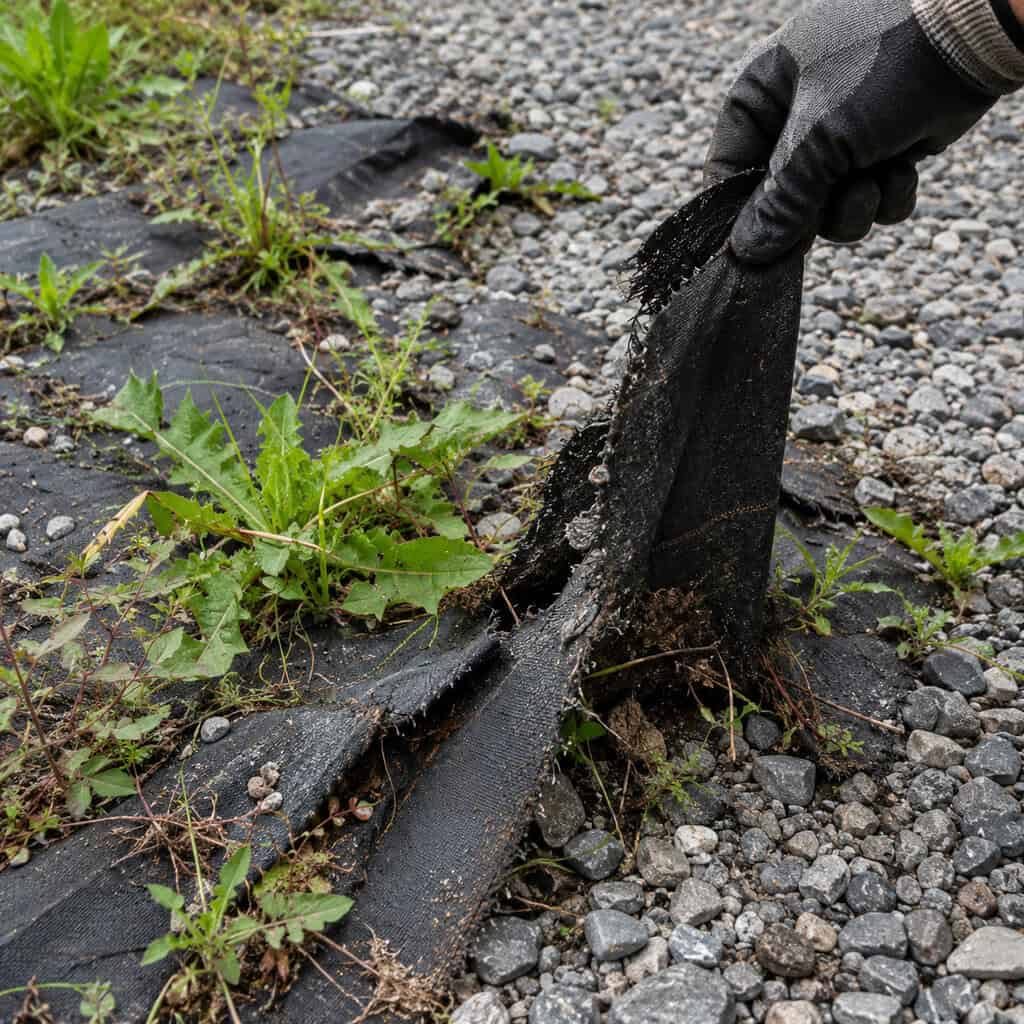
The thin black roll sold next to the mulch is not a soil separator. It’s a garden fabric.
Under angular stone and vehicle load it shreds, then migrates upward and surfaces as ragged black strips you’ll be pulling by hand for years. The weeds show up anyway — they root in the silt and organic dust that collects on top of the fabric, not underneath it.
Quarry operators are direct about this: a heavy woven geotextile for soil separation and stability is a different product entirely, and it’s what belongs under a driveway. For weeds, depth of stone and occasional raking do more than any cloth.
If weeds are already winning, that’s a driveway crack and joint problem to solve directly rather than a fabric problem to bury.
9. Mortared Flagstone Over a Shallow Base
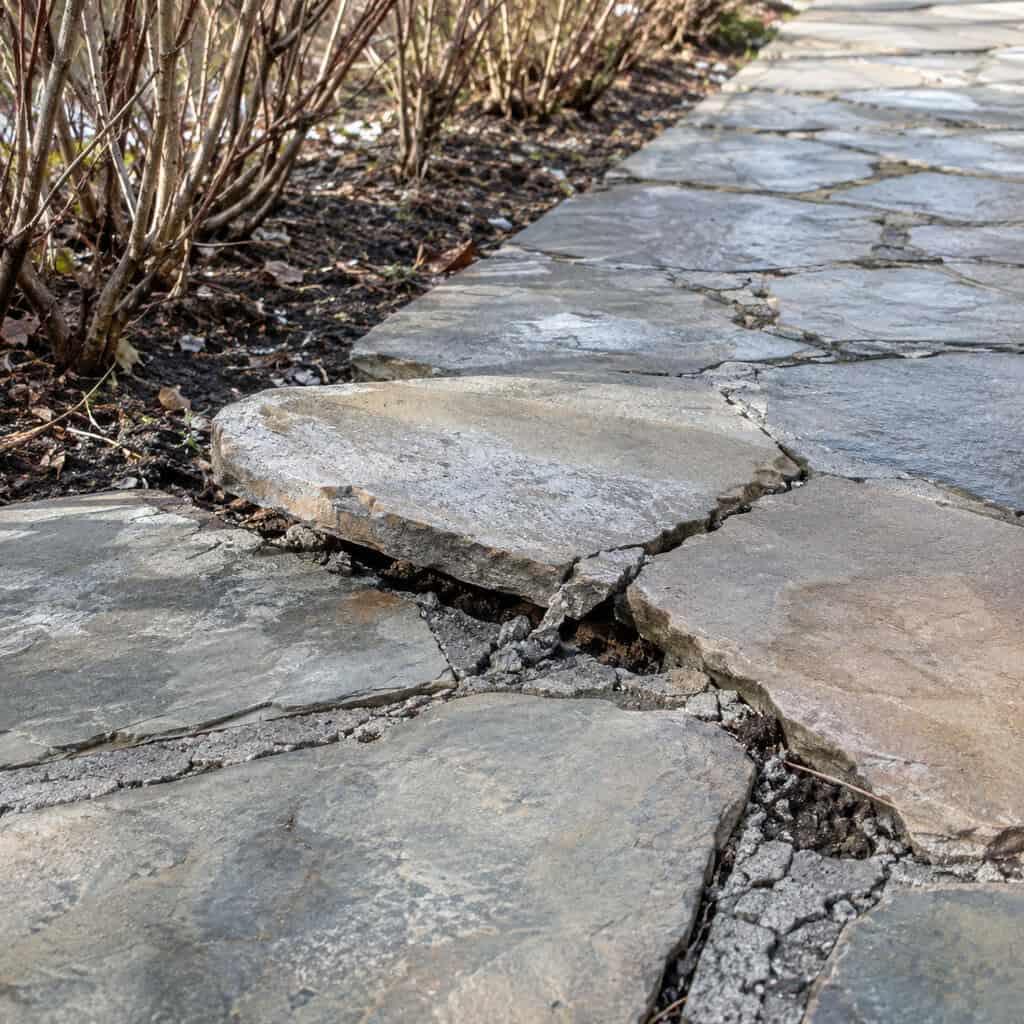
Rigid systems and moving ground don’t negotiate.
Grout stone into a mortar bed over four inches of gravel in a freeze-thaw climate and the joints crumble first — usually by the third spring. Then stones crack or pop loose. Every patch is a different shade of gray forever.
Dry-laid flagstone on compacted stone dust flexes with the frost and settles back. When something goes wrong, you lift the stone with your hands, add material, and reset it. No saw, no mortar, no visible repair. Fine Homebuilding walks through the method in detail.
10. The 36-Inch Front Walk
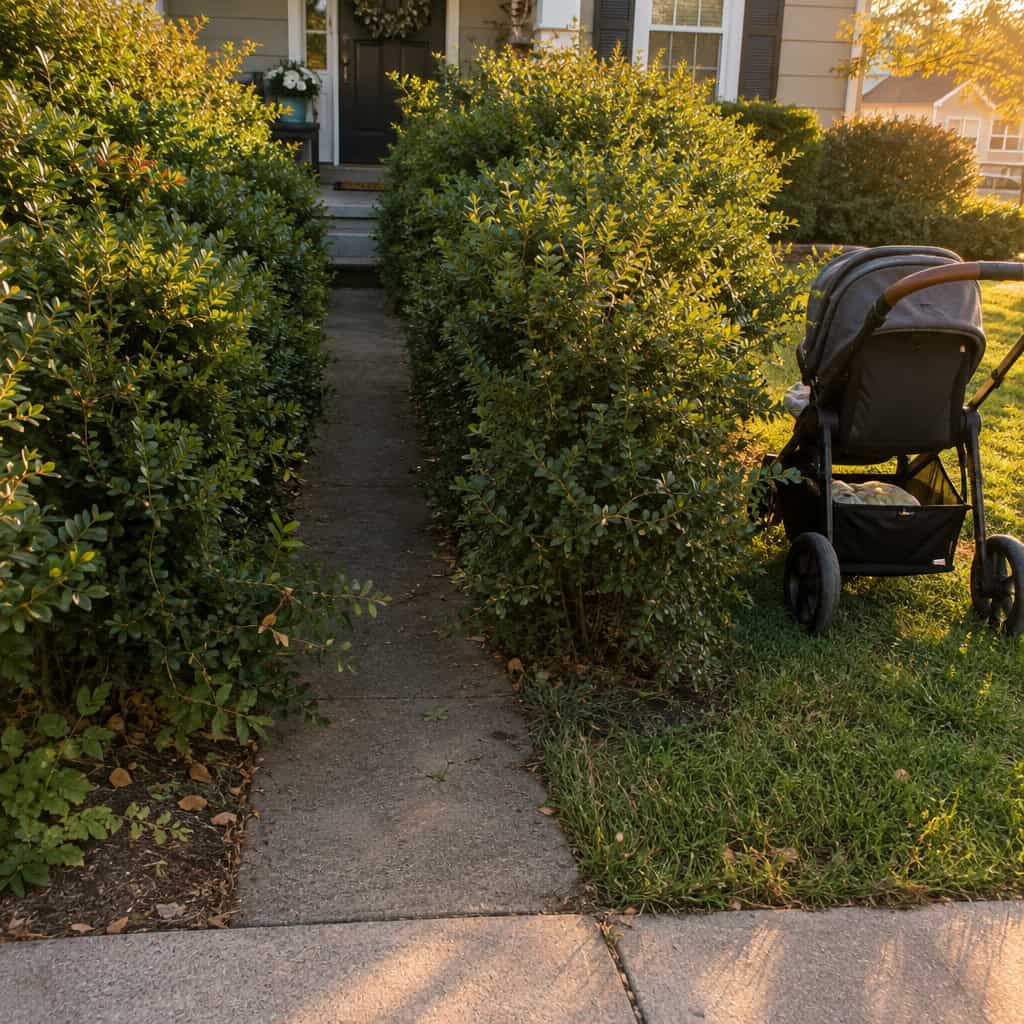
Three feet is the builder default and nobody has ever enjoyed one.
Two people can’t walk abreast. A stroller scrapes the edging. Carry groceries with someone and one of you steps into the mulch. It’s a path designed by a spreadsheet, not by anyone who has used a front door.
Forty-eight inches is the working minimum for a primary entry walk. Fifty-four to sixty if the budget stretches — that’s the width where a walk starts to feel like architecture instead of a sidewalk to the mailbox.
11. Thin Patio Pavers Used on a Driveway
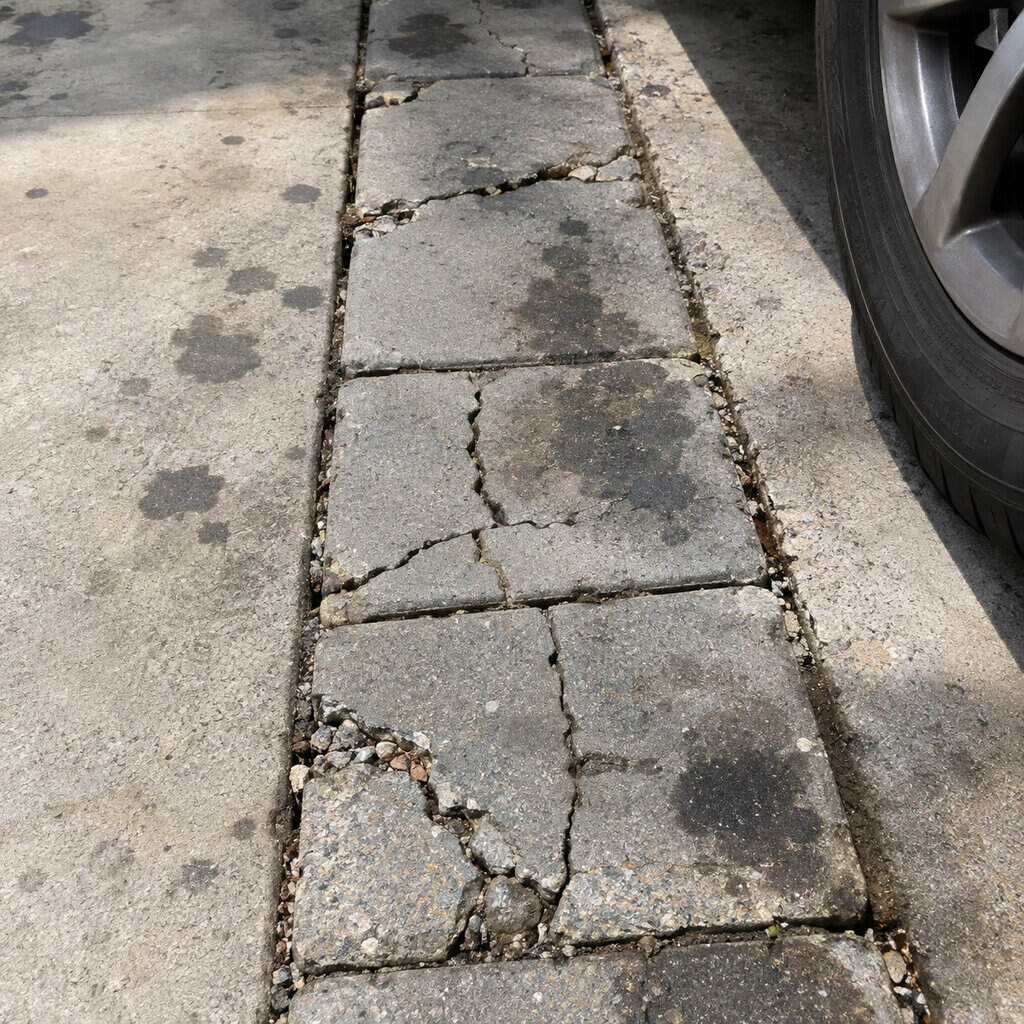
Standard patio pavers are 60mm — roughly 2-3/8 inches. They’re engineered for feet and patio furniture.
Put a 4,000-pound SUV on them, add a UPS truck turning on the apron, and they crack through the middle and spall at the corners. The failures cluster exactly where the wheels track.
Vehicular surfaces take 80mm pavers, about 3-1/8 inches thick, over 8 to 12 inches of compacted aggregate. The thickness matters, but the base under it matters more.
12. A High-Gloss ‘Wet Look’ Sealer
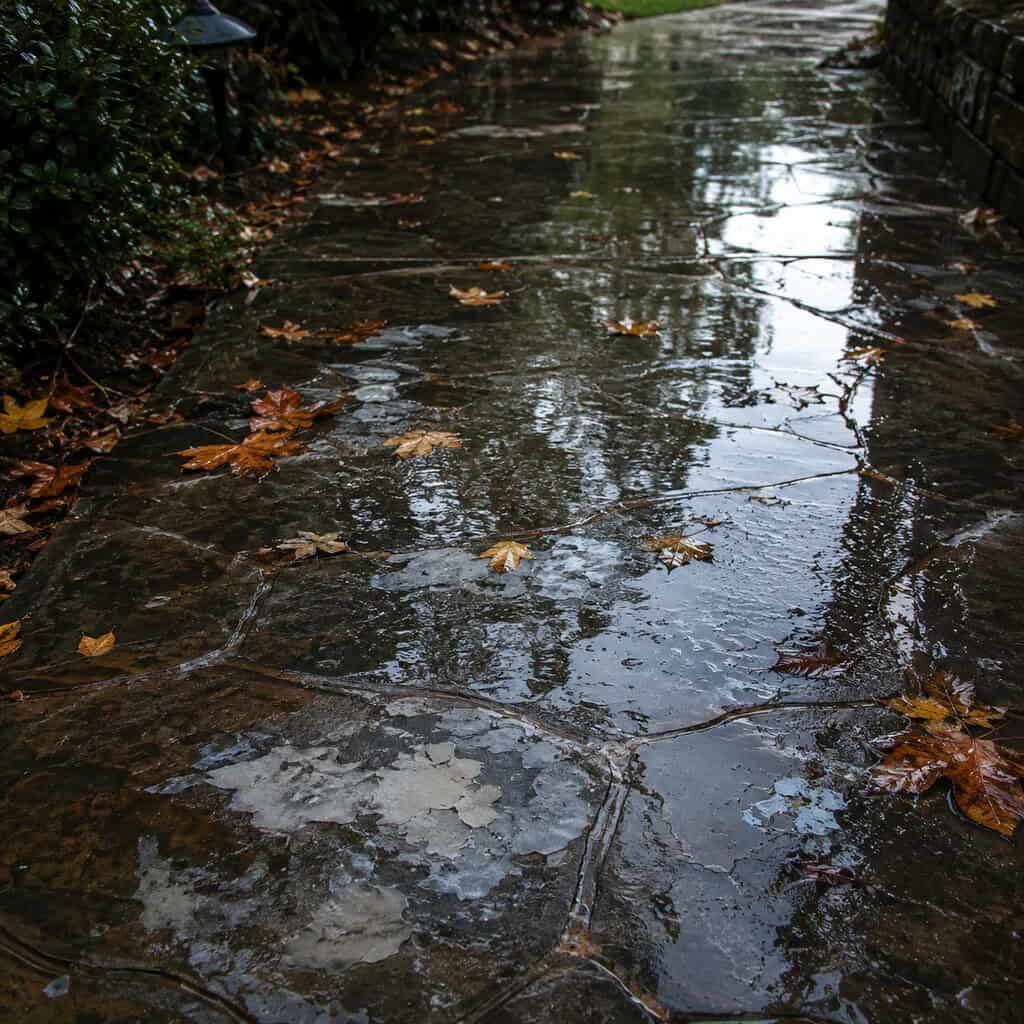
Wet concrete looks richer than dry concrete. Someone figured out how to bottle that, and the showroom sample is gorgeous.
In practice, a film-forming glossy sealer turns a shaded walk into an ice rink the first damp autumn. It traps moisture underneath, which then hazes the film white. By year three it’s peeling in sheets, and stripping it is a chemical nightmare.
The same logic quietly ruins polished porcelain and honed stone chosen under showroom lighting. Smooth is a liability outdoors.
Pros use a breathable penetrating sealer and pick a textured, thermal, or flamed surface finish. Experienced stone installers will talk many clients out of sealing entirely.
13. Decomposed Granite With No Stabilizer
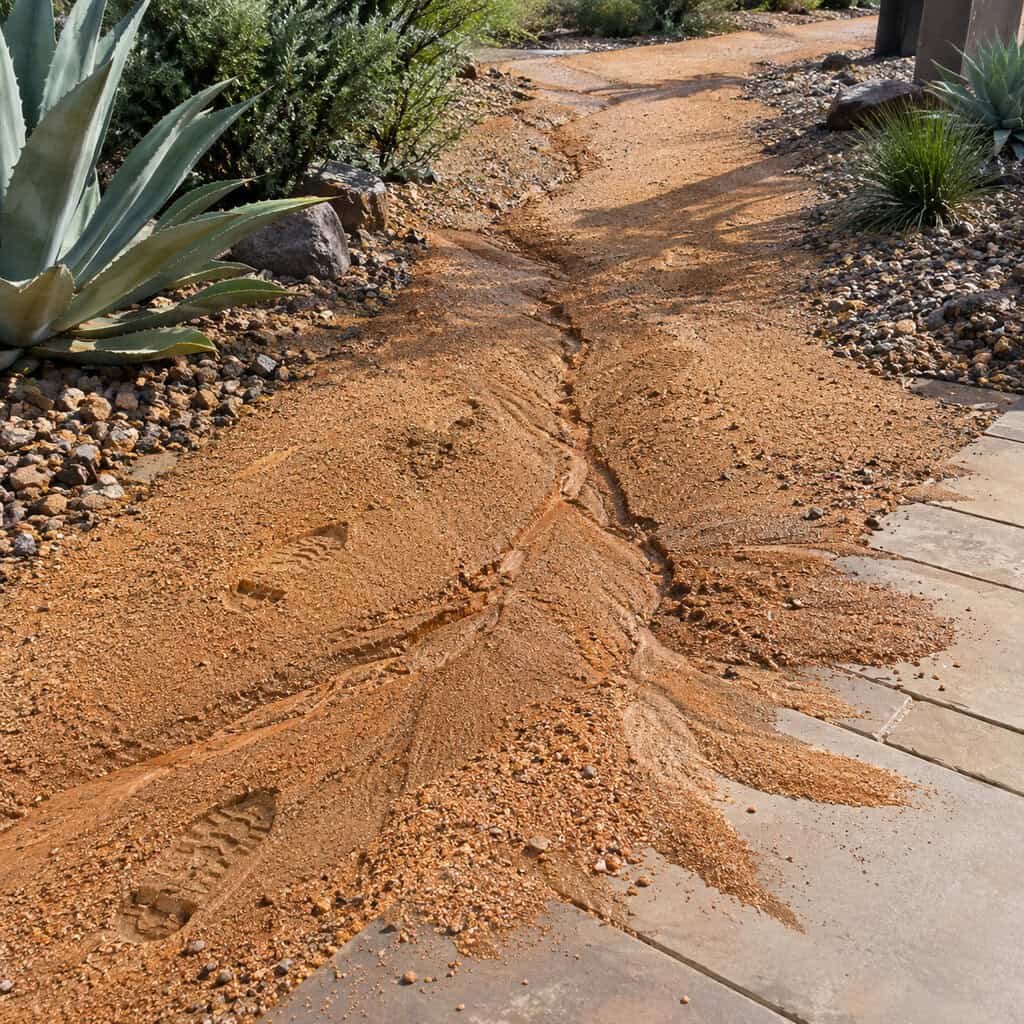
Raw DG is a one-season European garden path.
It rills into channels during the first real downpour, holds a print of every footstep, and migrates toward the low end of the property. The orange dust tracks across tile floors and permanently tints car carpets.
Stabilized DG — mixed with a resin or lime binder, compacted in lifts, edged in steel — holds its surface for years and still drains. It costs more per ton and saves you the annual rebuild.
14. A Driveway That Drains Toward the House
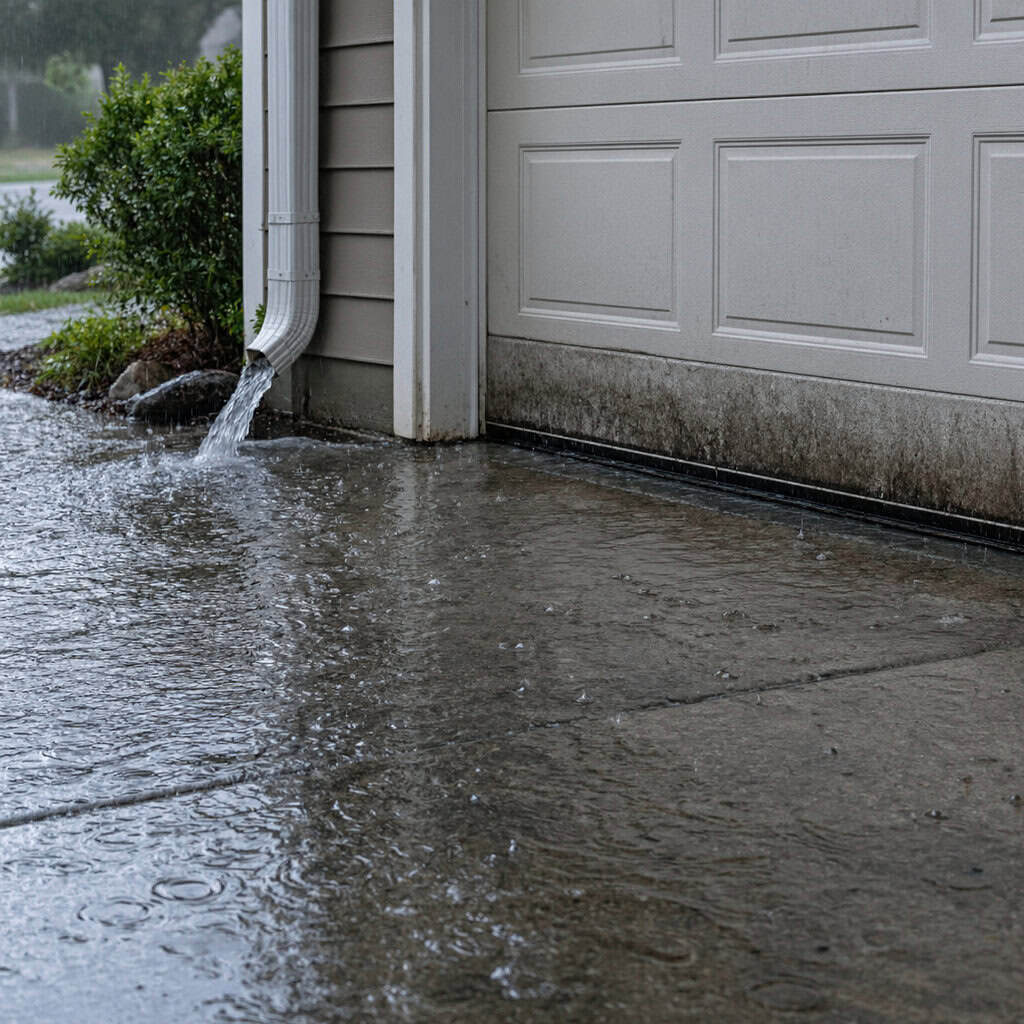
This is the one that costs the most money to fix and the most money to ignore.
A flat or back-pitched driveway sends every inch of rain toward the garage slab and the foundation wall. Pavement is impervious, so a 600-square-foot driveway generates roughly 375 gallons of runoff in a one-inch storm — and all of it goes wherever the slope points.
The minimum target is 1 to 2 percent of fall away from the structure. That’s an eighth to a quarter inch of drop per foot, or roughly 2 to 4 inches across a 16-foot-wide drive. Below 1 percent, surface tension and minor settlement are enough to hold puddles in place.
At the garage apron, a trench drain tied to daylight or a dry well catches whatever the grade can’t shed. Where the drive is already in and can’t be repitched, that trench is the fix.
Then there’s the compounding error: a downspout discharging onto the driveway. In winter it freezes into a sheet across your walking path. In spring it funnels roof water straight to the foundation. Pipe downspouts underground past the paving — a few hundred dollars that routinely prevents a five-figure basement job.
Permeable paving is the other route. University extension programs document the stormwater math closely, and the Virginia Cooperative Extension covers both permeable pavement systems and the base reservoirs they require. If the broader yard already floods, start with the grading and gutter work before you pour anything.
15. Railroad Ties and Timber Step Risers
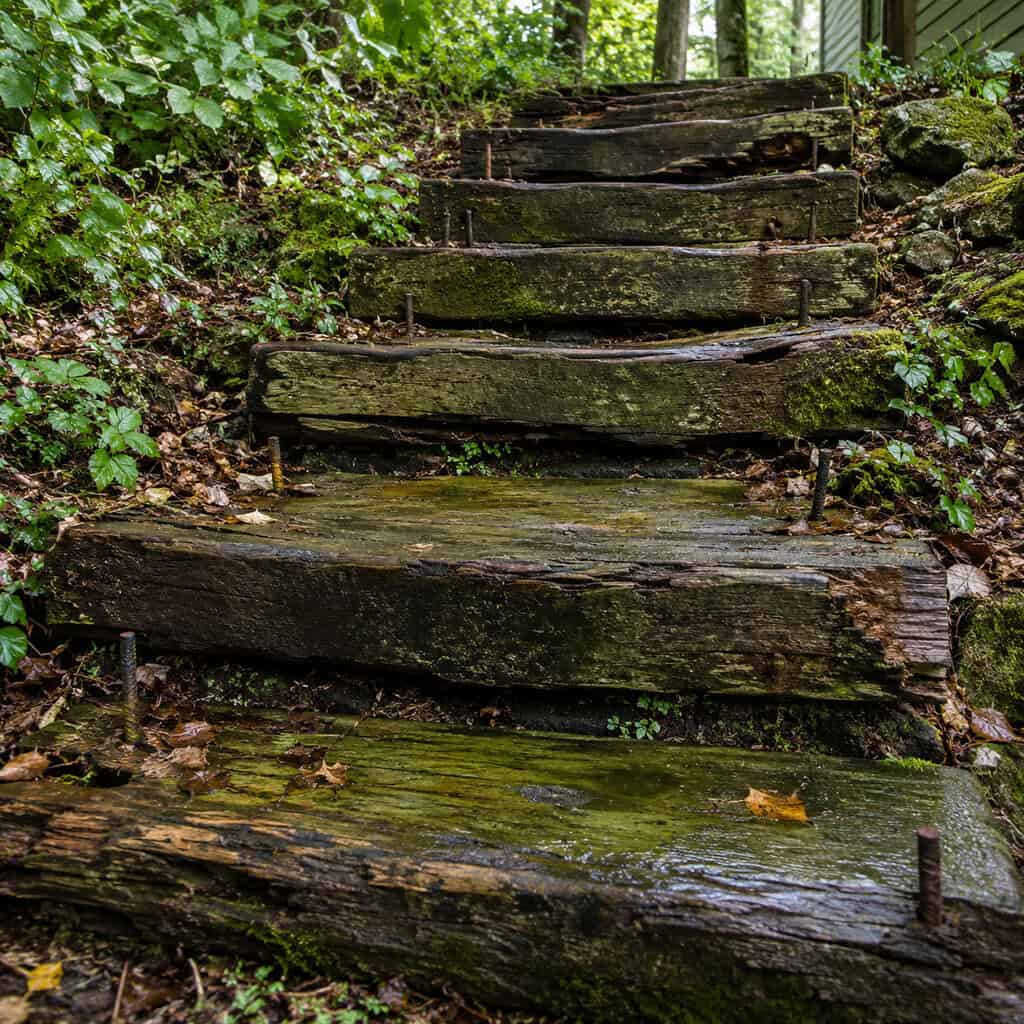
They were everywhere from 1975 to 1995, and almost none of them are still square.
Creosote ties bow, splinter, and leach dark staining into the soil below them. The rebar spikes work loose as the wood shrinks, so the treads start to shift underfoot. Algae turns the flat tops slick by the second wet spring.
Creosote is a genuine problem around kids, dogs, and anything edible growing nearby. The EPA restricts its use, and pressure-treated replacements aren’t much better looking after a decade.
Precast concrete step units, solid stone slabs, or segmental wall block cost more upfront and are still dead level in twenty years.
16. Concrete ‘Resurfacer’ Over a Cracked Slab
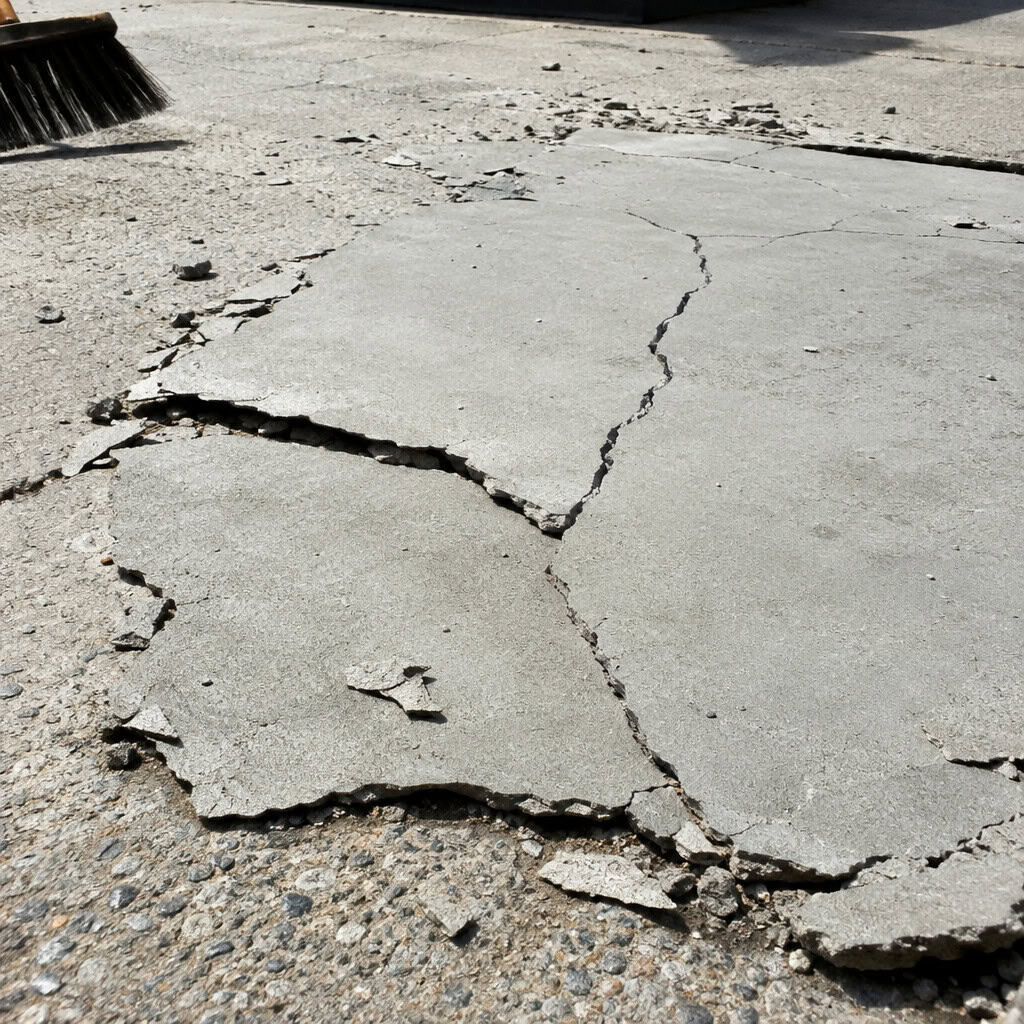
The pitch is irresistible: skim a quarter-inch overlay across a tired driveway and it looks new for a few hundred dollars in material.
The physics don’t cooperate. A thin bonded overlay is mechanically attached to the slab beneath it, so whatever that slab does, the overlay does too. Existing cracks telegraph through within a season — often within one freeze cycle. Then water gets into the crack, freezes under the overlay, and the topping delaminates in dinner-plate-sized sheets.
Resurfacing works on a slab that’s structurally sound and merely ugly. Spalled surface, light wear, discoloration — fine. Cracks wider than a credit card, elevation changes between sections, or rocking slabs mean the base has failed, and nothing you apply to the top will fix the bottom.
For settlement, pros use slab-jacking or polyurethane foam lifting — holes the size of a penny, foam injected underneath, the slab raised back to grade in a couple of hours. Typically $600 to $1,800 for a driveway section versus $6 to $12 per square foot for replacement.
When a section is cracked through in multiple directions, the honest answer is saw-cutting it out full depth and pouring new. Replacing one panel properly beats resurfacing the whole drive twice.
17. Slate and Soft Layered Stone Outdoors
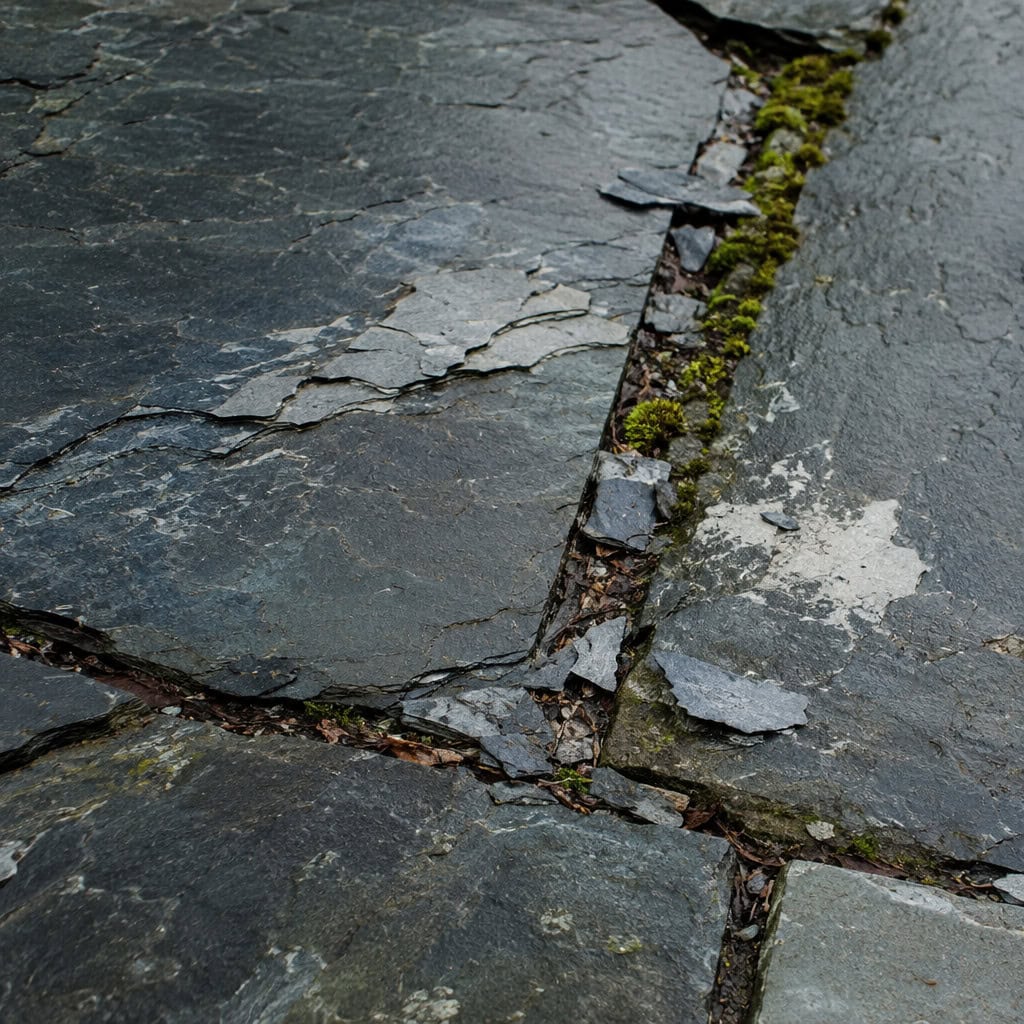
Slate is made of layers. Water gets between them.
In a freeze-thaw climate that water expands and pries the top lamination loose, so every spring the surface sheds thin flakes and leaves pale scars where the dark color used to be. Within five years a slate walk reads as mottled and chalky instead of rich.
Dense bluestone, granite, and dimensional limestone handle the same winters without delaminating. Ask the supplier for the stone’s absorption rating and whether it’s rated for your freeze-thaw zone — reputable yards have the number.
18. Polymeric Sand as a Fix for a Bad Base
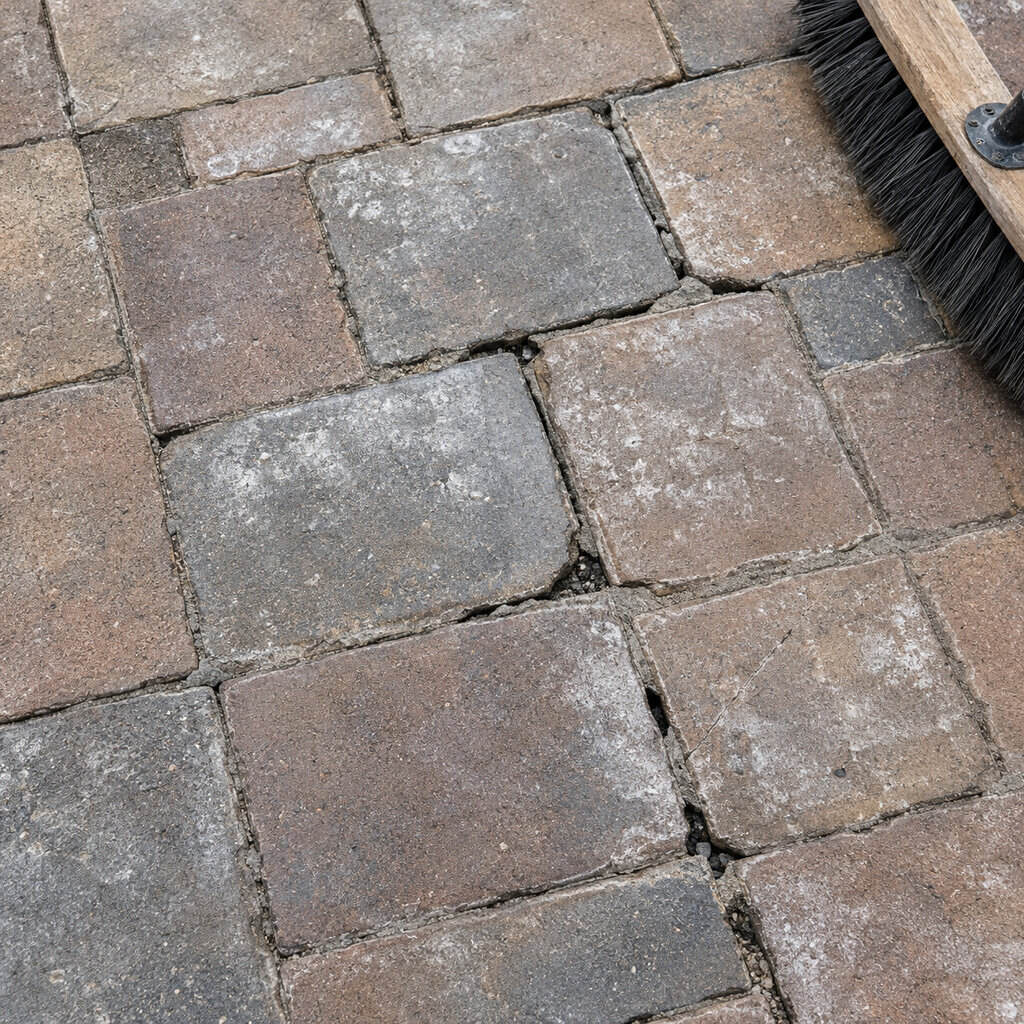
Polymeric sand is a finish. It is not a structural product, and it cannot stabilize anything.
Sweep it into the open joints of a paver walk that’s already moving and you buy roughly one season. The hardened joints crack along the same lines the pavers are shifting on, then crumble down into the voids underneath.
Install it on damp pavers or water it wrong and you get the other classic failure: a white polymer haze bonded to the paver faces. Removing that is genuinely miserable work.
Fix the base, re-compact, reset the field, then sand. In that order.
19. Black Plastic Coil Edging
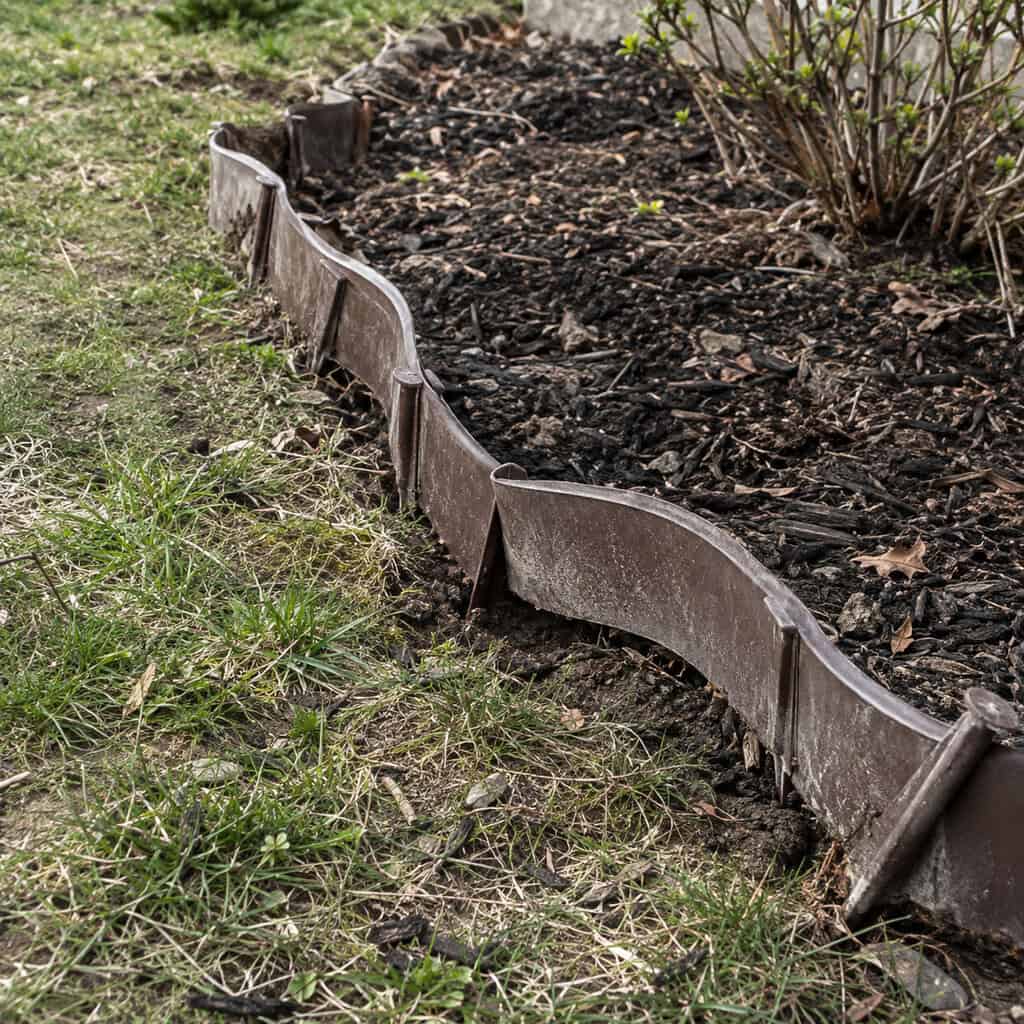
The brown roll with the bulbous top rim, sold for about $25 for 20 feet.
Frost pushes it up every winter and it never goes back down. The stakes pull out. By year two it’s waving above the mulch line like something surfacing in a lake, and UV has turned it brittle enough to snap when you try to push it back.
Eighth-inch steel or aluminum edging costs three times as much and holds a crisp line for decades. Where vehicles are involved, a poured concrete curb is the only thing that survives a tire.
20. An Artificial Turf Walkway
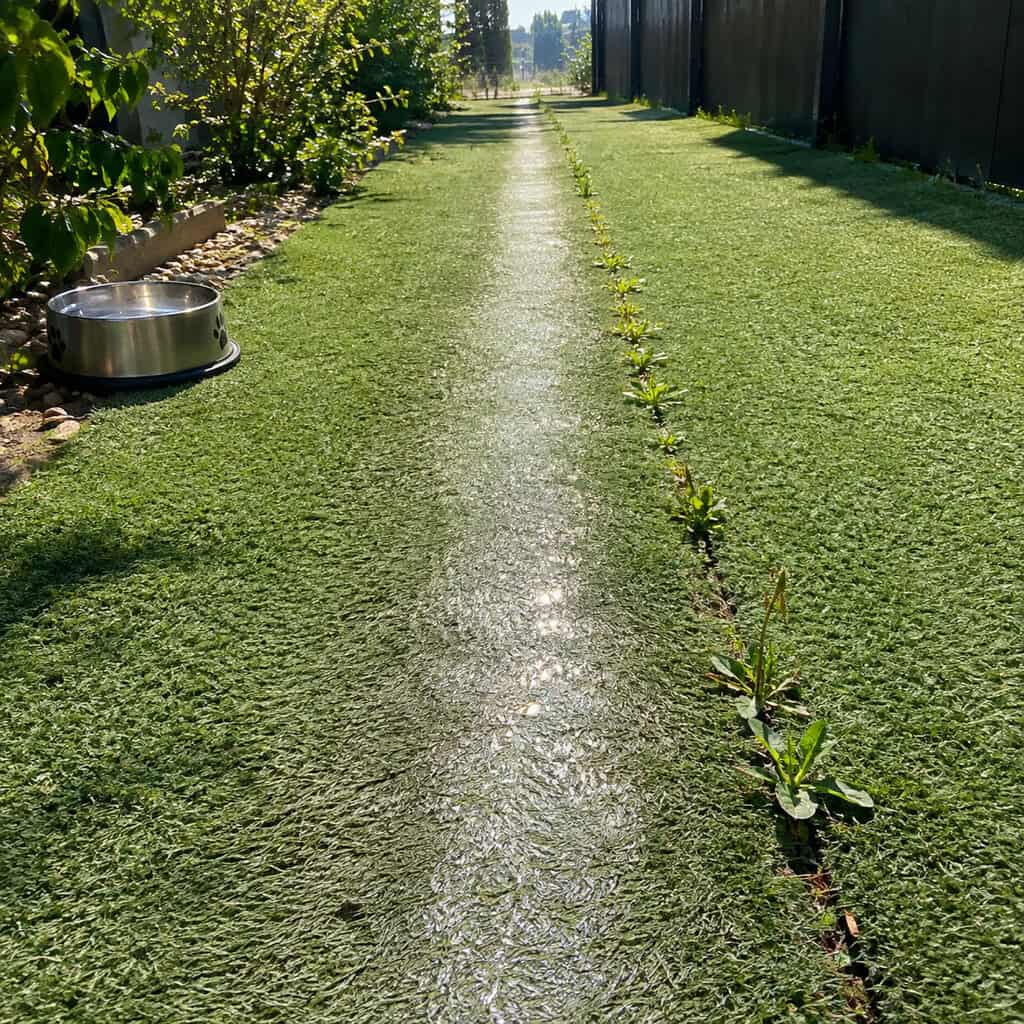
Synthetic grass surfaces can run 40 to 60 degrees above air temperature in direct sun. A 90-degree afternoon makes a turf path genuinely too hot for bare feet or dog paws.
It also flattens. Traffic lanes develop a shiny, matted sheen that no brushing restores, and pet odor settles into the infill and stays.
Weeds still win, too — they colonize the seams and root in the accumulated organic debris on top.
For the soft green effect, pros set a stone path and plant creeping thyme or dwarf mondo grass in the joints. It smells like something when you step on it, and it doesn’t cook.
21. Running-Bond Pavers Under Car Tires
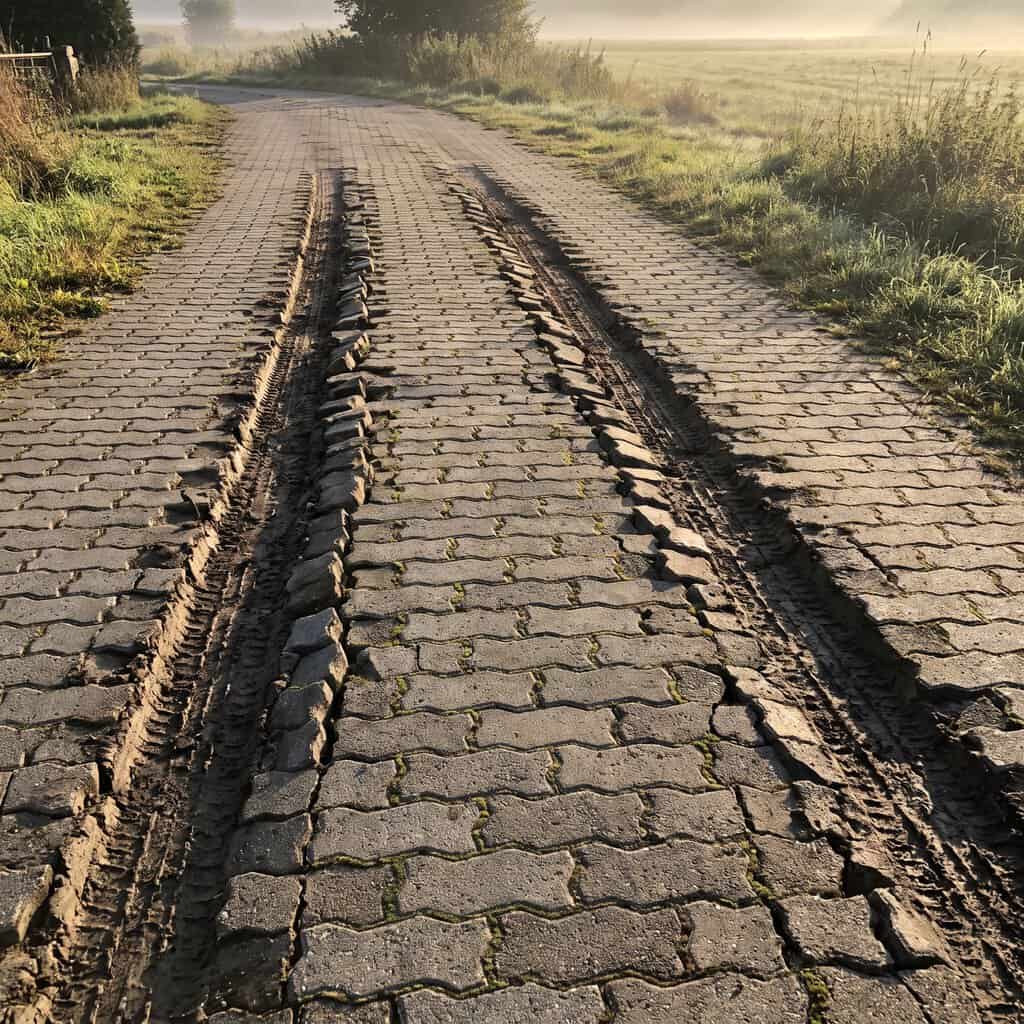
Pattern isn’t decoration on a driveway. It’s structural.
Running bond and stack bond create continuous straight joint lines. Braking and turning forces push pavers along those lines, so the wheel paths slowly rut and shove out of alignment.
Herringbone — 45 or 90 degrees — breaks every joint line within one paver’s length. There’s nowhere for a unit to travel. It’s the pattern engineers specify for vehicular interlock, and it’s why you see it on port yards and bus lanes.
Save the running bond for the front walk.
22. Sealcoating Asphalt Every Single Year
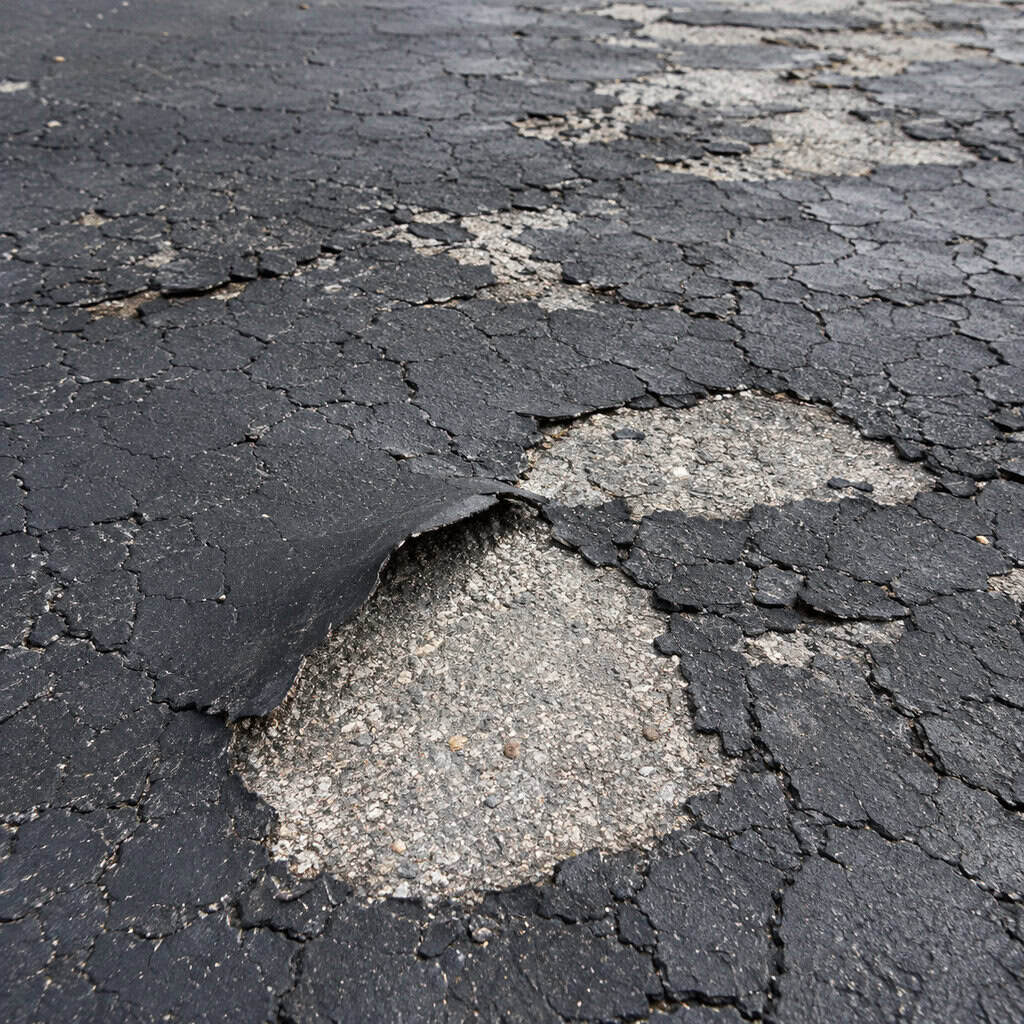
An annual sealcoat sounds like diligence. It’s an upsell.
Each coat adds thickness to a surface layer that has no flexibility. Stack five or six and the skin alligators into a web of fine cracks, then peels away in patches that look worse than the asphalt did.
Sealing brand-new asphalt is the other half of the mistake. Fresh pavement needs 6 to 12 months to cure and release its oils. Seal it early and you trap those oils, leaving a surface that stays soft enough to scuff under a kickstand.
Every three to five years is the real interval. Put the money you save into crack filling — that’s the maintenance that actually extends pavement life.
23. A Gravel Driveway on a Real Slope
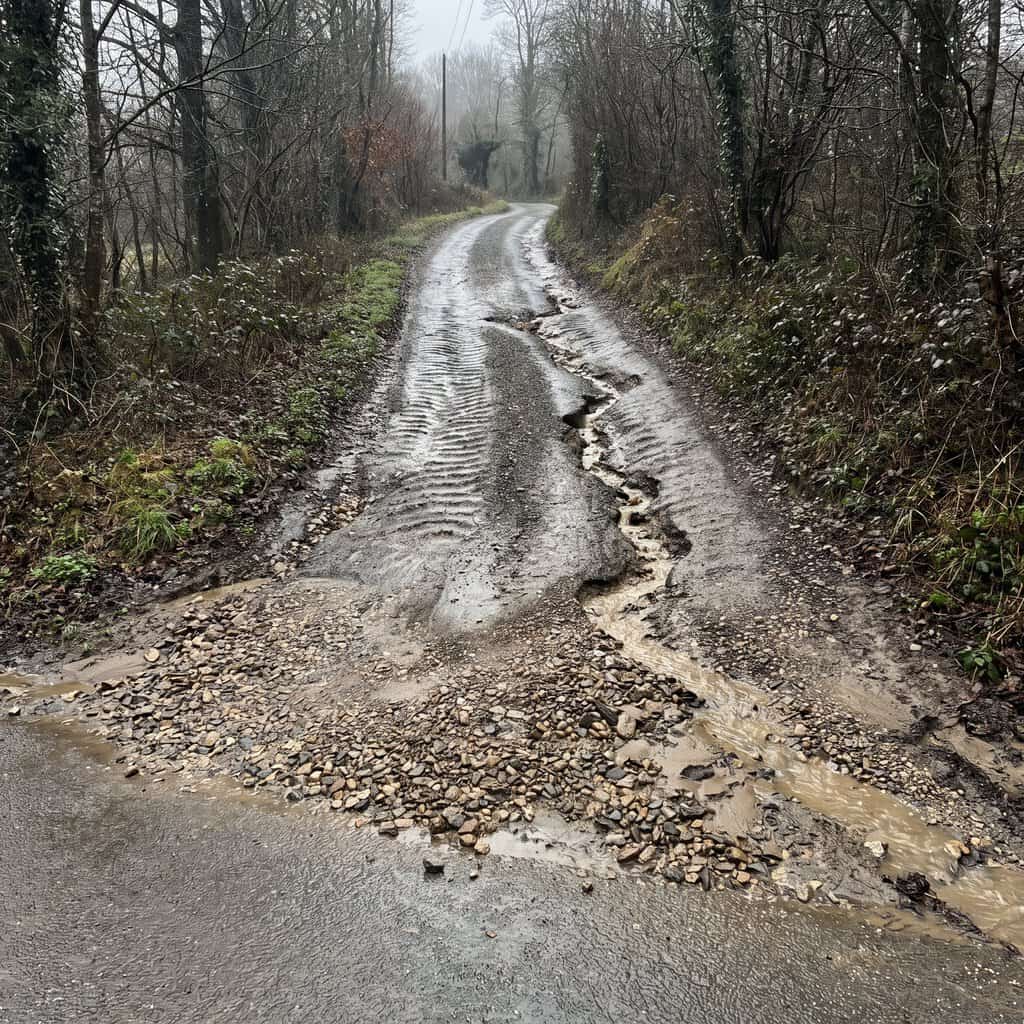
Past roughly 8 to 10 percent grade, loose stone and stormwater stop being compatible.
Water accelerates down the wheel tracks, carries the fines out, and leaves a washboard of ruts and an eroded gully at the bottom. You regrade every spring and buy more stone every fall.
Two fixes work. Pour concrete or asphalt ribbons in the wheel tracks and leave gravel between them — cheaper than full paving, and the ribbons stop the scouring. Or install a cellular gravel grid, a honeycomb panel that holds the stone in individual cells so it physically can’t migrate.
24. Recycled Rubber Pavers and Mats
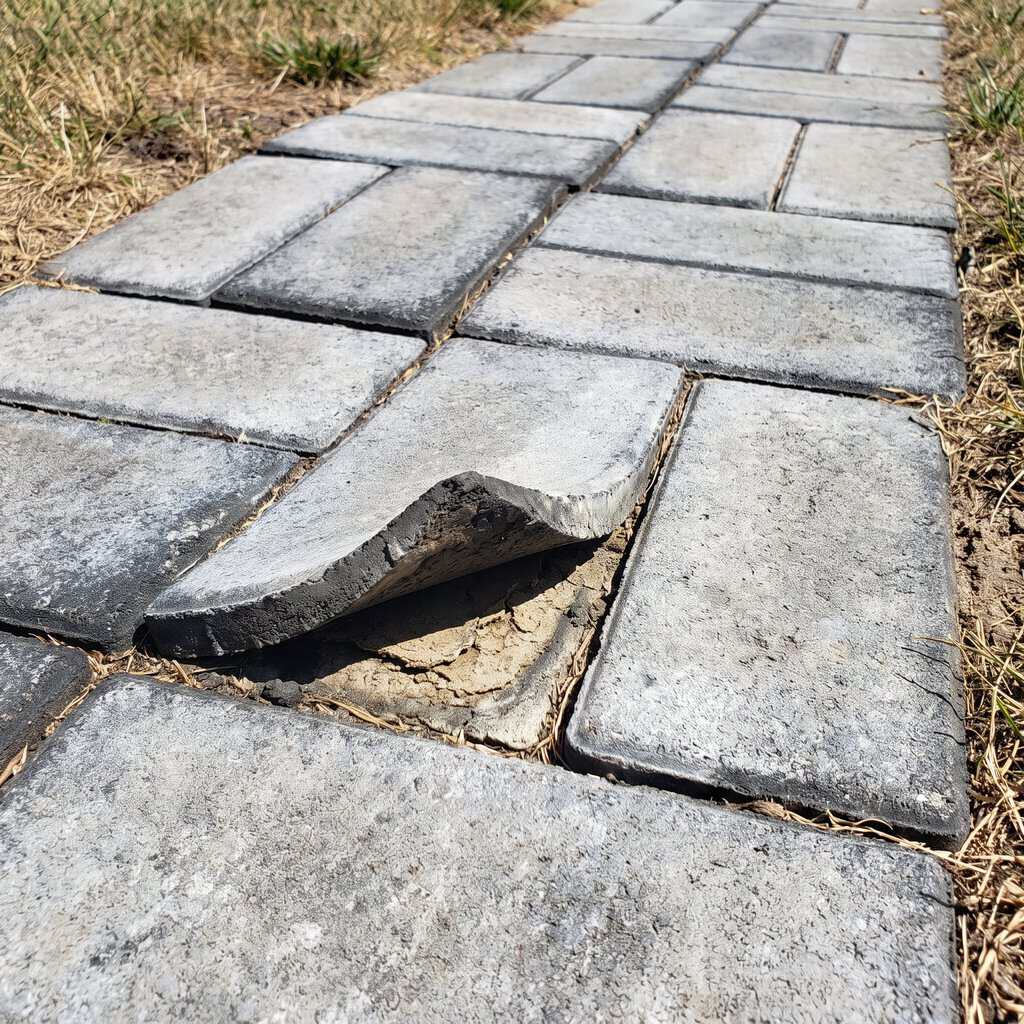
Sold as the surface that can’t crack. True, and irrelevant.
Rubber softens in summer heat and gives off a distinct tire smell on hot afternoons. UV bleaches it from black to a chalky gray within three or four seasons. The adhesive at the edges releases, the mats curl upward, and now you have a trip hazard that also looks bad.
If the appeal was drainage, permeable pavers do that job properly — the University of Illinois Extension lays out how the open-graded base beneath them actually stores and infiltrates runoff. If the appeal was durability, driveway-rated concrete pavers win outright.
25. A Nine-Foot Driveway With Nowhere to Turn Around
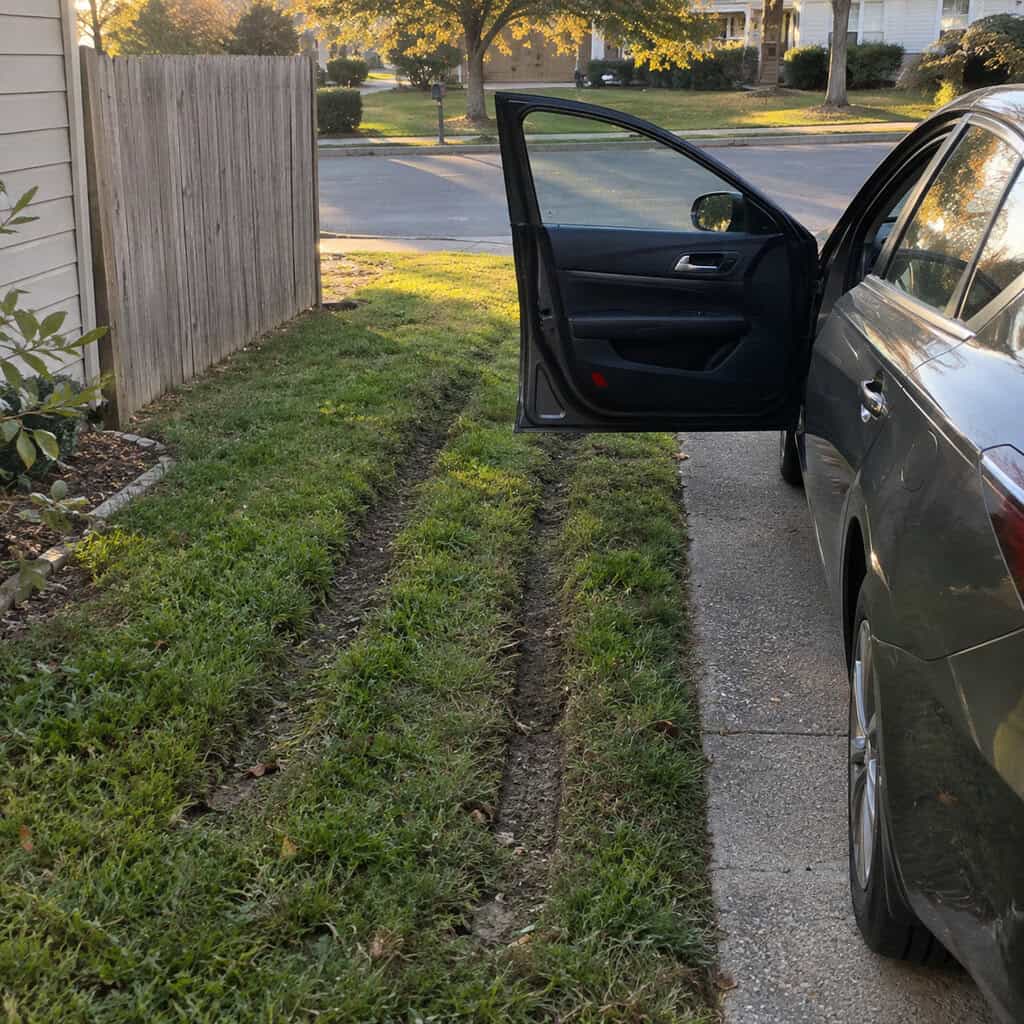
You feel this one every single day for as long as you own the house.
Nine feet means opening a car door over the lawn, or over the mulch bed, or not fully at all. Single drives want 10 to 12 feet minimum — more if there’s a walkway running alongside or if anyone in the house uses a cane or a wheelchair.
No turnaround is the bigger regret. It means backing into the street every trip, in the dark, in the rain, for thirty years.
Widen to 12 feet and add a parking apron or a bump-out while the excavator is already parked on site. Coming back later means a second mobilization charge and a seam where old meets new.
26. Cheap Solar Stake Lights Along the Walk
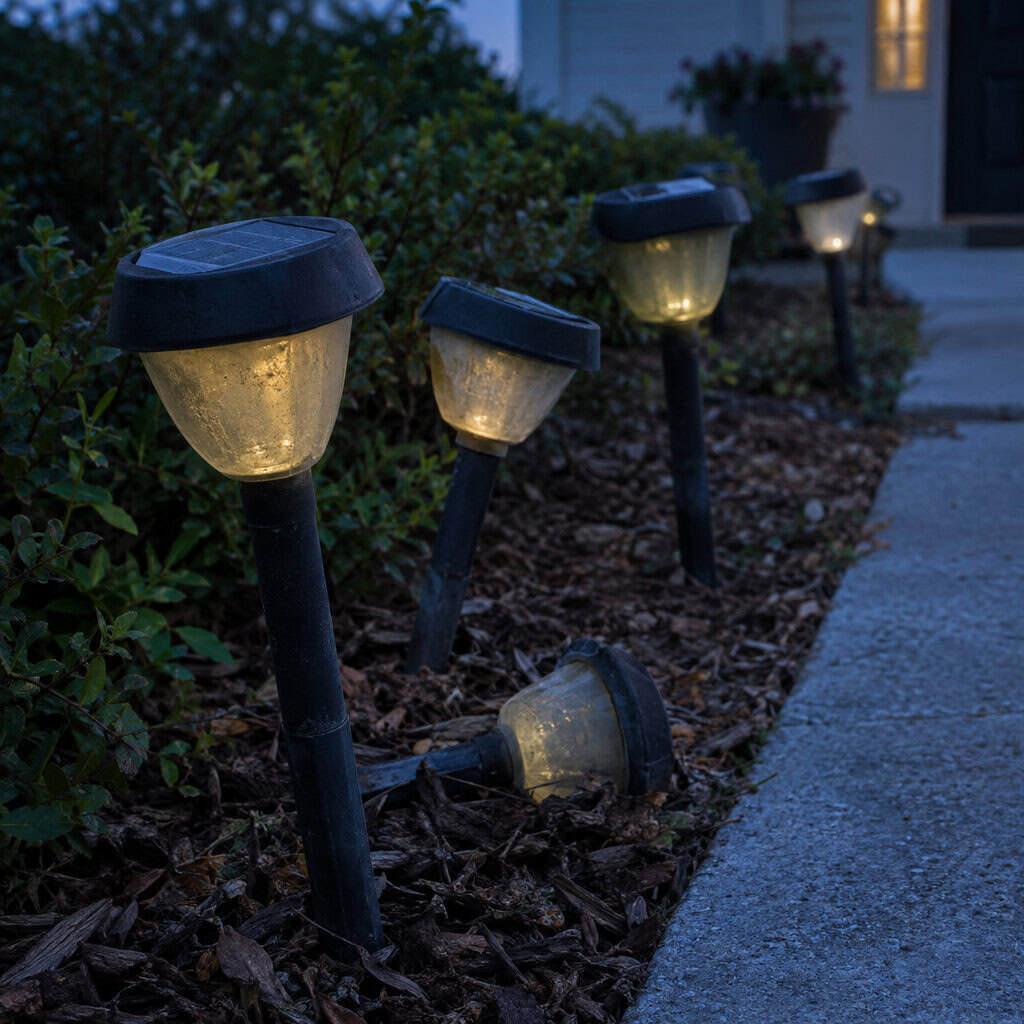
Six for $30, and that’s roughly what you get.
The NiMH batteries lose capacity within a year, so by season two they glow for ninety minutes instead of eight hours. The plastic lenses cloud over from UV. Every one of them leans after the first few mows, and eventually they’re just colored plastic lying in the bed.
A low-voltage landscape system runs a transformer off a GFCI outlet and buried 12-gauge cable to solid brass or copper path fixtures. Real light output, aimable, dimmable, and the fixtures outlive the house. Budget $100 to $200 per fixture installed and stop buying stakes forever.
27. A Single Odd-Height Step in the Walk
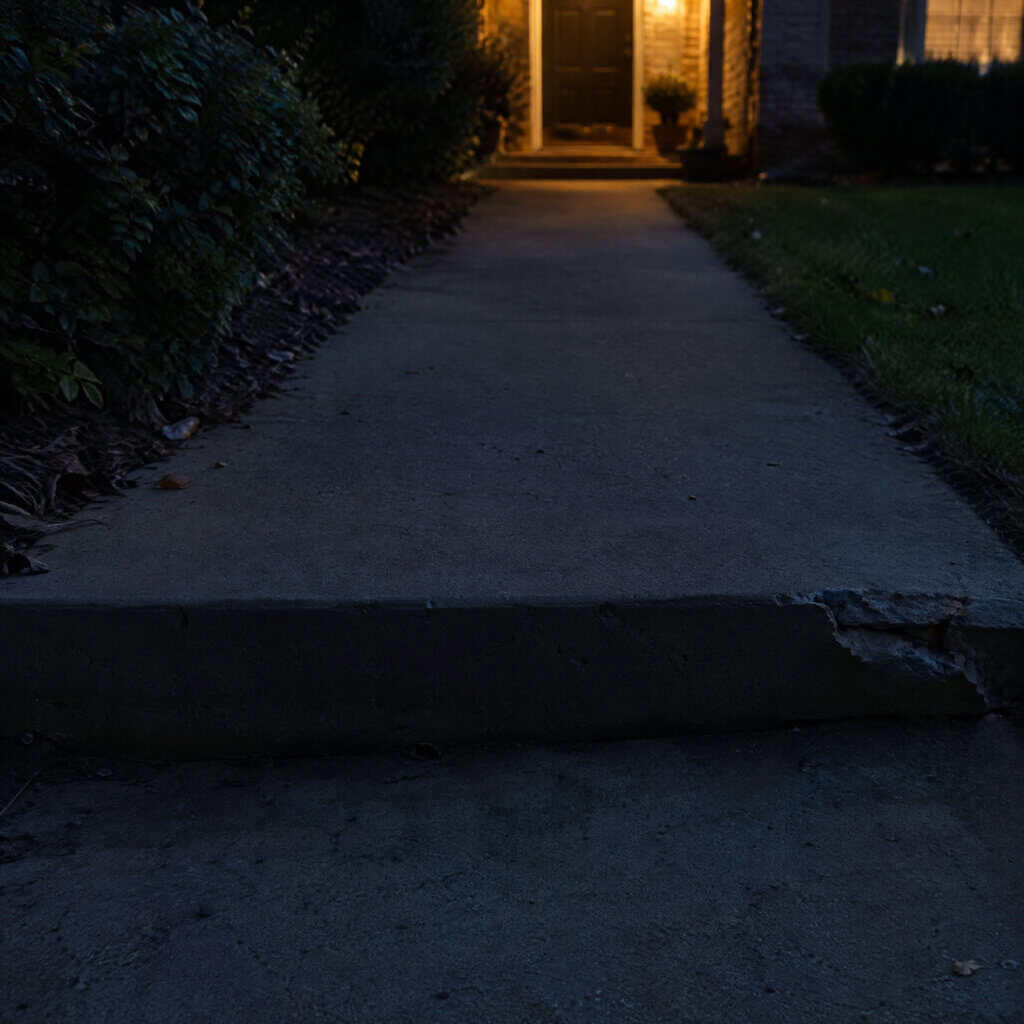
One lone riser is the most reliable fall hazard in any front yard.
The brain reads a walkway as continuous. A single 5-inch drop, or a flight where one riser is 6 inches and the next is 7-1/2, gets missed — especially at night, especially by anyone carrying something.
It almost always comes from fitting a walk to an existing grade after the fact instead of designing the grade and the walk together.
Regrade to eliminate it if you can. If you can’t, build a proper run of three or more risers at uniform height, add a graspable handrail, and light the treads. Code typically allows no more than 3/8 inch of variation between risers in a flight, and that number exists for a reason.
28. A Shade Tree Planted Four Feet From the Walk

The tree wins. It always wins.
A sapling four feet off the front walk looks balanced the day it goes in the ground. Eight years later, the structural roots that flare from the trunk have thickened into the top 12 to 18 inches of soil — exactly where your base course lives — and they lift slabs like a jack.
The worst offenders are the fast, shallow-rooted species builders love because they fill a lot quickly. Silver maple. Sweetgum. Bradford pear. Willow. Northern catalpa. They’re also the species most likely to drop limbs, which is a separate conversation.
- Large shade trees: 15 to 20 feet from any hard surface
- Medium trees: 10 to 12 feet minimum
- Small ornamentals: 6 to 8 feet
- Never directly uphill of a retaining wall or step run
Where a tree is already established, keep the nearby surface flexible. Dry-laid pavers or flagstone can be lifted, the root shaved or root-pruned by an arborist, the base rebuilt, and the stones reset. Poured concrete gives you one option: demolition.
Root barriers installed at planting — rigid panels 24 to 36 inches deep along the walk side — redirect roots downward instead of outward. They cost almost nothing at planting time and nothing works as well afterward. Before anything goes in the ground near hardscape, it’s worth knowing what that tree actually becomes.
29. A Tar-and-Chip Driveway
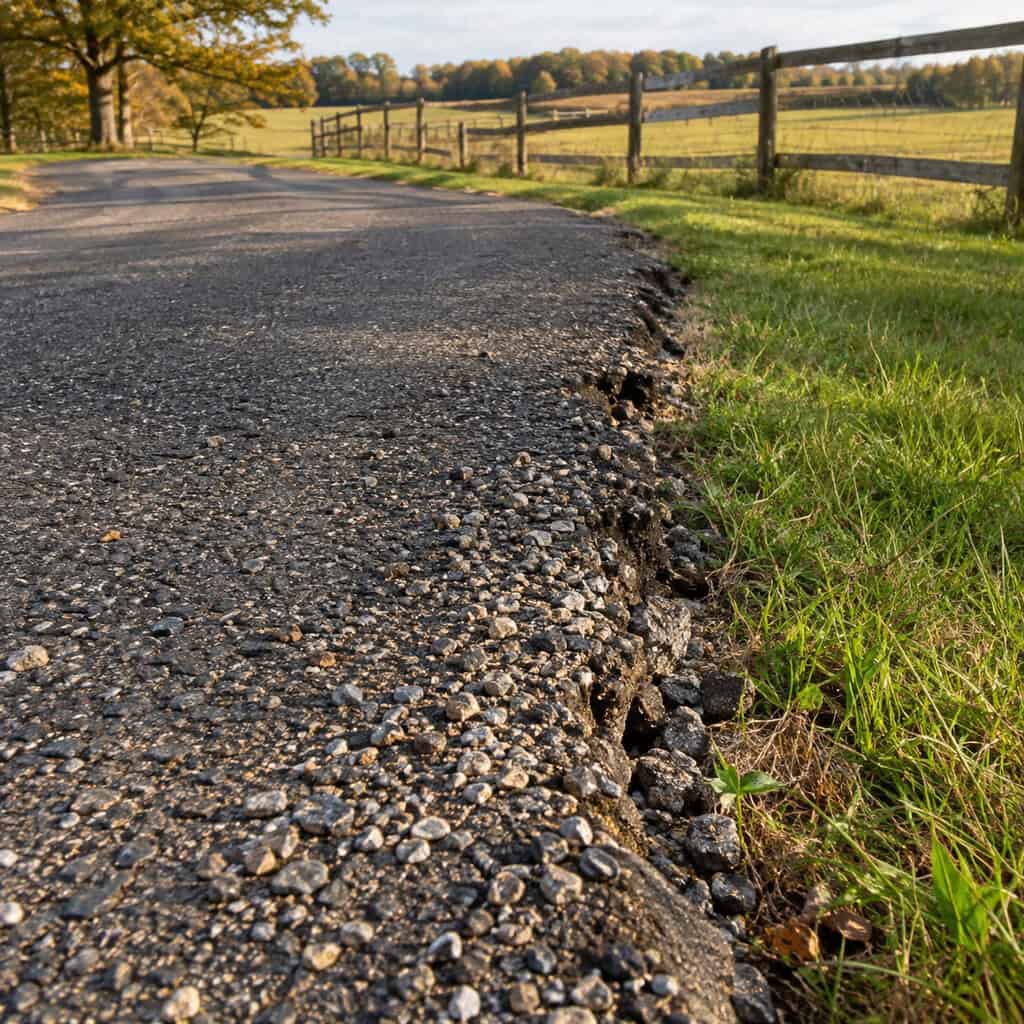
Honest judgment call: chip seal earns its reputation on long rural drives, where it’s dramatically cheaper than asphalt and the rough texture gives real traction.
On a suburban lot it reads as unfinished. It sheds loose stone for the first several months — into the lawn, into the garage, under the mower — and a plow blade scrapes the chips right off. Edges crumble where there’s no curb to hold them.
If your drive is 400 feet of gravel that washes out annually, chip seal is a genuine upgrade. If it’s 40 feet from the street to a two-car garage, spend the difference on asphalt.
30. White Marble Chips and Decorative White Stone
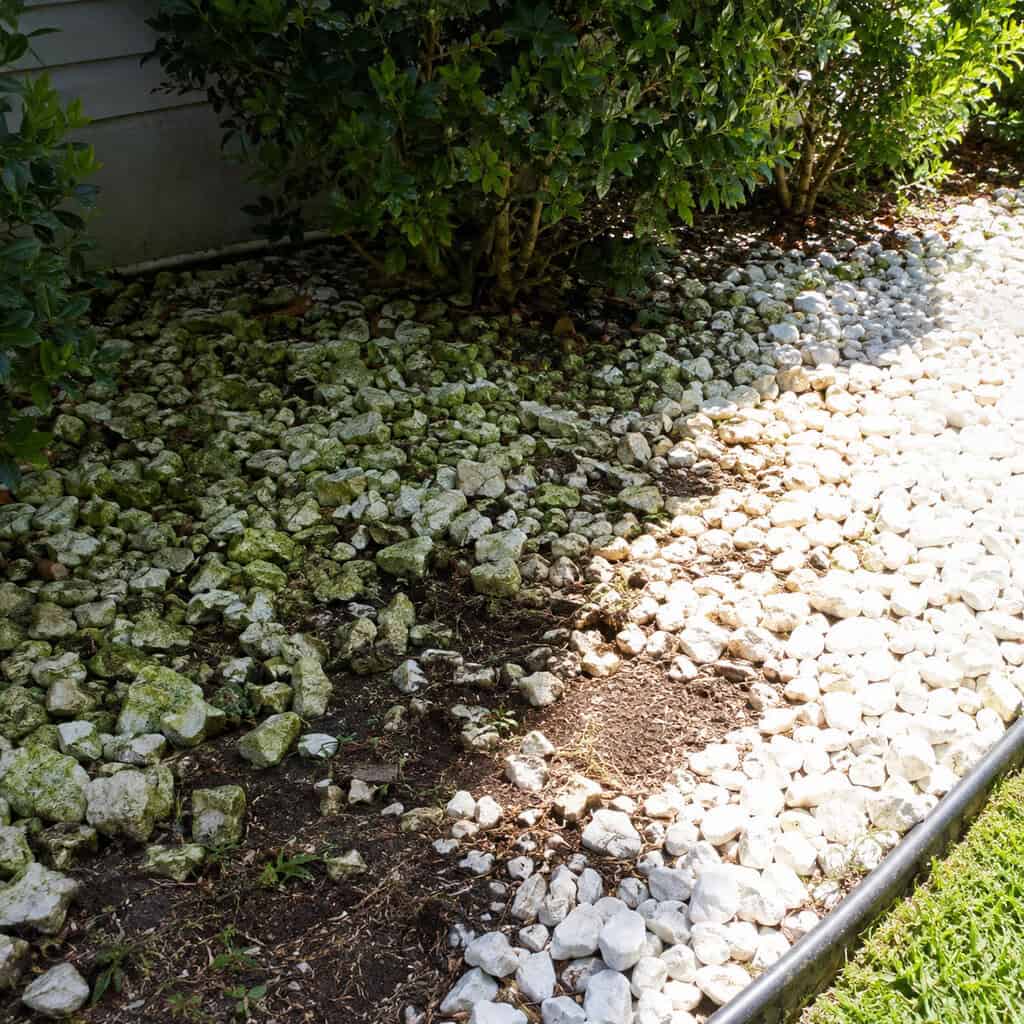
Blinding in July, green in November.
White marble and dolomite chips throw serious glare off a south-facing front yard, and in shade they grow algae that stains them a dull gray-green. Marble is also soft enough that it breaks down and stains rust-colored where iron is present in the soil.
And like all decorative stone without a proper separation layer, the chips sink. Within four or five years half the stone is embedded in soil and you’re hauling in more.
If you want light-colored stone, use an angular crushed granite or a tan pea-size limestone over woven geotextile, and expect to top-dress it.
31. Antique Cobblestone and Rough-Tumbled Setts
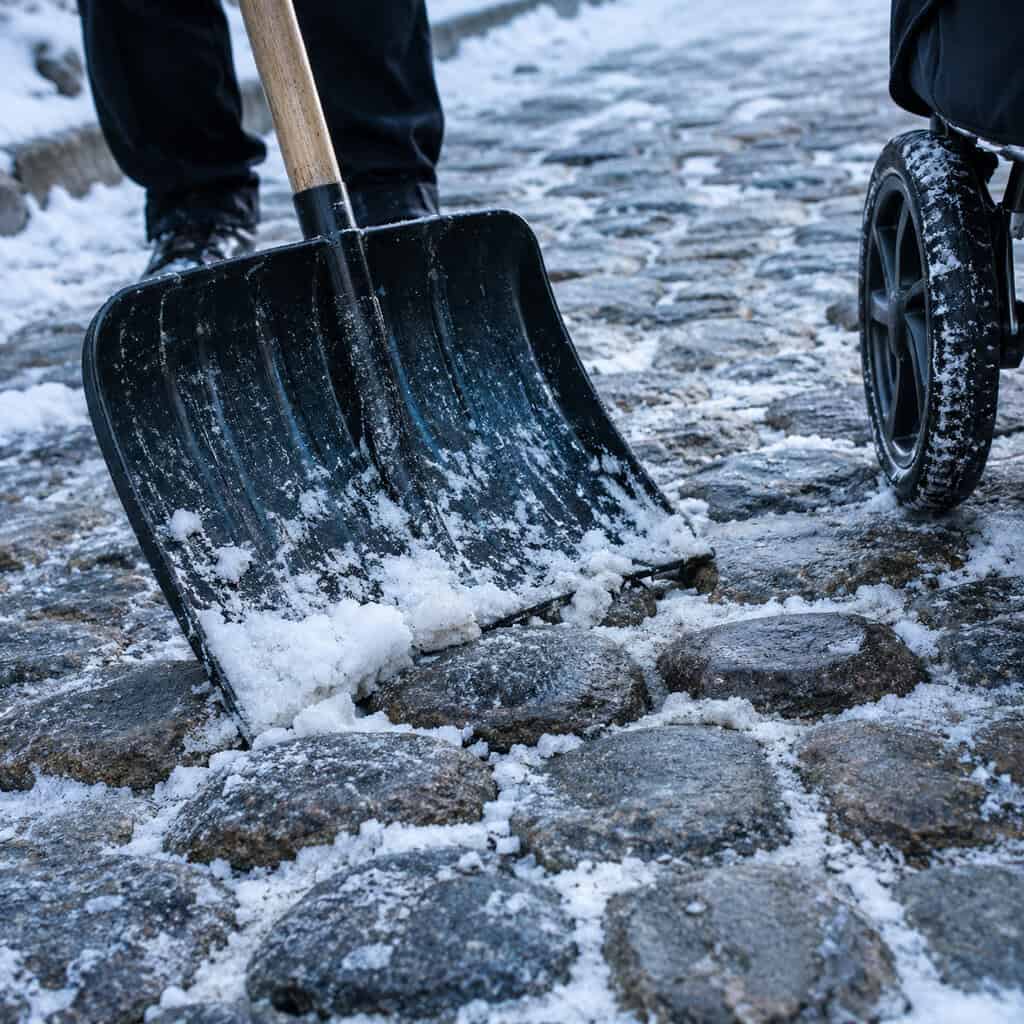
These are the most beautiful materials on this list, and they’ll outlast your house by two centuries.
They also fight everything that rolls. A snow shovel catches on every joint. Strollers rattle hard enough to wake a sleeping kid. Heels wedge between setts. A wheelchair is close to impossible, and for anyone with a balance issue the surface is a daily negotiation.
Genuine cobble has a place — a short apron, a decorative border, a drive court where nobody walks much. As the main route from the car to the front door in a snow climate, it’s the kind of beauty you quietly resent by February.
Sawn-top setts split the difference. Same stone, same look from six feet away, flat enough to shovel.
Nearly every regret on this list traces back to the same two decisions: what’s underneath, and how wide.
Base depth and compaction determine whether a surface is still flat in ten years. Dimensions determine whether you enjoy using it. Both are invisible in the showroom and both are nearly impossible to change later.
The material you pick is the part everyone argues about. It’s the part that matters least.
Get the boring decisions right and almost anything looks good on top of them.