


Walk past a good garden center in late February. The pots flanking their front door still look intentional — green, structured, a little red somewhere.
Now look at your porch.
The spruce went bald by New Year’s. The birch branches slid sideways in a windstorm. Whatever berries were in there are gray and shriveled, and the whole thing has that sad post-holiday slump you keep meaning to deal with.
The difference isn’t money. It’s material selection and about four techniques nobody tells you about when they’re ringing up your greens.
Professional winter containers get built in November with March in mind. Every stem, every live plant, every hidden layer is chosen because it survives a freeze-thaw cycle or because it wakes up right when everything else quits.
Here are 33 things garden centers put in their own winter pots — and why each one is still standing when yours isn’t.
1. Fraser and Concolor Fir Boughs
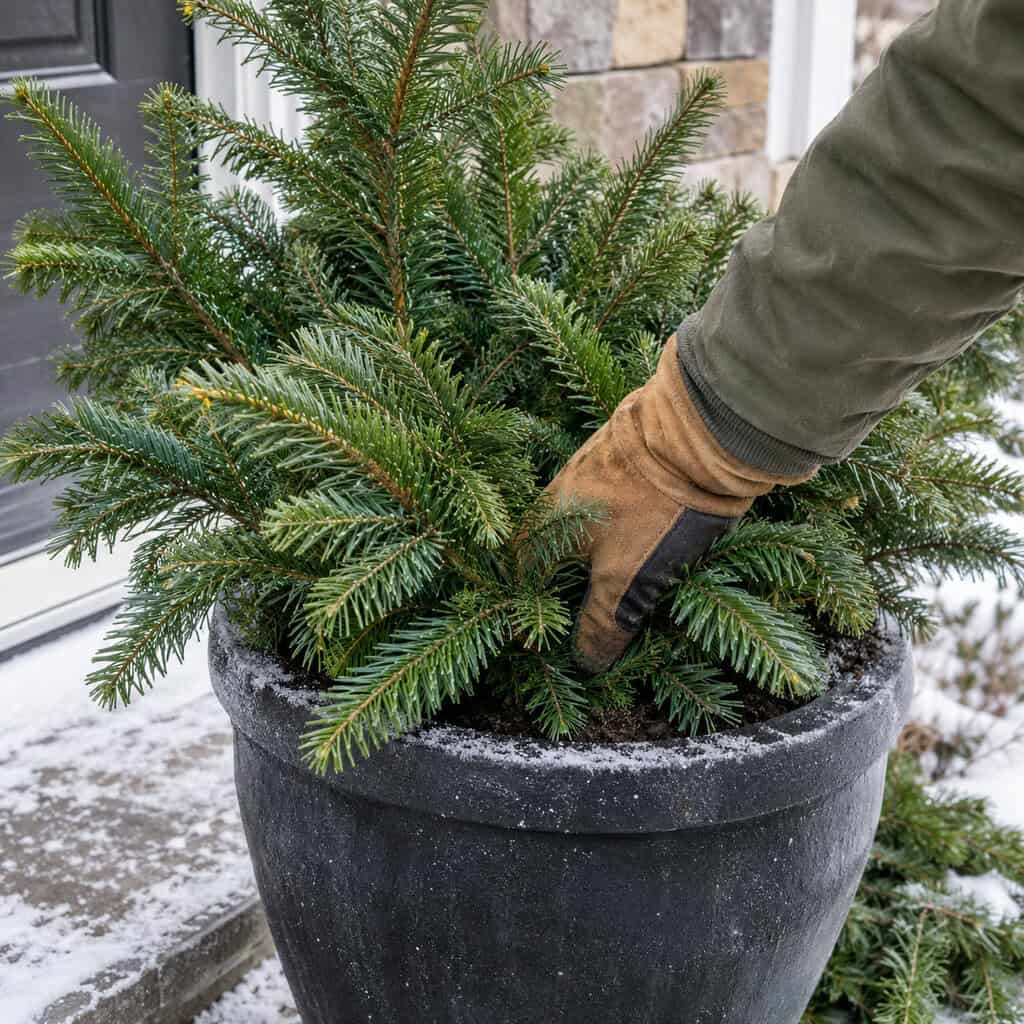
Start here, because this single choice decides whether your pot lasts six weeks or sixteen.
Cut fir holds its needles far longer than cut spruce. Blue spruce can start dropping within about two weeks indoors, and it isn’t much kinder outside once the wind gets at it. Fraser fir just sits there being green.
Concolor fir goes a step further — crush a needle and you get citrus, almost tangerine. Garden centers build the skeleton of nearly every porch pot out of fir boughs for exactly this reason, then layer the fussier material on top.
Ask for fir by name. If the bundle is unlabeled and the needles roll between your fingers like little square pins, that’s spruce. Put it down.
2. Winterberry Holly Stems
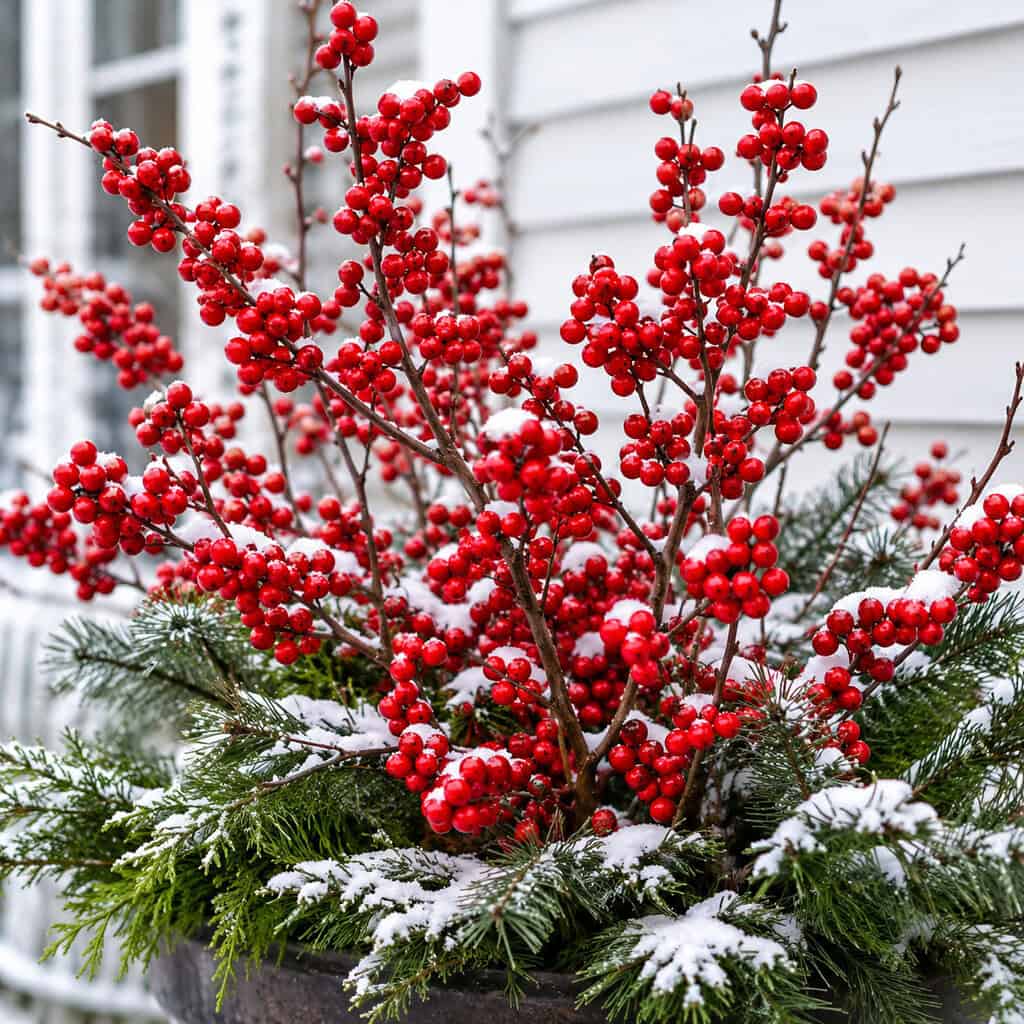
This is the red that reads from the curb at thirty miles an hour.
Winterberry is a deciduous holly — Ilex verticillata — so the stems arrive bare, just wood studded with glossy scarlet fruit. No leaves to brown, nothing to shrivel. In a pot that freezes and stays frozen, those berries hold their shine into February most years.
Two things dull them. Birds, which is a feature as much as a problem, and repeated freeze-thaw, which slowly turns the fruit dark and soft.
The trade fix is simple. Push extra stems deep into the back of the pot in November and leave them there. In January, when the front stems have been picked over, pull the back ones forward and you’ve refreshed the whole arrangement in ninety seconds without buying anything.
Now the part the garden center won’t mention. Holly berries, including winterberry, are toxic to dogs and cats. The saponins in the fruit cause vomiting, drooling, and diarrhea, and the pointed leaves of evergreen hollies can injure the mouth on the way down.
A porch pot is exactly where this matters, because it sits at nose height along the route your dog takes four times a day. Berries also drop. A planter that sheds fruit onto the steps all winter is a slow-release temptation for a bored lab.
If you’ve got a chewer, set winterberry high in the arrangement and sweep the steps. Or swap it for red twig dogwood and get your color from bark instead. Plenty of other landscaping plants are toxic to dogs in ways that catch owners off guard, and berries are the usual culprit.
3. Red Twig Dogwood Stems

Almost nothing in a winter container looks better in March than it did in December. This does.
Cornus sericea bark intensifies in prolonged cold. The stems you cut in November at a dull brick red will be screaming lipstick-red by the February deep freeze, especially against snow.
Cut them long — 30 to 36 inches — and set them in a tight vertical cluster rather than fanning them out. Fanned stems look like a failed bouquet. A tight column looks deliberate.
One quirk pros enjoy: dogwood stems sitting in a wet pot will sometimes root by spring. Pull them out in April and you may find white roots. Pot them up and you’ve got free shrubs.
4. Hellebores (Lenten Rose)
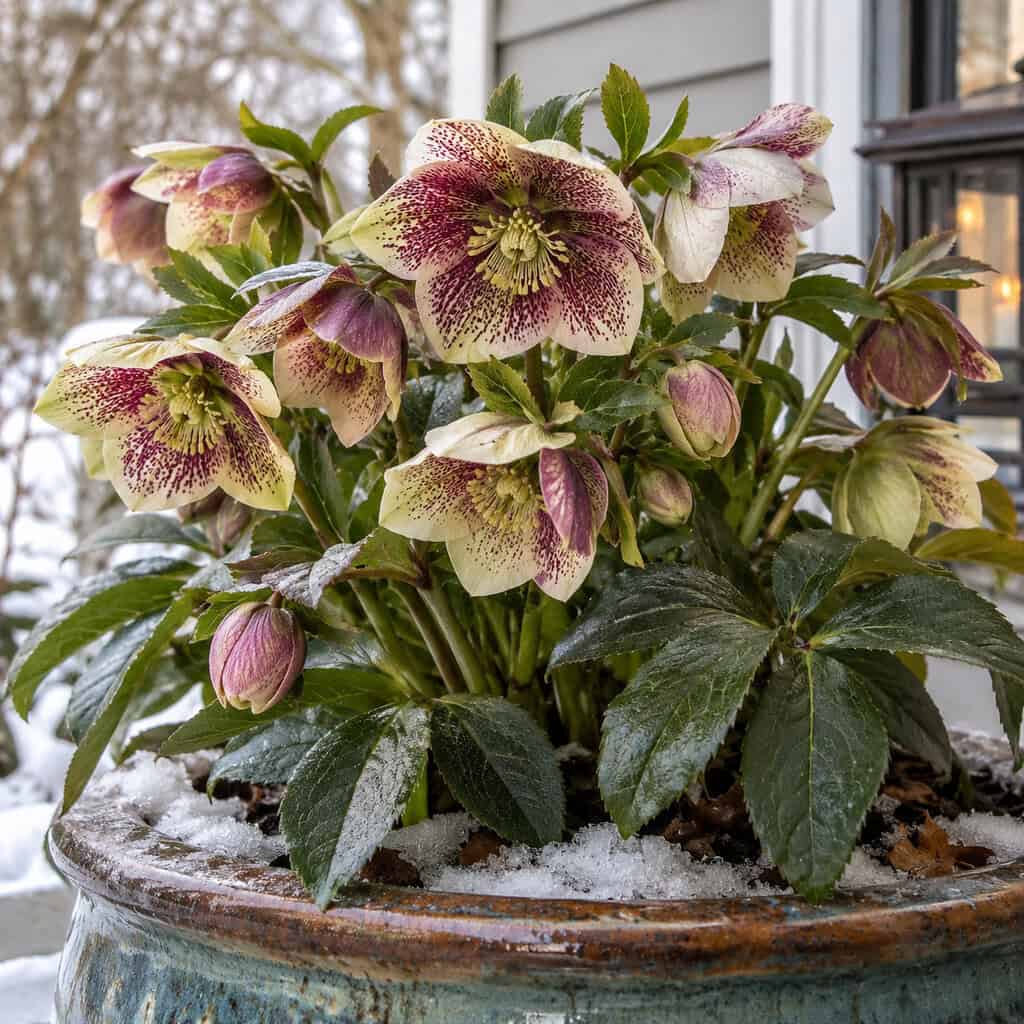
If you only add one living plant to a winter container, make it this one.
Hellebores are hardy to roughly zone 4, keep leathery evergreen foliage all winter, and then do the thing nothing else does — they bloom in late February and March. Nodding cream, plum, and speckled flowers, opening while the rest of the yard is mud and gravel.
Garden centers set a one-gallon hellebore slightly off-center in a large pot in November, build greens around it, and know the pot has a second act built in. The buds swell in February. By the time your neighbors are scraping dead greens into a yard waste bag, your container is flowering.
They want afternoon shade and shelter. A north- or east-facing porch is close to ideal. In April, lift the whole plant out and put it in the ground — it’ll come back for a decade.
The caution is real, though. Hellebore is toxic to dogs and cats. Every part of the plant contains cardiac glycosides and irritant compounds, and ingestion can cause drooling, vomiting, abdominal pain, and in serious cases an irregular heartbeat.
The bitter sap makes most animals spit it out fast, which is why severe poisonings are rare. But “rare” isn’t “never,” and puppies test everything.
Handle it with gloves too — hellebore sap irritates human skin. If pets patrol your porch unsupervised, put the hellebore in a tall pot or a pedestal planter and keep the chewable material at ground level limited to something safe like ornamental grass plumes.
5. Birch Poles and Log Clusters

Birch can’t wilt. It can’t fade, drop needles, or brown at the tips. That’s the entire argument.
White birch poles cut to three staggered heights — say 48, 36, and 28 inches — give a container a vertical spine that’s still doing its job in March when the softer greens have gone tired and olive.
Set them before you add anything else, in a triangle, not a flat row. The back pole goes tallest.
Garden centers buy birch once and reuse it for five or six seasons. Pull the poles in April, hose off the dirt, stack them in the garage. That’s a $40 purchase amortized into nothing.
6. Boxwood — Potted Dwarf and Cut Sprigs
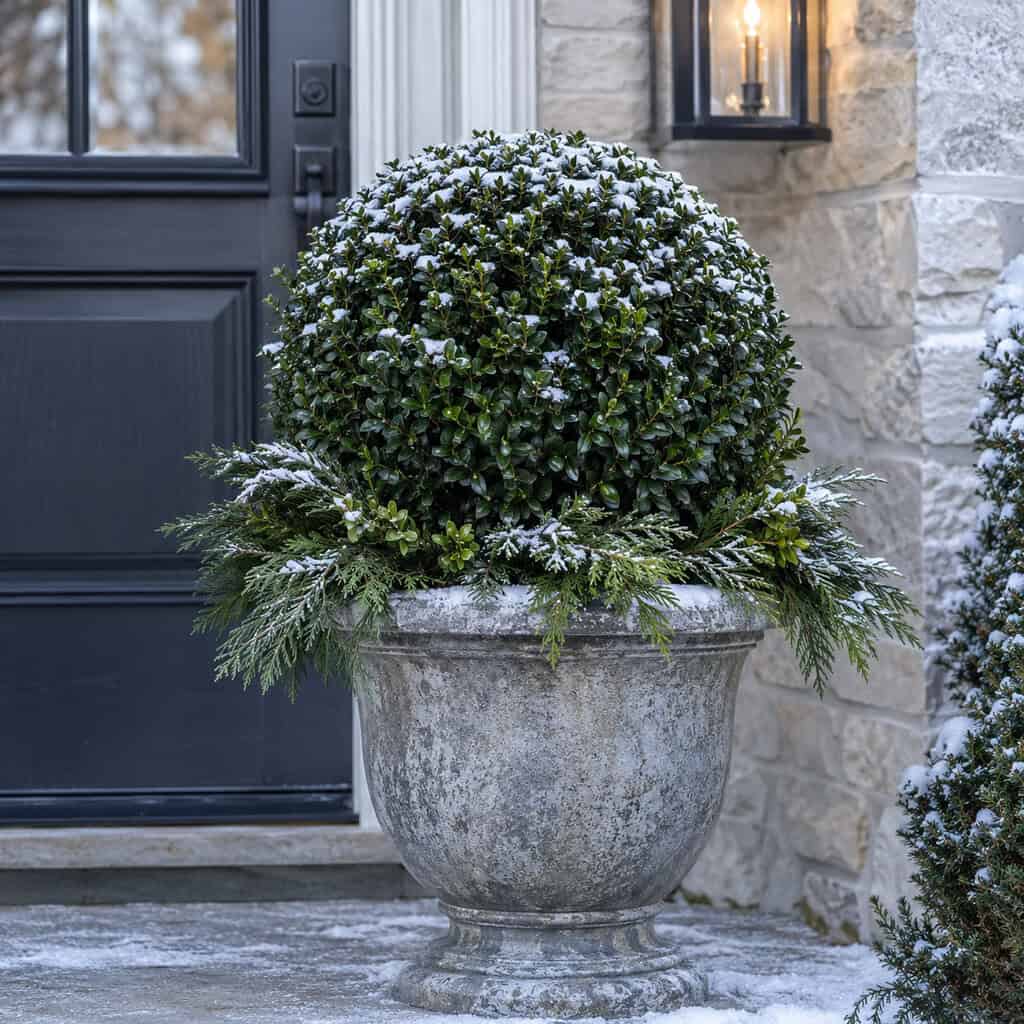
The workhorse. Cut boxwood sprigs stay green for months in a frozen pot, and a potted dwarf globe like ‘Green Velvet’ can simply live in the container year-round for several seasons.
Use the cut sprigs to fill the middle layer, where fir is too loose and magnolia too heavy. The small dark leaves read as density from the street.
The catch nobody warns you about is winter bronzing. On a south- or west-facing porch, winter sun plus frozen roots equals foliage that turns orange-brown by February. It’s not dead, it’s dehydrated — but it looks awful.
Face your boxwood pots north or east if you can. If you can’t, hit them with an anti-desiccant in late November and again in January.
7. Winter Heath (Erica carnea)
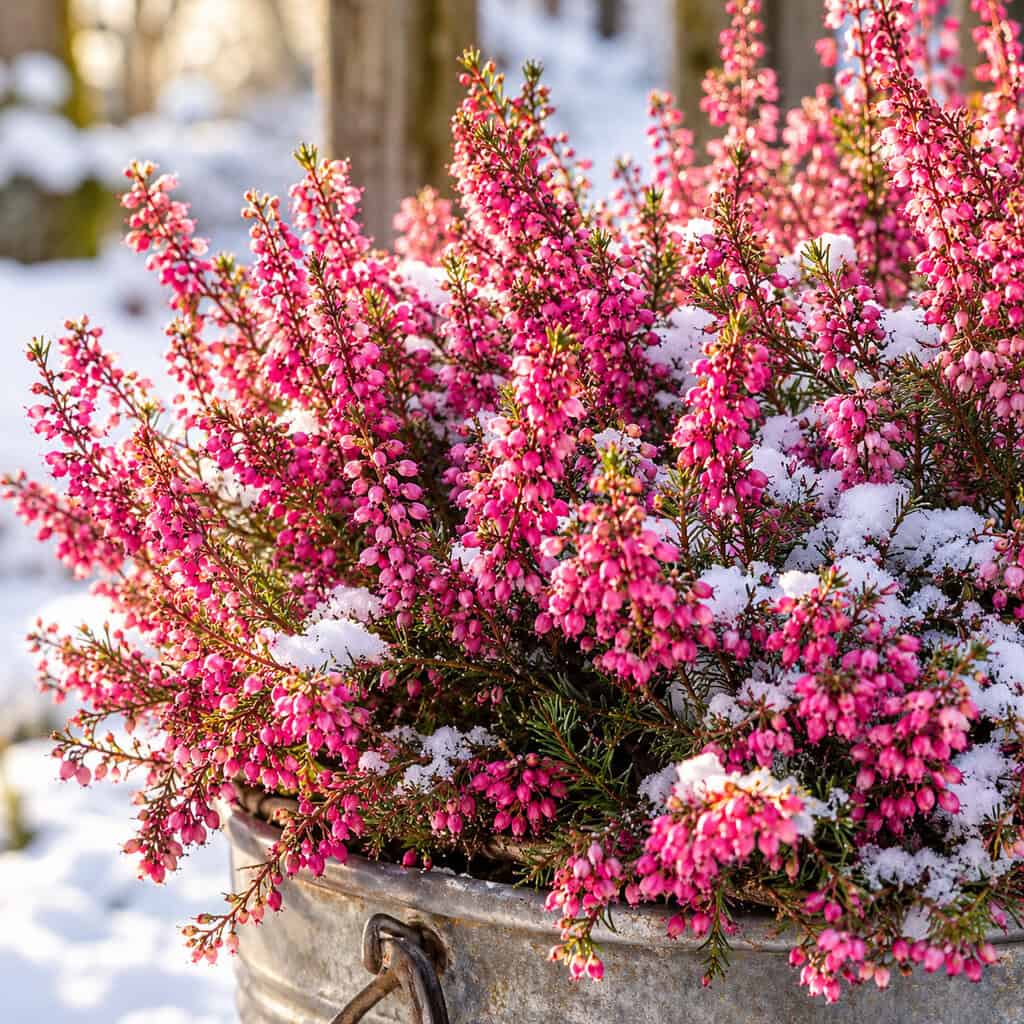
Most homeowners have never heard of this one and want it immediately once they see it.
Winter heath produces actual flowers — pink, white, or rose spikes — from January through March in zones 5 through 7. The Missouri Botanical Garden lists bloom time for cultivars like ‘Springwood Pink’ as January to March, which is not a typo.
It stays low and mounded, perfect for tucking at the rim where it spills slightly over the edge. Unlike summer heather, winter heath tolerates neutral soil, so standard potting mix is fine.
Buy it in bud, not in bloom. The buds color up slowly and you get more weeks of show.
8. Magnolia Leaf Fans (Brown-Back Magnolia)
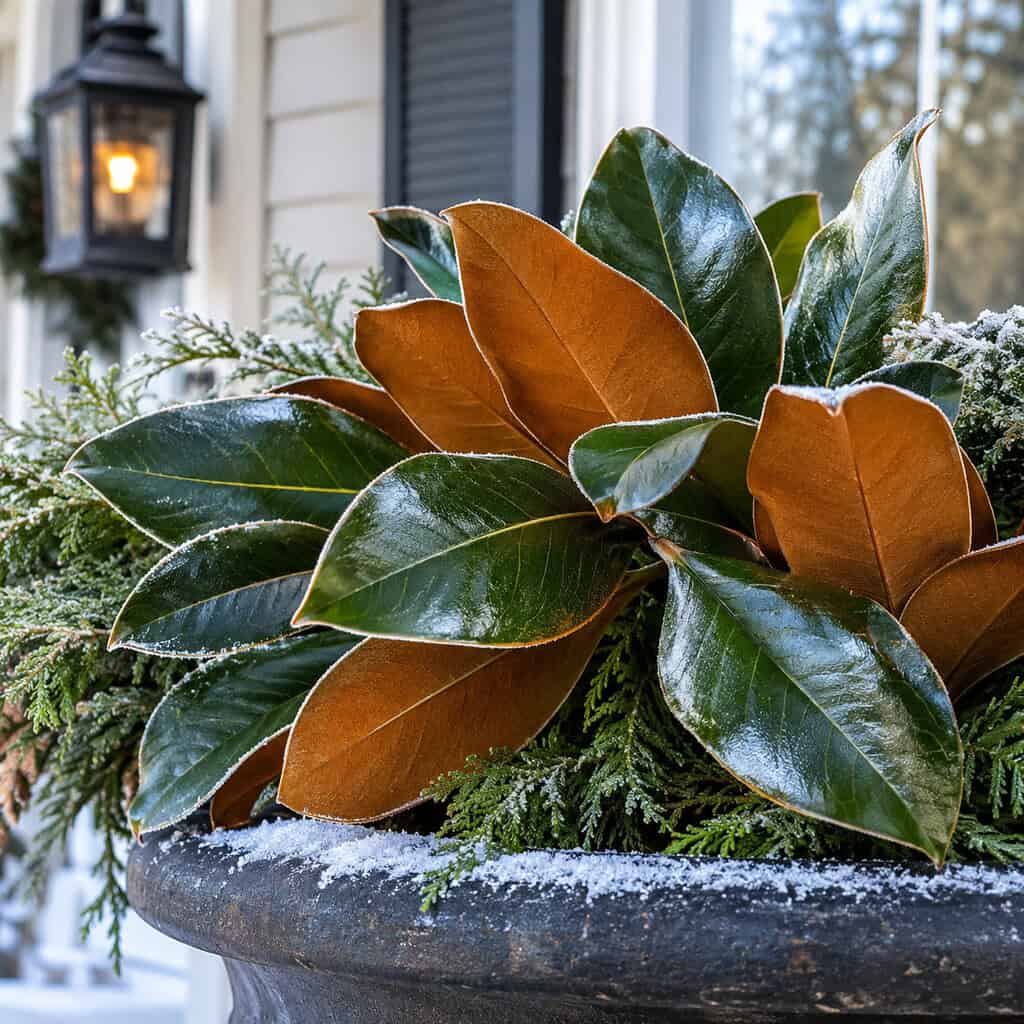
Southern magnolia leaves are the longest-lasting broadleaf cut in the business. They go leathery and stiff in cold, but they never collapse into mush the way most broadleaf material does.
The trick is the flip. Glossy dark green on top, warm bronze suede underneath — so you get two colors out of one stem depending on how you angle it.
Designers use three or five leaves fanned out low on one side, pointing slightly downward. It covers the ugly transition where greens meet pot rim.
Expect them to look good into April. They just quietly stop being lush and start being decorative.
9. Evergreen Sedge — ‘Everillo’ and ‘Ice Dance’ Carex

Every container wants a spiller. In winter, most spillers die.
Evergreen sedge doesn’t. ‘Everillo’ holds a chartreuse glow that practically lights up against dark fir on a gray February afternoon, and ‘Ice Dance’ brings cream-edged green with a stiffer habit.
The foliage flops and arches over the rim naturally, which is what you want — it softens the hard line between pot and plants without needing ivy.
Come March, give the clump a hard refresh cut, then plant it out in a shady bed. It’ll be back to full size by June.
10. Curly Willow and Contorted Filbert Branches

Pure silhouette, zero maintenance.
Curly willow twists in corkscrews. Contorted filbert — Harry Lauder’s walking stick — zigzags like it’s been through something. Both are cut in late fall and both look exactly the same in March as they did in November.
Their best stretch is that bleak January-February window after the holiday greens flatten out and before anything blooms. Against snow or dark siding, the branching pattern does all the work.
Five to seven stems, varied heights, leaning outward from the center. Don’t overthink it.
11. Skimmia japonica
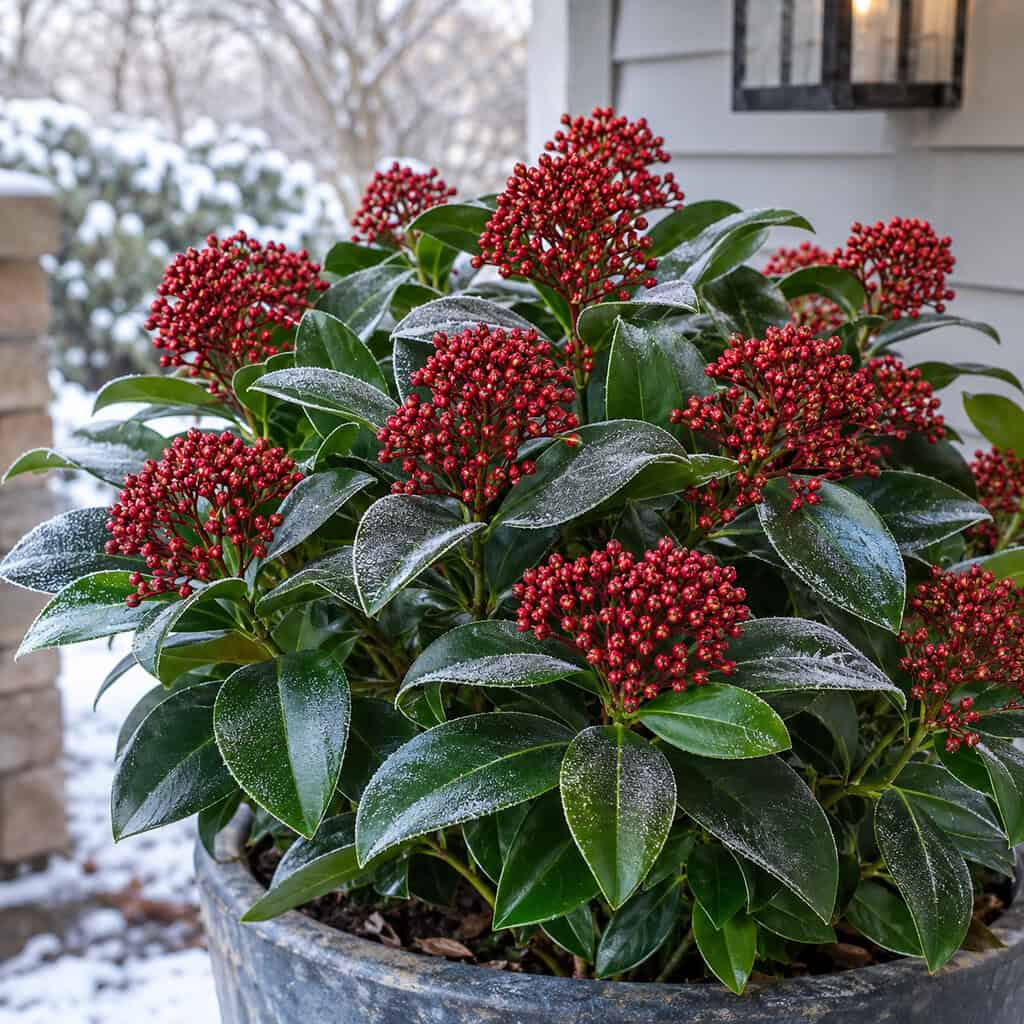
A European garden center staple that still startles American shoppers.
Skimmia carries tight clusters of red flower buds on glossy evergreen leaves from October straight through to spring, when they finally open into fragrant white flowers. Four to five months of color from something that technically hasn’t bloomed yet.
Zones 6 through 8. It needs shade and real shelter from winter wind, so a covered porch or a north-facing entry is where it earns its keep.
Male and female plants exist, and the males have the showier buds. For a container, that’s what you want.
12. Sugar Pine and Ponderosa Cones on Picks
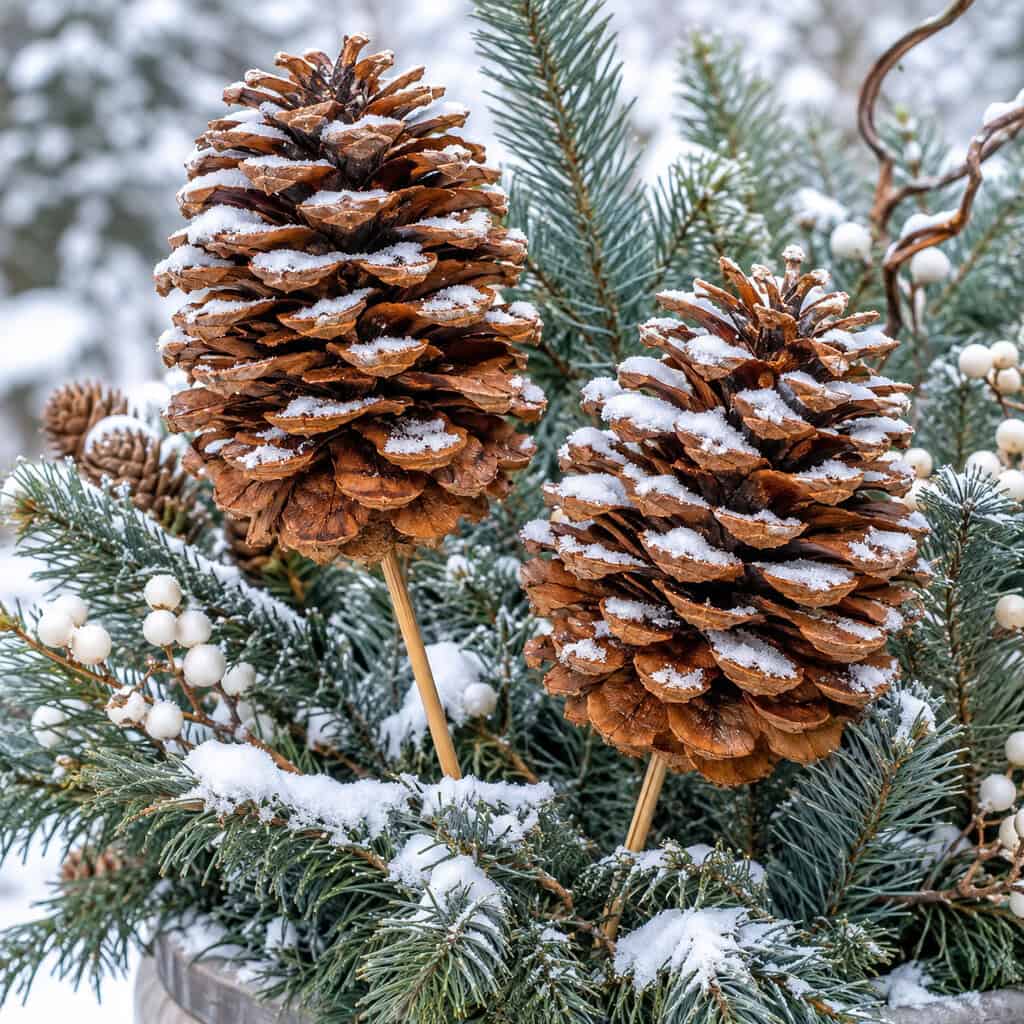
The cheapest three months of texture you can buy.
Big western cones — sugar pine runs a foot long, ponderosa is squat and heavy — wired onto 18-inch picks can be pulled out, re-angled, and pushed back after every windstorm. They never fade, never shed, never need anything.
Pros wire their own rather than buying the glittered ones. Glitter sheds onto the steps by January and the whole pot starts to look cheap.
Use floral wire and a pair of pliers. Wrap twice around the bottom scales, twist tight, tape the wire to a bamboo pick. Ten cones takes fifteen minutes and lasts a decade.
13. Pansies and ‘Cool Wave’ Violas
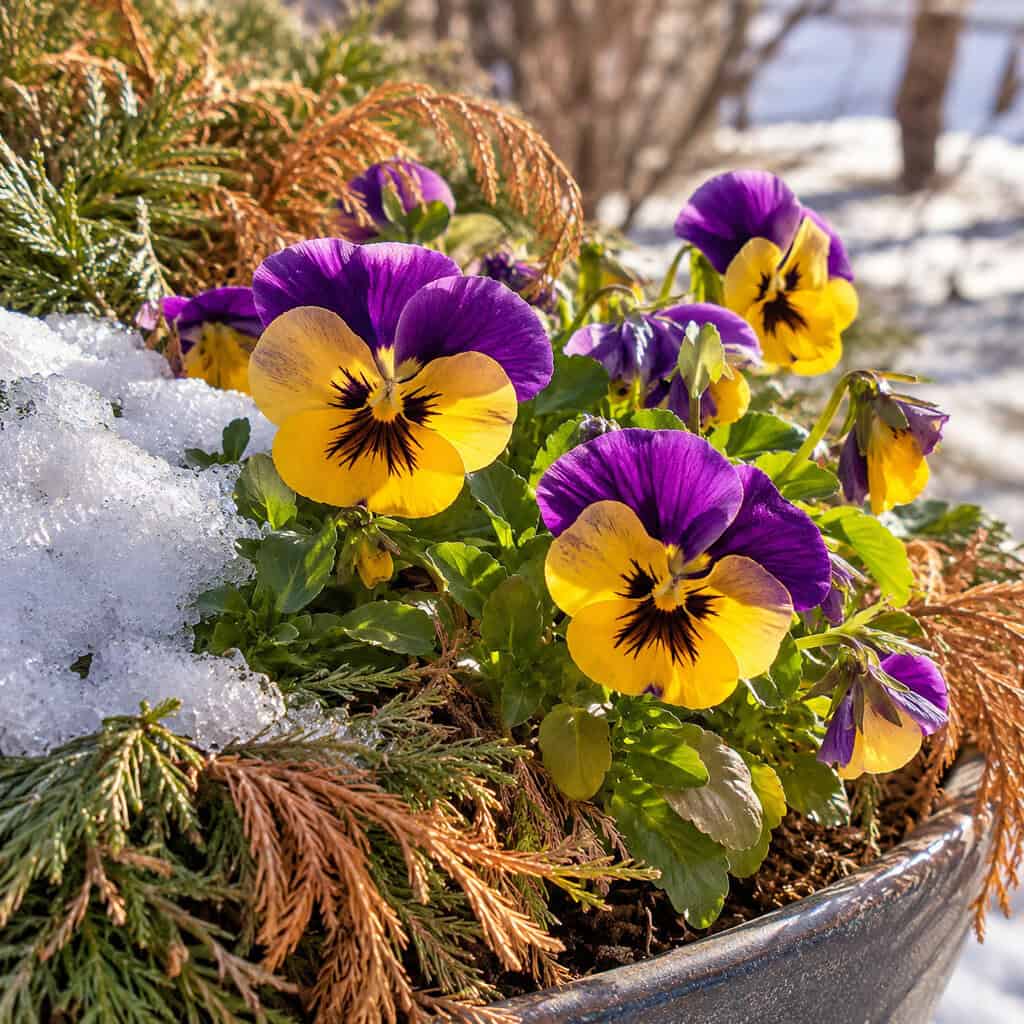
The most misunderstood plant in the winter container business.
Planted in October, pansies bloom for a few weeks, then the first hard freeze flattens them into limp green pancakes. Homeowners assume they’re dead and rip them out.
They’re not dead. They’re waiting.
The moment nights stay above freezing in late February or March, those flattened crowns push new growth and re-flower hard. Garden centers plant pansies for the March rebound, not for the December show — a pot with pansies and nothing else going for it still turns purple and gold right on schedule.
‘Cool Wave’ is the trailing type. It spills and takes cold better than most.
14. Western Red Cedar and Incense Cedar Sprays
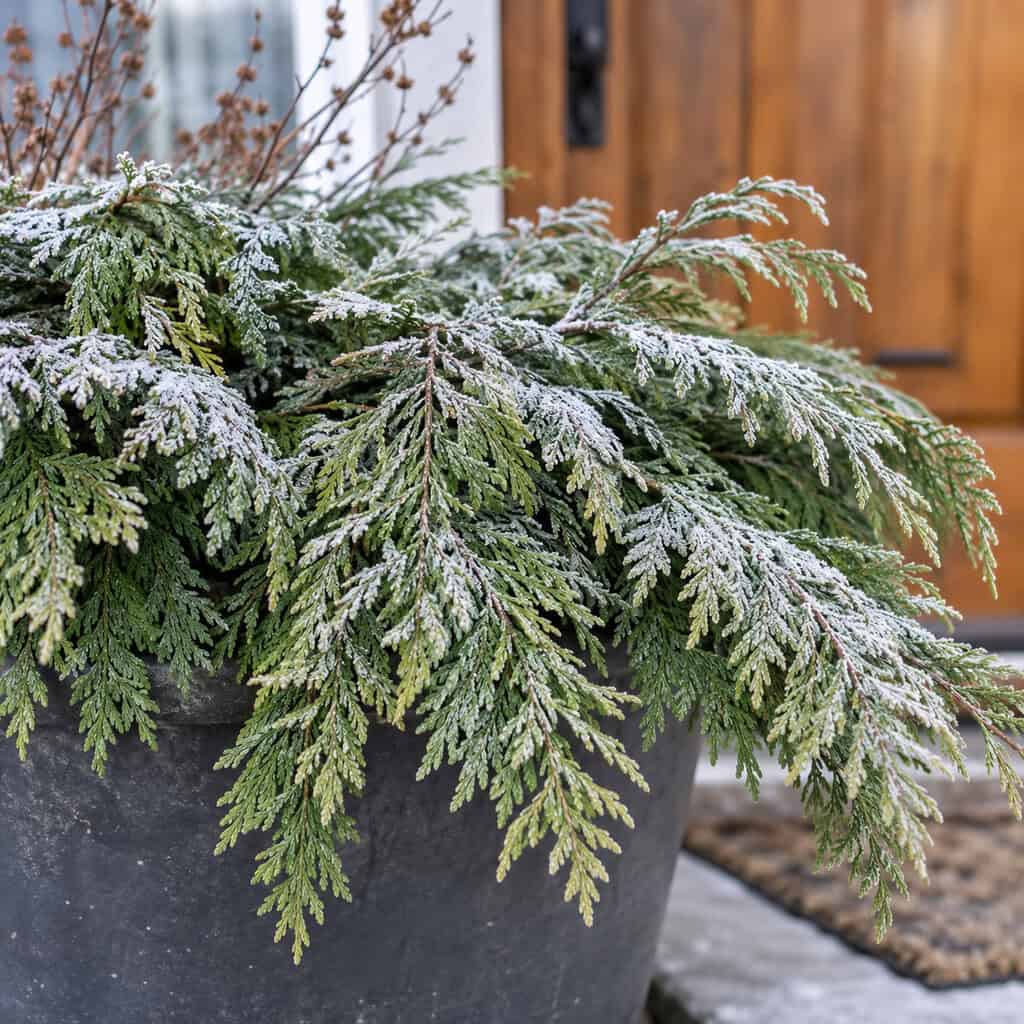
Fir gives you vertical. Cedar gives you horizontal.
Those flat, fan-shaped sprays fill the wide middle of a pot in a way fir boughs physically can’t, and they hold for many weeks as a cut green. University extension horticulturists regularly list the cedar family among the longest-lasting cuts for outdoor containers — University of Illinois Extension puts them in the same tier as fir and juniper.
Incense cedar smells like a freshly sharpened pencil, which is exactly right for a front door in December.
Layer cedar sprays flat and slightly drooping, under the fir, over the rim. They hide mechanics and stems better than anything else.
15. Wintergreen (Gaultheria procumbens)
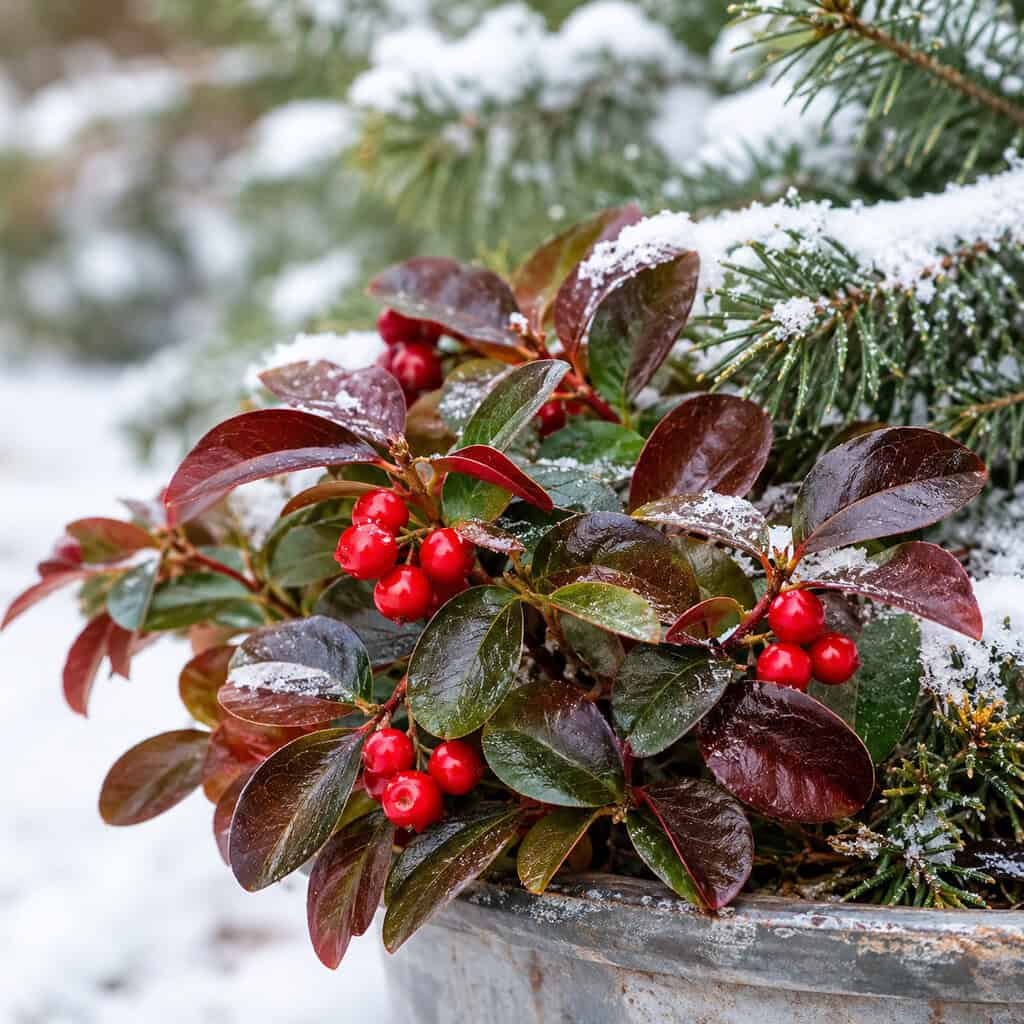
Those little four-inch pots by the register. Buy three.
Wintergreen brings scarlet berries on glossy low foliage that bronzes to deep burgundy in cold. It’s genuinely hardy, not a seasonal throwaway, and it reads far more expensive than the $4 it costs.
Tuck them right along the rim at the front, where people see the pot from four feet away. The berries last well into late winter and the leaves smell like wintergreen when crushed.
In spring, plant them under a rhododendron. They’ll spread into a groundcover.
16. The Freeze-Set Trick
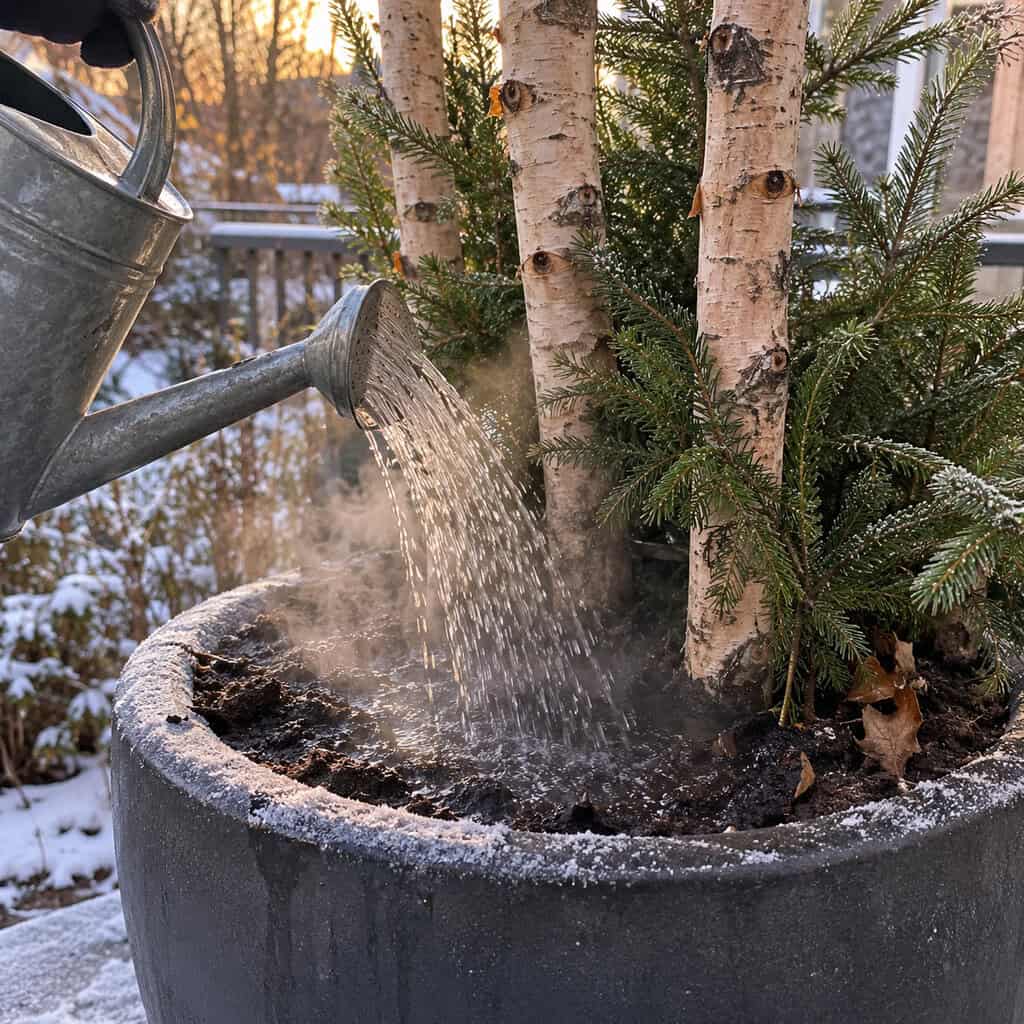
This is the actual trade secret, and it costs nothing.
When a professional builds a winter pot, the container is filled with damp soil or damp sand — not dry mix, not foam. Stems go in six to eight inches deep. Then the whole thing gets watered thoroughly and left to freeze solid.
That block of ice grips every single stem until the March thaw. Forty-mile-an-hour wind doesn’t move a thing.
Homeowners skip the watering step because it feels wrong to water a pot in November. That’s why their birch poles end up leaning into the hedge by Christmas.
Do it on a day above freezing, then let the cold do the rest.
17. Heuchera (Coral Bells)
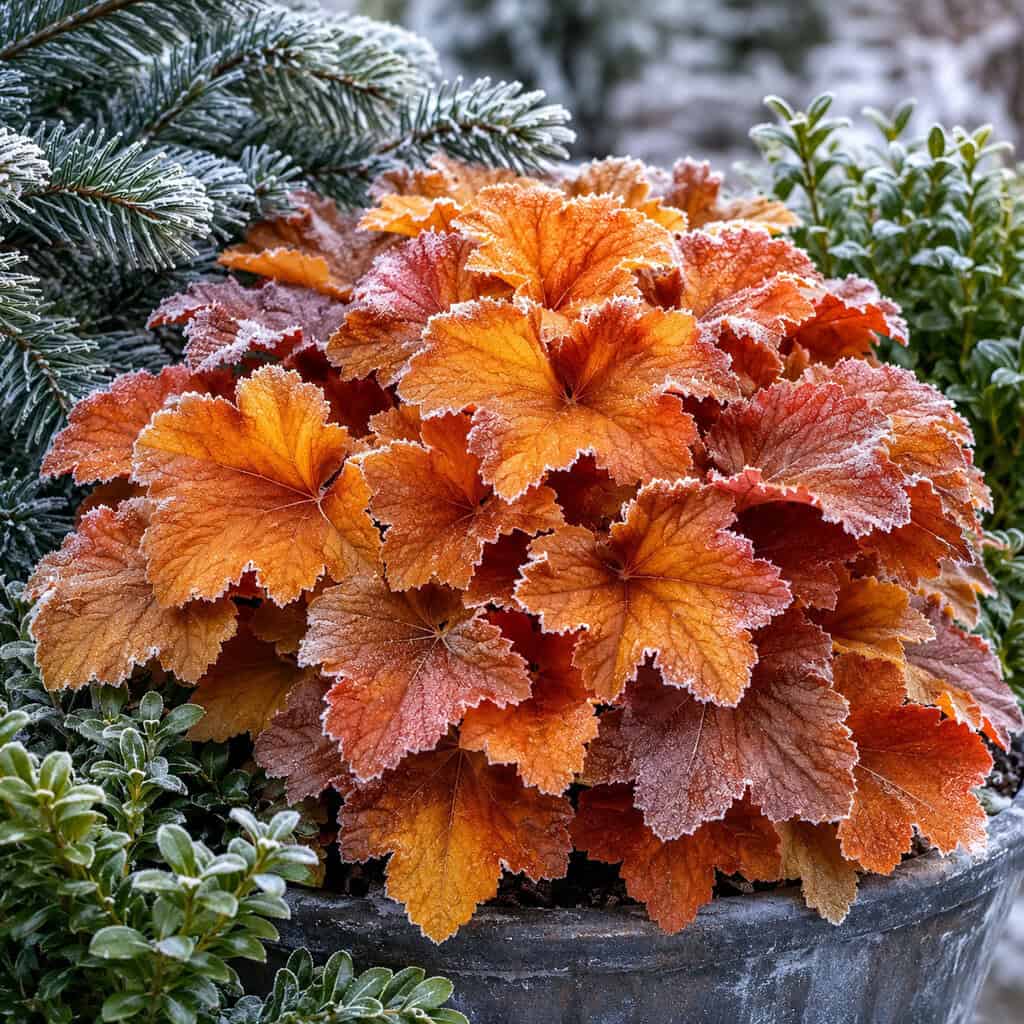
Caramel. Plum. Silver with dark veining. There’s no other foliage color like this available in February.
Heuchera is semi-evergreen and holds its leaves through winter reliably in zone 6 and warmer. In colder zones it melts back to a nub, then pushes new leaves early — often before the last snow.
Against dark fir and boxwood, a caramel-leaved heuchera like ‘Caramel’ or ‘Marmalade’ is the warm note that keeps the pot from looking like a cemetery arrangement.
Set it mid-height, not at the rim. The leaf rosette wants to be seen from above.
18. Berried Juniper Sprigs
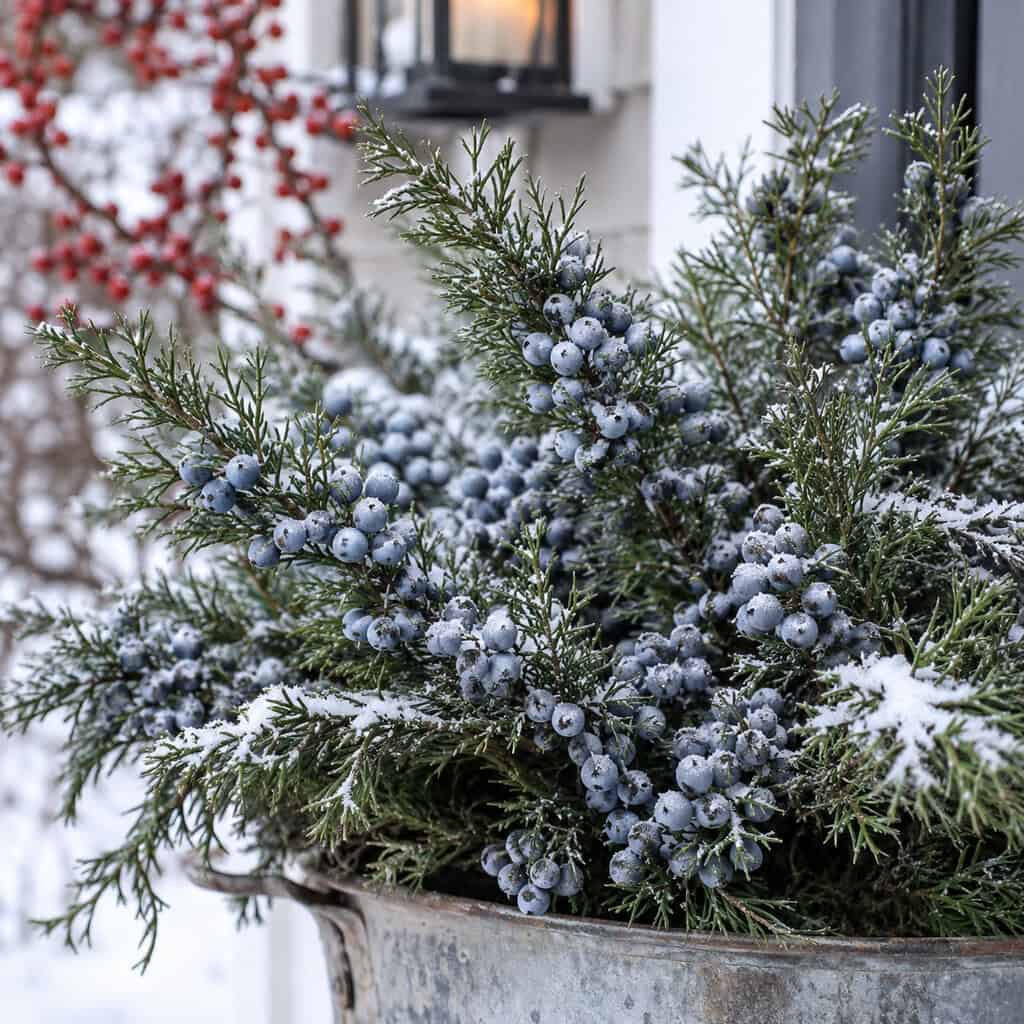
When a pot needs something cool against all that red, juniper is the answer.
The blue-gray berries — technically modified cones — have a frosted bloom on them that holds all winter. The stems stay stiff, so whatever angle you set them at is the angle they’ll be at in March.
Needle retention on cut juniper is excellent, better than most people expect from something that sharp and dry-looking.
Wear gloves. It’s prickly, and the sap stains.
19. Pieris japonica (Andromeda)
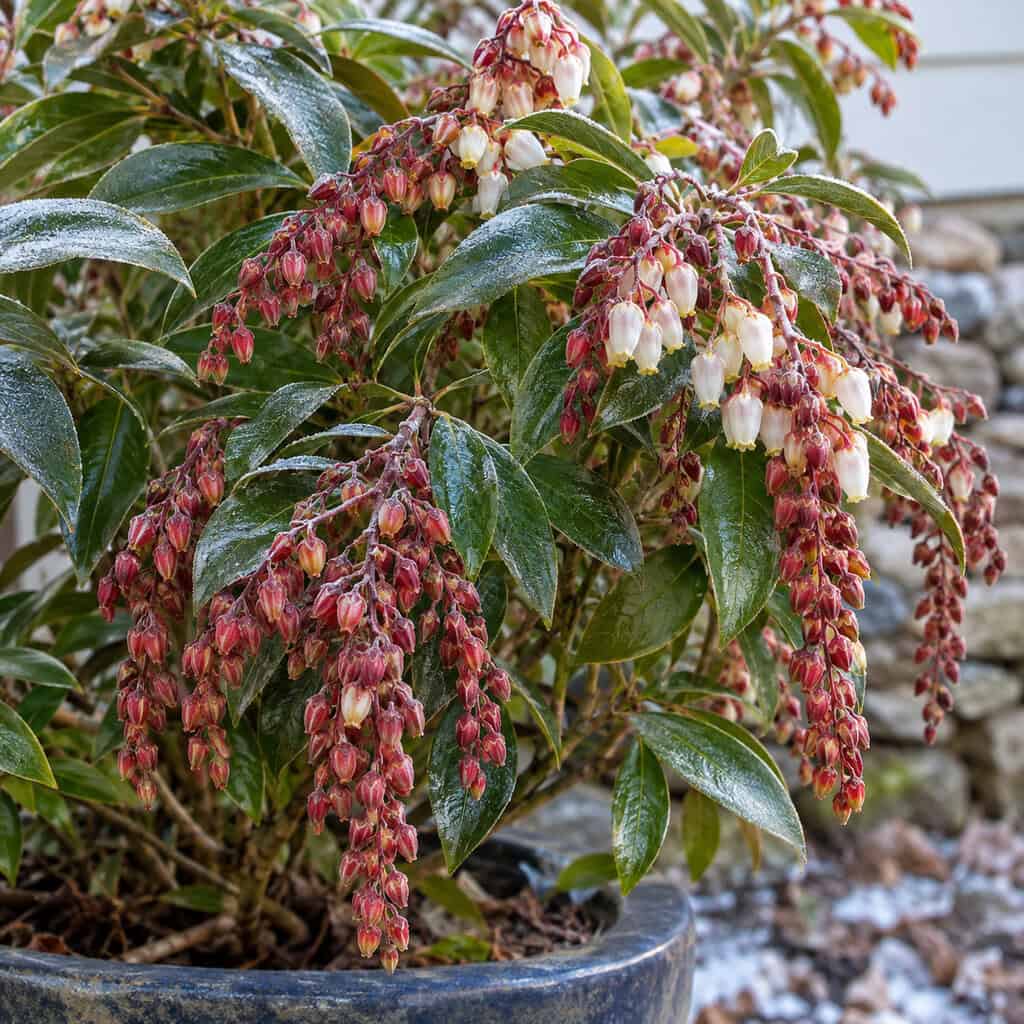
Pieris does something strange and wonderful: it forms its flower chains in fall and then just hangs them there, fully built, all winter long.
So from November onward your container displays dangling strands of tight buds — coming attractions in rust-red or pale green — that finally open into white lily-of-the-valley bells in February or March.
That’s a four-month plant from a single purchase. New spring growth comes in bronze-red too.
It needs acidic soil and shelter from wind, same as rhododendron. Keep it off the windiest corner of the house.
20. Dried Panicle Hydrangea Heads
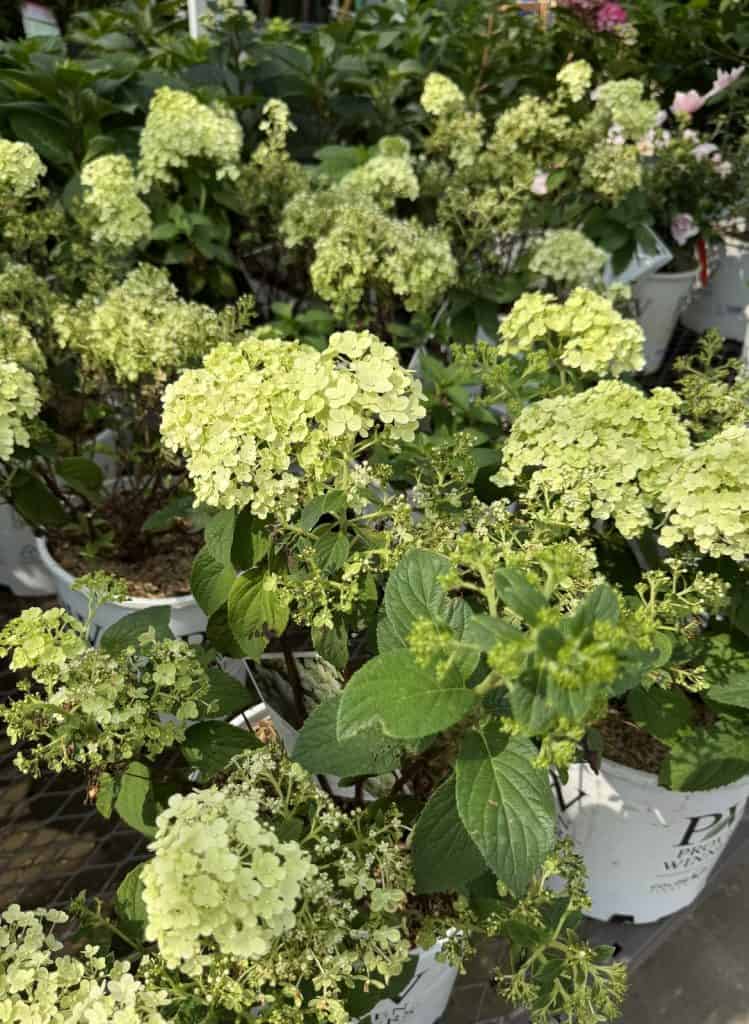
Here’s where most people go wrong with dried hydrangea in a winter pot: they use the wrong hydrangea.
Panicle types — ‘Limelight,’ ‘Little Lime,’ ‘Quick Fire’ — dry right on the stem in fall and hold their cone shape through hard freezes. They weather from pink and lime to a soft parchment tan by March, which looks intentional.
Mophead hydrangeas do not. Those big round heads hold moisture, freeze, thaw, and turn to brown mush within weeks.
Cut panicle heads with 18 inches of stem in late October, after they’ve already gone papery on the shrub. Don’t cut them fresh and green.
21. An Anti-Desiccant Spray on the Greens
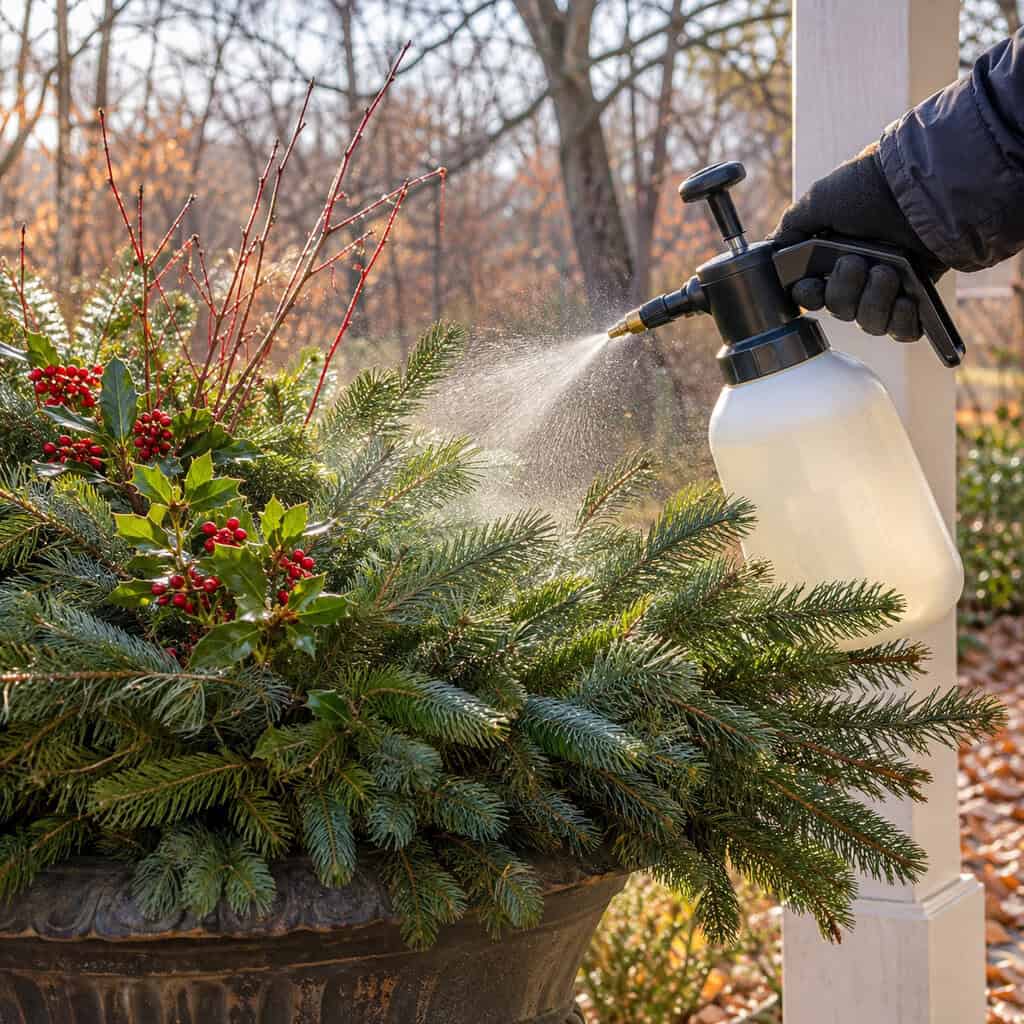
This is why the garden center’s display pot still looks fresh in February while yours browned out before Christmas.
A wax-based anti-desiccant — Wilt-Pruf and similar products — coats cut needles and broadleaf foliage with a thin flexible film that slows water loss. Winter wind and sun pull moisture out of cut greens constantly. The coating cuts that rate down significantly.
Spray at planting, on a day above 40°F, with the greens dry. Then re-coat in early January when the first application has worn thin.
Skip it on waxy blue conifers. It can strip the blue bloom off blue spruce and some junipers.
22. Gold Threadleaf Cypress and ‘Rheingold’ Arborvitae
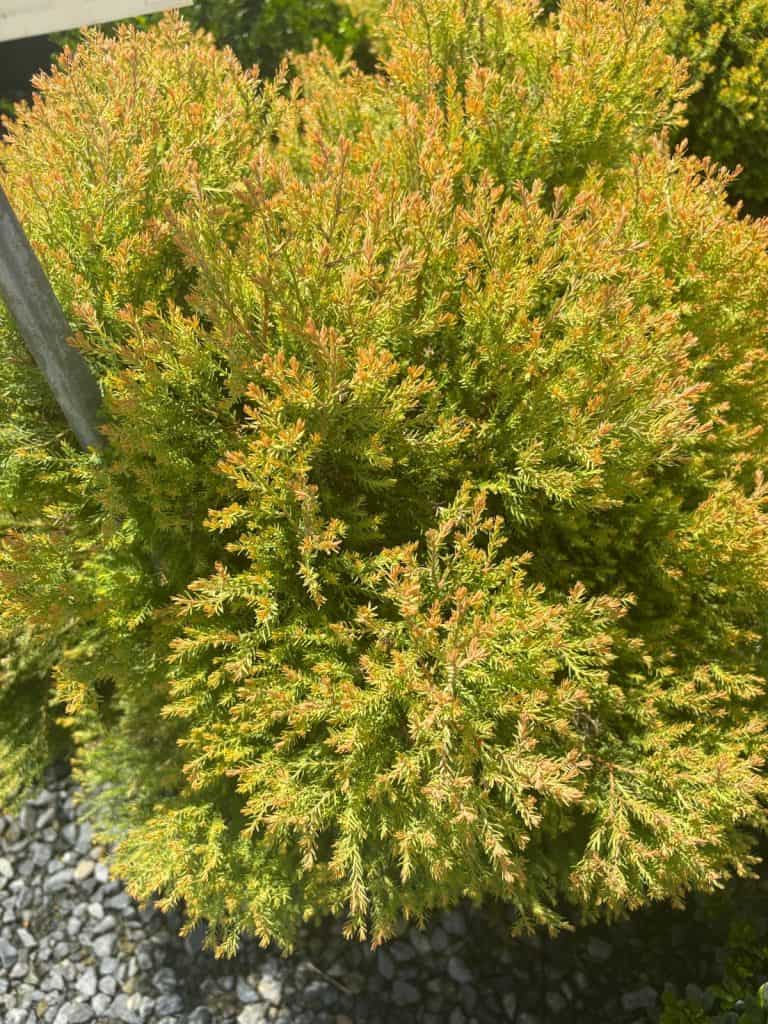
Gold conifers get better in cold, which makes them backwards from everything else in the yard.
‘Golden Mop’ threadleaf cypress keeps a bright chartreuse all winter and sheds snow off its stringy texture. ‘Rheingold’ arborvitae goes one further — it shifts from gold to a genuine copper-bronze as temperatures drop, deepening right through February.
Both go in as live potted plants, not cuts. They’ll stay in the container for several years if the pot is big enough and insulated.
One gold conifer in a pot full of dark green does more visual work than five extra bunches of greens.
23. Winter Jasmine (Jasminum nudiflorum)

Bare green stems cascading over a pot rim, covered in bright yellow flowers, in January. No leaves at all.
It looks like forsythia got the date wrong by two months. Zones 6 through 9, and it blooms on and off from January into March depending on how the cold runs.
The stems are long and whippy, which makes it the best flowering spiller available for winter. Let them hang 18 inches over the edge.
Not fragrant, despite the name. Buy it for the color.
24. Silver Dollar Eucalyptus
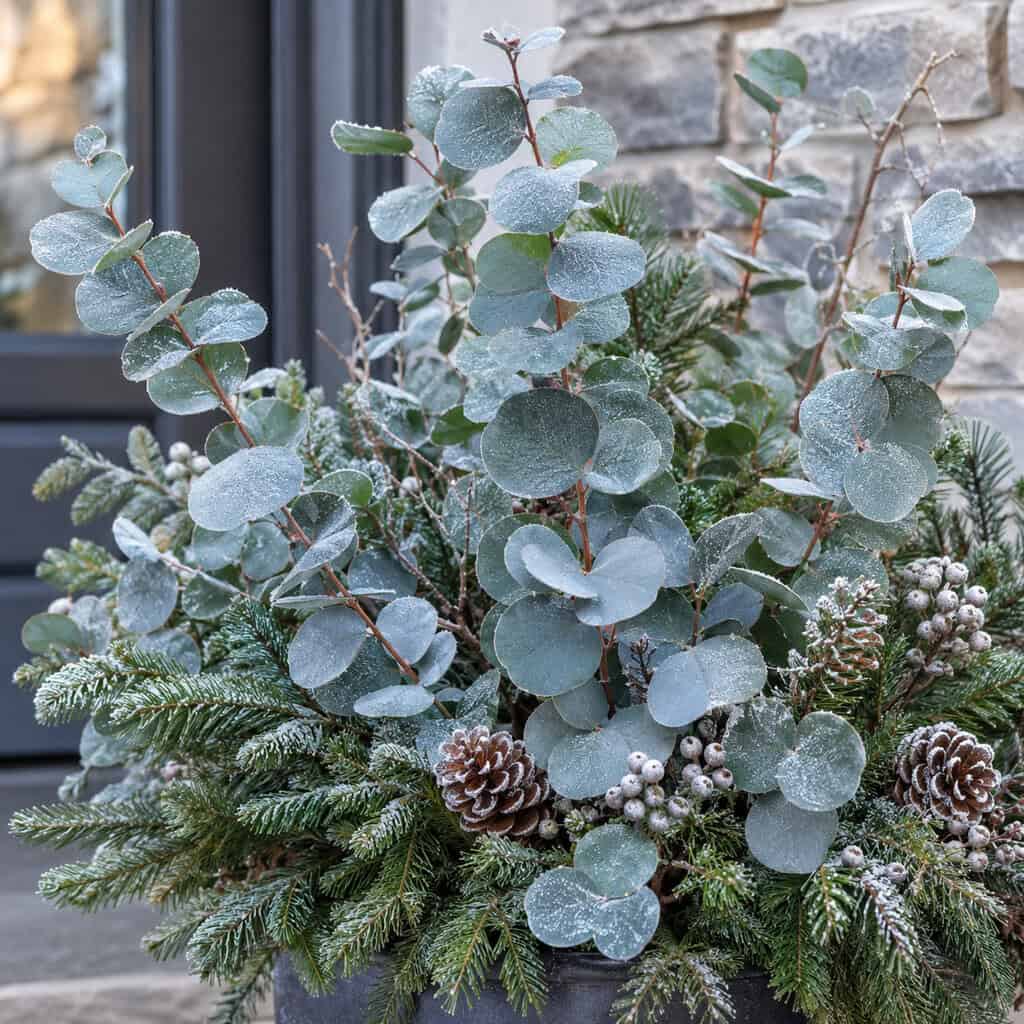
Material that improves as it dries is rare. This is one.
Fresh eucalyptus is floppy. After a few weeks in cold air the stems stiffen, the round blue-silver leaves hold their color instead of browning, and the whole thing keeps a faint menthol scent well into late winter.
Designers reach for it when a pot has gone too heavy and too dark — the silver lifts everything around it.
Buy fresh bunches from the florist cooler rather than preserved dyed stems. Preserved eucalyptus bleeds color in rain.
25. Yucca ‘Color Guard’
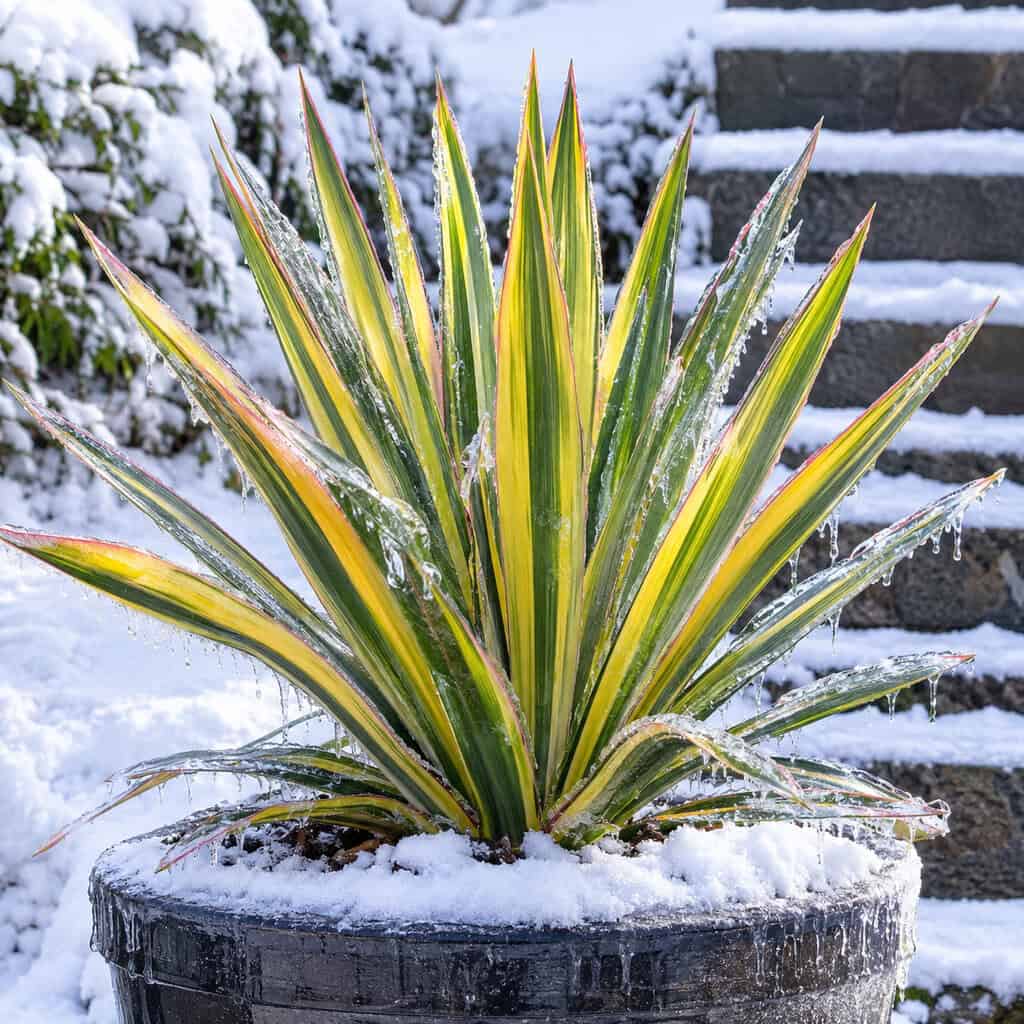
Hard, upright, gold-and-green striped blades that ice slides right off of.
Hardy to zone 4 and completely evergreen, ‘Color Guard’ gives a container real architecture at exactly the moment every soft element has collapsed. In February it’s often the only thing in the pot still standing at full attention.
The gold center stripe picks up warm tones from across the yard, and cold weather pushes a pink flush into the leaf edges.
Nothing else in a winter pot looks like it. One is plenty.
26. Faux Berry Picks and Permanent Botanicals
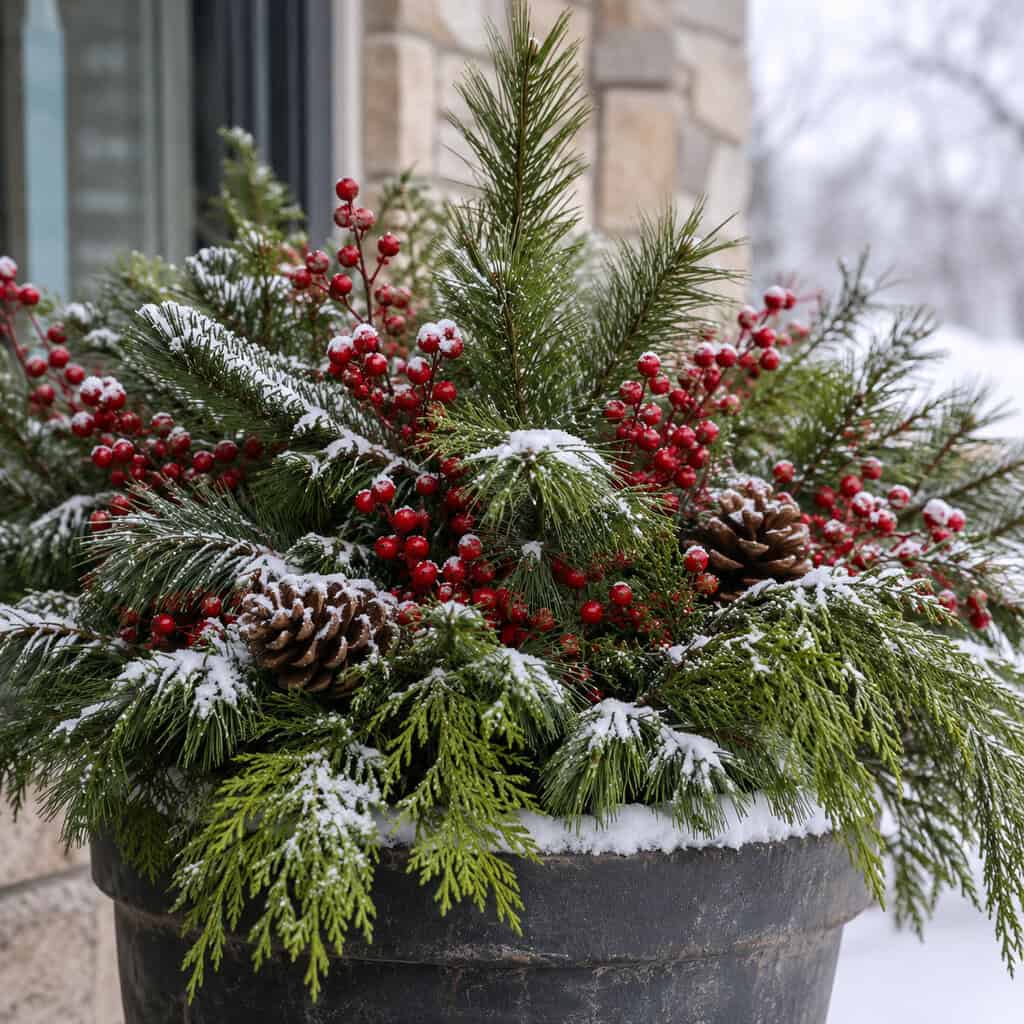
Garden centers blend fake stems into fresh greens and don’t advertise it. Here’s the honest math: real berries shrivel by February, and permanent ones don’t.
The rules that keep it believable are strict. Keep faux material under a third of the total pot. Set it deep, so it emerges from inside the greens rather than sitting on top. And buy matte — anything with a plastic shine reads fake from the sidewalk.
Faux magnolia leaves, red berry clusters, and frosted eucalyptus are the three that hold up best to scrutiny.
Avoid faux evergreen boughs entirely. That’s where the illusion always breaks.
27. Mahonia
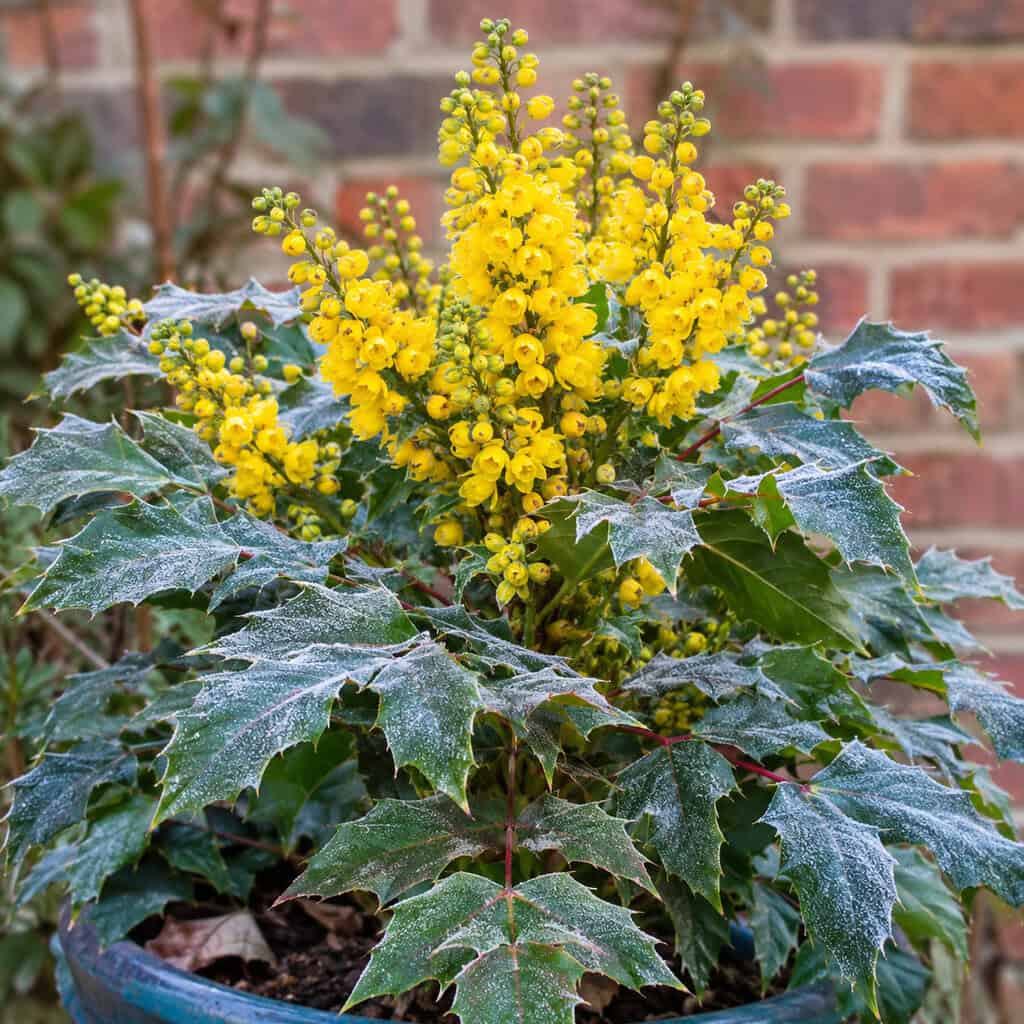
Spiny blue-green leaves that look like holly, fragrant yellow flower spikes in the coldest weeks of the year, and powdery blue berries after that.
Structure, flowers, and fruit from one plant across one winter. Nothing else on this list does all three.
‘Winter Sun’ and ‘Charity’ are the showiest for containers. They want shade and shelter — exposed winter sun scorches the foliage.
The leaf tips are genuinely sharp, so keep it out of the traffic lane on a narrow porch.
28. An Insulated Pot and the Two-Zone Rule

This is the entry that decides whether your live plants are alive in April.
Roots in a container don’t get the ground’s insulation. They experience air temperature from every side, which runs roughly two USDA zones colder than your actual region. If you’re in zone 6, the inside of that pot is behaving like zone 4.
So the rule garden centers follow is simple: pick plants rated two zones hardier than where you live. Zone 6 homeowner, zone 4 plant. That’s why hellebore, yucca ‘Color Guard,’ and arborvitae show up again and again — they’ve got the margin.
Penn State Extension covers the overwintering side of this in detail, including grouping pots together and insulating the sides.
Lining matters as much as plant choice. Foam board cut to fit the inside walls, or a few wraps of bubble insulation between the soil and the pot wall, keeps the root ball from swinging through daily freeze-thaw cycles.
Then there’s the pot itself. Terracotta and unglazed low-fired ceramic absorb water, and water expands about 9% when it freezes. That’s what splits a $200 planter down the side in January — not cold, water.
Fiberglass, heavy-duty resin, thick glazed stoneware rated frost-proof, and wood all survive. If you love a terracotta pot, bring it inside empty and run a resin look-alike on the porch for the winter.
Raise every pot on feet. A container sitting flat on a porch slab freezes to it, traps meltwater, and that standing water finds its way under the threshold and along the foundation — a slow, expensive problem nobody connects back to a planter.
And drill the drainage. A frozen plug of ice in the bottom of a pot kills roots by suffocation just as reliably as cold does.
29. Dog Hobble (Leucothoe)
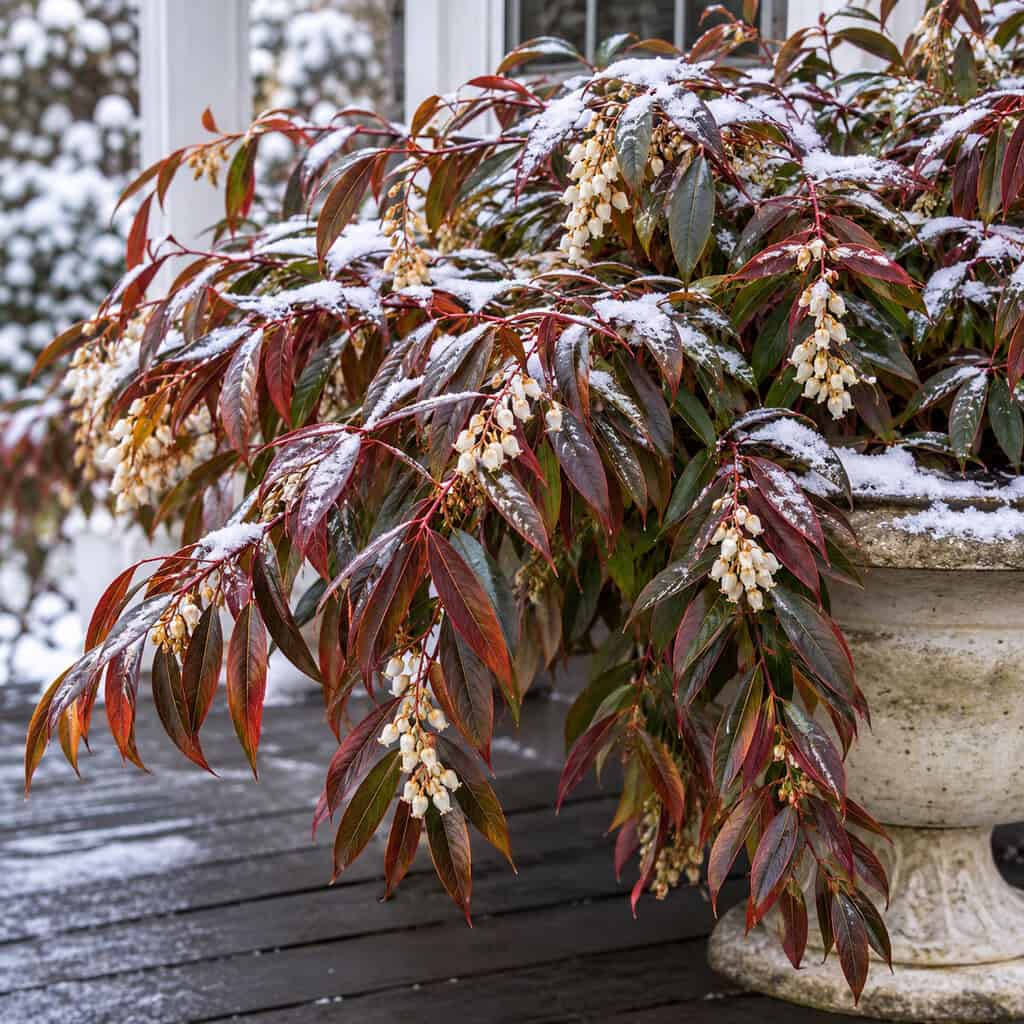
An arching evergreen with long pointed leaves that flush bronze-burgundy once cold sets in.
It’s specifically recommended for containers because it tolerates a pot winter without sulking — The Washington Post ran it on a list of fall container plants that actually make it through.
The arching habit means it leans outward over the rim on its own, no training needed. ‘Rainbow’ brings cream and pink variegation if you want more than green.
In April, put it in the ground in part shade. It’s a good shrub for that awkward strip under a deck.
30. Standing Grass Plumes and Seedheads
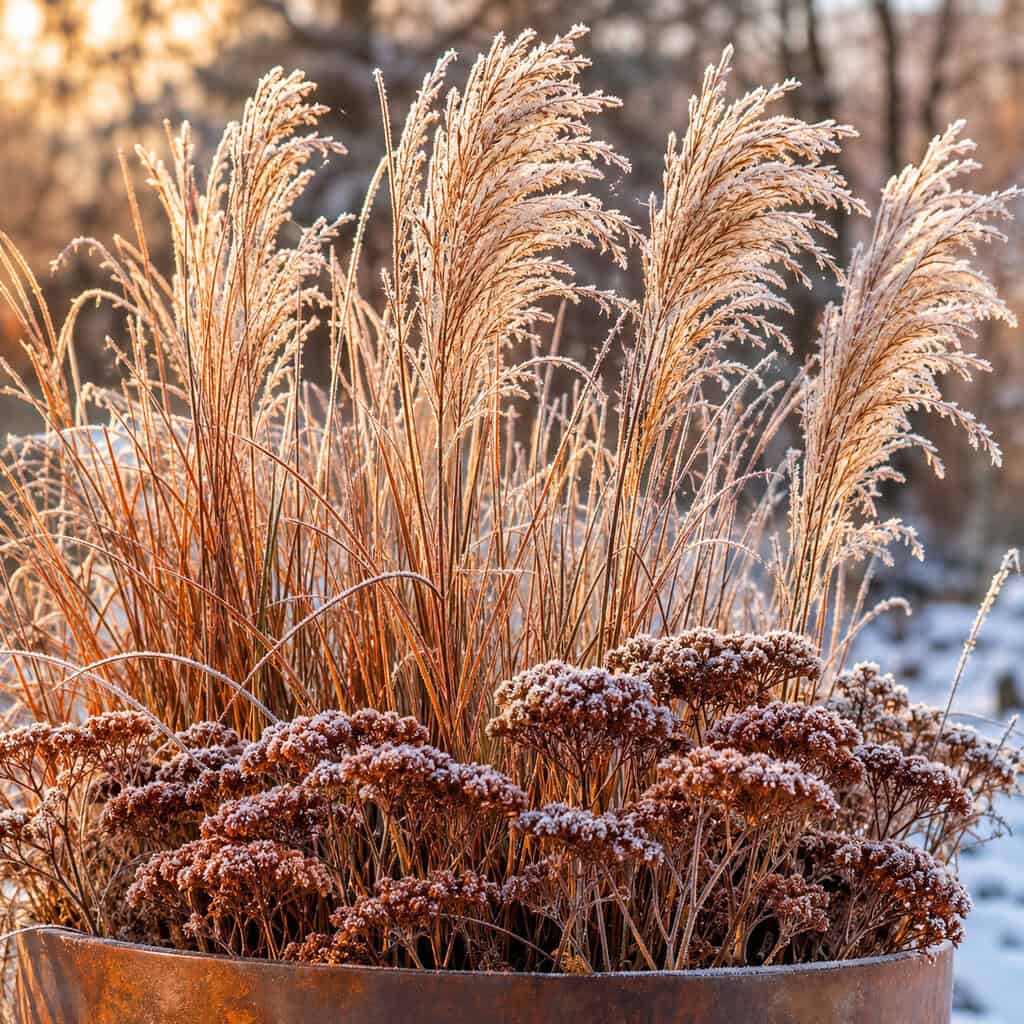
The most repeatable tip here, because it’s free.
Little bluestem turns copper-orange and holds it. ‘Karl Foerster’ feather reed grass stands dead upright through snow load. Sedum ‘Autumn Joy’ heads go rust-brown and catch frost on every tiny floret.
All of it is already in your beds, and all of it is material you were planning to cut down anyway. Harvest it in October before winter storms knock it flat, and stand it in the back of the container.
It’s the same logic behind leaving ornamental grasses standing in the beds instead of cutting them in fall — the winter structure is the whole point.
Three plumes, back row, tallest point in the pot. Done.
31. English Ivy as the Spiller

Walk into any garden center in November and there’s a bench of four-inch ivy for exactly this purpose. It trails beautifully, it’s cheap, and in zone 6 and warmer it stays green through most of the winter.
Tucked at the rim, it softens the pot’s edge and keeps spilling right through March in a sheltered spot.
It does burn. Exposed to full winter wind and sun with frozen roots, ivy goes crispy brown at the edges and looks worse than nothing by February. Shelter is non-negotiable.
But the bigger issue is the one nobody at the register mentions. English ivy is toxic to dogs and cats.
The leaves contain triterpenoid saponins — and the foliage is more toxic than the berries, which is backwards from most plants people worry about. Chewing it causes drooling, vomiting, abdominal pain, and diarrhea. Contact with the sap causes skin irritation in people and animals both.
Think about where this plant sits. It trails over the rim of a pot on your front steps, at exactly the height a dog’s nose passes four times a day, every day, for five months. Cats are worse — a trailing vine moving in the wind is a toy as far as they’re concerned.
If you’ve got pets who are loose on the porch, this is the easiest swap on the list. Evergreen sedge gives you the same arching spill with no toxicity. Wintergreen gives you trailing color and is non-toxic. Winter jasmine gives you cascade plus yellow flowers.
Ivy also escapes. It’s listed as invasive across the Pacific Northwest and much of the mid-Atlantic, and a pot dumped at the edge of the woods in April is how it gets started.
Swap it. You lose nothing visually and you stop worrying about it.
32. A Hidden Bulb Layer — Iris reticulata, Crocus, Snowdrops
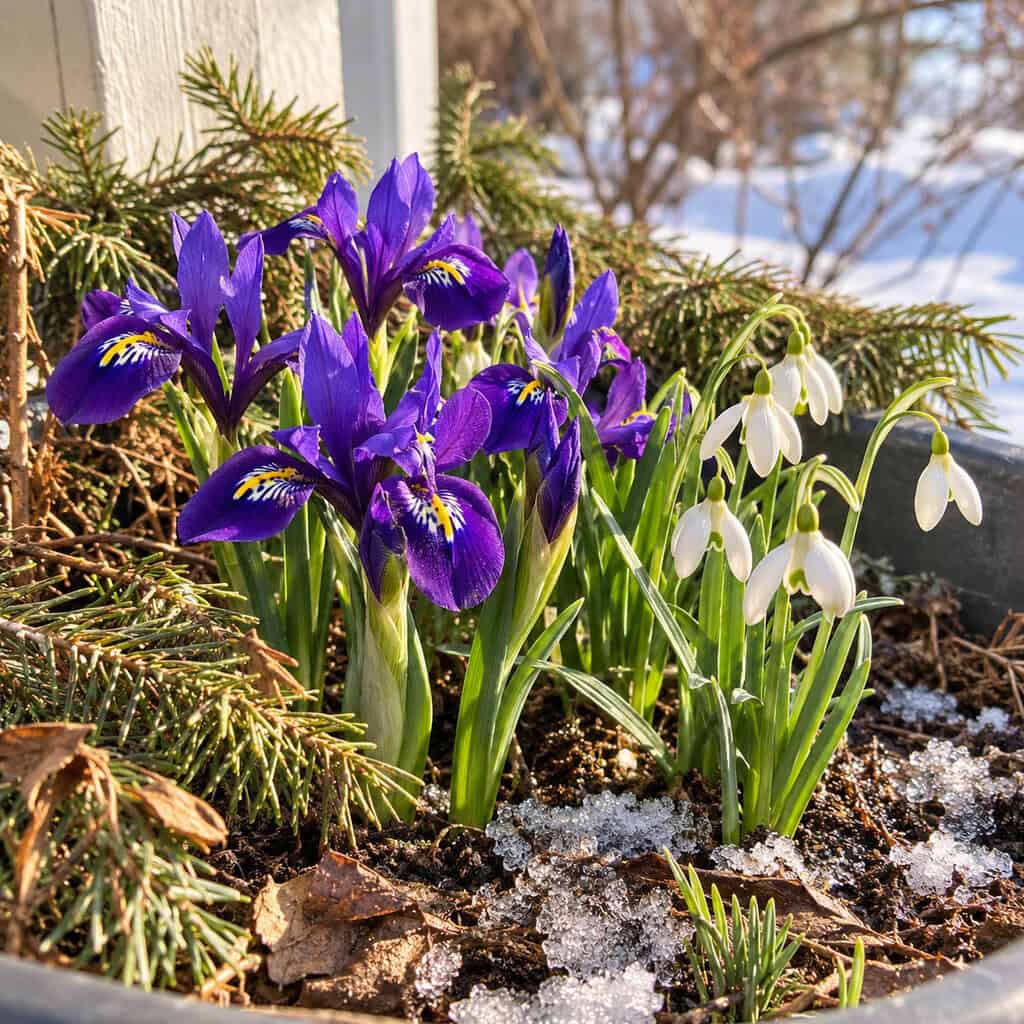
Almost no homeowner does this, and it’s the literal answer to the question of what a winter pot looks like in March.
At planting time in November, before any greens go in, push a layer of small bulbs four inches down into the soil. Iris reticulata in deep purple and blue. Crocus. Snowdrops. Twenty to thirty bulbs in a large container.
They sit through the freeze, get their chilling hours, and then erupt in late February and March — exactly when the cut greens have gone olive and tired and you were starting to resent the whole thing.
Iris reticulata is the showstopper. Six inches tall, flowers twice the size the plant seems able to support, and it opens while there’s still frost on the pot rim.
Push the bulbs toward the front and sides, away from where you’ll be stabbing birch poles in.
33. Pussy Willow Stems
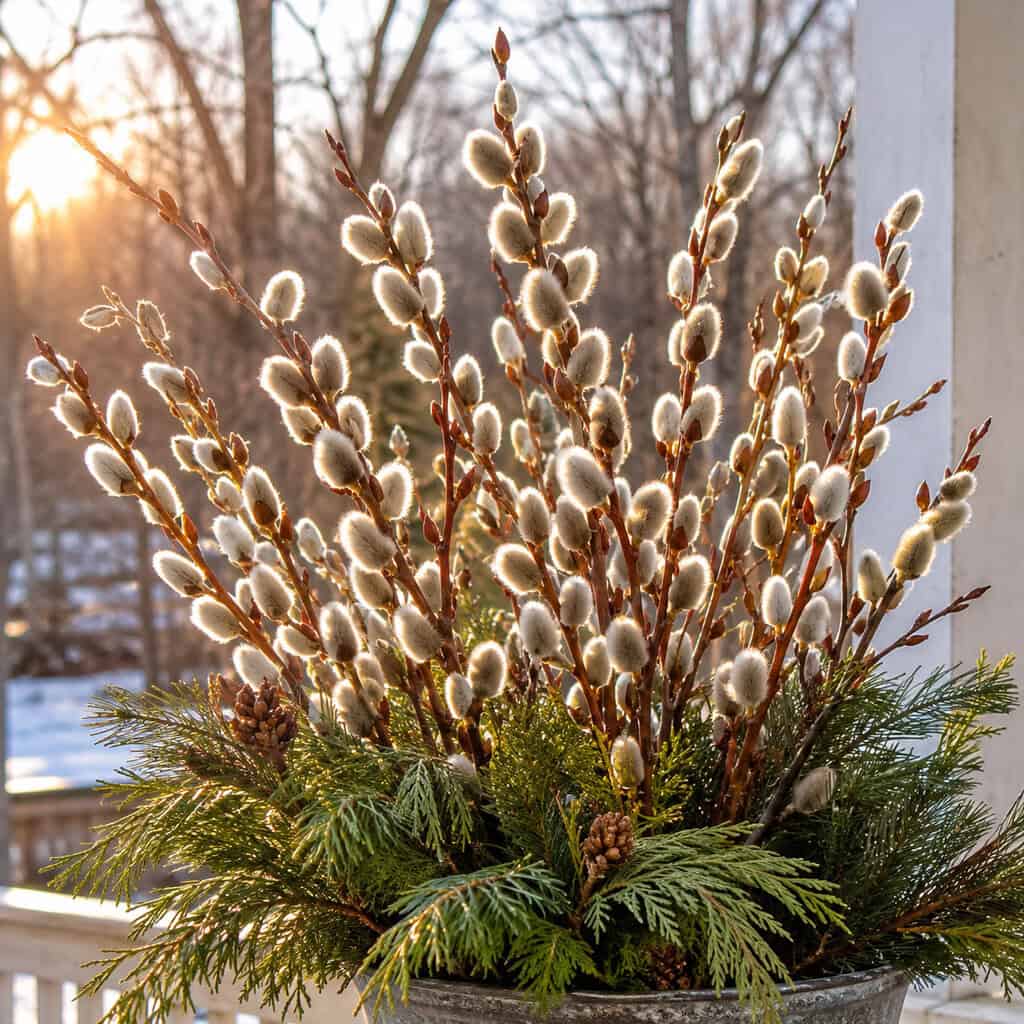
Save this one for January, when you’re bored with the pot and six weeks from anything green.
Pussy willow stems added in midwinter sit quiet for a few weeks — just straight brown rods with small bumps along them. Then, around the last week of February, the bumps split and the silver catkins push out.
By mid-March they’re full, soft, and catching light at a time when nothing else in the yard is doing anything at all.
It’s the container’s last act. The greens behind them have given up, the dogwood has peaked, and the pot ends its run announcing that spring is coming.
Pull them out in April and stick them in a bucket of water. They root almost spitefully easily.
The difference between a pot that quits in December and one that’s still working in March comes down to a handful of decisions made in November — fir instead of spruce, damp soil instead of dry, a hellebore buried in the middle, thirty bulbs nobody can see.
None of it is expensive. Most of it is cheaper than replacing a sad arrangement twice.
Build it once, water it in, let it freeze. Then forget about it until something yellow shows up in the dirt and reminds you that you planned ahead.