


A holiday display gets judged from a moving car, usually in about two seconds and usually after dark. That brief look is enough for anyone to sort a house into polished or thrown together.
The sorting has little to do with how many lights are up. Clean lines, one consistent color and a display that turns on and off on schedule look deliberate on almost any budget.
Small errors stack up the other way, and the street picks up on them even when nobody can say exactly why. Nearly every one has a cheap fix, and most take less than an hour.
Below are 27 holiday lighting errors that drag down a home’s curb appeal, along with what to do instead.
1. Controller Stuck on Chase Mode

Most multi-function light sets come out of the box running a demo cycle that jumps from chase to flash to fade every few seconds. Leave it there and the house looks like it is trying to sell something.
Motion pulls the eye in a way steady light never does, so a flickering roofline overpowers everything else in the yard, including the parts that look good.
Find the small control box near the plug and press the button until the strand holds a steady burn. If the box has a memory function, it will stay put after a power outage. If not, tape a note to the storage bin so next year starts on the right setting.
2. Two Shades of White Side by Side

White lights span a wide range of color temperatures, from roughly 2400K, which looks like candlelight, to above 6000K, which looks blue. Put two of those on one roofline and the difference jumps out at night, even to people who have never heard the term Kelvin.
Packaging makes it worse. One brand’s soft white can be another brand’s warm white, and a reorder two years later may not match the first batch.
Pick a single Kelvin number, ideally 2700K to 3000K for a traditional house, and buy every strand for one side of the house in the same order. Keep one spare from that batch for repairs.
3. A Roofline That Dips Between Clips

A straight line of light along the eaves is the backbone of most displays, and it is also the easiest place to spot a flaw. Every loose span between clips creates a small dip, and a row of them makes the whole roof edge look slack.
Wind and cold contraction make it worse as the season goes on, so a strand that looked tight in November can droop by mid-December.
Space clips about 12 inches apart for C7 and C9 strands and no more than 18 inches for mini lights. Pull each section snug before snapping the next clip shut, and check the line from the street before putting the ladder away.
4. A Dark Front Door

Plenty of houses get a lit roofline and a lit yard while the front door sits in shadow. The entry is where the eye naturally lands, so leaving it dark makes the display feel aimed at nothing.
Framing the door takes very little. A pre-lit garland across the top and down both sides, or a pair of lit planters on the steps, puts the focus where it belongs.
Keep the door lighting in the same color temperature as the rest of the house. Swapping the porch fixture to a 2700K bulb often pulls the whole entry together better than adding another strand.
5. One Dead Section in the Middle of the Run

A dark stretch in an otherwise lit line tells every passing driver that nobody has looked at the house since the lights went up. It is the flaw people notice first and forgive least.
On most LED strands, the culprit is a blown fuse in the plug, a corroded socket or a single bulb that worked loose and broke the circuit for its section. A plug-in light tester, around $20, usually finds the problem in minutes.
Keep two spare fuses and one full replacement strand in the storage bin. Then look at the house from the sidewalk every few nights so a gap never sits for a week.
6. A Second Story Left Dark

On a two-story house, it is common to see the garage and the first-floor eaves lit while the upper roofline stays black. From the street, the display looks like it stopped partway through.
The dark area is not really the issue. The lopsided outline is, because it makes the house look unfinished.
If the upper eaves are out of reach, skip the roofline and frame what is fully reachable: porch columns, garage door trim and front windows. For a complete outline, installers often charge $3 to $6 per linear foot on a two-story home, and most include removal in January.
7. C9 Bulbs Pointing Every Direction

Large C7 and C9 bulbs look polished only when they stand in an even row. When some point up, some tilt sideways and a few hang down, the roofline looks crooked even if the wire is perfectly straight.
This usually happens when strands go up without clips that grip the socket, or when bulbs get twisted in storage.
Use all-in-one shingle and gutter clips that hold each socket at the same angle, typically straight up on shingles and straight out on gutters. Once it is dark, spend five minutes at ground level spotting strays, then straighten them with a light-hanging pole.
8. A Bright Orange Cord Snaking Across the Yard
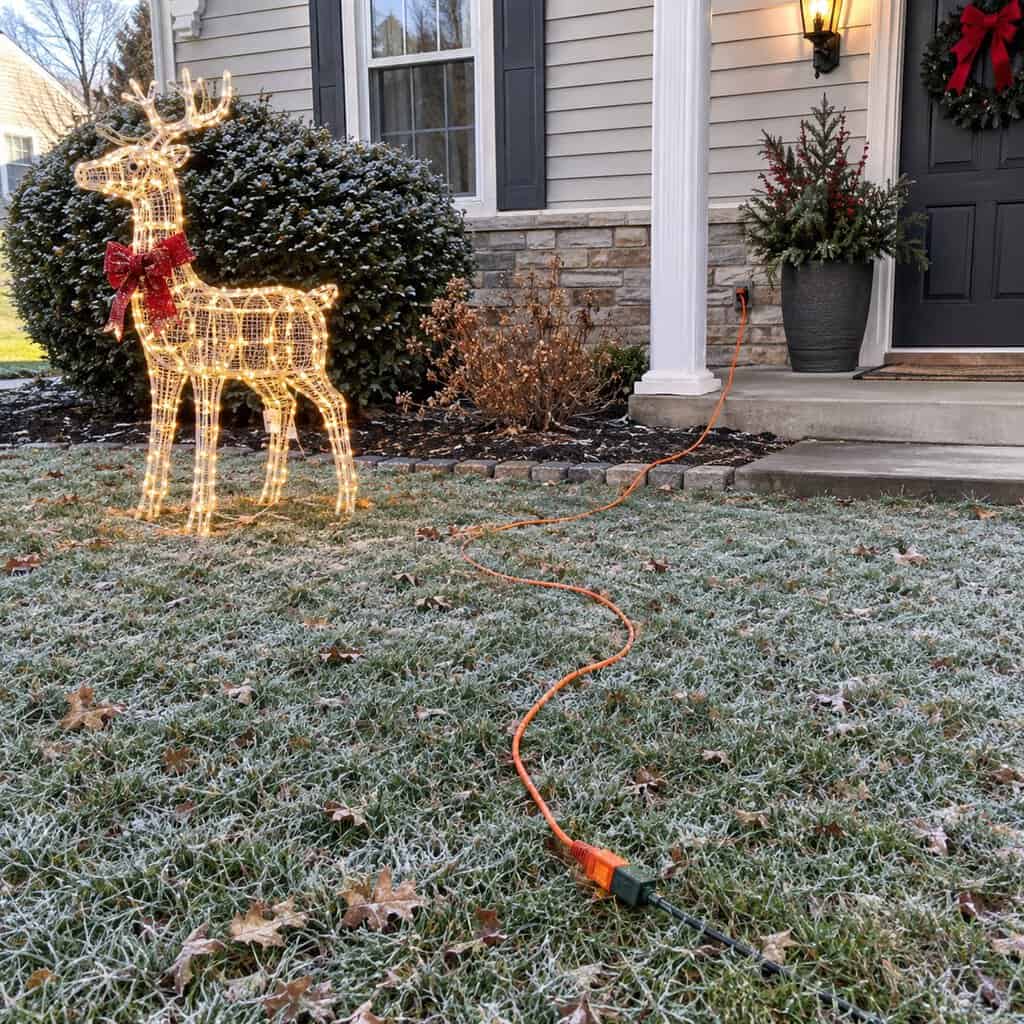
The standard hardware-store extension cord is orange so people do not trip over it on a job site. In a front yard, it catches headlights and porch light and draws a line straight to the outlet.
Outdoor-rated cords also come in green, brown, black and white. Match the cord to what it crosses: green on grass, brown or black over mulch, white along light siding.
Keep runs short by using more than one outdoor outlet when possible, and lift every plug connection off the ground. A covered outdoor connection box, about $10, keeps rain and snowmelt away from the plugs and cuts down on nuisance GFCI trips.
9. Blue-Tinted Cool White Strands

Cool white sits at the far end of the color scale, usually 5000K to 6500K, and inexpensive versions often throw a noticeable blue cast. On red brick or tan stucco, that cast clashes with the warm wall colors and makes the house look chilly.
It can work as an accent on a stark modern facade with gray siding, or on bare branches meant to look icy.
For most traditional homes, look for a number between 2700K and 3000K printed on the box. Terms like bright white or pure white are marketing language and do not reliably tell you which way a strand leans.
10. A Tree Lit Only as High as Arms Can Reach

Front yard evergreens often end up lit from the ground to about 7 feet and dark above that. The result is a tree with a glowing skirt and a black top, which looks unfinished from any distance.
Lights also tend to get piled on the outer tips of the lowest branches, leaving the interior hollow.
Work from the top down with a ladder or a light-hanging pole, which runs about $25. Weave strands in and out of the branches instead of draping them, and plan on roughly 100 mini lights per foot of tree height on a dense spruce or fir. If the top is truly out of reach, light a smaller tree well instead.
11. Nails and Staples Holding the Strands

Staple guns and finishing nails seem quick, but every one leaves a hole in trim or siding that stays visible long after the lights come down. Over a few seasons, the fascia ends up dotted with rust stains and split paint.
Driving a nail through a shingle is worse, since it gives water a path into the roof deck. A staple fired across a wire can also cut the insulation and cause a short.
Plastic clips are made for nearly every surface, including shingles, gutters, brick, railings and siding. A pack of 100 costs a few dollars and comes off cleanly in January.
12. Too Many Strands Plugged End to End

Every strand has a maximum number of sets it can safely power in a chain, printed on the tag near the plug. Older incandescent minis often allow only a few, while many LED sets allow dozens.
When the run is too long, the far end gets less power and glows dimmer, so the roofline appears to fade out halfway across. Push further and the fuse blows or the breaker trips.
Split long runs into shorter ones that start from separate plugs. A three-outlet outdoor splitter at the outlet lets each section draw power straight from the source rather than through the strand before it.
13. A Lawn Crowded With Inflatables
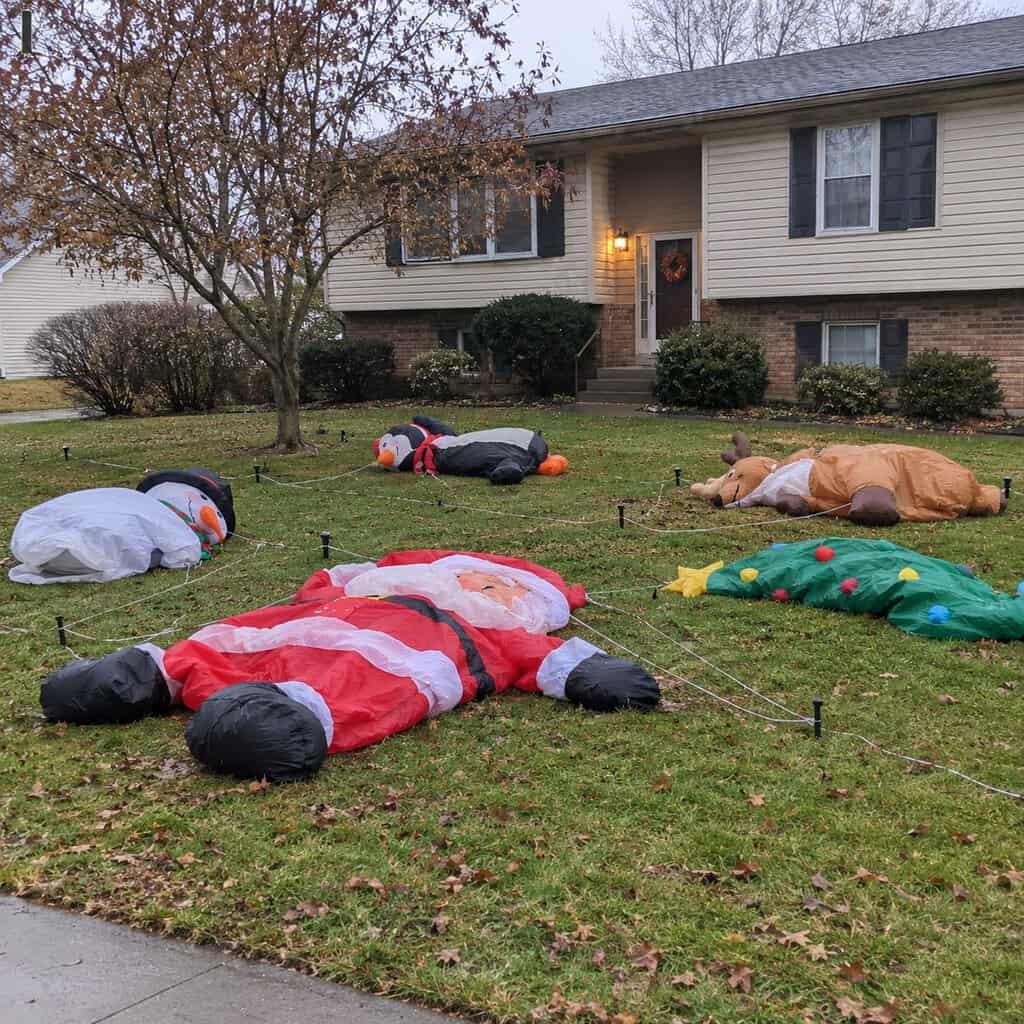
A single inflatable near the walk can be fun, especially at a house with kids. Once five or six share the same lawn, they compete for attention and the yard starts to resemble a seasonal store aisle.
They also spend more than half of each day flattened in the grass. That daytime view of crumpled nylon and stake lines does more harm than the nighttime view helps.
Choose one or two in the 6 to 8 foot range, place them where they can be seen clearly from the street, and stake every tether. Put them on their own timer so they stand up shortly before the lights come on.
14. Net Lights Stretched Over the Wrong Shrubs
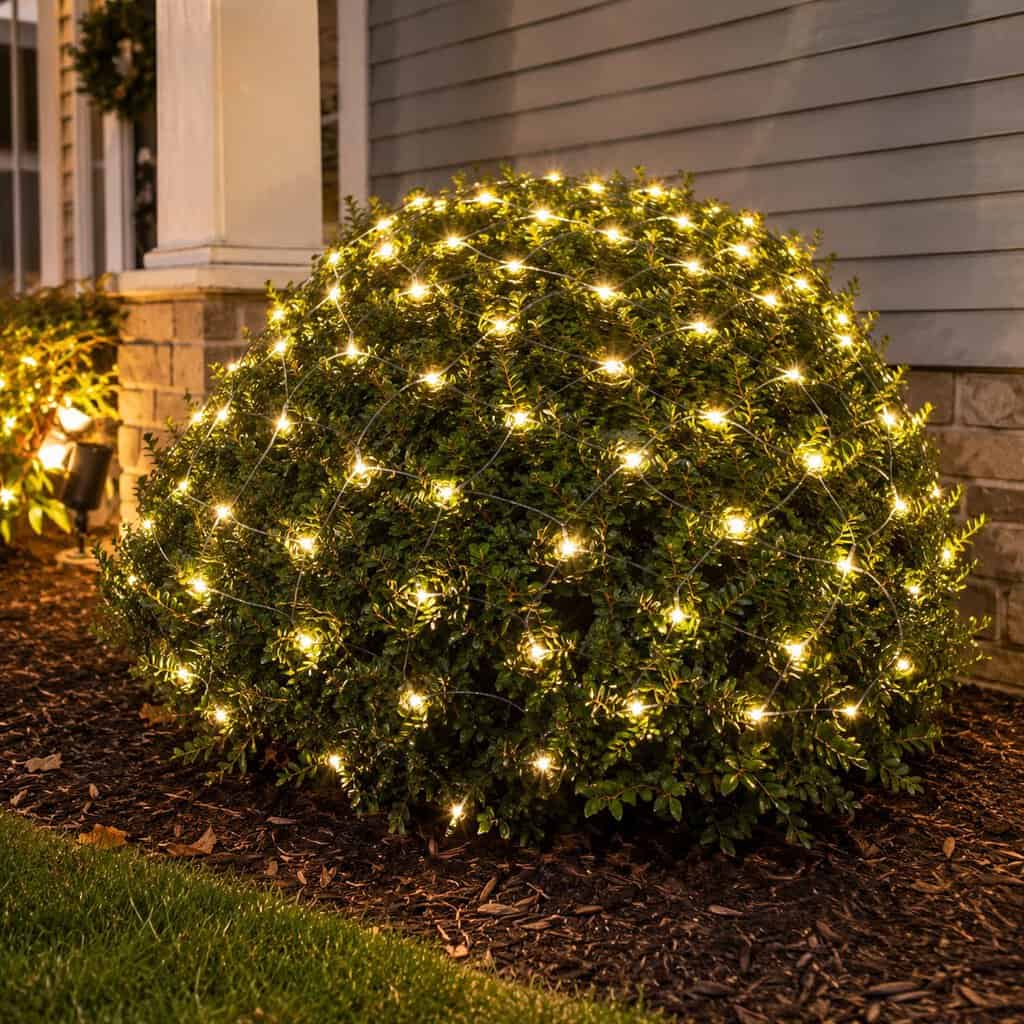
Net lights are built for flat-topped, boxy hedges. On a round, pyramidal or loose shrub, the grid stretches in some places and bunches in others, so the light looks lumpy and the base of the plant stays dark.
They also hide the shape of the shrub, which is the main reason to light it.
On rounded shrubs under 4 feet, wrap mini lights in loose spirals from the base, tucking the strand slightly into the foliage. Save net lights for clipped rectangular hedges such as privet, and pull the net all the way to the ground before staking the edges.
15. A Small Wreath Lost on a Big Wall

A standard 24-inch wreath looks generous indoors and tiny from 50 feet away. Hung alone above a double garage or centered on a two-story wall, it nearly disappears.
Outdoor decorations need to be scaled to viewing distance, not arm’s length. A useful guide is to size a wreath at about one-third the width of the door or window it decorates.
On a large blank wall, go with 36 to 48 inches and aim a small spotlight at it from below. Matching wreaths on each upstairs window also work well if one large wreath feels too heavy for the house.
16. Three Bulb Styles on One Side of the House

Large C9s along the gutter, minis on the porch rail and an icicle strand on the garage, all on the same face of the house, look like leftover inventory rather than a plan. Each style has its own size, spacing and brightness, and they do not blend.
A consistent look does not require one type everywhere. It means one type per line or surface.
A dependable pairing is C9s on the roof edge and minis in the shrubs and trees, since height keeps the two apart. Retire odd strands to the backyard or the garage interior instead of using them up out front.
17. Candles in Some Windows but Not Others

Electric window candles are a classic look, especially on colonial and farmhouse styles. The effect falls apart when only three of eight front windows have them, or when a few glow white and others glow amber.
Windows read as a grid from the street, so every gap in the pattern stands out.
Put a candle in every front-facing window on both floors, and buy them in one batch so the bulbs match. Battery models with a 6-hour auto timer avoid cords across the sill. Set each one centered on the lower sash so they line up from outside.
18. Lights Running Without a Timer
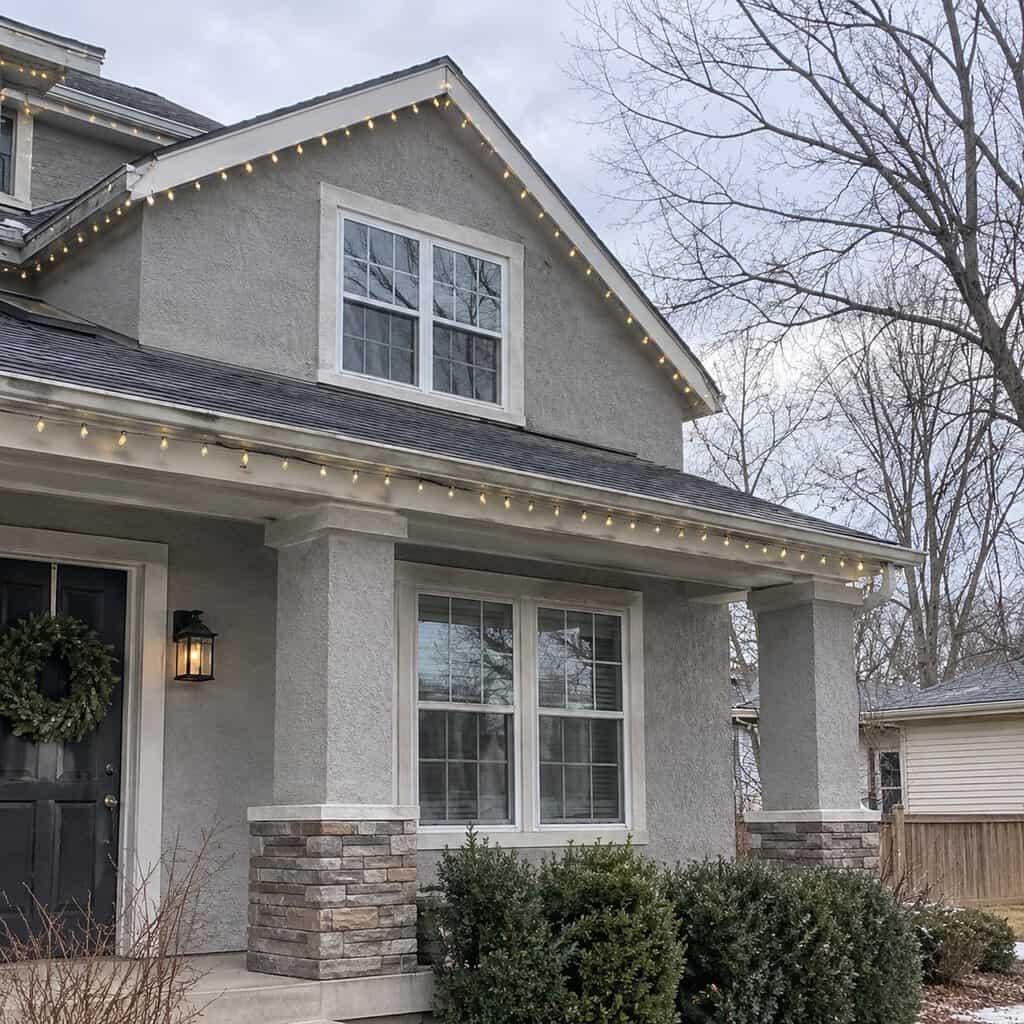
Strands left on through the day look like tangled wire and gray plastic in sunlight, and lights still burning at 2 a.m. suggest someone simply forgot. Neither helps the house.
A display looks most deliberate when it switches on at dusk and off at a set hour, the same way good landscape lighting does.
An outdoor plug-in timer with a light sensor costs $15 to $30 and handles the whole job: on at sundown, off after 5 or 6 hours. A smart outdoor plug adds phone control. Either one trims the electric bill and extends the life of the strands.
19. Uneven Spacing on a Wrapped Trunk
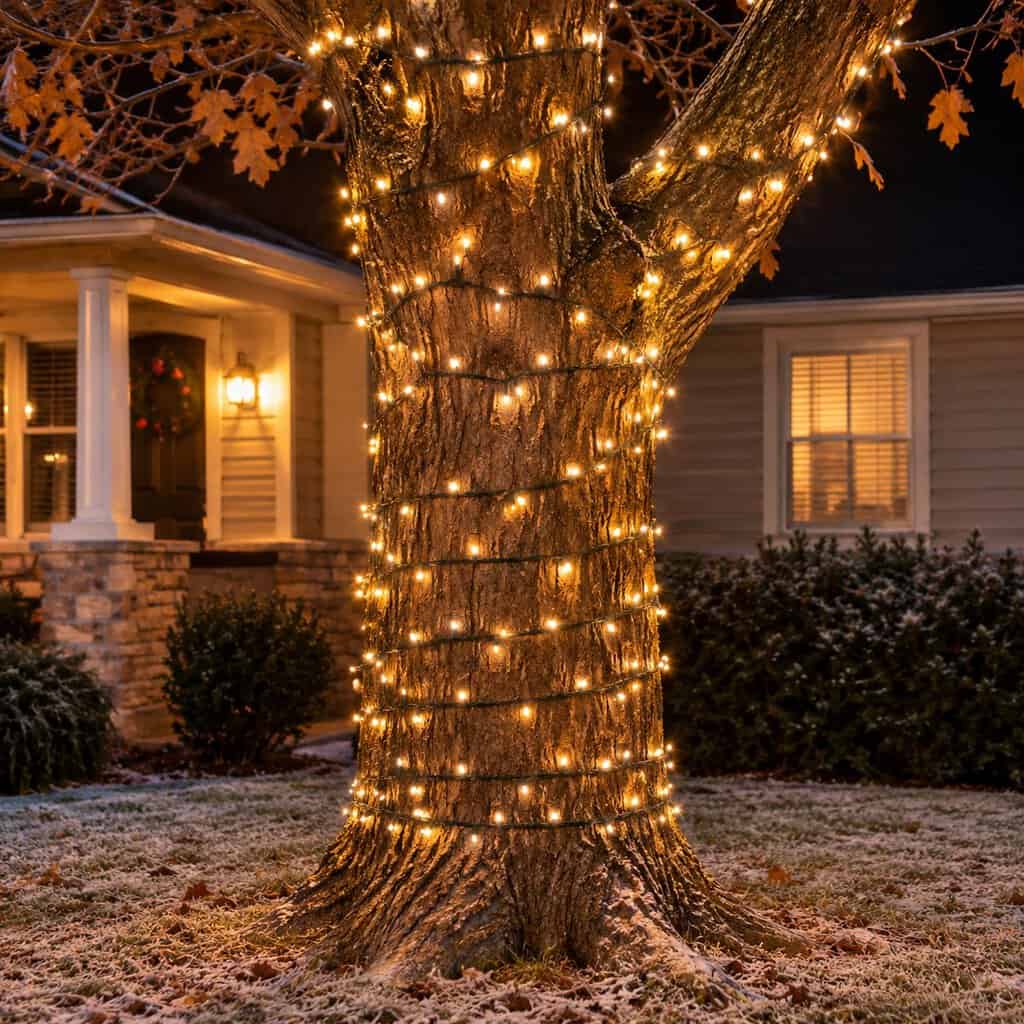
Wrapped trunks look sharp when the spirals are evenly spaced and messy when they are not. Because a trunk is a straight vertical shape, any change in spacing from bottom to top is obvious, and wraps tend to loosen as the person wrapping climbs higher.
Cut a stick or strip of cardboard to the spacing you want, 4 to 6 inches suits most trees, and hold it against the last wrap as a guide. Start at the base and keep steady tension.
Plan for plenty of strands. Running out halfway up leaves an awkward stop that is hard to hide.
20. A Floodlight Blasting the Front Wall

A single bright flood staked in the lawn and pointed straight at the house tends to wash out everything around it. Strand lights on the eaves lose contrast, the trim loses its shadows and the siding looks flat.
Bright floods also spill into neighbors’ windows and drivers’ eyes.
Use lower-output fixtures, around 200 to 400 lumens, set close to the wall and angled steeply upward so the light skims across brick, stone or columns. Aim them at specific features such as the entry or a tree, and choose warm fixtures that match the rest of the display.
21. A Mashup of Unrelated Themes
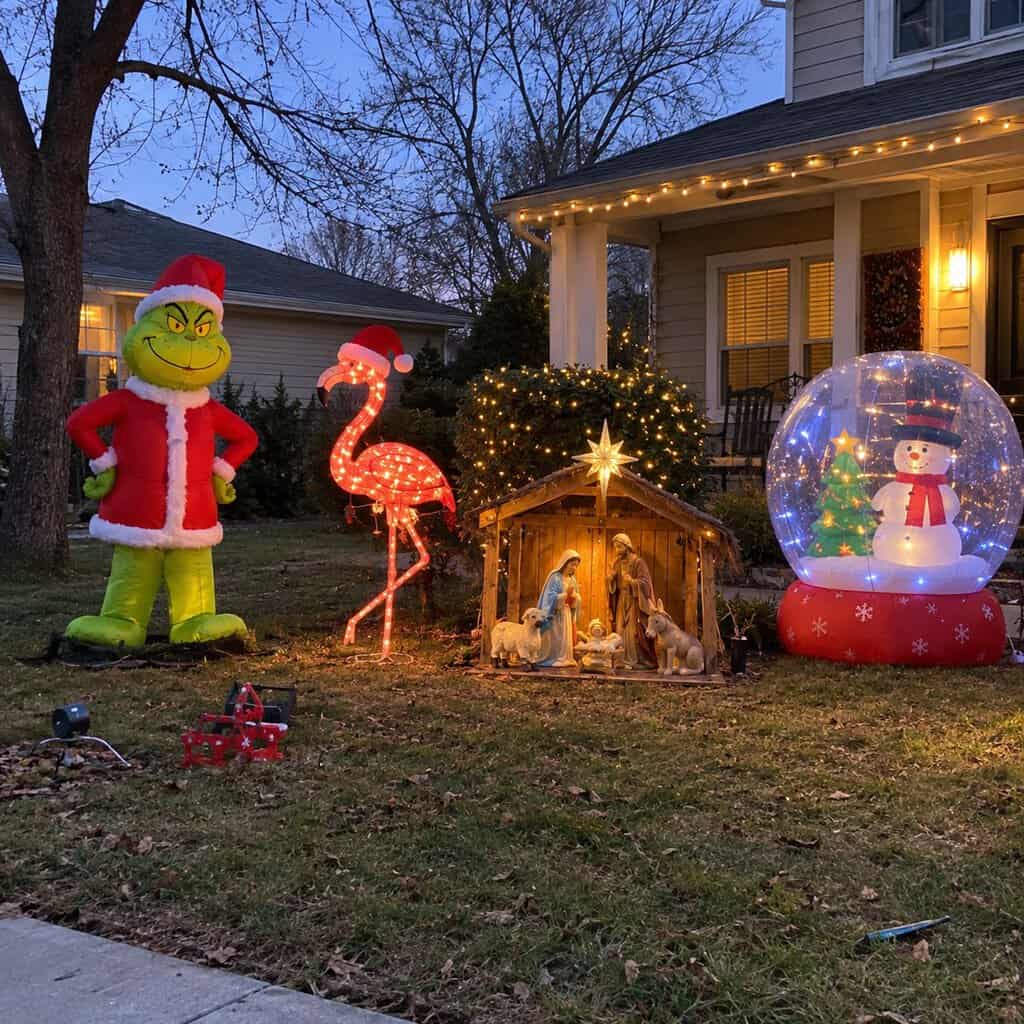
Cartoon characters on the lawn, a nativity by the porch, a lit flamingo in a Santa hat and a giant snow globe on the driveway each have their fans. Together, they cancel each other out and the yard looks like the result of several unrelated shopping trips.
A display does not need to be formal to look intentional. It needs a consistent mood, whether classic, whimsical or rustic.
Choose one theme for the front yard and move the rest to the backyard, a side yard or an indoor window. Rotating pieces from year to year keeps favorites in use without crowding.
22. Indoor Light Sets Used Outside

This one is about safety more than style. Indoor-only sets have thinner wire insulation and sockets that are not sealed against moisture, so rain, snow and freeze-thaw cycles quickly lead to corrosion and shorts.
A corroded connection heats up, and that heat often sits right against dry garland, wreaths or leaves packed in a gutter.
Before any strand goes outside, check the tag near the plug. It should say indoor and outdoor use and carry a UL, ETL or CSA mark. Anything labeled for indoor use only belongs on a mantel or an indoor tree.
23. Green Wire Against Light Trim

Green-wire strands were designed to vanish inside an evergreen. Clipped to white gutters, cream soffits or pale siding, they show up as a dark zigzag that is plain to see for most of the day.
The display spends more daylight hours off than nighttime hours on, so the wire matters as much as the bulbs.
Buy white-wire strands for light trim, brown or black wire for dark brick, stone and stained wood, and keep green wire for shrubs, garland and trees. Prices are nearly identical across wire colors at most retailers, so the switch costs nothing extra.
24. Every Color at Once

Red, green, blue, multicolor and white strands all on one house rarely look festive. The colors compete, and there is no main color for the eye to settle on.
Restraint reads as confidence. Pairings such as warm white with red, or warm white with green garland, look tidy on almost any house style. Classic multicolor works well too, as long as it is the only color up.
If mixing is the goal, separate colors by zone: one for the roofline, another for the shrubs. That way each area looks planned instead of random.
25. A Display With Only One Layer

Many houses light only the roof edge and leave everything below it dark. Even a crisp roofline looks thin when it floats above a black yard, because nothing at eye level anchors it.
Professional installers think in three heights: ground, middle and top. Each layer gives the eye a step to climb.
Start with low shrubs or a few path lights at ground level. Add something around 4 to 7 feet, such as a lit wreath, porch railing garland or a small wrapped ornamental tree. Two added layers usually matter more than doubling the roofline lights.
26. Matted, Faded Garland
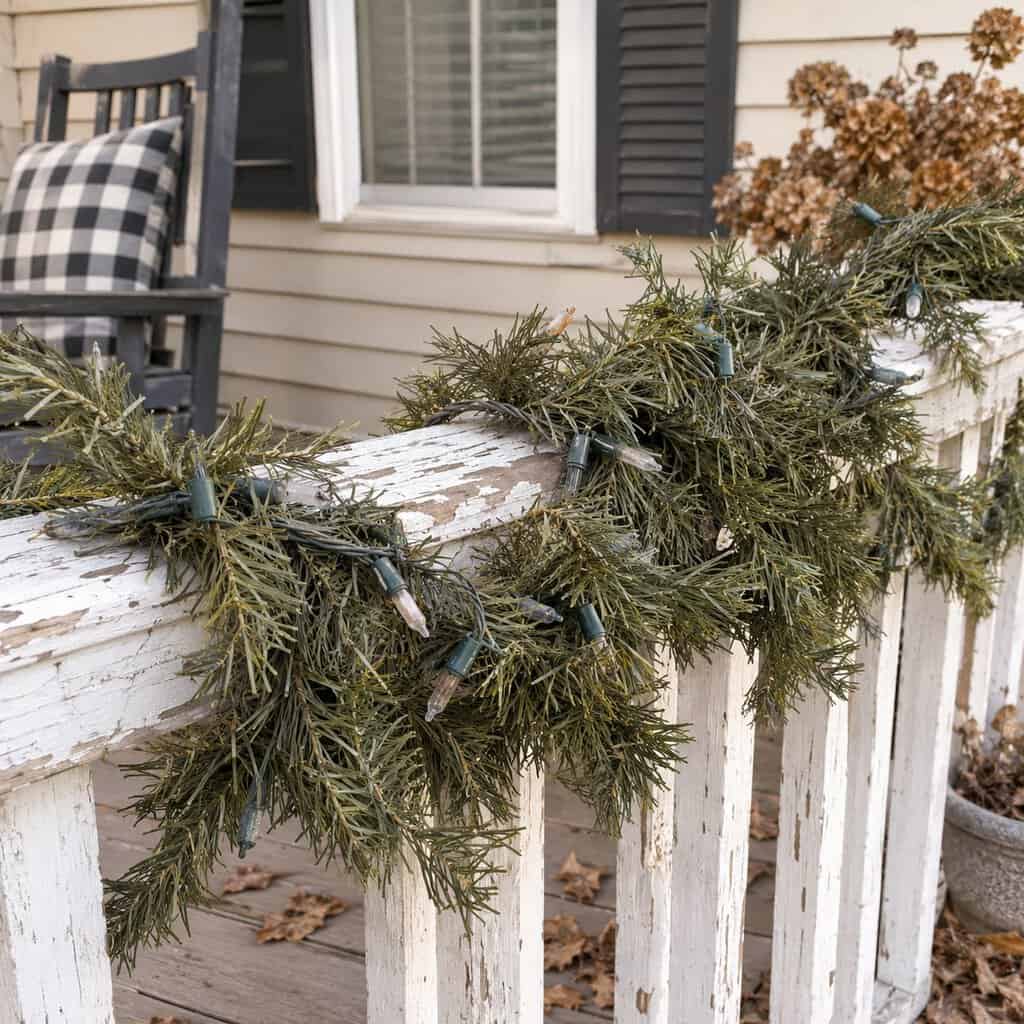
Artificial garland on railings and around the door takes a beating from sun, wind and storage. After a few years, the needles flatten, the green fades toward olive, and built-in lights burn out in patches.
Up close, tired garland makes everything near it look older, including a freshly painted door or a new porch fixture.
Fluff each branch tip by hand before hanging, and replace any section with large dark gaps. When buying new, look for PE needles, which hold their shape better than flat PVC, and store garland loosely coiled in a bin rather than crushed in a bag.
27. Lights Still Hanging Well Into Spring
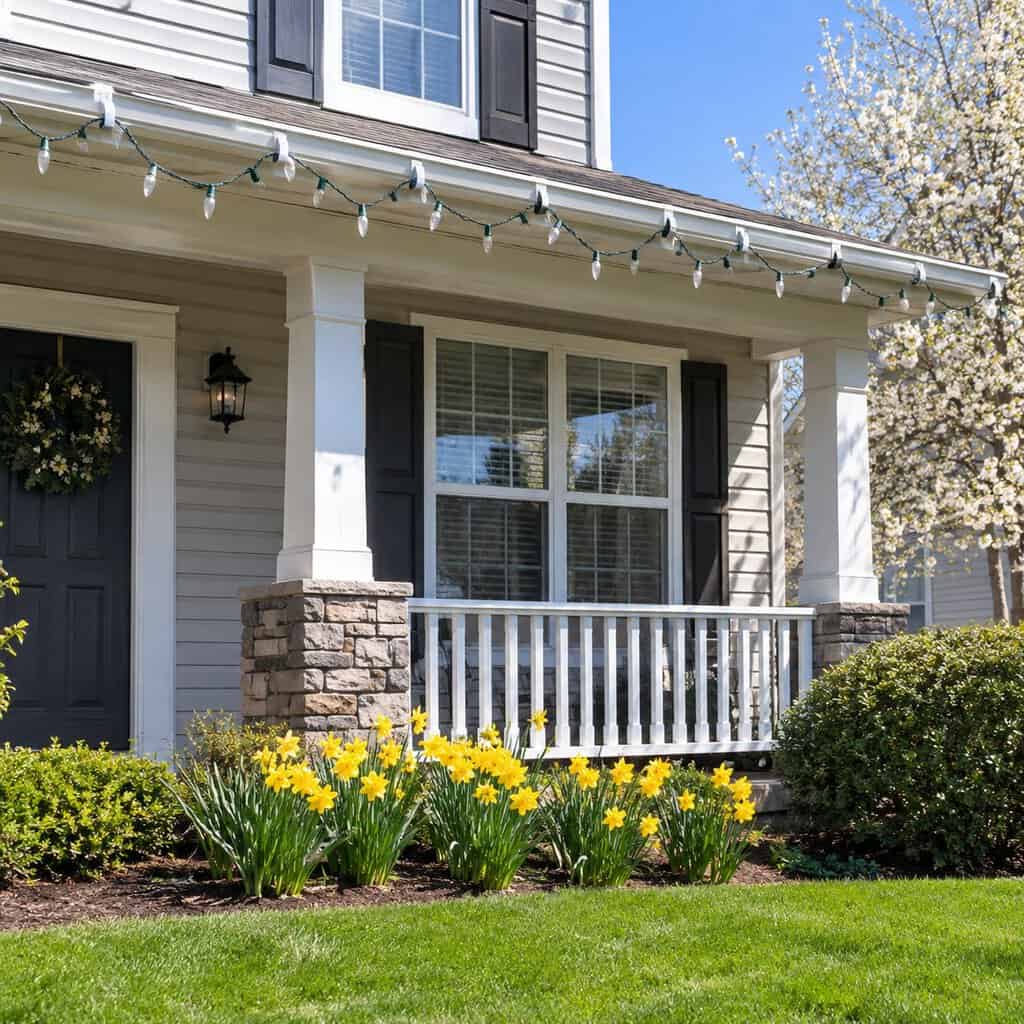
Holiday lights that stay up into March or April shift from cheerful to neglected. A dark strand on the gutter or a row of leftover clips sends the same message as an unraked yard.
Weather is the usual excuse, but a mild afternoon in mid to late January is typically enough to get everything down.
Remove the clips along with the strands, since they turn brittle and yellow in summer sun. Wrap each strand around stiff cardboard, tag it with where it hung and its length, and store it in a lidded bin. Setup next year goes much faster.
Where to Start This Season
Not every item here needs attention at once. The biggest gains usually come from three steps: matching color temperature across the house, tightening the roofline and putting everything on a timer.
After that, work outward. Light the front door, add a layer at eye level and swap any cord or wire that shows in daylight.
Each change is small and inexpensive. Together, they make a modest display look like it was planned from the start.