


The first night is always perfect. You flip the switch at dusk, the beds glow, the tree out front looks like something from a magazine, and you stand in the driveway longer than you’ll admit.
Year five looks different. Half the path lights are dark. One is dangling out of the mulch where the edger found it. The floodlight over the garage makes your warm brick look like a parking structure.
Outdoor lighting ages harder than almost anything else in a yard. It sits in wet soil, bakes in UV, gets mowed over, and gets wired by people in a hurry on a Saturday.
Most of the failures are predictable. They’re baked in at the moment of purchase, before a single shovel goes in the ground.
Here are 28 outdoor lighting choices that look great on day one and turn into regret by year five.
1. Solar Stake Path Lights

Everyone starts here. Twelve lights for $30, no wiring, no transformer, done in twenty minutes.
The LED isn’t the problem. The battery is. Those little NiMH cells in bargain stakes start losing capacity almost immediately, and most are noticeably weaker by their second season.
Then the panel hazes. Cheap polycarbonate clouds under UV, so even on a blazing July day it can’t harvest a full charge. The light limps along at firefly brightness for a year before it finally quits.
Some brands sell replacement cells and lens caps, which helps if you bought a fixture worth repairing. Most people didn’t.
2. The 5000K Daylight Floodlight Over the Garage

The box said brighter. You believed it.
5000K reads blue to the human eye. It flattens brick, drains the warmth out of cedar and stone, and makes a nice house look like a distribution center at 9 p.m.
DarkSky recommends 2700K or warmer for residential exteriors, and their home lighting assessment walks through why. Swap the lamp. It’s a $15 fix for the single biggest visual mistake on this list.
3. The Airport-Runway Path Light Lineup

Eight fixtures, perfectly spaced, marching down both sides of the walk like taxiway markers.
Pros don’t do this. They stagger fixtures on one side and let the pools of light overlap into a soft ribbon, which uses about half the fixtures.
Half the fixtures means half the failure points. And the walk reads as a path instead of a landing strip.
4. Wire Nuts and Electrical Tape at Every Splice
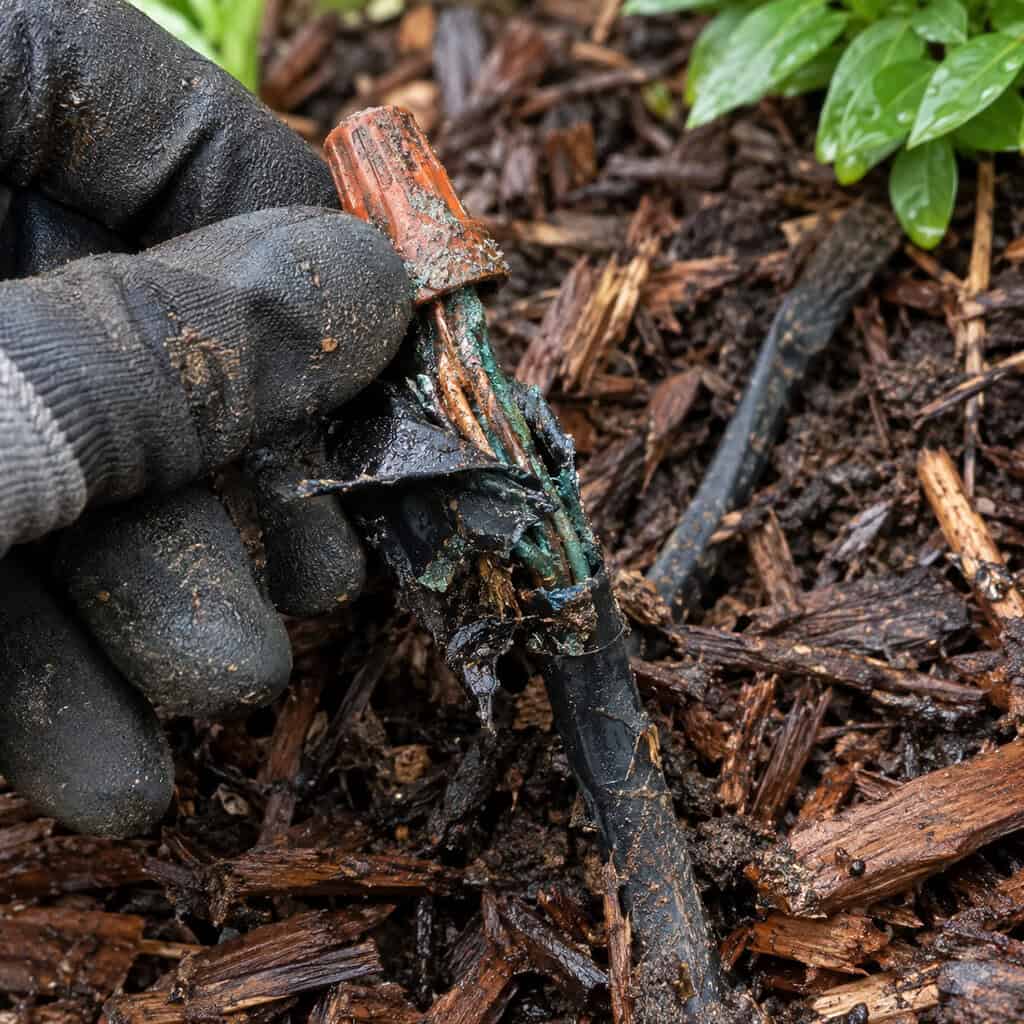
This is the one that kills entire systems, and almost nobody sees it coming because the failure happens underground where you can’t watch it.
A wire nut is designed for a dry junction box. Buried in mulch, it wicks moisture straight into the copper by capillary action. Electrical tape makes it worse — it traps the water in.
Within two seasons the strands turn green and powdery. Resistance climbs, voltage drops, and the fixtures downstream of that splice go dim before they go dark. Then you’re digging up forty feet of cable trying to find which joint rotted.
Use silicone-filled direct-burial connectors instead. The gel-filled twist-on type (King Innovation’s DryConn and the Ideal UnderGround series are the ones most landscape crews carry) take about ten seconds each, and the gel displaces water permanently. For heavier runs, a heat-shrink butt splice with internal adhesive is the step above that.
Budget roughly a dollar a connection. A twelve-fixture system costs you maybe $20 in connectors and buys you a decade of not troubleshooting.
5. Cool-White Lights Right Over the Patio Table

Sit under a bright white fixture in July and you’re not hosting dinner. You’re running a field study on local insect populations.
Short-wavelength light — the blue-heavy output of cool white LEDs — pulls night-flying insects far more aggressively than warm sources. Research on street lighting and insect abundance has measured real population-level effects from exactly this kind of lamp.
Moths are the visible half. The less obvious half is that every midge, gnat, and lacewing you draw to the table also draws the things that eat them, and mosquitoes orient toward the warm, CO2-rich cluster of people sitting under the glow.
Three changes fix it. Go warm — 2200K to 2700K, amber if you can find it. Drop the brightness way lower than feels right; patio seating needs far less light than people install. And move the actual light source away from where bodies sit.
- Warm amber bulbs, 2700K or lower
- Fixtures mounted at the patio edge, not overhead at the table
- A dimmer, so you can run at 30 percent on bug-heavy nights
- One brighter task light at the grill only, switched separately
Light the perimeter, keep the table dim, and let the bugs gather over there instead. It works better than any citronella candle you’ll buy.
6. Painted Aluminum and Resin Fixtures in Irrigated Beds
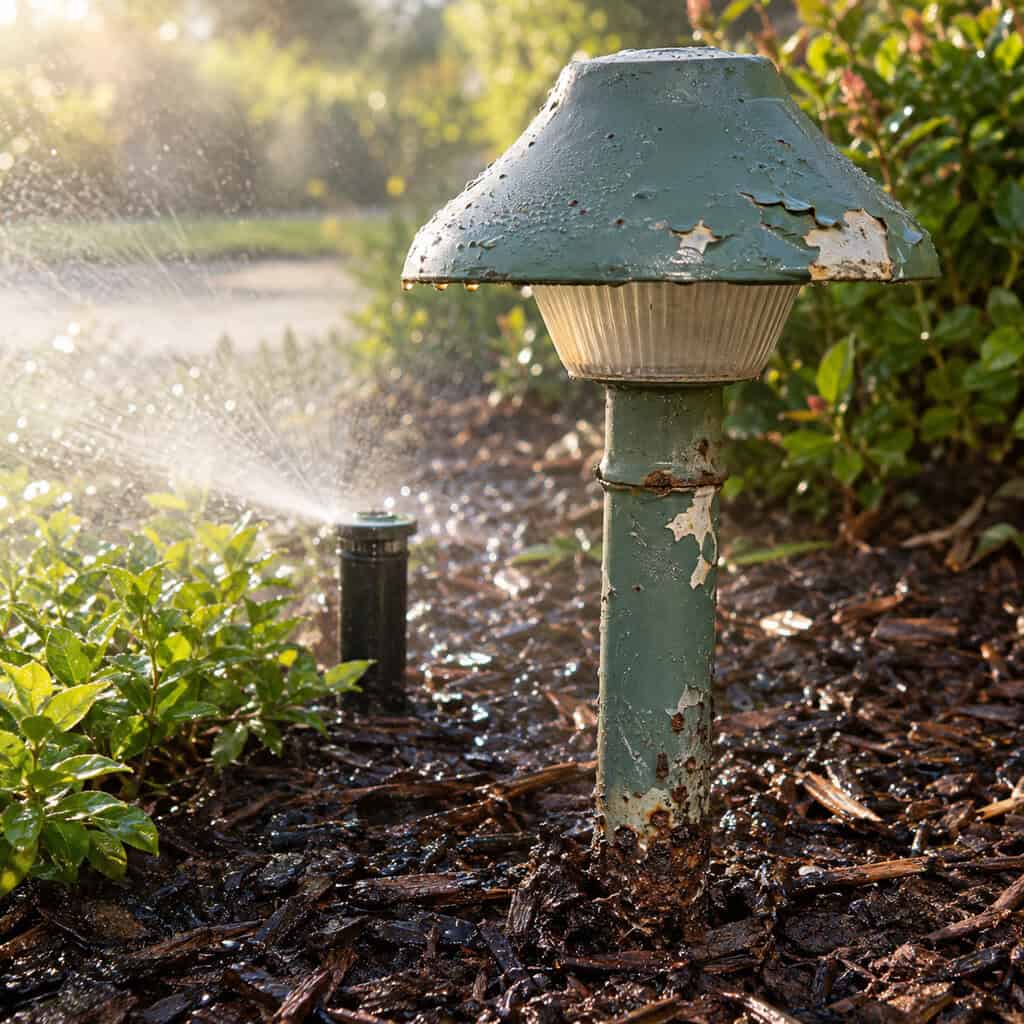
Sprinkler water, fertilizer salts, and acidic soil are a brutal combination for thin painted metal.
The paint blisters at the seams first. Then the aluminum pits, the stake snaps at the ground line, and the resin housings go chalky and crack when you nudge them with a rake.
Cast brass and copper cost two or three times more and patina instead of corroding. Many carry lifetime housing warranties — the manufacturers know the metal outlasts the homeowner.
7. A Motion Floodlight Aimed at the Street

Aimed wide at the road, it fires every time a car passes, a cat crosses, or a branch moves in the wind.
After about eight months of false triggers, the household stops looking out the window. The light has trained everyone to ignore it, which is the opposite of security.
Mount it high. Aim down and inward across the approach to the door, not outward at the property line. Keep the sensor head clear of shrubs that sway.
8. Integrated LED Fixtures With No Replaceable Lamp

Sealed fixtures took over around 2015 because they’re cheaper to manufacture and easier to waterproof.
The catch shows up when the driver fails — and the driver almost always fails before the diode does. There’s no bulb to change. The whole fixture goes in the trash, stake and all.
You also lose the ability to adjust. A yard changes over five years; the tree fills in, the bed grows, and you want a tighter beam or a warmer tone. With a replaceable MR16-style lamp you buy a new bulb. With an integrated fixture you buy a new everything.
9. In-Ground Well Lights Set Flush in the Lawn
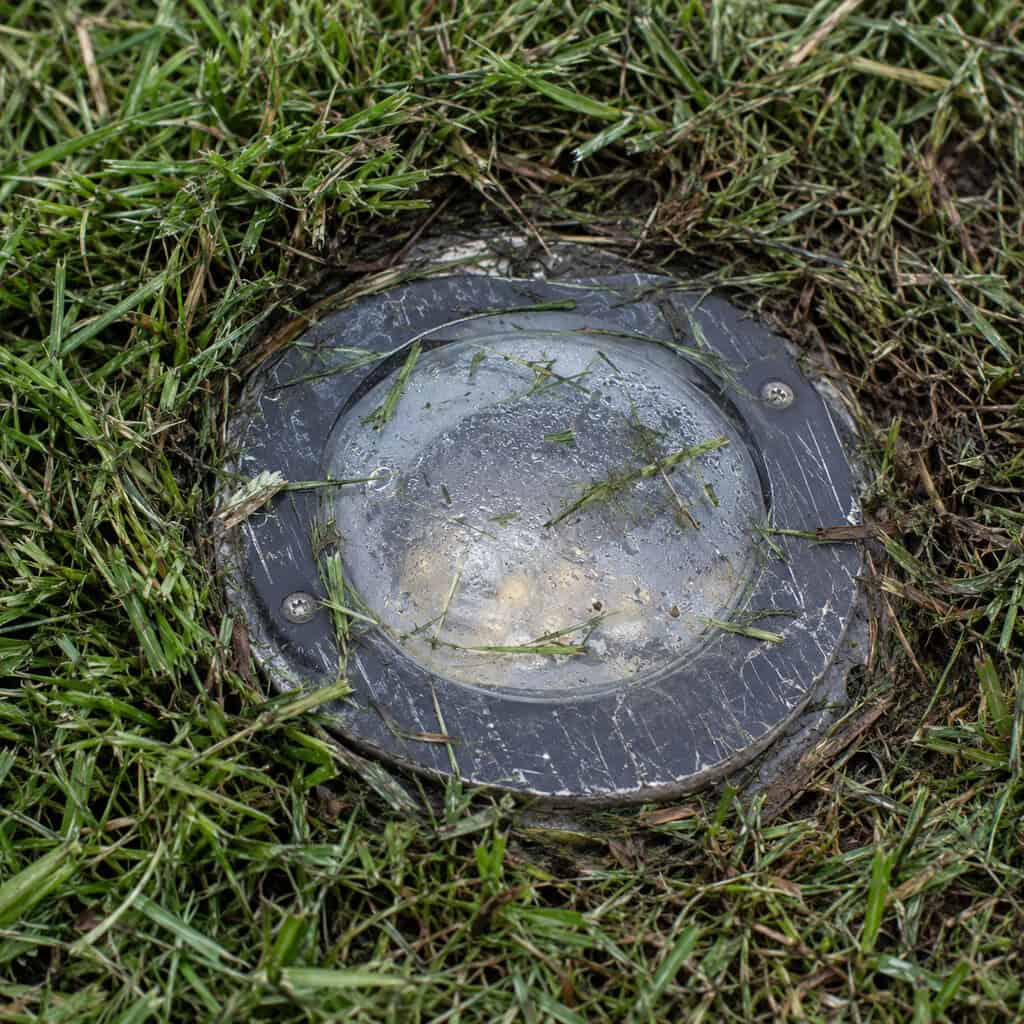
Gorgeous in the showroom photo. Miserable in turf.
The lens sits at grade, so it collects clippings, mulch, and standing water, and the mower deck grinds the trim ring every single week. Gaskets give out, moisture gets in, and the lens fogs from the inside where you can’t clean it.
Digging one out to replace it is a half-day job with a shovel and a lot of swearing. Set well lights in beds, over a few inches of drainage gravel, or skip them.
10. Oversized Mushroom-Cap Path Fixtures

The big domed hat was the builder default from about 1992 through 2008, and it instantly dates a yard.
It also lights the wrong thing. That wide cap throws a bright ring at ankle height that illuminates the fixture itself more than the walkway.
Low-profile and paver-integrated options do the job without announcing the decade. Designers have been steering homeowners away from oversized path hats for years now.
11. Cable Laid on Top of the Mulch
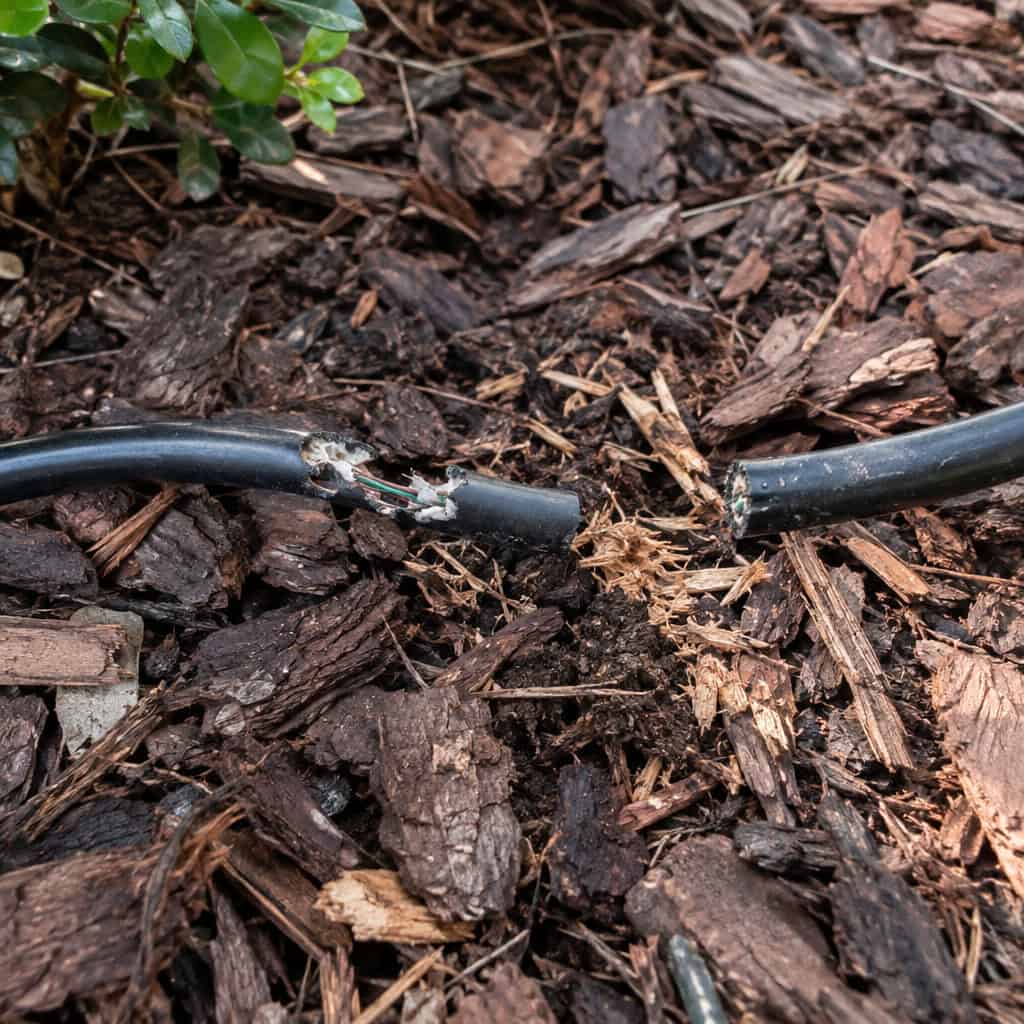
It’s the shortcut everyone takes on install day. The cable’s low voltage, the mulch covers it, and you tell yourself you’ll bury it properly next spring.
You won’t. And three things start working on that cable immediately.
The edger finds it first. One pass along the bed line and you’ve got a severed run and no idea where, because the cut is hidden under three inches of bark.
Rodents find it second. Warm mulch beds are prime nesting habitat for voles and mice, and they gnaw cable jacket as a matter of routine — sometimes for nesting material, sometimes just to wear their teeth down. A chewed jacket doesn’t fail right away. It corrodes slowly, then shorts in the middle of a rainy week.
Aerators and dethatchers find it third. Anything with tines that pulls across a bed edge will hook a loose cable and drag twenty feet of it out of the ground.
Bury it six inches. Use a flat spade to cut a slit trench, drop the cable in, and heel it closed. Leave a loop of slack coiled at every fixture so you can reposition later without splicing, and run the cable along a line you’ll remember — parallel to the bed edge, never diagonally across open lawn.
12. An Uplight Strapped or Bolted to the Tree Trunk
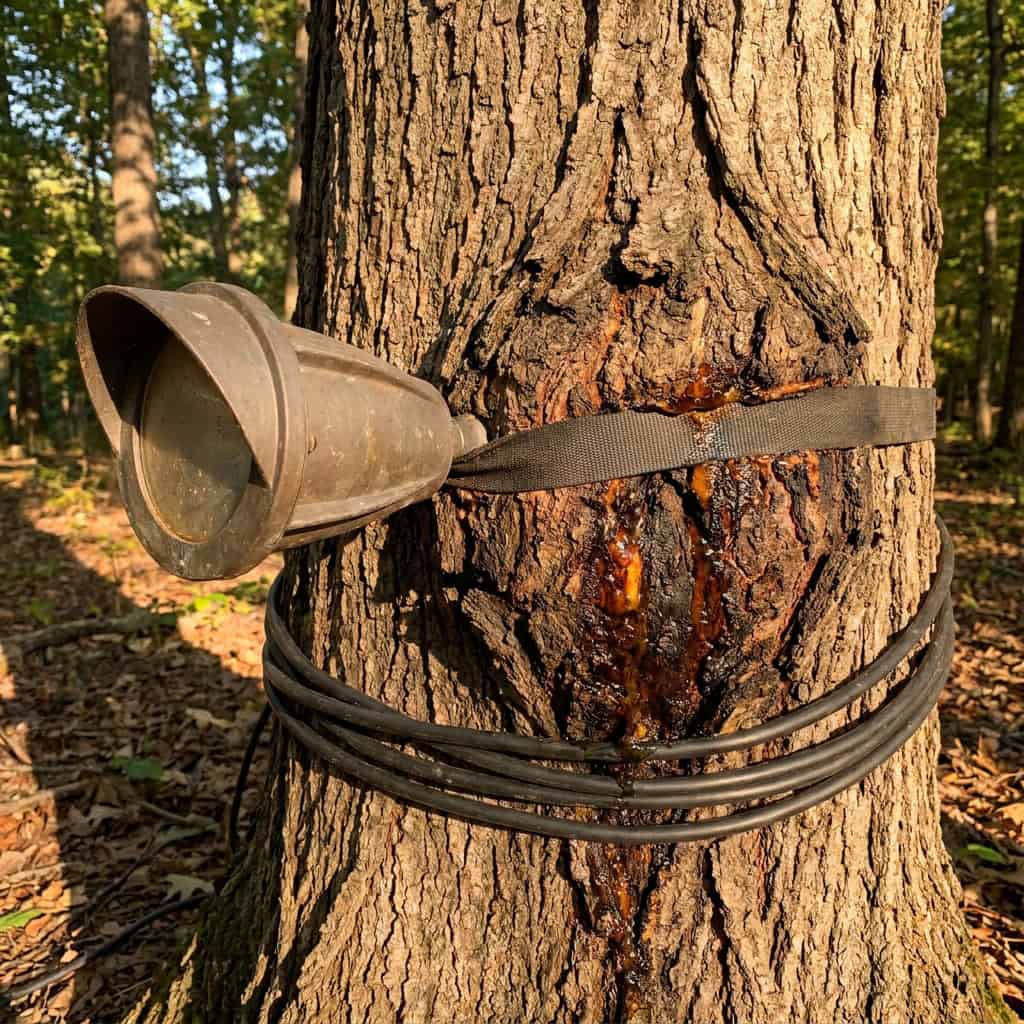
A maple can put on an inch of trunk diameter in a good year. The strap holding your uplight doesn’t grow at all.
What follows is girdling. The hardware cuts into bark, the wound opens a door for borers and decay fungi, and the tree you spent $400 lighting becomes the tree you spend $2,000 removing.
Set fixtures on the ground instead, pulled back from the root flare. A wider setback also gives you a better beam up through the canopy. If you’re choosing a tree that’s going to grow fast, plan the lighting setback for the trunk it becomes, not the one you planted.
13. Permanent App-Controlled Color Roofline Lights

The pitch is that you never hang Christmas lights again. The track gets screwed to your fascia permanently.
Two problems arrive later. The first is taste — a color-cycling roofline is welded to one specific moment in residential style, and that moment will pass.
The second is worse. The whole system runs through a manufacturer’s app and cloud server. When the company gets acquired, pivots, or sunsets support, you own a very expensive strip of trim and a dead phone app.
14. A Transformer Loaded to 100 Percent

Twelve 5-watt fixtures, a 60-watt transformer, perfect math. Except it isn’t.
Fully loading a transformer guarantees voltage drop at the far end of the run — the last two or three fixtures go brown and dim while the near ones look fine. It’s the most common complaint in year-two systems.
Size for about 80 percent load and run heavier wire than feels necessary. 12-gauge for anything past 50 feet, even when 14 is technically rated.
And leave headroom on purpose. In three years there’s a patio, or a new bed, or a flag you want lit, and a maxed transformer means starting over.
15. Consumer-Grade String Lights From the Seasonal Aisle

Bistro lights over the patio are one of the best things you can do for a backyard. The $25 set is not the way to do it.
Thin cord stretches and sags into a droop that no amount of re-hanging fixes. The sockets are sealed, so when a bulb dies, the section dies with it.
Commercial-grade cord with replaceable bulbs, hung on a stainless catenary wire rather than on the cord itself, is the version still lit in year five. It’s also the version that makes a yard feel like an actual outdoor room instead of a patio with decorations on it.
16. Outdoor Extension Cords as Permanent Wiring

It started as a temporary run for one string of lights. That was four years ago.
Now there’s an orange cord under the mulch, a second one pinched in the back door jamb, and a daisy chain of three plugged into a garage outlet that may or may not be GFCI-protected.
Extension cords are built for temporary, supervised use. Buried in mulch they overheat because the soil holds in the heat the cord is designed to shed. Pinched in a door, the jacket splits and the conductors sit exposed to rain. Chained together, voltage drops and current draw climbs on a cord that was never rated for continuous load.
That’s a shock hazard and a fire hazard sitting in the same place. And after a claim, an adjuster looking at the cause of a fire is absolutely going to note permanent wiring done with extension cords.
The fix is one afternoon of work by an electrician. A weather-resistant, GFCI-protected exterior receptacle with an in-use bubble cover — the kind that stays weatherproof with a plug in it — runs a few hundred dollars installed in most markets.
- GFCI protection on every exterior receptacle, tested monthly
- An in-use (bubble) cover, not a flip-lid
- Low-voltage landscape cable for anything running out into the yard
- No cords through doors, windows, or under mulch, ever
Everything else on this list is money and aesthetics. This one is the house.
17. One Mechanical Dial Timer Running the Whole Yard

The dial timer with the little pins was fine in 1985. It drifts, and it has no idea what month it is.
So in November the lights come on an hour after full dark, and by late June they’re burning at 7 p.m. in broad daylight. You reset it twice a year, then stop bothering.
An astronomic timer tracks sunset by date and location and never needs adjusting. Zone the yard while you’re at it — path lights can run until midnight while patio lights shut off at ten.
18. A Porch Lantern Too Small for the House

Builders undersize this fixture almost universally, because it’s a line item and nobody’s shopping the house on its porch light.
The working rule: a wall lantern should be roughly one-quarter to one-third the height of the front door. On a standard 80-inch door, that’s a 20 to 26 inch fixture. Most builder lanterns are 11 inches.
From the curb it reads like a dollhouse accessory bolted to a full-size home. It’s the cheapest high-impact change on this entire list, and the one people put off for a decade.
19. Adhesive LED Strip Tape Under Cap Rails and Risers

Peel, stick, glow. Then August.
Adhesive releases in heat, so the tape starts drooping off the underside of the rail in loops. Moisture creeps into the cut ends, and sections go dark or drift color — one run turns pink while the next stays white.
Designers warn against visible strip tape outdoors for exactly these reasons. Use recessed riser lights, or outdoor-rated tape in an aluminum channel with sealed end caps.
20. Unshielded Fixtures Aimed From the House Into the Yard

A pair of bright spots on the eaves, pointed out across the lawn. Cheap, easy, and it lights everything.
It also throws glare straight across the property line and into bedroom windows — including the ones upstairs in your own house. And anyone standing in the yard is looking directly into the source, which means they see less, not more.
Fully shielded fixtures aimed downward keep the light on the target. The practical standard is nothing emitted above 80 degrees from straight down. DarkSky International has the full shielding guidance if you want to check your own fixtures.
21. Tiki Torches as the Actual Lighting Plan

For one party in July, they’re perfect. As the plan you still rely on in year five, they’re a problem.
Open flame on a bamboo pole, three feet from dry mulch, in wind, with kids and dogs moving around it. Fuel canisters tip. Wicks get left burning.
And the citronella claim is far weaker than the packaging implies — the protected zone around a torch is small and collapses in any breeze. Keep two for atmosphere. Don’t let them be the system.
22. Fixtures Placed for Today’s Plant Sizes

The spotlight framing that three-gallon boxwood looks surgical on install day.
By year four the shrub has swallowed it. The beam is lighting the inside of a plant, and you’ve got a glowing green orb in your bed instead of an accent.
Plan beam angle and setback for mature size — look up the tag, not the pot. Leave enough slack cable at each fixture that it can migrate two or three feet outward as the bed fills. Spreading plants like late-season ornamental grasses are the usual culprits, since they can triple their footprint in a few seasons.
23. A Big-Box Kit You Can’t Match in Three Years

Retail landscape lighting SKUs churn constantly. The kit you bought in spring is often gone by the next spring.
So when two fixtures die in year three, your choices are a mismatched yard or replacing all eight. Most people replace all eight, which is how a “budget” system costs more than a good one.
Buy into a fixture line a landscape supplier still stocks. That’s the unglamorous reason professional installs still look consistent after a decade.
24. The Glass-Globe Lamppost at the End of the Driveway

A suburban fixture since the 1960s, and it has never been good at its job.
One dim globe throwing light in every direction, including up. A bulb that requires a ladder and an awkward reach. A wasp nest inside it by every August. And one cracked pane after the first season the plow comes through.
If it’s staying, convert it to a shielded warm LED so it stops glaring, and let real path lighting handle the actual walkway. The same logic applies to other driveway choices that look fine until year five.
25. Lighting Everything and Leaving Nothing Dark

Over-lighting is the single most repeated warning from landscape designers, and it’s the hardest one to hear because it feels like restraint for its own sake.
It isn’t. Without shadow, a yard has no depth. Every plant, wall, and path gets the same flat exposure and the garden stops reading as a garden — it reads as a lit surface.
Designers keep saying the same thing about over-lighting: light three or four things well and leave the rest alone.
There’s a cost to the brightness that nobody puts in the quote. Fireflies don’t signal in lit yards. Stars disappear above a bright lawn. And the backyard you wanted to sit in at night turns out to need some night in it.
26. Clear-Glass Lanterns With Exposed Edison Bulbs

The filament look ran hard from about 2014 to 2020, and it photographs beautifully.
In person, at eye level, beside a door, it’s glare. A bare filament at head height is the most uncomfortable thing you can point at a visitor’s face.
Then there’s the collection. Clear glass plus a warm bulb equals a visible pile of dead insects in the bottom of the lantern by mid-August, on permanent display. Seeded or frosted glass solves both problems and costs the same.
27. Solar Deck Post Cap Lights

Same battery clock as the stakes, mounted eight feet higher where you’re less likely to notice the decline.
These fail politely. They don’t go out — they fade, month over month, until the deck perimeter is a row of dull orange dots that add nothing after dusk.
Low-voltage post caps run off the same transformer as the rest of the yard, match in color temperature, and stay at full output in year five. Wire them during the deck build if you possibly can.
28. The Utility-Rented Dusk-to-Dawn Pole Light

Common on rural and semi-rural properties since the 1970s, and the billing arrangement is the trap.
You don’t own it. You rent it, often for $10 to $15 a month, forever, and after twenty years you’ve paid several thousand dollars for a fixture that glares across the whole property and washes out every star over the field.
It also wrecks night vision. Walk out from under it and the dark areas are darker than they’d be with no light at all.
Call the utility. Most will remove it, and some will swap it for a shielded, warmer fixture on request. Then light the actual places people walk.
Here’s the short version of what separates a system that survives from one that doesn’t:
| Regret in 5 Years | Still Working in 5 Years | |
|---|---|---|
| Power | Solar stakes, extension cords | Low-voltage, GFCI source |
| Color | 5000K daylight | 2700K or warmer |
| Housing | Painted aluminum, resin | Cast brass, copper |
| Lamp | Sealed integrated LED | Replaceable MR16 |
| Splices | Wire nuts and tape | Silicone-filled burial |
| Coverage | Light everything | Three or four focal points |
Nearly every row costs more on day one and less by year three.
The pattern underneath all 28 is the same: outdoor lighting fails at the connection, the battery, and the beam angle — never at the part you were shopping for.
Spend the money where it’s invisible. Buried cable, sealed splices, brass housings, warm lamps, a transformer with room to grow.
Then light four things and stop. Leave the rest of the yard dark enough that the fireflies still bother showing up.