

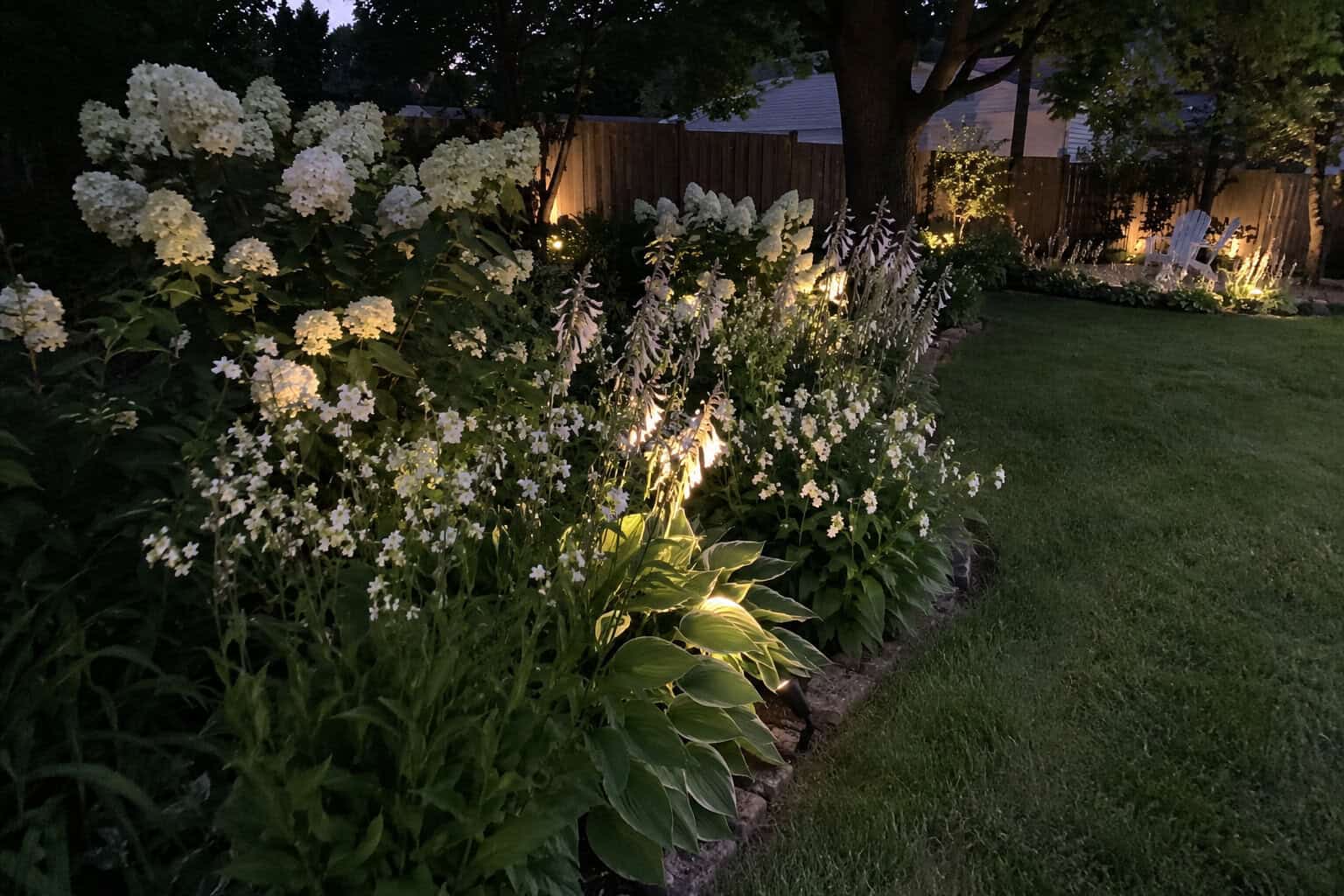
Step outside at dusk and watch what happens to your flower beds. The reds go black. The purples vanish. But the whites? They light up.
There’s a reason for it. As your eyes shift to night vision, they lose color and cling to contrast, and pale petals are the last thing to fade. A white flower under a full moon looks lit from inside.
Moon gardens have been a thing since Victorian evening strollers wanted something to look at after supper. The idea is simple: plant white blooms, silver leaves, and night-scented flowers where you sit in the evening, and the whole space glows.
Some of these open only after sundown. Some pump out perfume that carries across the yard on warm air. A few are gorgeous and also dangerous — worth knowing before you plant them near a curious dog or a toddler.
Here are 29 plants that turn a dark yard into something worth sitting in.
1. Moonflower Vine (Ipomoea alba)
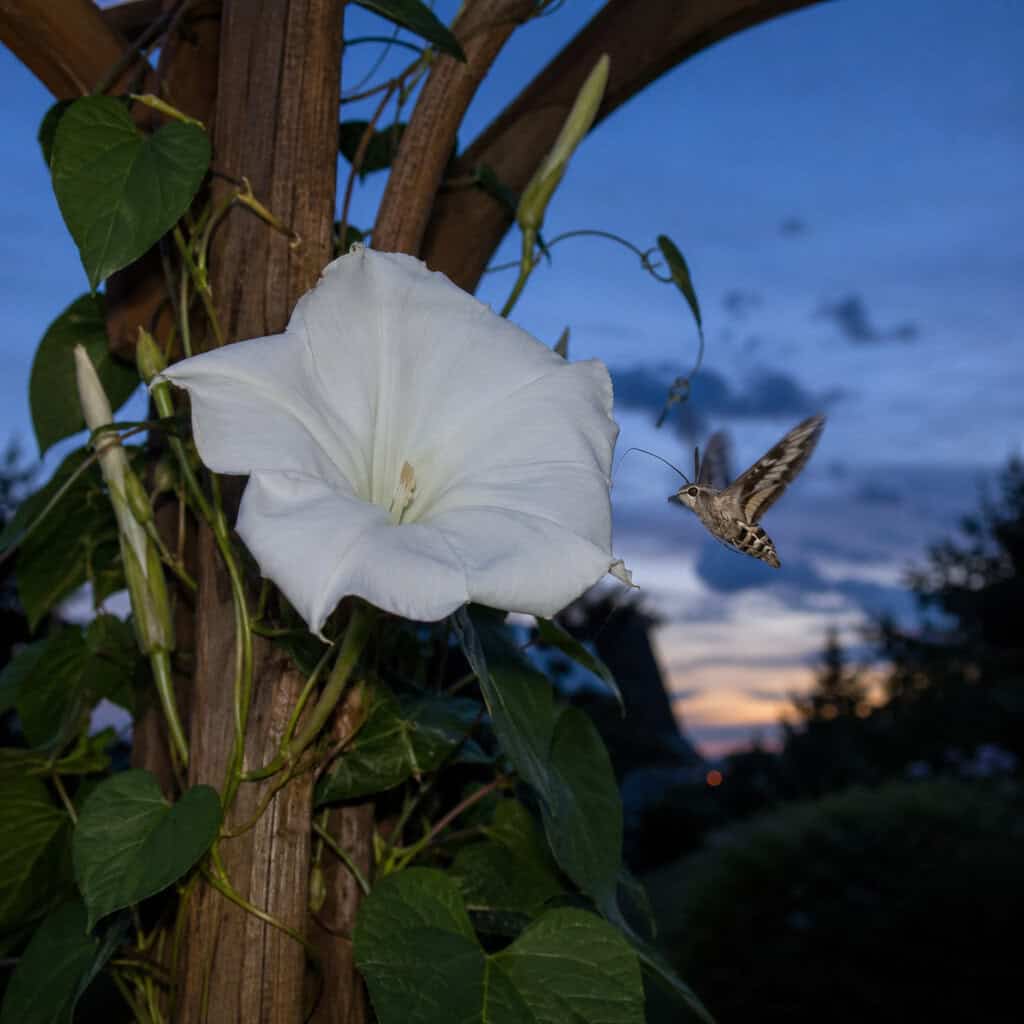
If you plant one thing on this list, plant this. It’s the flower the whole moon-garden idea is built around.
The buds stay furled all day like tightly twisted umbrellas. Then, right around dusk, they unwind. You can actually watch them open — a six-inch white trumpet unspooling in a few minutes flat.
The scent comes with it. Sweet, lemony, jasmine-ish, and strong enough to stop you on the porch steps. That perfume is bait for sphinx moths, the big hovering ones people mistake for hummingbirds.
It’s a fast, hungry annual vine. Give it a trellis, an arch, or a fence and it’ll climb ten to fifteen feet in a single season, then die back at frost. Soak the seeds overnight before planting to soften that hard coat. UF/IFAS Gardening Solutions lists it as the anchor for exactly this kind of after-dark planting.
One caution before you fall in love. The seeds carry mild toxicity, and they’re roughly the size and shape of something a kid or a dog might decide to sample. Nothing on the level of the truly scary plants further down this list, but plant it up high on a structure, and if a pet is prone to eating whatever it finds, keep an eye on where the spent flowers and seed pods drop.
2. Angel’s Trumpet (Brugmansia)
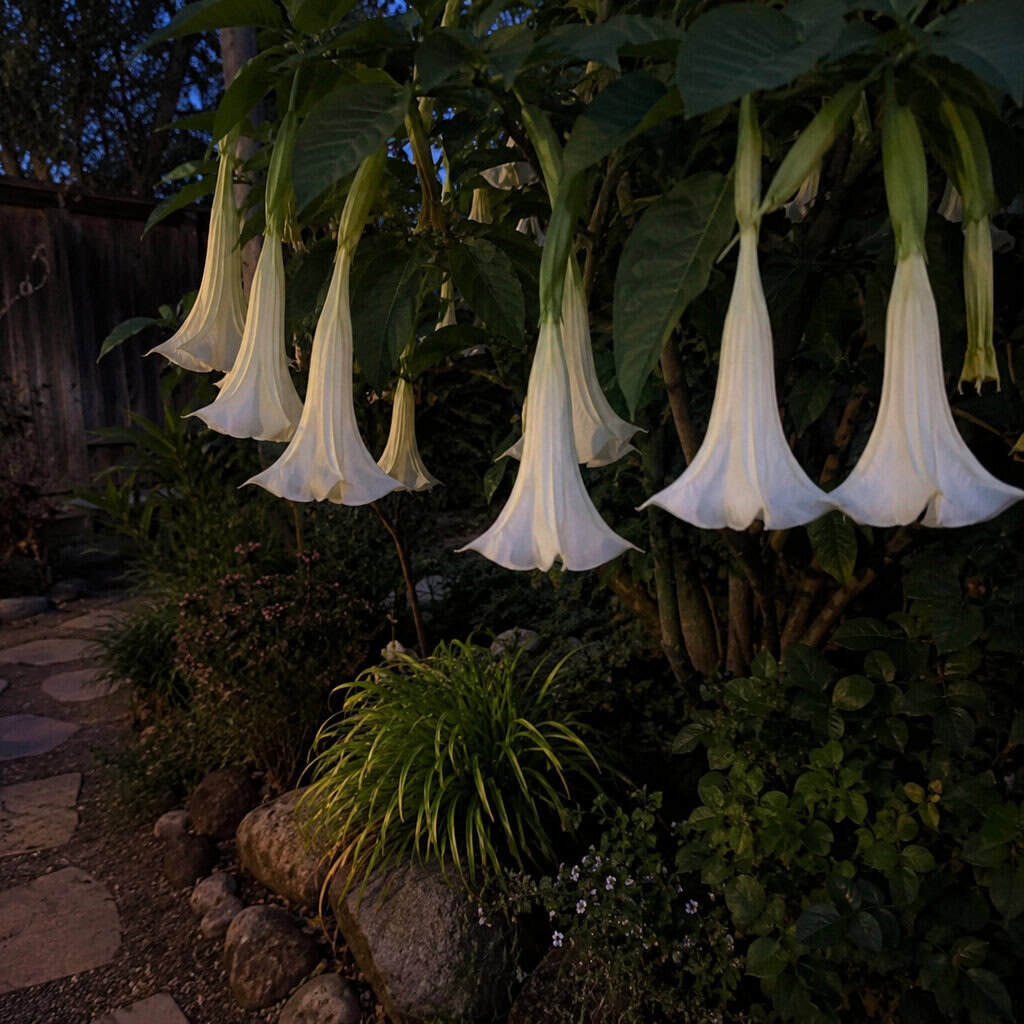
This is the drama queen of the back border. Trumpets up to a foot long hang straight down like pendant lamps, and by evening they’re throwing off a heavy, cloying fragrance you can smell across the patio.
In warm zones it grows into a small tree. In cold ones people grow it in a big pot and haul it inside for winter. Either way it wants to be the tallest thing in the bed.
Now the part that matters. Every single part of this plant is poisonous — leaves, flowers, seeds, sap. Brugmansia contains tropane alkaloids, and ingestion can cause a racing heart, dilated pupils, confusion, hallucinations, and worse.
Dogs and cats that chew it can end up at the emergency vet. Children have been poisoned by handling and then rubbing their eyes or mouth. This is not a plant to grow along a path where a toddler wanders or a dog patrols.
Put it at the far back of a bed, out of reach, and wash your hands after pruning. Grown with that respect, it’s one of the most spectacular things you can own. Grown carelessly, it’s a hazard. Beautiful, but plant it away from pets and kids.
3. Datura / Thorn Apple (Datura inoxia)
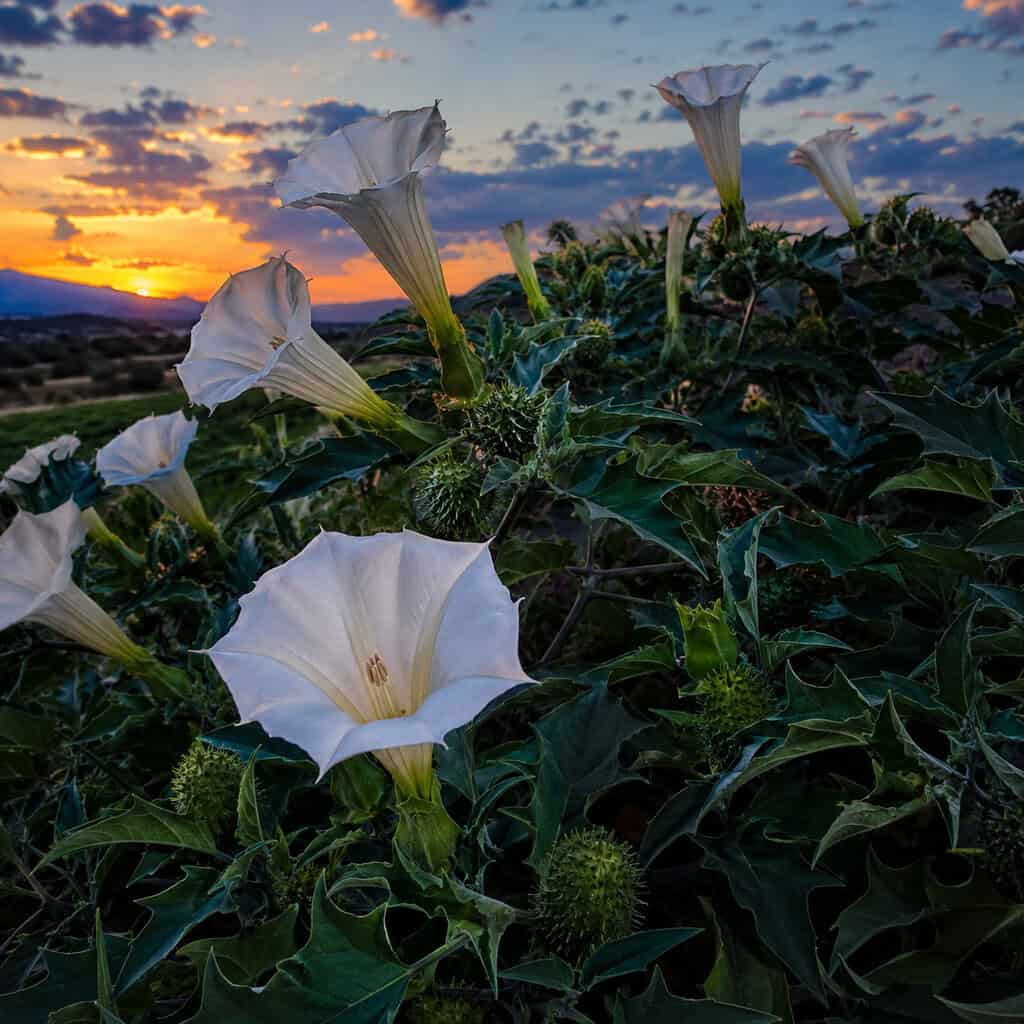
Here’s the one that fools people. Datura gets called “moonflower” too, and its big white trumpets open in the evening just like Ipomoea alba — except these point up at the sky instead of climbing a vine.
Learn the difference before you buy seeds off a swap table. The safe moonflower is a twining vine with heart-shaped leaves. Datura is a bushy, sprawling plant with jagged leaves and, later, spiny seed pods that split open like little green mines.
Why it matters: Datura is in a different league of dangerous. It’s loaded with scopolamine and atropine, the same compounds behind old poisoning cases, and it’s highly toxic to pets and children.
Swallowing any part can bring on delirium, a pounding heart, blurred vision, and hallucinations that land people in the hospital. The seeds are the most concentrated part, and those spiny pods hold hundreds of them.
Some gardeners grow it anyway for its ghostly evening blooms, and it does self-sow with abandon. But if you’ve got animals or little kids using the yard, skip it entirely and plant the vine instead. The Farmers’ Almanac notes how easily the two get mixed up — knowing which is which is the whole game here.
4. Flowering Tobacco (Nicotiana sylvestris)
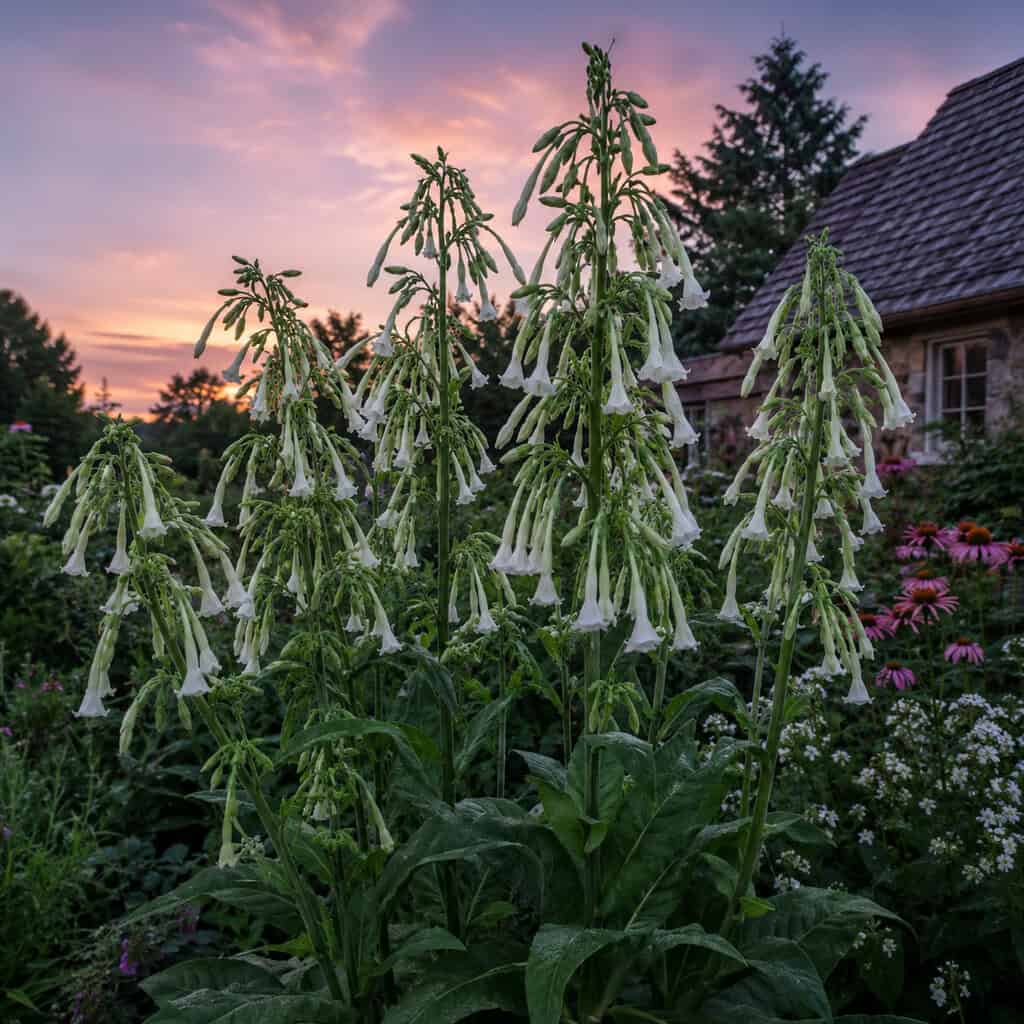
Tall and elegant. This one shoots up to three to five feet, then drips clusters of long white tubular flowers off the top like a fountain frozen mid-splash.
Some folks call them white shooting stars. The nodding trumpets catch light beautifully in the low sun.
Wait for dusk, though. That’s when the jasmine-like fragrance kicks in, thick and sweet, calling in the same moths that work the moonflowers.
Grow it as an annual from seed in most of the country. It’s a reliable performer that reads gorgeous in a dim border.
5. Evening Primrose (Oenothera)
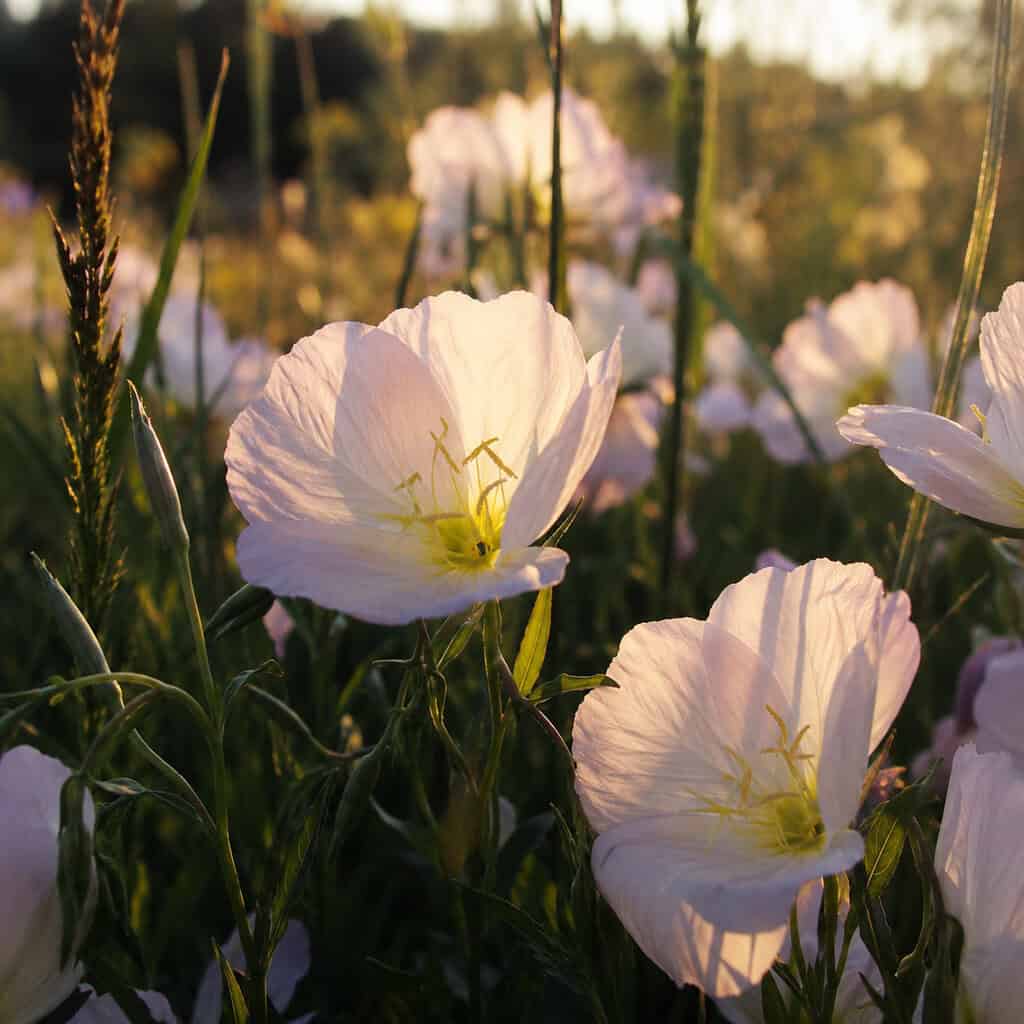
The name tells you when it clocks in. Pale flowers unfurl in the late afternoon and keep perfuming the air well after dark.
Yes, the blooms lean pale yellow rather than snow white — but in dim light they still glow, and the after-dusk scent earns the plant its spot.
It’s tough as nails. Drought-tolerant, low-fuss, and native across much of North America, which means it feeds local pollinators instead of just looking pretty.
Plant it and mostly forget it. That’s the pitch.
6. Four O’Clock ‘Alba’ (Mirabilis jalapa)
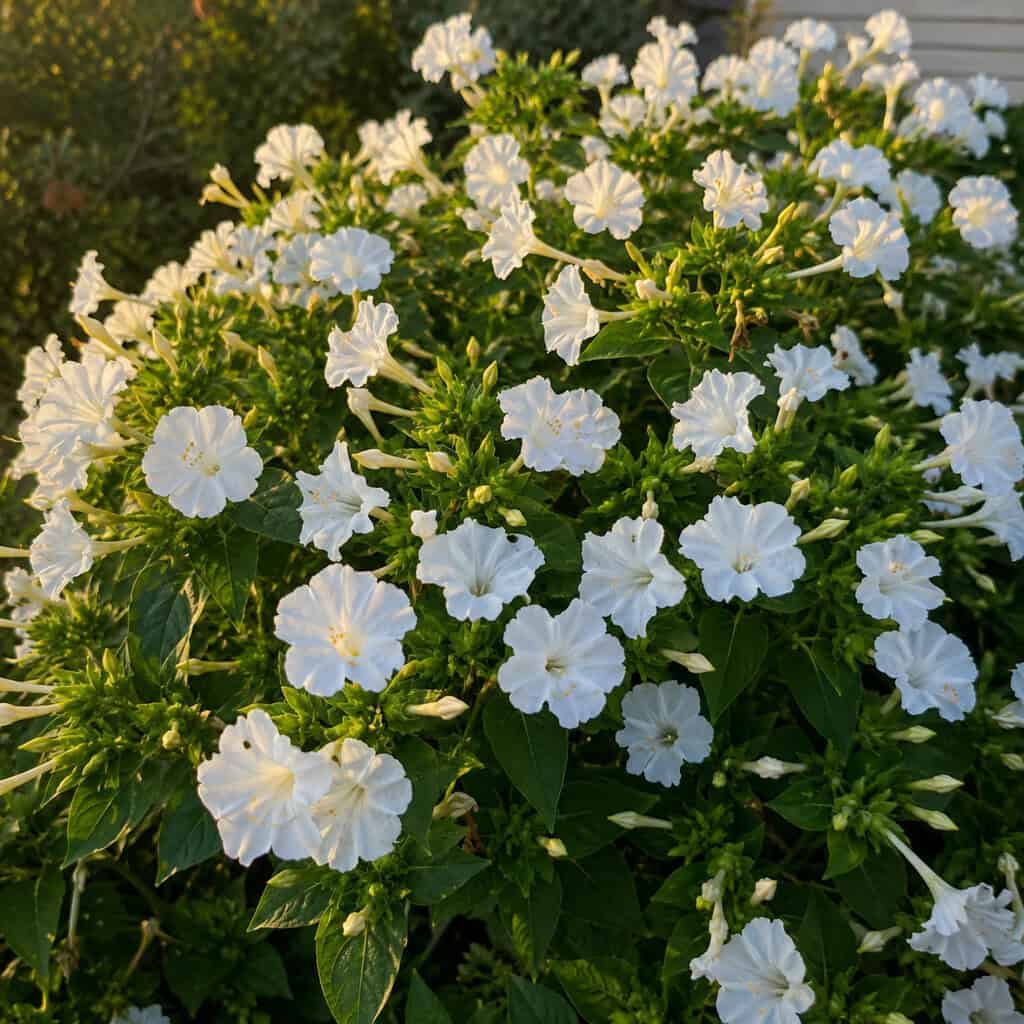
Named for its schedule. The flowers pop open around four in the afternoon and stay open all night, then close by morning.
The white ‘Alba’ form is the one you want for a moon garden. It glows in low light and gives off a honeysuckle-sweet scent as the evening cools.
It grows fast and bushy from seed, almost like a small shrub by midsummer. In warm zones it comes back from a tuber each year.
One note for pet owners: all parts are poisonous if eaten, seeds and roots included. Fine to grow — just not somewhere a dog digs or a kid grazes.
7. Night Phlox (Zaluzianskya ovata)
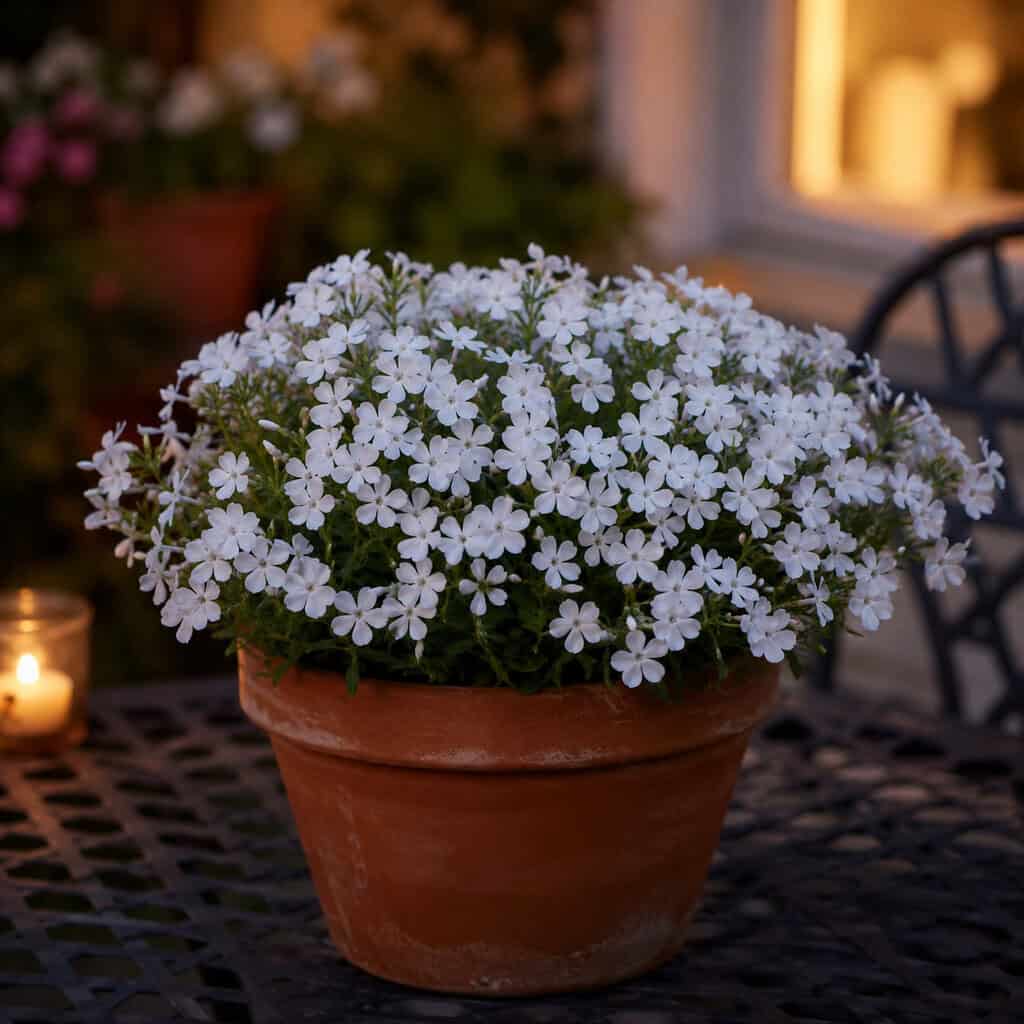
Small plant, big smell. This tidy little dome gets smothered in tiny white flowers that stay shut and unremarkable all day.
Then the sun drops and they open, releasing a scent people describe as honey and vanilla with a hit of almond. It’s out of proportion to the size of the thing.
Grow it in a pot right by where you sit. That’s where it earns its keep.
In cold zones it’s not hardy, so overwinter the container somewhere sheltered.
8. Night-Scented Stock (Matthiola longipetala)
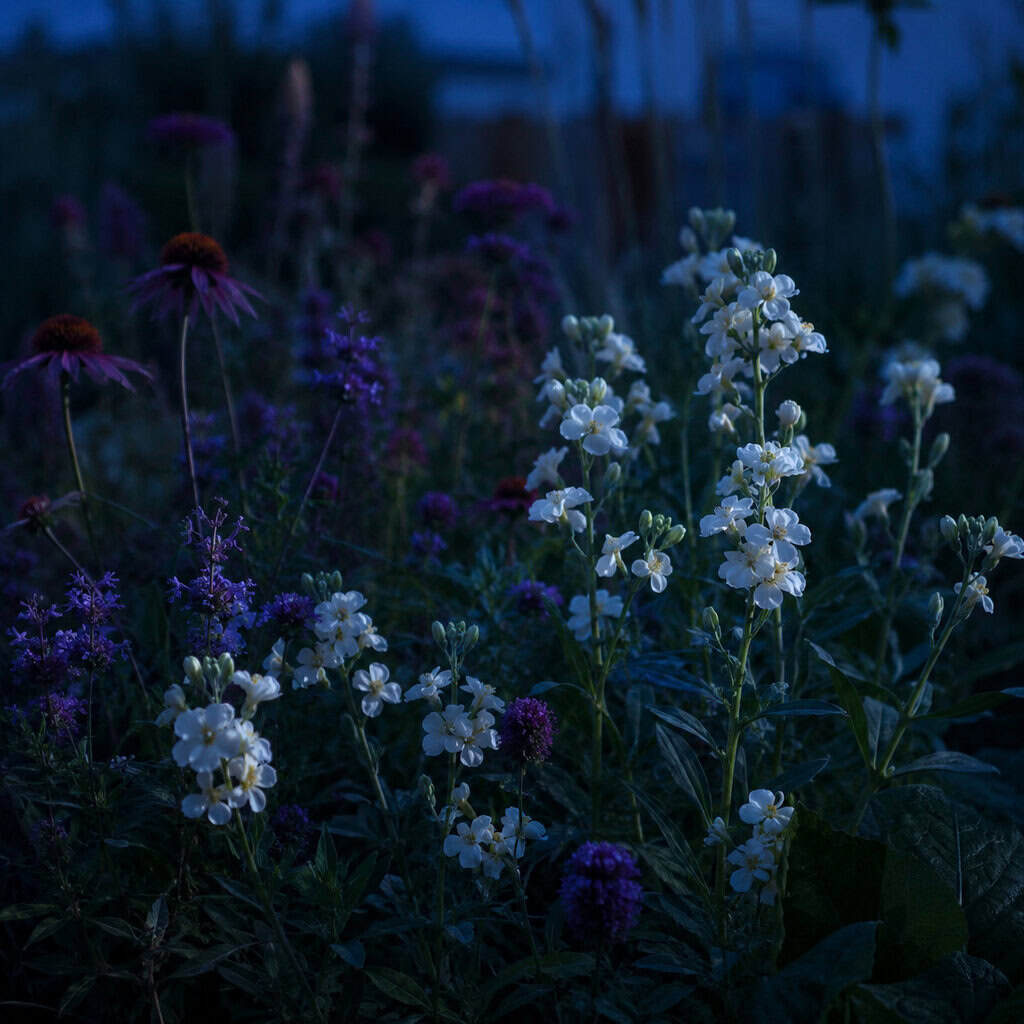
The plainest-looking plant here, and one of the most rewarding. By day the little flowers look half-closed and scruffy, almost like weeds.
Then light fades and they open on cue, pumping out a clove-sweet fragrance that carries. It shuts back up at daybreak.
This is the plant that shows off the whole science of the moon garden — blooms that literally respond to darkness. Scatter the seed thickly among showier flowers to hide its daytime homeliness.
Cheap, easy, and unforgettable after dark.
9. Tuberose (Agave amica / Polianthes tuberosa)
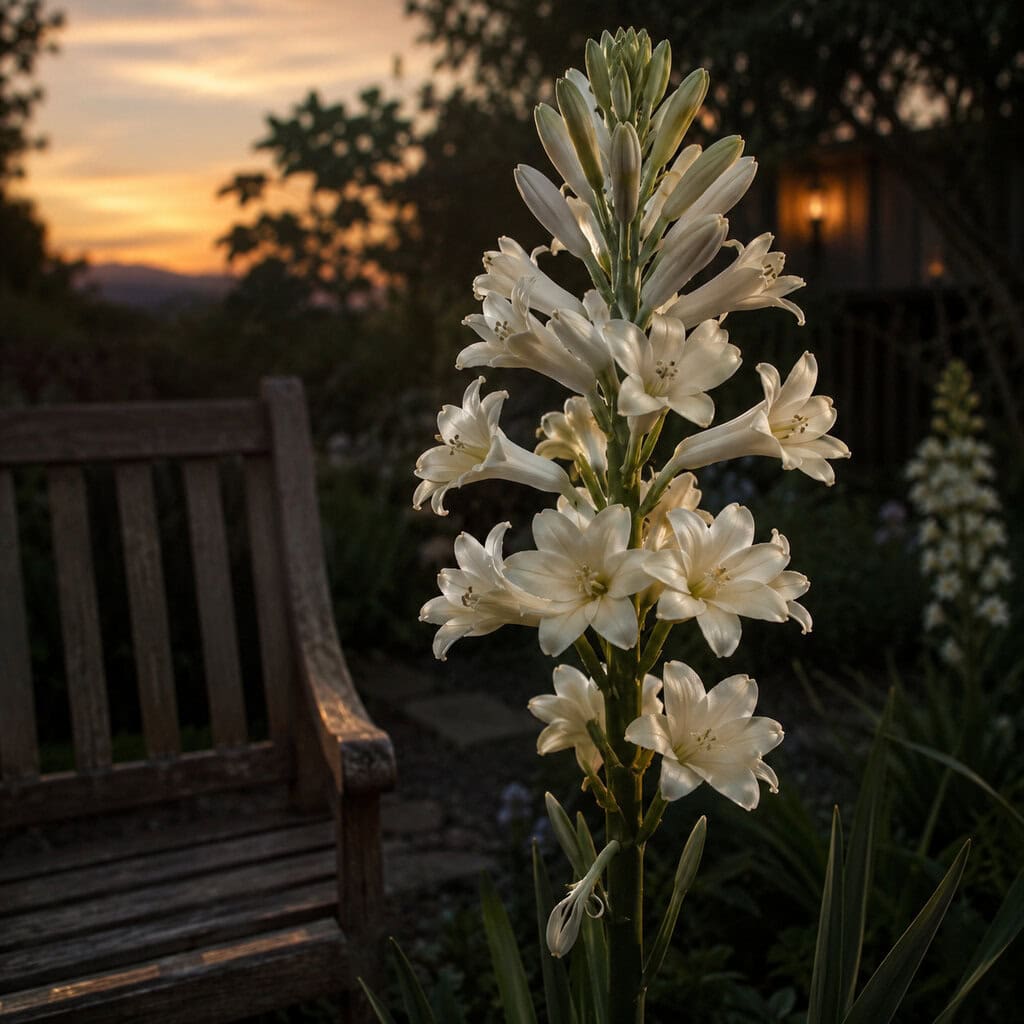
Close your eyes near a tuberose in bloom and you’re standing in a perfume counter. This is the scent behind countless fragrances, and it comes straight off the plant.
Creamy-white flowers climb a tall spike, opening from the bottom up. The fragrance intensifies as night falls and it’s genuinely powerful.
Plant the bulbs near a bench or a dining spot where you’ll catch every bit of it. A little goes a long way.
Warm-season grower — dig and store the bulbs in cold climates, or treat them as a splurge you replant each year.
10. Night-Blooming Jasmine (Cestrum nocturnum)
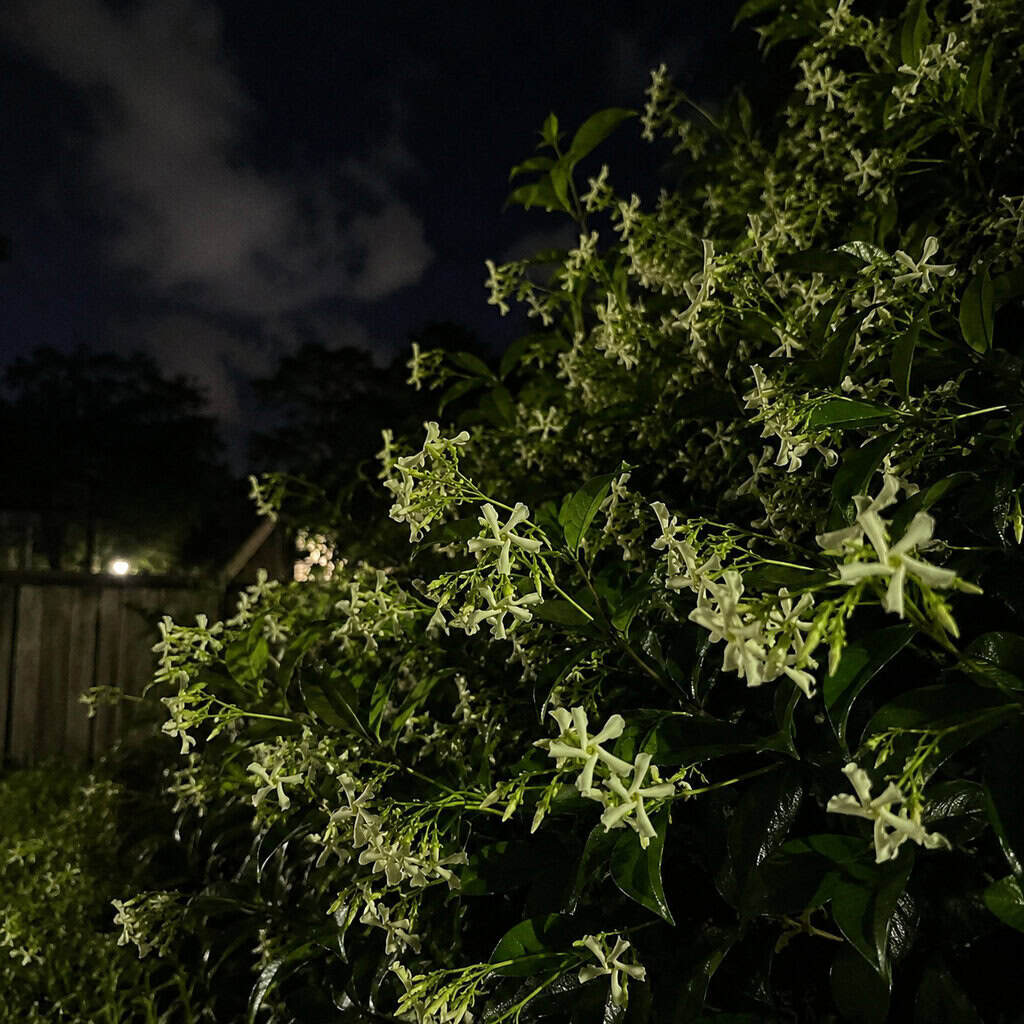
They call it Queen of the Night, and it earns the title through smell alone. The flowers themselves are small, greenish-white, and easy to miss.
The perfume is not. Once the sun’s down, this shrub can scent an entire backyard, and neighbors two doors down will know it’s blooming.
That’s the catch. Up close it can tip from heavenly into overwhelming, and some people find it too much in a small enclosed space.
It’s a warm-climate shrub, happiest in frost-free zones or a large pot you bring in. Plant it at the edge of the yard and let the scent drift to you.
11. Night-Blooming Cereus (Selenicereus / Epiphyllum)
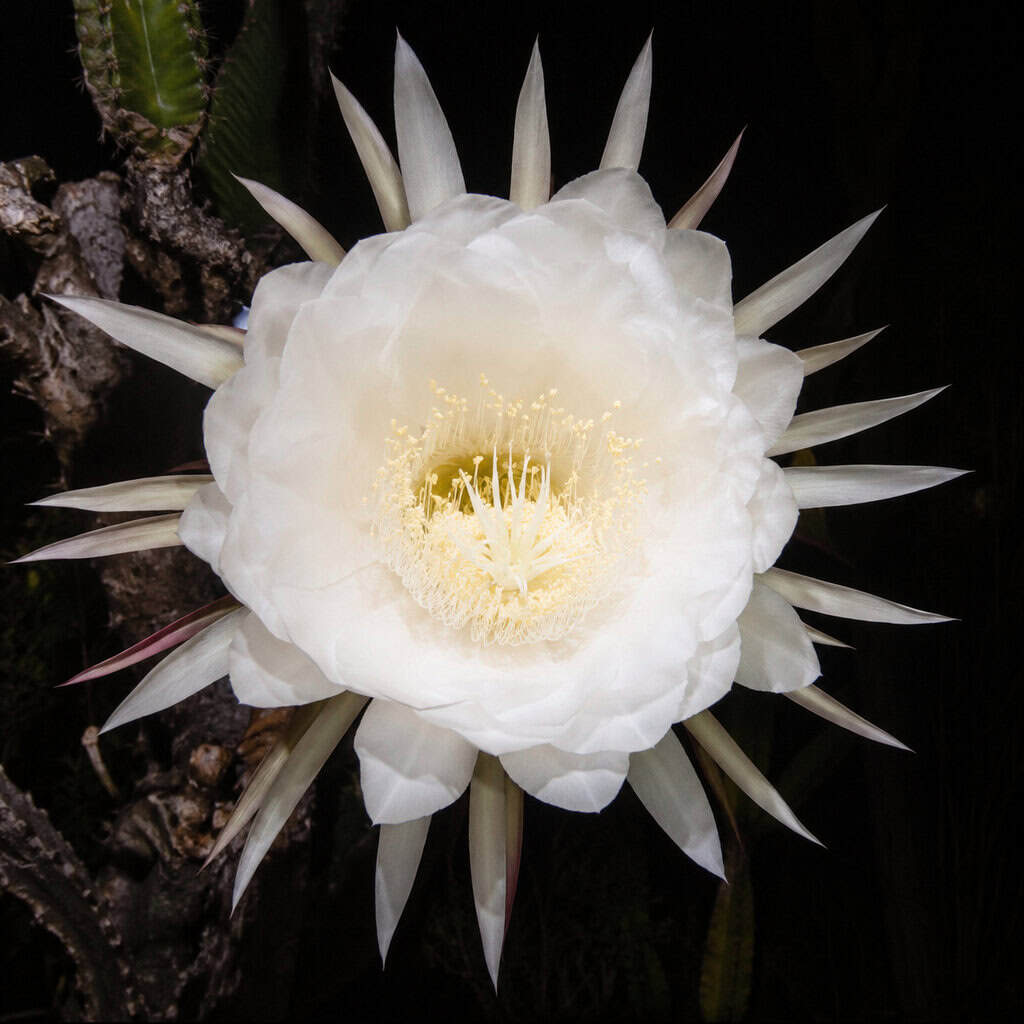
Mark your calendar — you might only get one night. This scraggly tropical cactus spends all year looking like nothing, then throws out an enormous white flower that opens after dark and is gone by dawn.
The blooms are the size of dinner plates and heavily fragrant. Plants in the same area often flower on the same night, as if they’ve agreed on it.
People throw parties when theirs is about to open. That’s how much of an event it is.
In cold climates it lives in a pot and comes indoors, which is easy since it tolerates neglect the rest of the year. Blink and you’ll miss the show.
12. Oriental Lily ‘Casa Blanca’
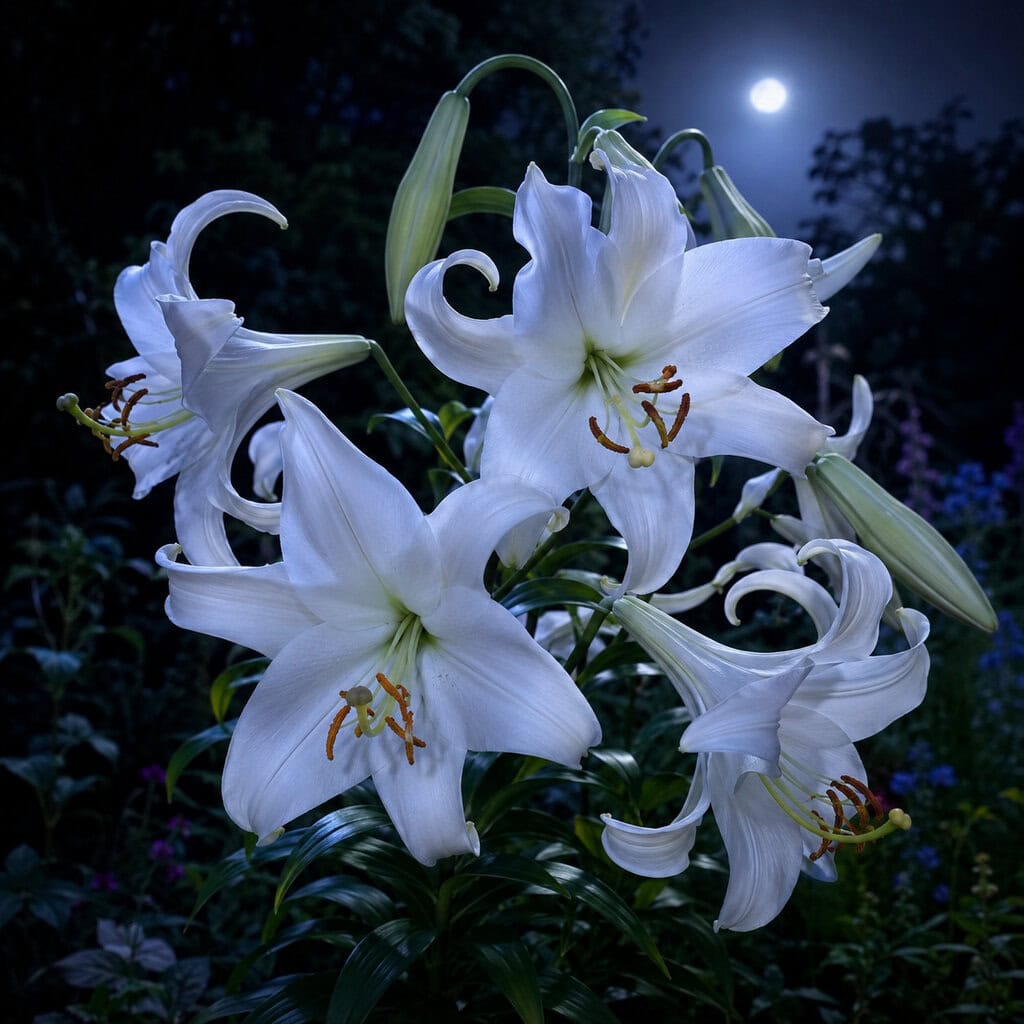
Pure pearl-white and enormous. The recurved petals catch moonlight and seem to magnify it, and the evening fragrance is rich and sweet.
Few things anchor a moon garden the way a stand of ‘Casa Blanca’ does in midsummer. It’s a florist favorite for good reason.
But if you have cats, stop and read this twice. True lilies — including this one — are among the most dangerous plants a cat can encounter.
Every part is toxic to cats: petals, leaves, pollen, even the water in the vase. A cat that so much as brushes the pollen onto its fur and then grooms can go into kidney failure. It doesn’t take much.
Symptoms show up as vomiting, lethargy, and loss of appetite within hours, and without fast treatment it’s often fatal. If a cat has any access to your yard, this plant simply isn’t worth the risk — swap in white phlox or Casa Blanca-white cosmos instead. Gorgeous, but a hard no in any cat household.
13. Gardenia (Gardenia jasminoides)
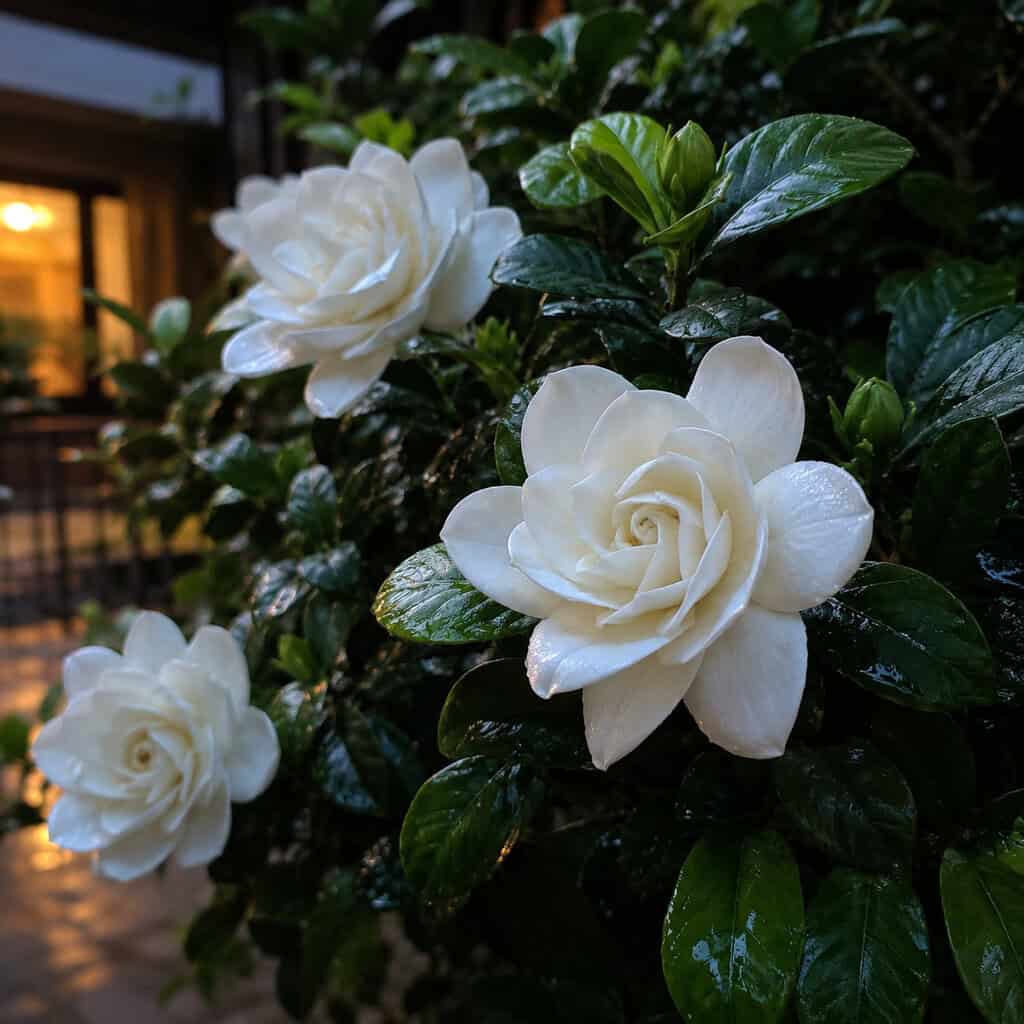
Glossy dark leaves, waxy white flowers, and a fragrance that’s practically famous. In the evening, gardenia scent settles over a patio like a soft blanket.
The contrast is what makes it work at night — those near-black leaves make the blooms look like they’re floating.
Fair warning: gardenias are fussy. They want acidic soil, steady moisture, warmth, and they’ll yellow their leaves and drop buds to protest anything they don’t like.
Worth the trouble to a lot of people. Just don’t expect it to be a plant-and-ignore situation.
14. Star Jasmine (Trachelospermum jasminoides)
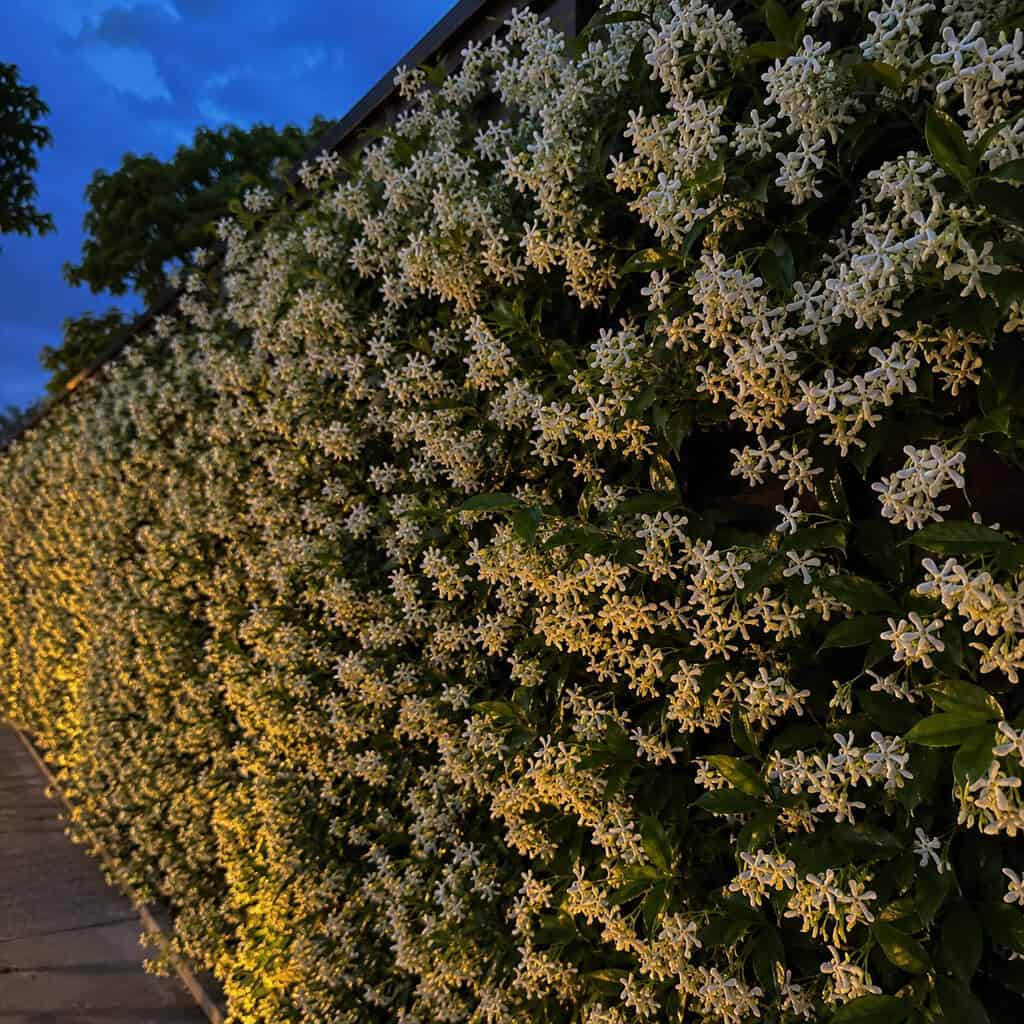
A whole wall of scent. Star jasmine covers a fence or arbor in tiny white pinwheel flowers, and when it blooms the fragrance is heavy and carries clear across the yard.
It’s a climber, so it does the vertical work in a moon garden — a glowing, perfumed backdrop for everything in front of it.
Evergreen in mild climates, with tidy dark leaves the rest of the year. Give it something to grab onto and it does the rest.
15. Sweet Alyssum (Lobularia maritima)
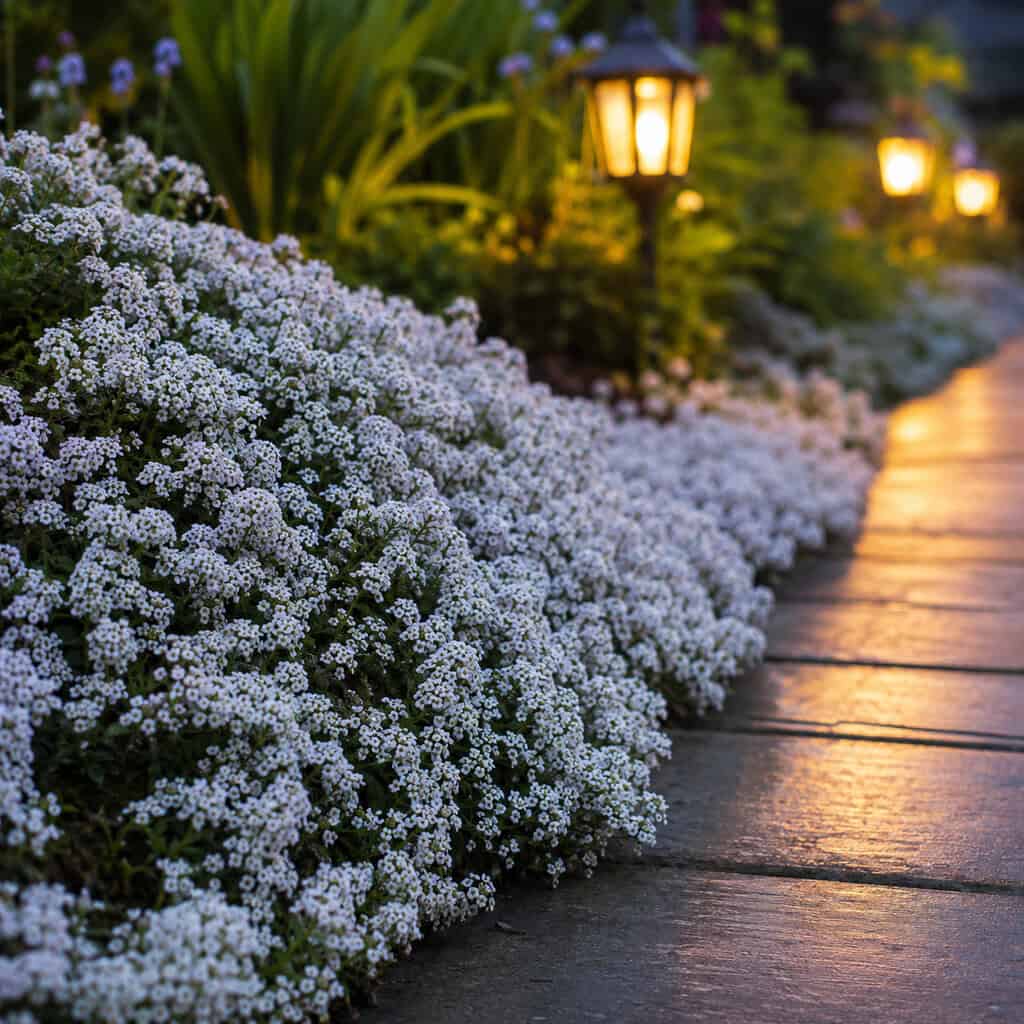
Think of it as snowfall along the ground. Alyssum spills low clouds of tiny white flowers over the edge of a bed or path, and in the dark the effect is pure drift.
Lean in and there’s a honey scent that floats on the evening air. Bees love it by day.
It blooms spring to frost, and sterile types like Snow Princess never quit. Tuck it at the front of everything.
Easy from seed, cheap by the flat, and it fills gaps fast.
16. White Garden Phlox ‘David’ (Phlox paniculata)
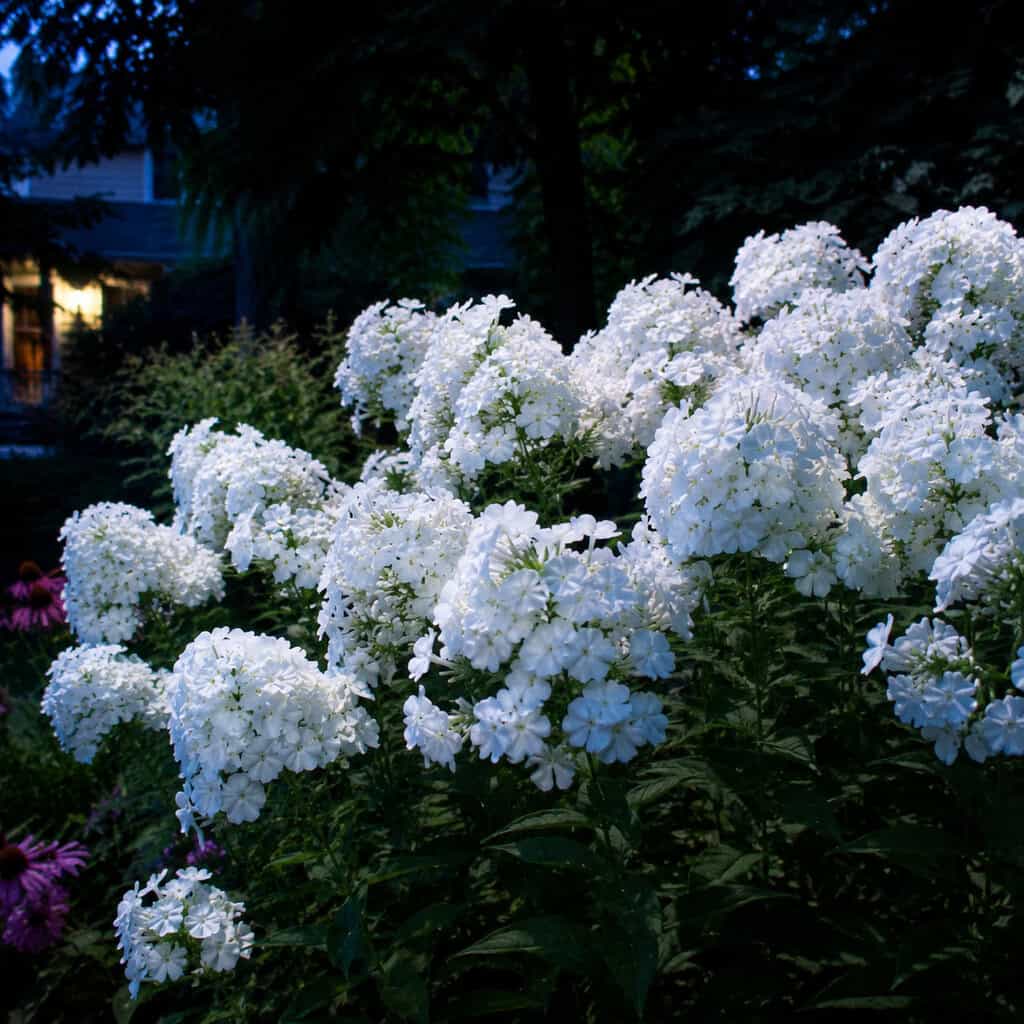
Big, fragrant clusters of pure white that light up a dark corner and hold their scent into the evening. It’s a summer-to-fall perennial workhorse.
Reach for ‘David’ specifically. It’s the mildew-resistant standard, and that matters — plenty of garden phlox turns into a powdery gray mess by August, but ‘David’ stays clean.
Plant it in a group for real glow. One stem is nice; a mass of it reads across the whole yard.
17. Shasta Daisy (Leucanthemum × superbum)
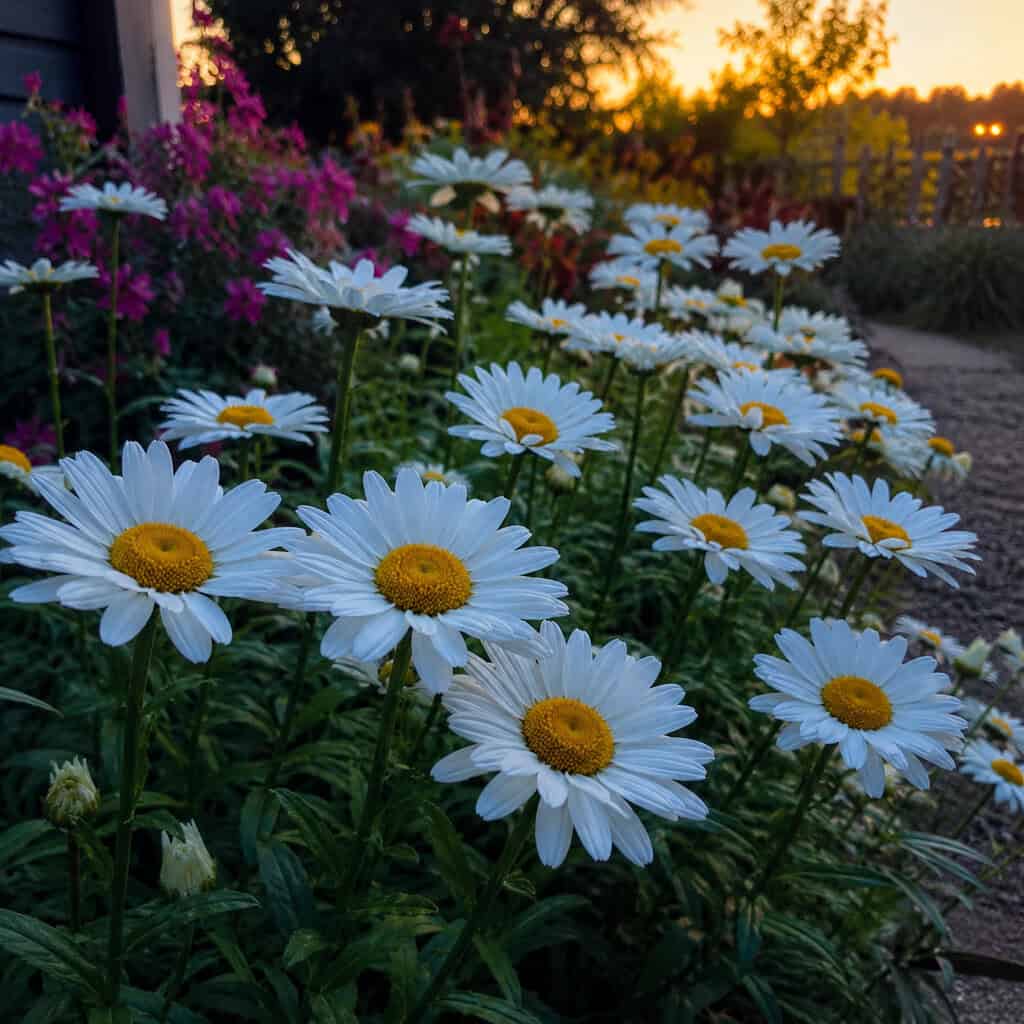
You already know this face. Crisp white petals ringing a bright yellow center — the daisy every kid draws.
Those white petals reflect light beautifully, and a patch of them holds a soft glow after dark. The plant is tough, low-maintenance, and deer tend to leave it alone.
A no-brainer for a beginner’s moon garden. Cut them back after the first flush and you’ll often get a second.
18. White Cosmos
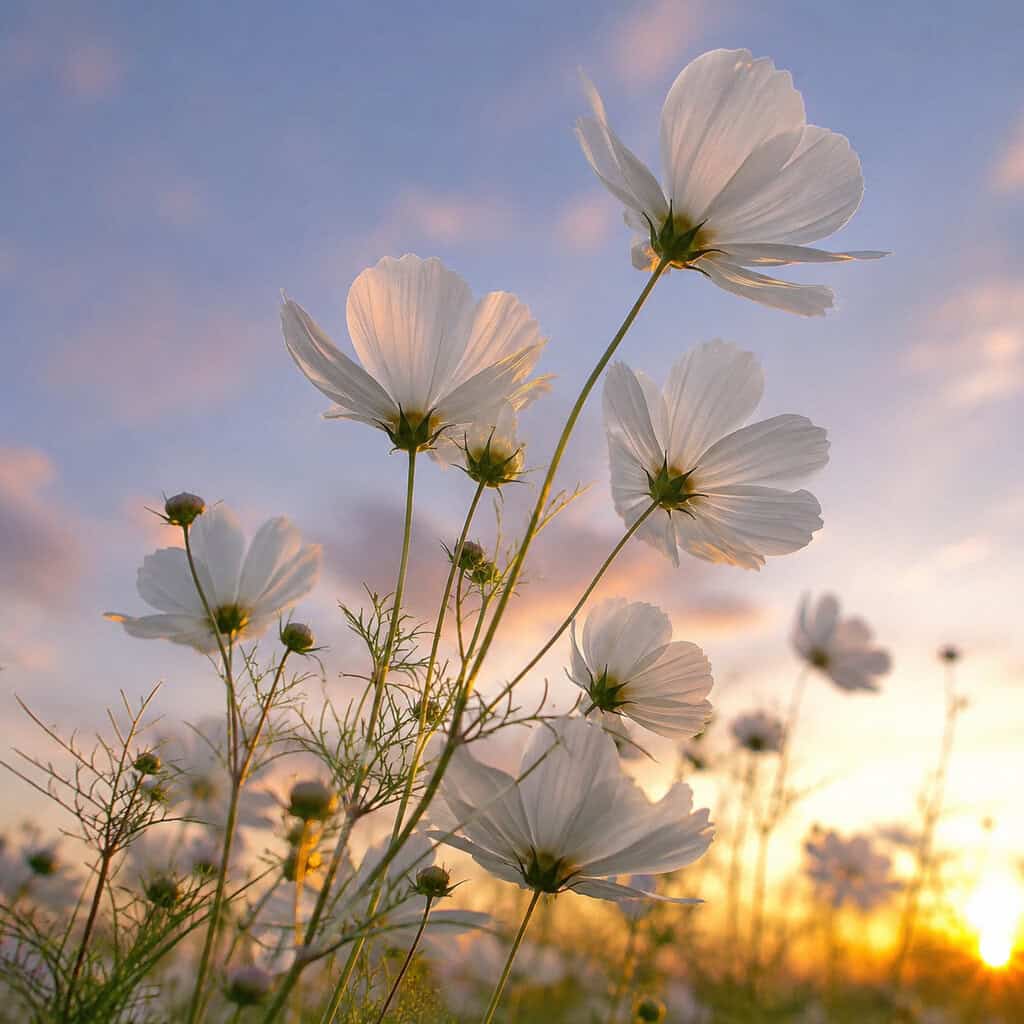
Weightless and dreamy. White cosmos float on thin wiry stems, and the slightest breeze sets them shimmering in low light like they’re barely tethered.
They grow tall and airy, mixing height without ever feeling heavy.
One of the simplest things you’ll ever start from seed — scatter, water, wait. Drought-tolerant once they’re up, and they bloom until frost.
The more you cut them for bouquets, the more they flower.
19. Baby’s Breath (Gypsophila)
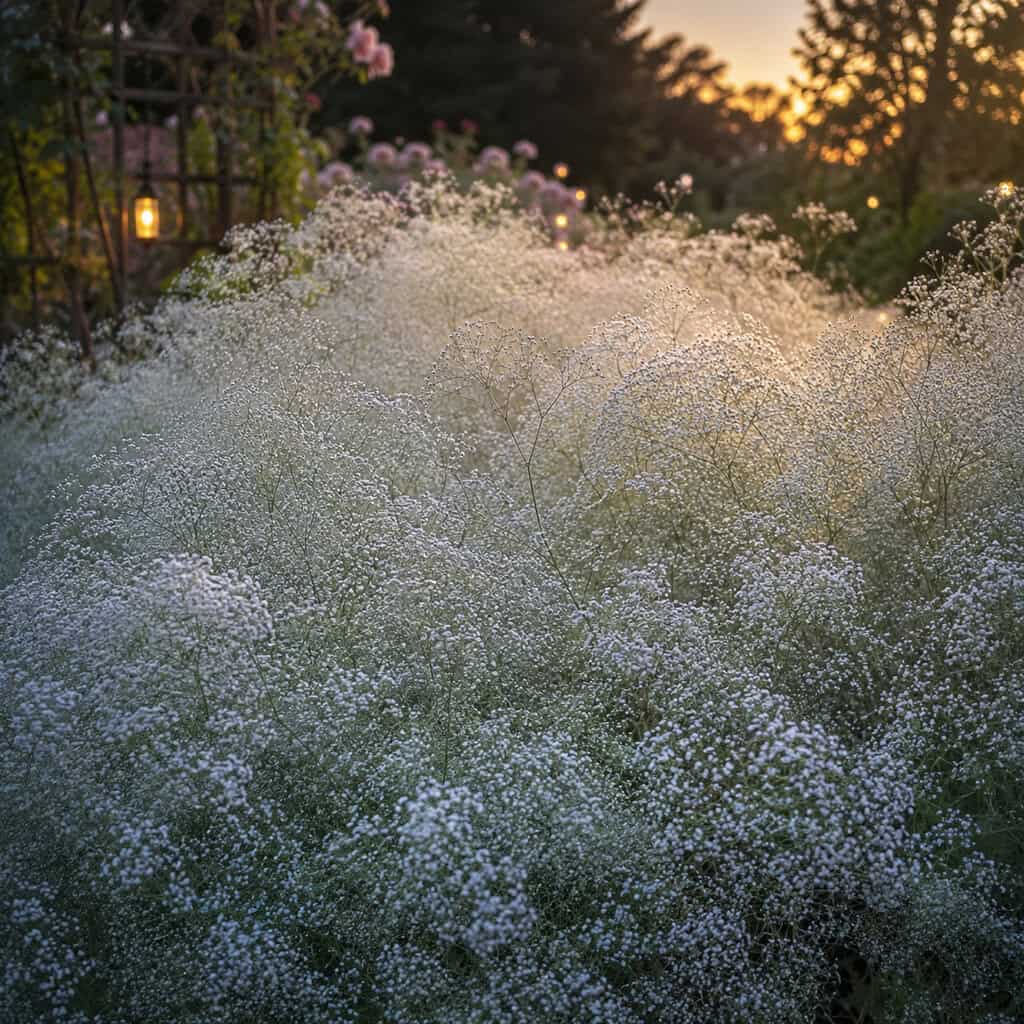
Massed baby’s breath turns into a low glowing cloud after dark. The individual flowers are tiny, but planted thickly they blur into a soft haze of white.
Its job is texture. It softens the bolder blooms around it and fills the spaces between, the way the filler in a bouquet does.
Give it good drainage and full sun. It sprawls happily and asks for almost nothing.
20. Japanese Anemone ‘Honorine Jobert’
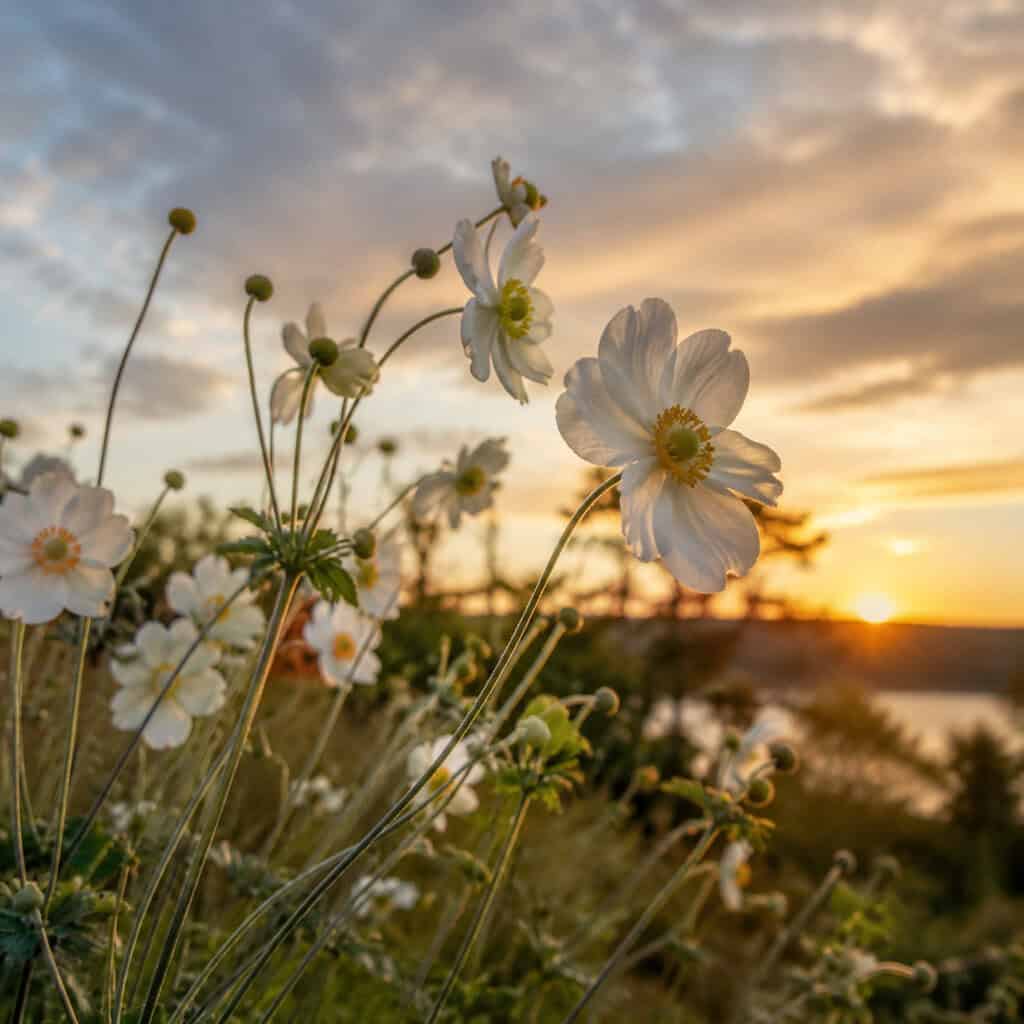
This is your fall closer. When the summer bloomers have called it quits, ‘Honorine Jobert’ keeps the white going into September on tall wiry stems.
The flowers dance in the slightest wind, single and clean with a small golden center. In fading autumn light they practically twinkle.
It spreads over time into a generous clump, so give it room. Invaluable for stretching the glow past the summer peak.
21. Candytuft (Iberis sempervirens)
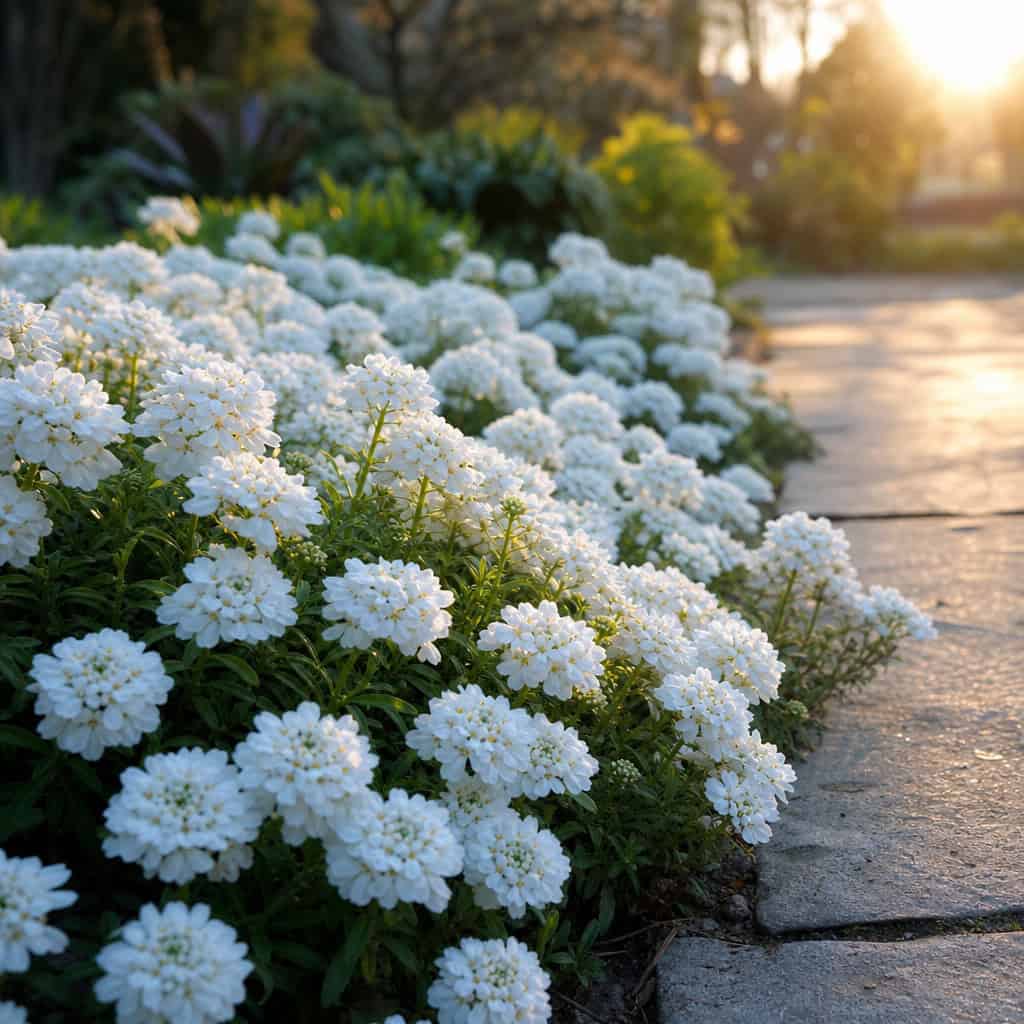
The early bird. Candytuft hugs the ground and covers itself in ruffled white flower heads in spring, before most of the night-bloomers have even woken up.
It edges a path with reflective brightness and stays evergreen the rest of the year, so the bed never looks bare.
Shear it lightly after it flowers to keep it tidy and dense. A solid anchor at the front of the border.
22. Mock Orange (Philadelphus)
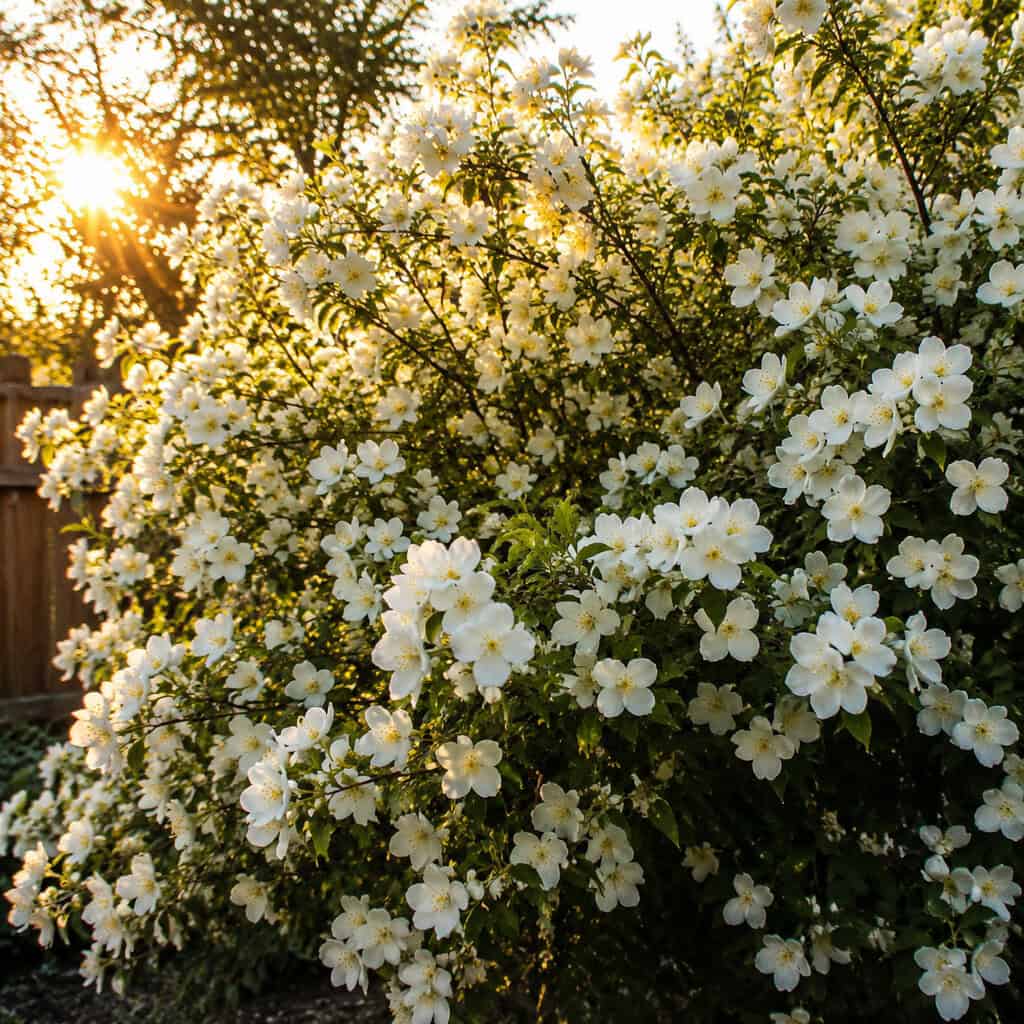
All the citrus scent, none of the fruit. Mock orange covers itself in brilliant white blossoms in late spring, and they smell like orange blossoms — sweet, clean, and strong in the evening.
It’s a big deciduous shrub, so it pulls double duty as a glowing privacy screen behind shorter plants.
Give it a hard prune right after flowering, since it blooms on old wood. Let it go too long between cuts and it turns leggy.
23. White Hydrangea (‘Annabelle’ & Panicle Types)
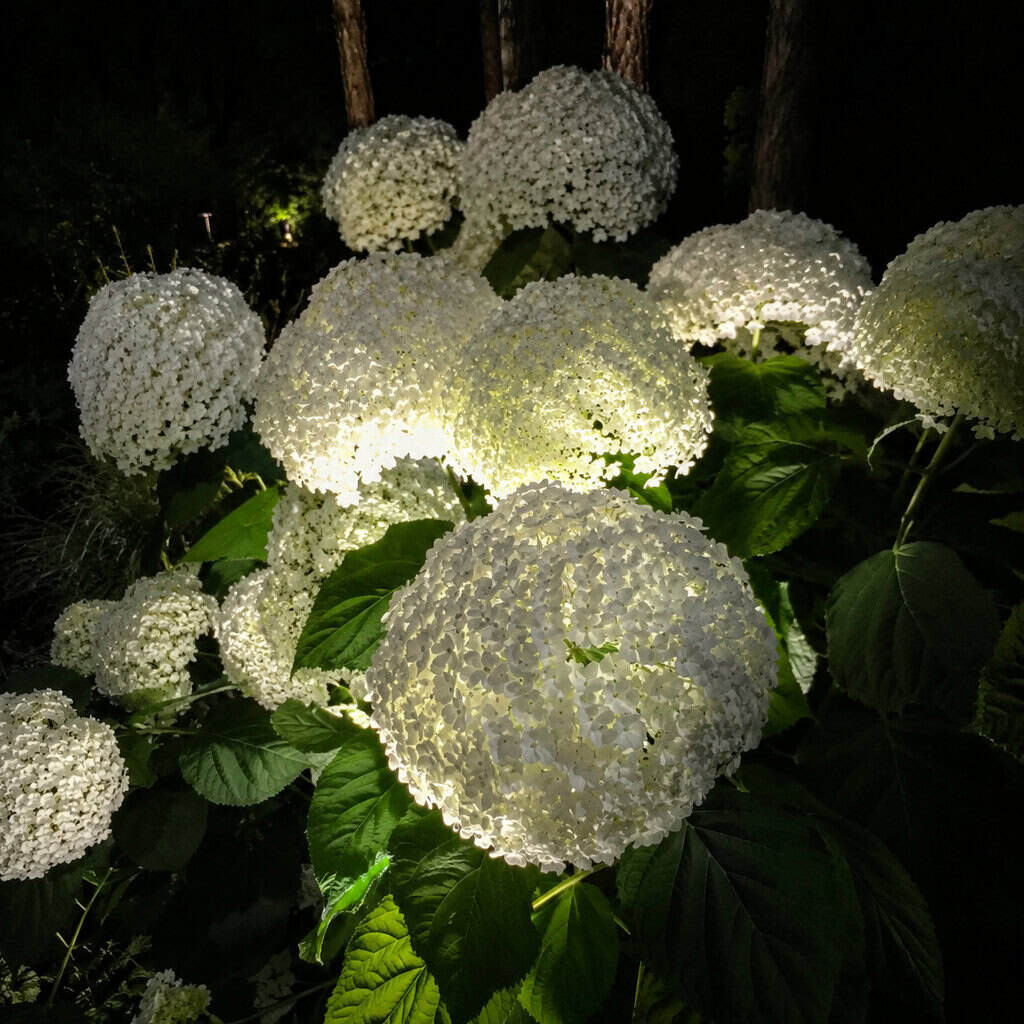
Nothing glows harder in the dark than a hydrangea. The blooms are enormous — softball-sized snowballs on ‘Annabelle,’ big white cones on the panicle types — and they light up against the leaves at night.
Scale is the secret. Small flowers disappear after dark; these giant heads read from across the lawn.
‘Annabelle’ takes some shade. Panicle hydrangeas like ‘Limelight’ want more sun and shrug off cold winters.
Plant a row and you’ve got a wall of glow. Best visual payoff on the whole list.
24. Sweet Autumn Clematis (Clematis terniflora)
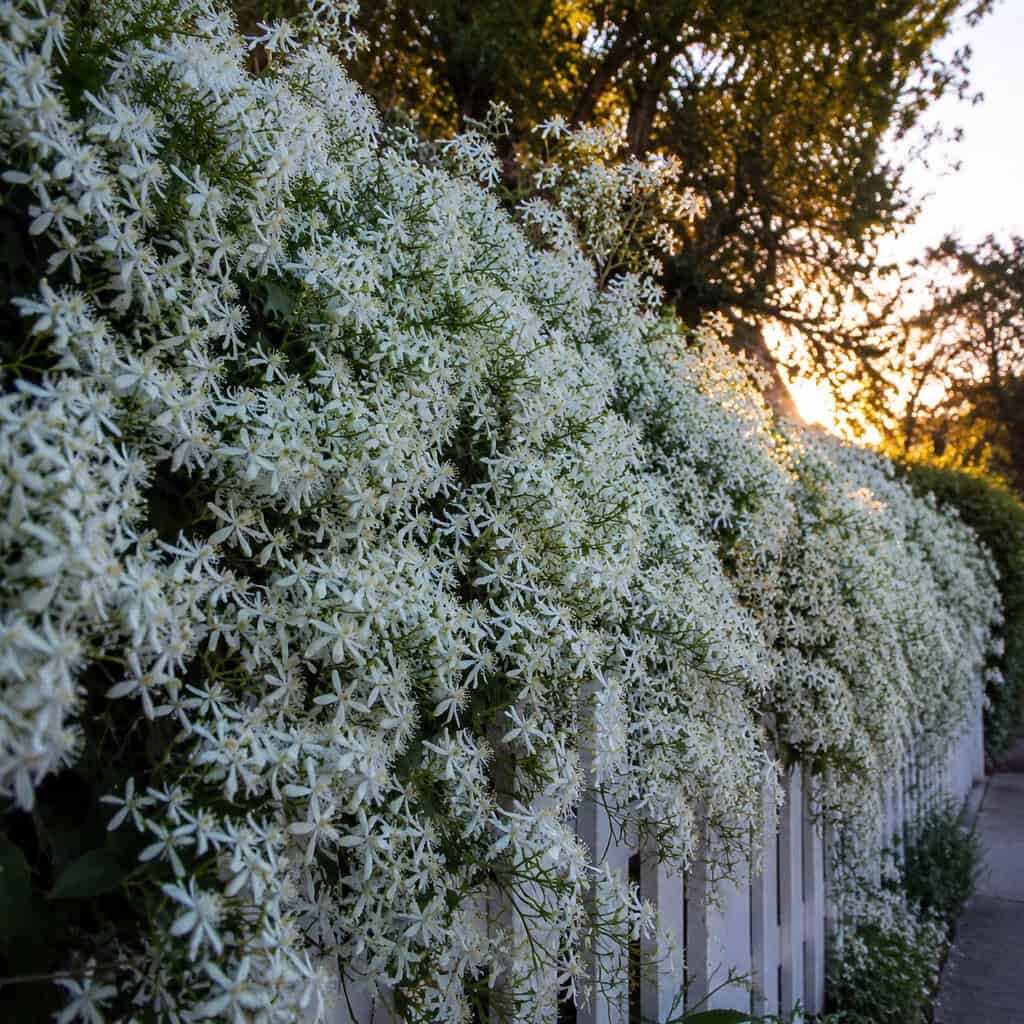
Come late summer, this vine buries itself under thousands of tiny white star flowers, fragrant and frothy, like someone draped a lace sheet over the fence.
It’s about as hands-off as a flowering vine gets. Fast, tough, and forgiving.
Almost too forgiving, actually. It’s vigorous to the point of aggressive, and it self-seeds freely, so keep the shears handy and cut it back hard each year to keep it in bounds.
Give it a strong support — it gets heavy.
25. Snowdrops & White Daffodils
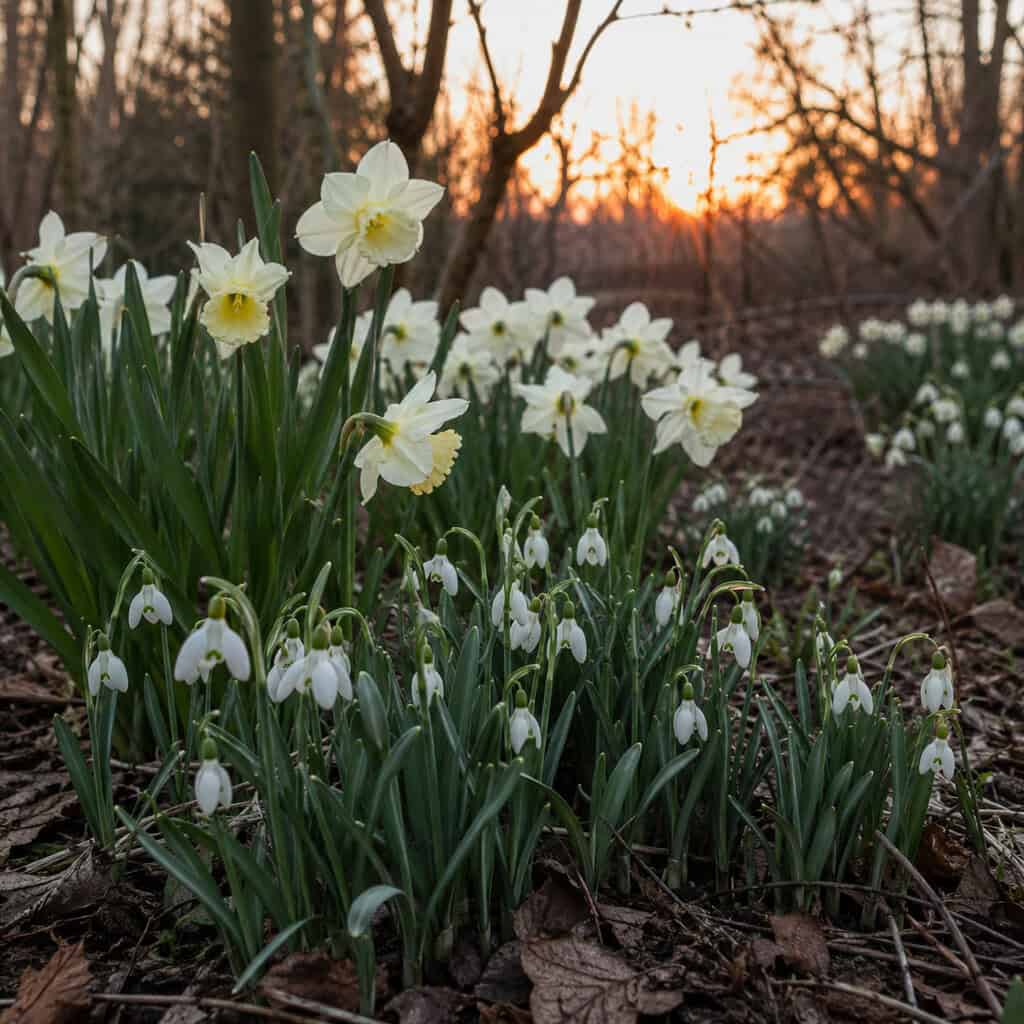
These are the bookends of the moon-garden year. Snowdrops, summer snowflakes, and white daffodils push up in late winter and early spring, reflecting moonlight before anything else is even awake.
They fill the gap when the border is otherwise brown and asleep. On a clear cold night, a drift of white daffodils under the moon is startling.
Plant the bulbs in fall and forget about them. They multiply on their own and come back a little bigger every year.
26. White Caladium (Caladium bicolor)
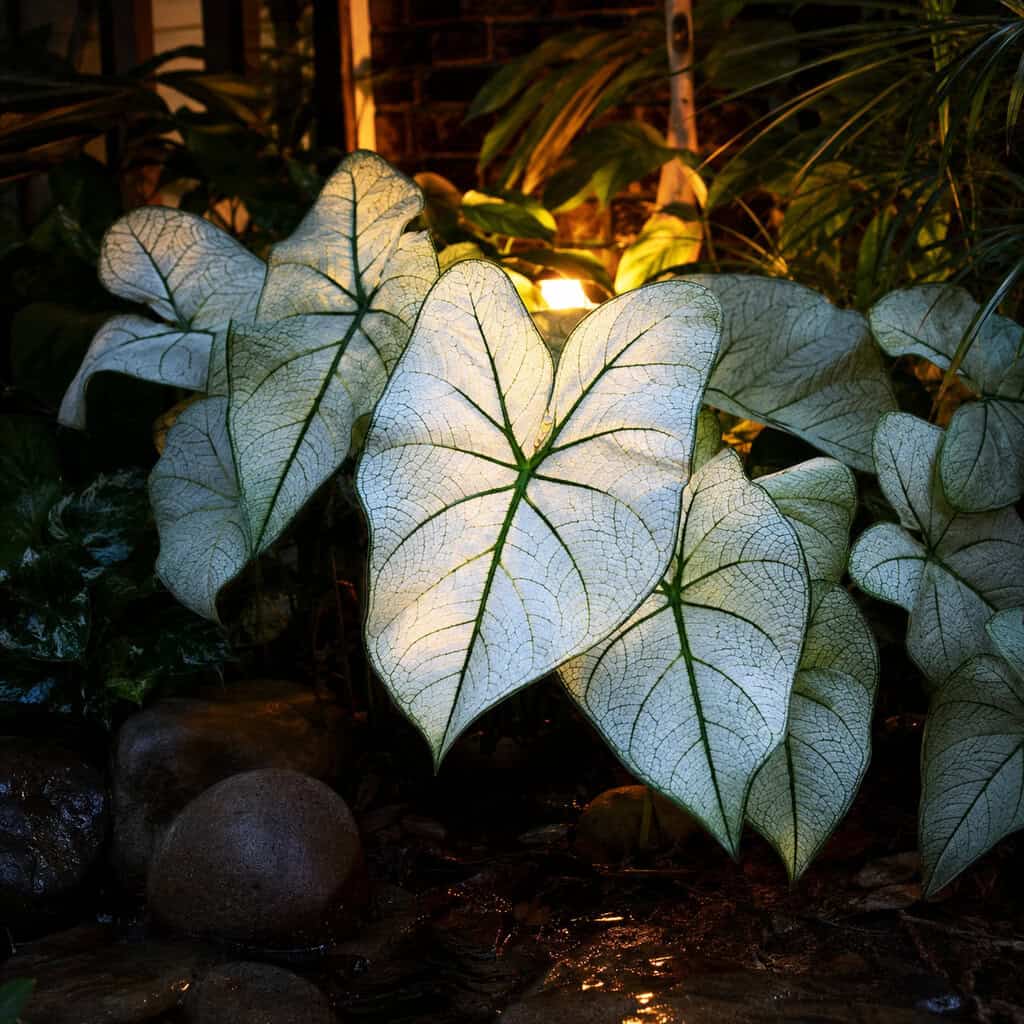
Not a flower — a glow-maker. Caladium grows big heart-shaped leaves that are nearly all white, veined and edged in green, and they light up a shady corner all day and all night.
If your evening sitting spot is under a tree or on a shaded patio, this is your answer. Most white bloomers want sun; caladium wants exactly the opposite.
It’s a tender tropical, grown from tubers, so treat it as an annual or lift and store it in cold zones. Keep it moist and out of harsh afternoon sun.
27. Lamb’s Ear (Stachys byzantina)
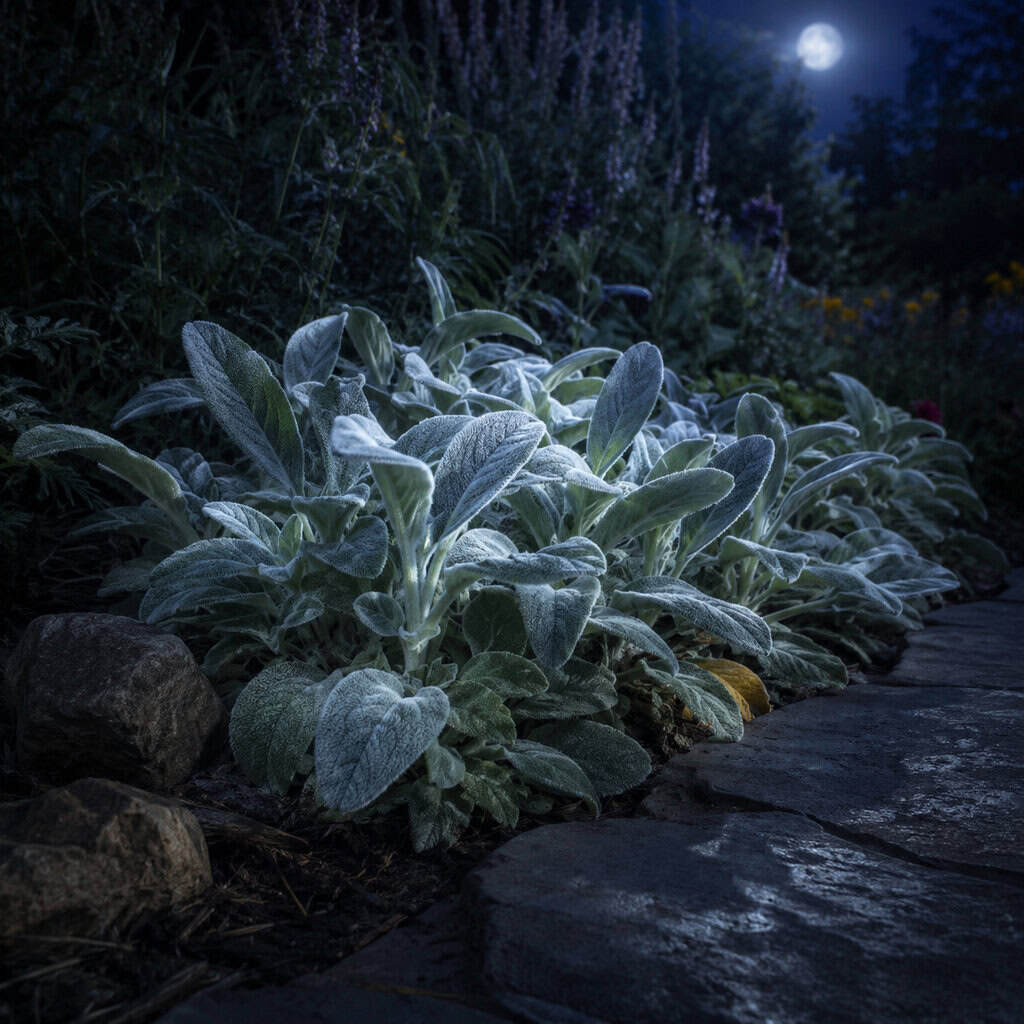
Touch it once and you’ll understand the name. The leaves are soft, thick, and fuzzy, like felt, and they’re a pale silver that catches moonlight and holds it.
Foliage matters as much as flowers in a moon garden, and lamb’s ear proves it. A low mound of it glows a soft silver even on a flower-free night.
It’s a tough spreading perennial that shrugs off drought and poor soil. The go-to silver edging for a reason.
28. Dusty Miller (Jacobaea / Senecio cineraria)
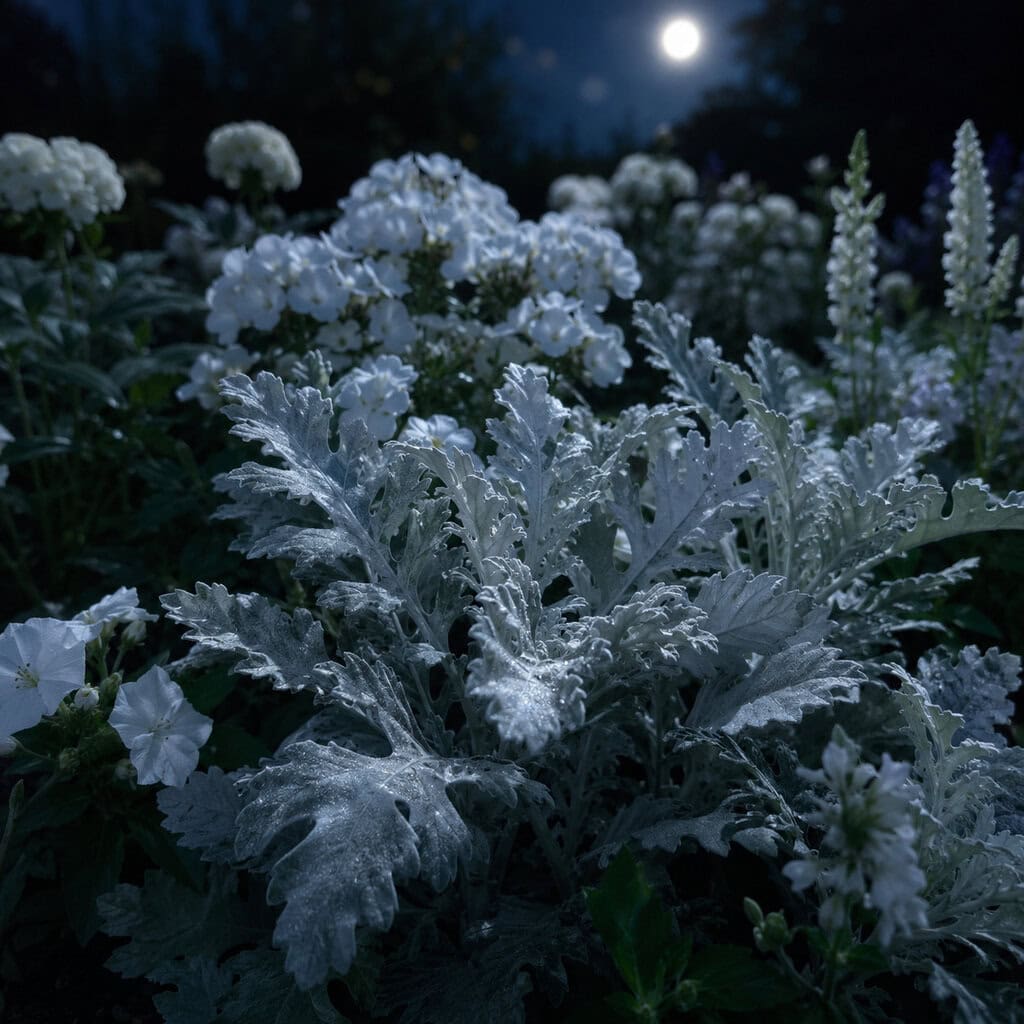
The great connector. Dusty miller’s frosted, deeply cut silver leaves shimmer in low light and go with absolutely every white flower on this list.
Its whole job is tying the bed together — a cool silver thread woven between the whites so nothing looks stranded.
Grow it as an annual most places, or a short-lived perennial where winters are mild. Pinch off the flowers if they appear; you’re growing this one purely for the leaves.
29. White Coneflower ‘The Price Is White’ (Echinacea)
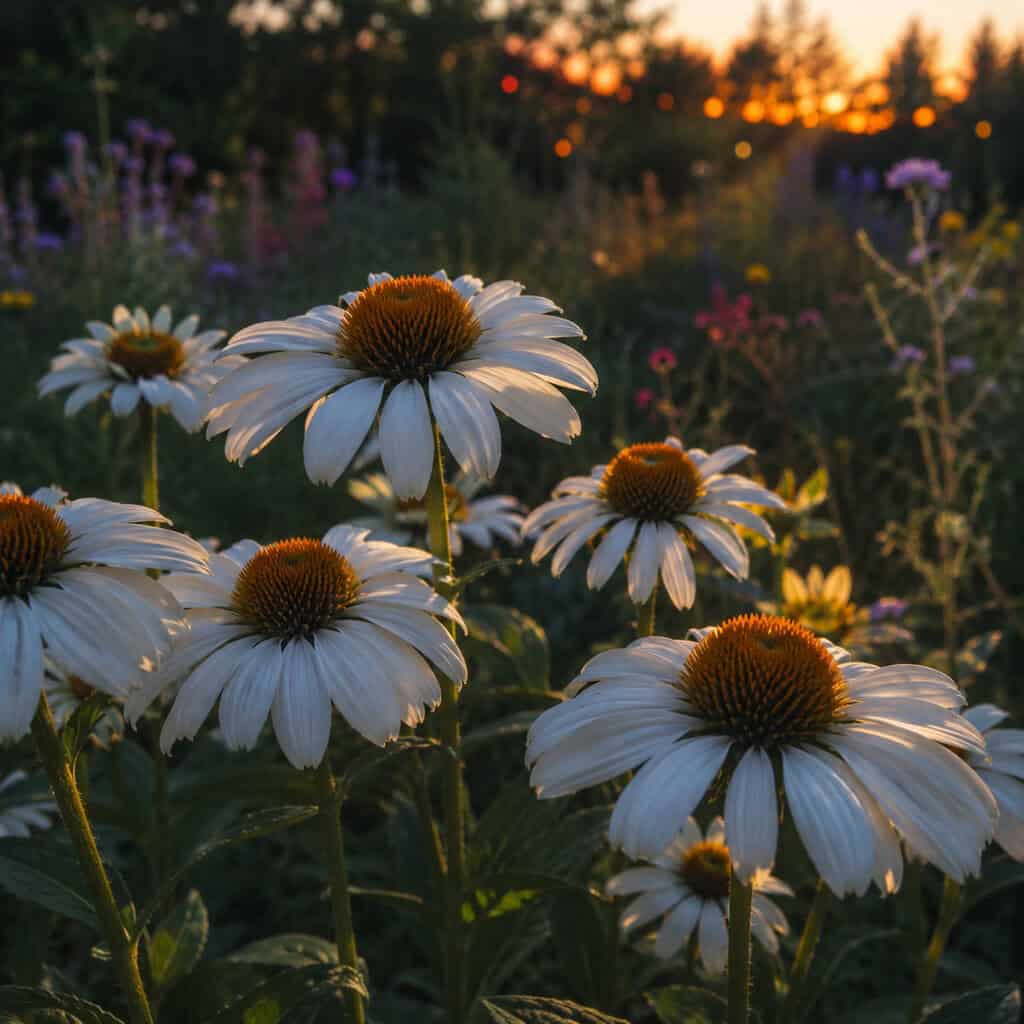
End on a native note. White coneflowers throw broad, flat blooms that reflect moonlight and seem to hover and glow after dusk.
The petals sit around a coppery cone that the butterflies and bees work hard by day and the goldfinches raid for seed later.
If you’d rather plant a native perennial than a fussy import, this is your pick. Tough, drought-tolerant, and it comes back stronger each year.
A moon garden that also feeds the pollinators — hard to argue with that.
Putting It Together
You don’t need all 29. Start with a moonflower vine on an arch, a clump of white phlox, and a border of lamb’s ear, and you’ve already got a garden that changes at dusk.
Layer for scent and season. A spring of candytuft and daffodils, a summer of hydrangeas and tuberose, a fall of Japanese anemones — the glow never has to stop.
Just keep the dangerous ones in mind. If a dog patrols the yard or a toddler wobbles through it, skip the datura, the lilies, and the angel’s trumpet, and lean on the safe glowers instead.
Plant it right, and the best hour in your garden becomes the one after the sun goes down.