

Drive past a landscaping crew in late October and you’ll see the same choreography every time. Blowers screaming. Beds scalped flat. Every leaf gone by lunch.
Now go look at the crew leader’s own yard.
Standing grasses. Leaves chopped into the turf. Perennial stems still up. A wire ring of leaves rotting in the back corner like it’s doing a job — because it is.
That gap isn’t laziness. It’s the difference between cleanup that sells and cleanup that works. A lot of what homeowners break their backs on every November is theater, and a handful of jobs nobody thinks about are the ones that decide whether a pipe splits, a maple dies, or the lawn greens out two weeks early.
Here are 33 fall jobs — the ones pros quietly skip at home, and the ones they’d do in the dark at 38 degrees.
1. Raking the lawn down to bare grass
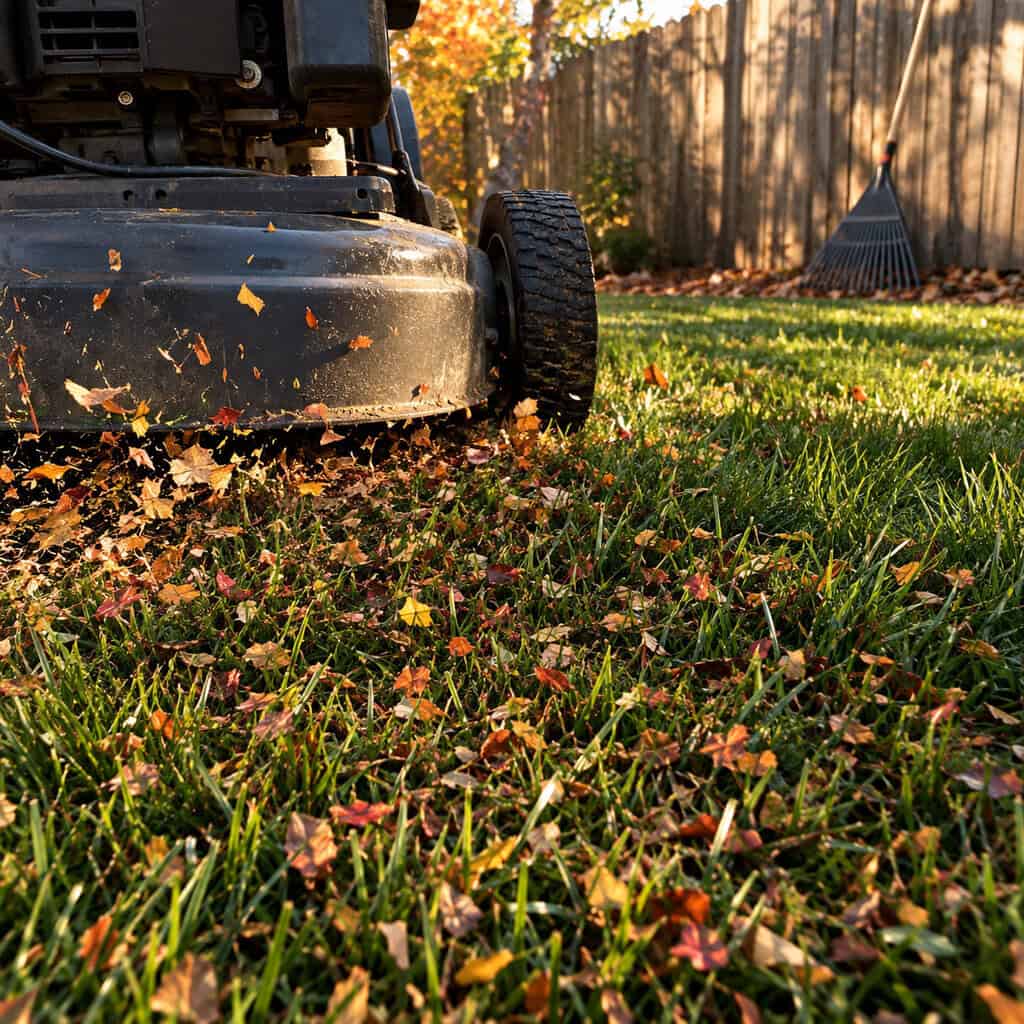
Watch a turf guy handle his own leaf drop. He mows. That’s it.
Two passes with the deck up a notch chops maple and birch leaves into confetti that disappears into the canopy in a couple weeks. Research out of Michigan State and University of Minnesota Extension found mulched leaves feed soil microbes, suppress spring weed seed, and don’t build thatch the way everyone assumes.
The only leaves that come off are wet oak mats thick enough that you can’t see green through them. Those smother.
Skip the rake. Mow until you can see grass, then stop.
2. The gutters, downspouts, and downspout extensions
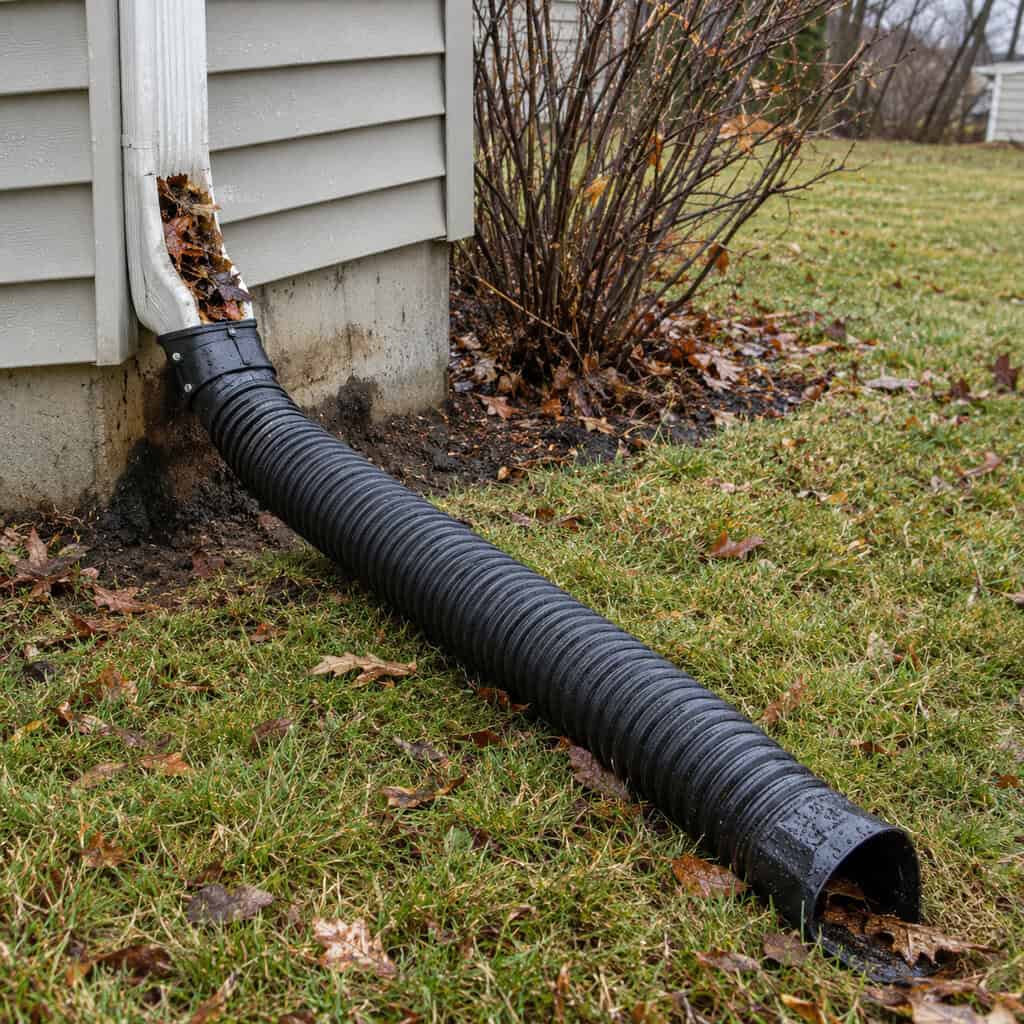
This is the job that gets done at a pro’s own house in headlamp weather, after the last stubborn oak finally lets go.
A packed gutter doesn’t just overflow. It freezes into a trough of ice that can weigh more than 100 pounds per 10-foot run, and that weight pulls spikes and hangers straight out of the fascia board.
The worse problem happens below. A single inch of rain on a 1,500-square-foot roof produces roughly 900 gallons of water, and every one of those gallons is supposed to be leaving the house. When the gutter clogs, that volume dumps in a concentrated column at the foundation corner, saturating the backfill soil that’s already looser than undisturbed ground.
Saturated backfill freezes and expands against the wall. That’s how hairline cracks become weeping cracks, and how a dry basement becomes a $12,000 waterproofing quote.
Then there’s the extension nobody installs. A downspout that ends in a splash block six inches from the wall is still depositing water inside the foundation’s drainage zone. Get it out at least four feet, and six to ten feet is better on clay soil or a flat lot.
Check the grade while you’re there. Soil should drop about six inches over the first ten feet away from the house — walk it after a heavy rain and look for standing water within that zone.
- Gutter seams dripping in cold weather (an ice-dam warning)
- Mud splatter on siding above the splash block
- A trench of eroded soil under the drip line
- Water pooling against the wall 20 minutes after rain stops
Flexible roll-out extensions are ten dollars. Foundation repair is not.
3. Cutting every perennial to the ground
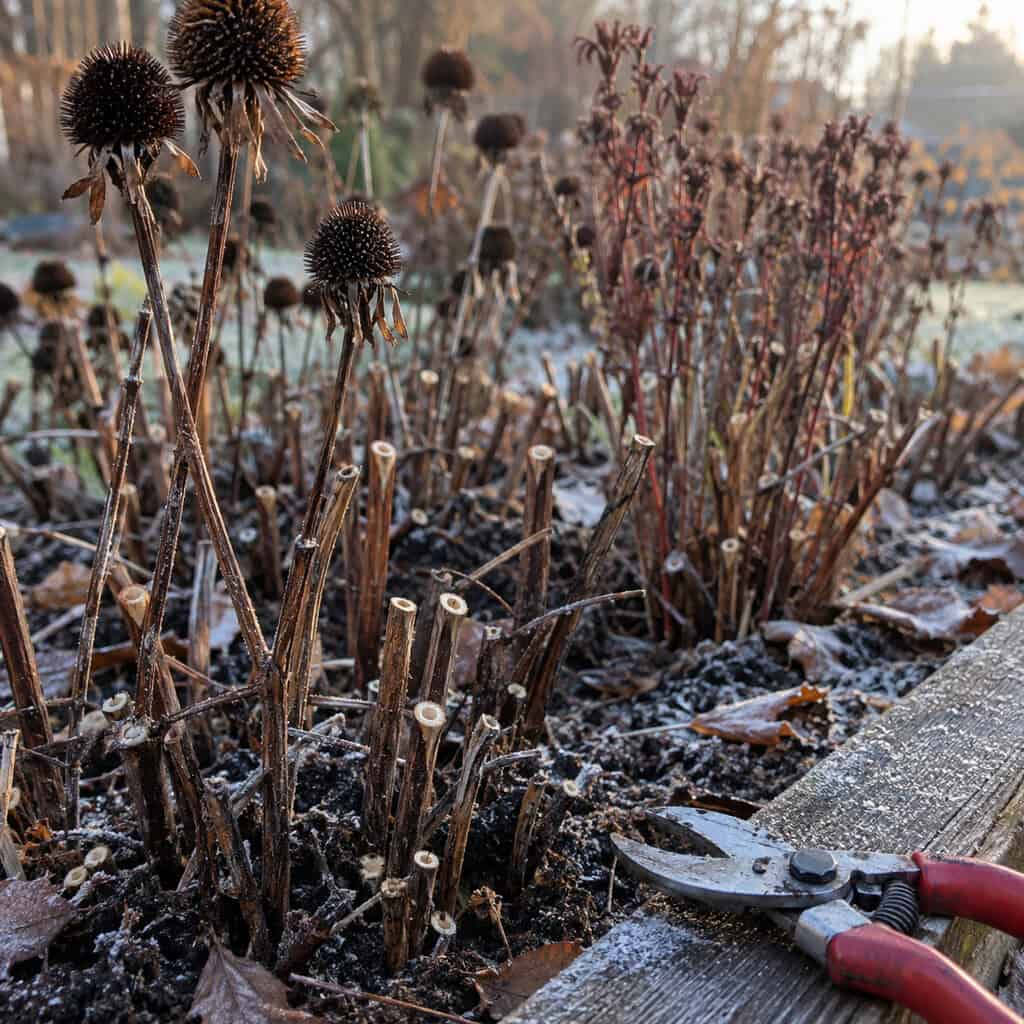
The clear-cut looks tidy for about a week, then the beds look like a parking lot until April.
Hollow and pithy stems — bee balm, coneflower, joe-pye, raspberry canes — are winter housing for small native bees that nest inside them. Seed heads on coneflower and rudbeckia keep goldfinches in the yard through January.
The pro compromise is stubble. Cut back to 12 to 18 inches so the bed reads as intentional rather than abandoned, and the stem-nesters still get a door. Illinois Extension now pushes this same approach outright.
Skip it. Wait until spring temperatures hold in the 50s.
4. Fallen acorns, black walnuts, crabapples, and mushrooms
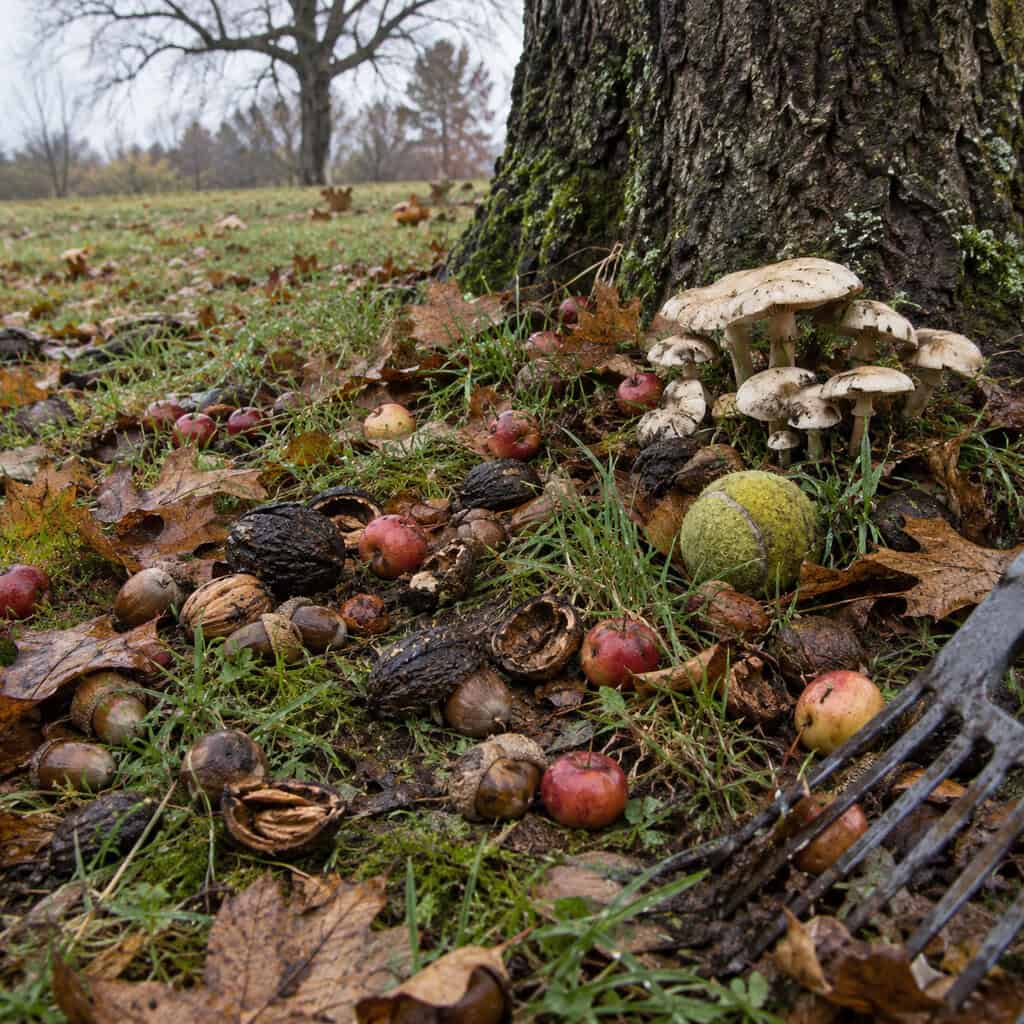
Any landscaper with a dog does a weekly sweep of the yard in fall, and it has nothing to do with appearance.
Moldy acorns and the black hulls on walnuts can grow tremorgenic mycotoxins that cause vomiting, staggering, and seizures in dogs. Fermenting crabapples under a tree are their own problem.
Fall is also peak mushroom flush in shaded turf, and most homeowners couldn’t identify the dangerous ones on a bet. Kick them over on sight.
Never skipped. Five minutes with a rake and a bucket, once a week, until the tree is bare.
5. Shearing shrubs into shape ‘while things are quiet’

October is slow, the shears are right there, and it feels productive. It’s also how people accidentally cancel spring.
Lilac, forsythia, azalea, rhododendron, and bigleaf hydrangea set next year’s flower buds during summer. Shearing now cuts them off and throws them in a tarp.
On anything that doesn’t bloom, late pruning can push a flush of soft growth that hasn’t hardened off before the first hard freeze kills it.
Crews do it on client properties because clients ask. At home the shears stay hung up until late winter — or until right after bloom on the spring-flowering stuff.
6. Hose bibs, garden hoses, and the sprinkler blowout
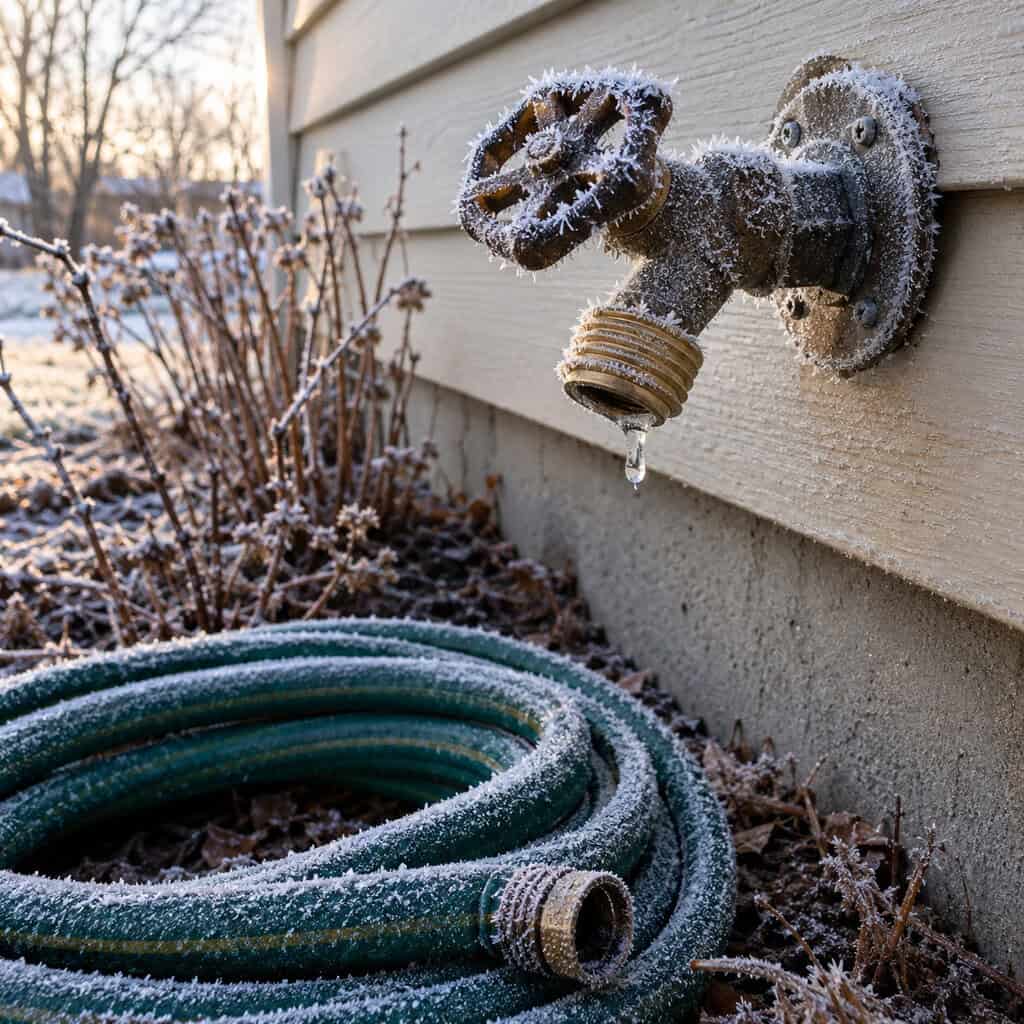
The single most expensive five-minute mistake in the American yard is a garden hose left threaded onto a spigot in November.
Here’s the mechanism most people never hear. A frost-free sillcock is designed so the actual shutoff valve sits eight to twelve inches back inside the heated wall, and when you shut it off, the water in the long barrel drains out the spout. Leave a hose attached and that barrel can’t drain — the hose seals it like a cork.
Trapped water freezes, expands about nine percent, and splits the copper stem behind the siding. Nothing happens in December. Nothing happens in January.
Then in April somebody turns the spigot on and water pours into the wall cavity, the sill plate, and the finished ceiling below. People discover it from a stain, not a sound.
Unthread every hose, drain it, coil it, and store it off the ground. Open the spigot for a minute afterward to let the barrel empty, then shut it. If you have an interior shutoff and a bleeder cap on the supply line, use both.
Irrigation gets the same discipline. Pros blow out sprinkler lines with compressed air on a calendar date, not a weather hunch — a single freeze event through a wet lateral can crack manifolds, backflow preventers, and heads across the whole zone.
Backflow assemblies sitting above grade are the most fragile piece and the most expensive to replace. Insulate or pull them.
7. Cutting down the ornamental grasses
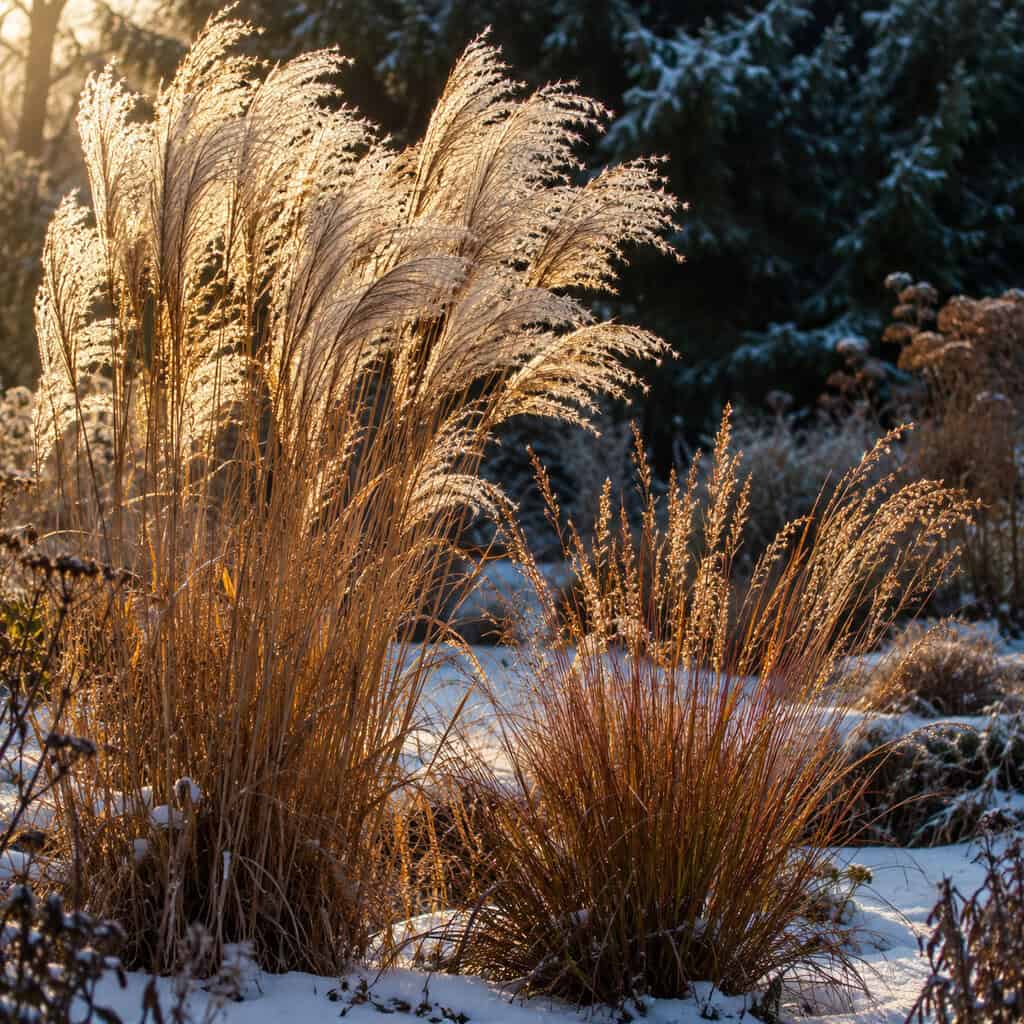
Miscanthus, switchgrass, little bluestem — they hit their best month the week everything else turns to mush.
Standing crowns shed water away from the center instead of holding it, which matters a lot during freeze-thaw cycles. The dead foliage also insulates the crown through cold snaps.
And the plumes do real work. Backlit at 4 p.m. in January, catching snow, moving in wind — that’s the entire winter garden for a lot of yards. Iowa State Extension lists them among the plants best left standing.
Cut them in October and you’ve bought yourself five months of staring at mud. Wait for March.
8. Core aeration and overseeding
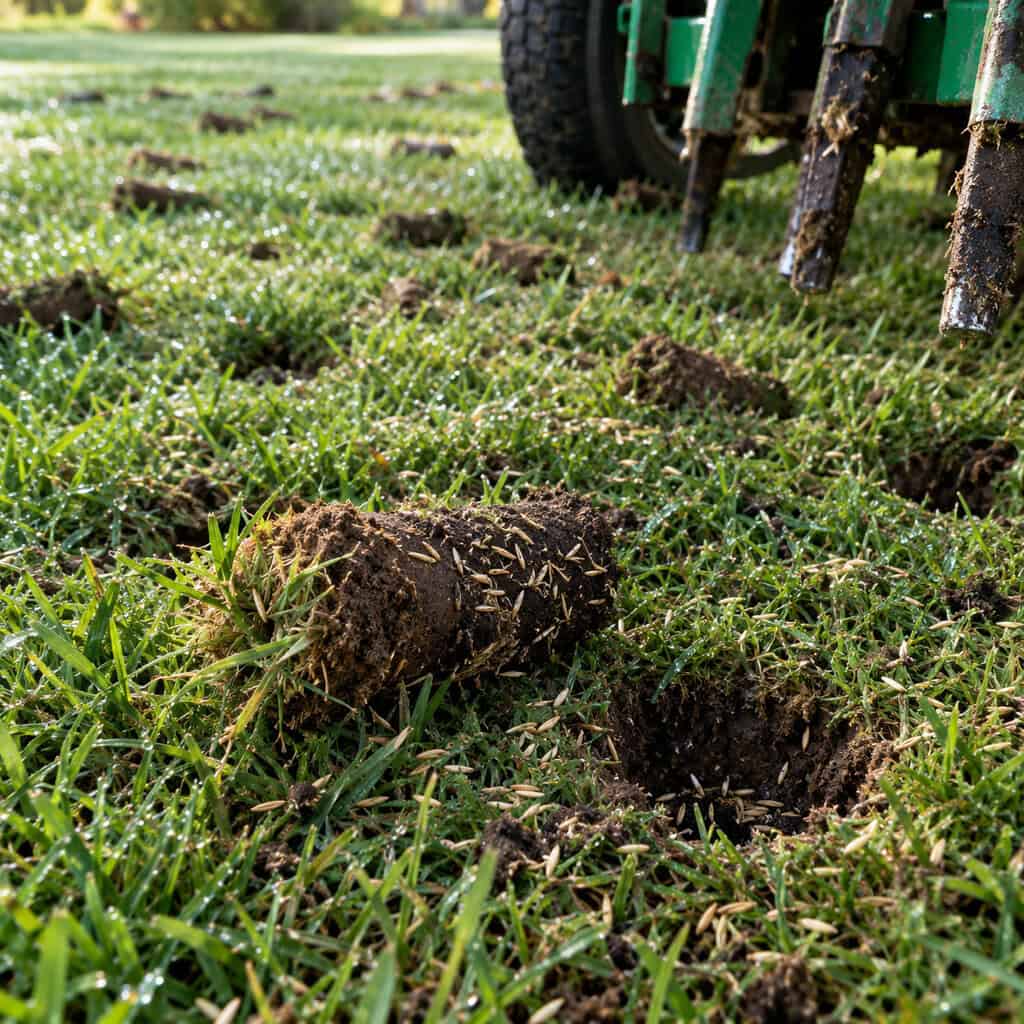
Highest return of any fall job. Tightest window of any fall job.
In cool-season country that’s late August through mid-September. Seed needs roughly 45 days of workable soil temperature to germinate and put down enough root to survive winter heave.
Pull cores, don’t spike. Spike aerators just compress the walls of the hole. Leave the plugs on the surface to break down.
Drop seed into the open holes and keep the top half-inch damp with short, frequent cycles. If the window closed on you, see entry 31 — there’s a fallback.
Nothing you do in April makes up for skipping this. Nothing. It’s the single biggest reason a neighbor’s lawn looks better than yours by May.
9. Cutting hosta, iris, peony, and daylily to the ground
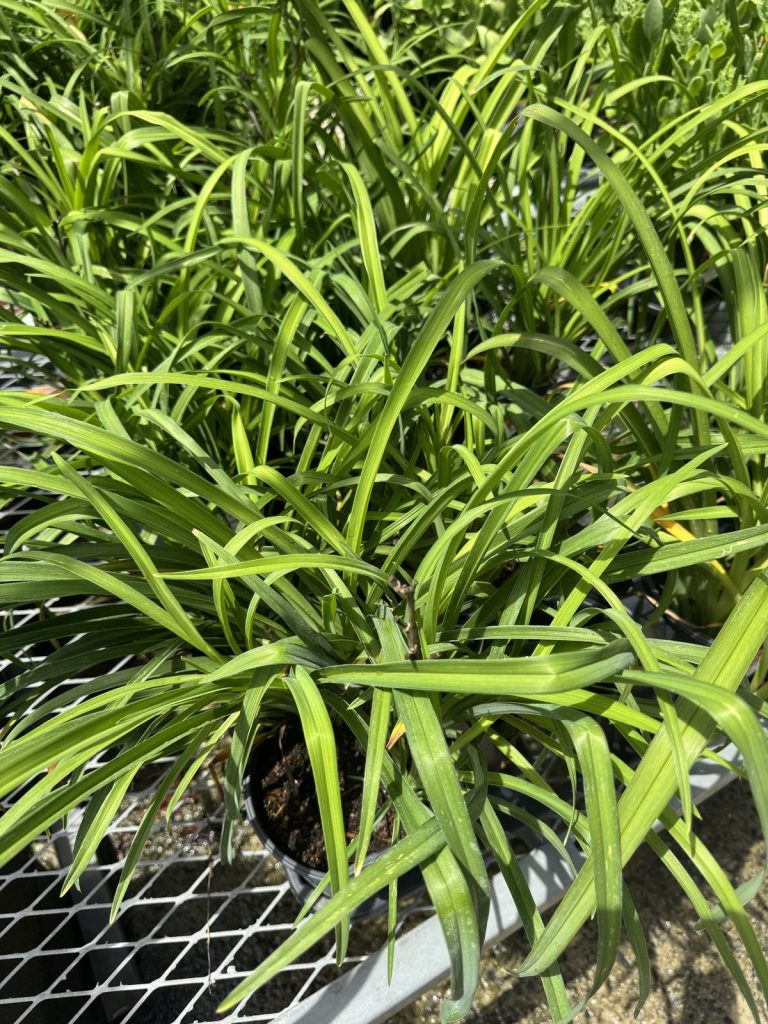
These four are the deliberate exceptions to the leave-the-stems rule, and pros are ruthless about them.
Collapsed hosta foliage is a slug hotel — a wet mat that shelters eggs straight through winter. Iris leaves harbor iris borer eggs laid in fall at the base. Peony foliage carries botrytis spores that reinfect the crowns in spring rain.
Cut all four after the first hard frost, right down to a couple inches. Bag the debris rather than composting it. UNH Extension names this same short list.
Everything else in the bed can stay up.
10. The fall grub treatment
Big-box shelves are stacked with grub product in September and October. Almost none of it will do anything.
Grub control splits into two categories that get sold as if they’re one. Preventive products — chlorantraniliprole, imidacloprid — need to be in the soil before or during egg hatch, which means May through mid-July depending on your region. Curative products like trichlorfon and carbaryl kill small, actively feeding larvae near the surface, which is a July-into-August situation.
By mid-October, those grubs are third instar: fat, tough-shelled, and already migrating down below the root zone to overwinter. A curative application at that point reaches maybe a fraction of them, and the preventive is nine months early for a pest that hasn’t laid eggs yet.
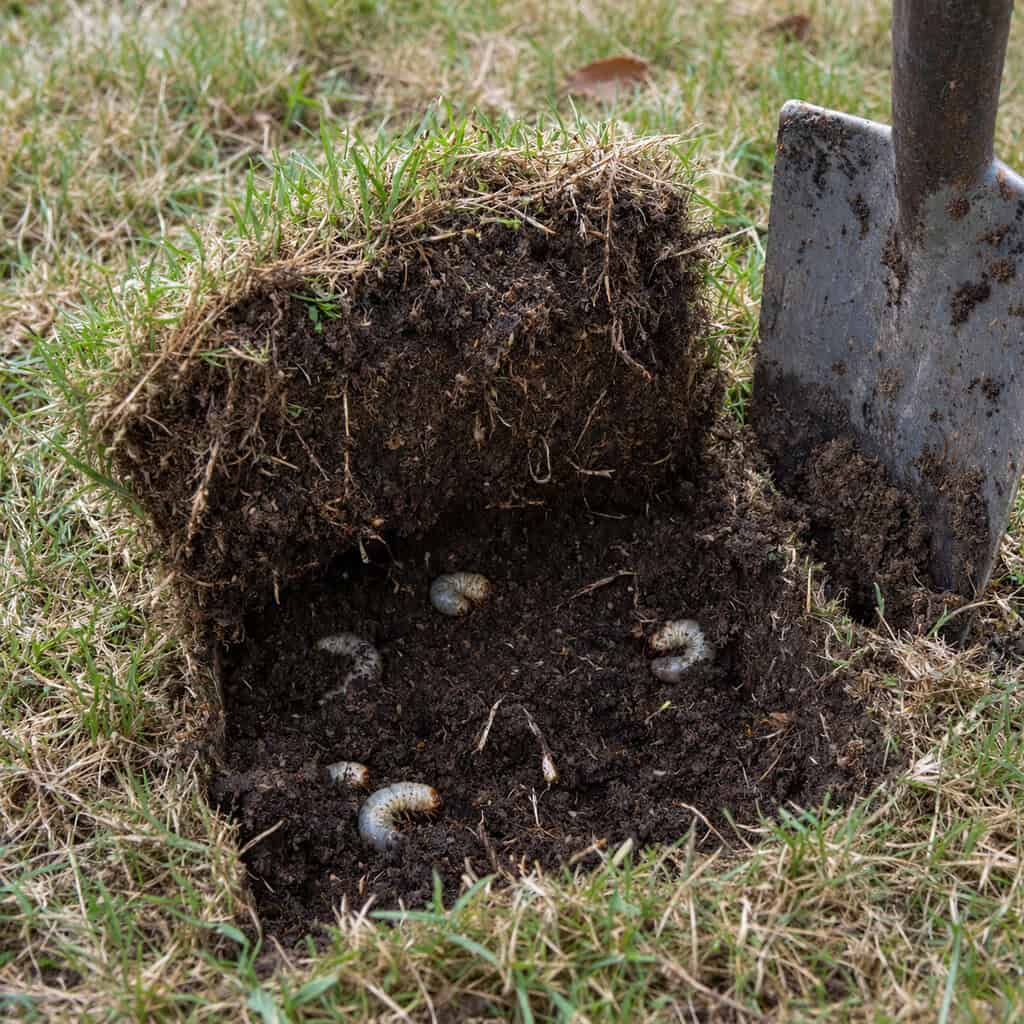
So pros scout instead. Cut a one-square-foot flap of turf three inches deep in a suspicious area and peel it back like carpet. Count what’s underneath.
Fewer than five grubs per square foot in a healthy lawn is background noise — no treatment justified. Ten or more, especially in a thin or irrigated lawn, and you mark next June on the calendar.
The other tell is wildlife. Skunks tearing up turf in ragged strips at night, or turf that rolls back with no root attached, means the damage is already done and a pesticide won’t undo it. Repair the damaged turf and plan the preventive for early summer.
Spending $70 on grub killer in October is buying insurance for a fire that already burned out.
11. Pulling mulch back off trunks and caging young bark
Mulch piled against a trunk is a vole condominium with heat included.
Voles tunnel under snow all winter and chew bark at the soil line where nobody’s looking. A complete ring of chewing girdles the tree, and a girdled maple is dead — it just doesn’t know it until July.
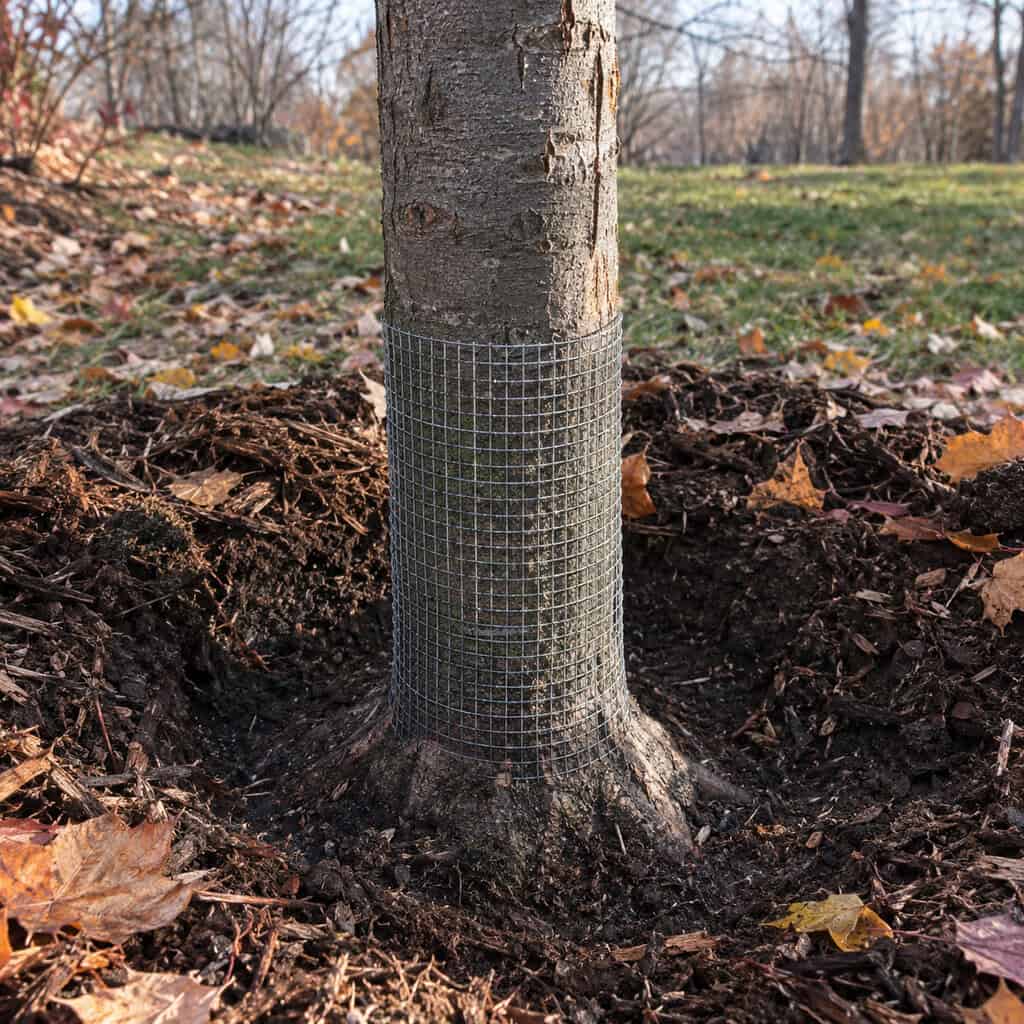
Pull mulch back three inches from every trunk so you can see the root flare. Then wrap young, thin-barked trees with a cylinder of quarter-inch hardware cloth, set an inch or two into the soil and standing 18 to 24 inches tall.
Four dollars of wire mesh. A fifteen-year-old tree.
12. Diseased leaves bagged, never composted

Rose black spot, apple scab, tar spot, tomato blight, powdery mildew — they all overwinter on fallen plant tissue sitting on the soil surface.
Spring rain splashes the spores back up onto new growth. That’s why the same rose gets the same disease every single June.
Home compost piles rarely hold 130 to 150°F long enough to kill pathogens all the way through. The center might. The edges never do.
Bag it. Municipal yard waste facilities run hot, windrowed piles that actually sterilize. Yours doesn’t.
13. Deadheading the hydrangeas
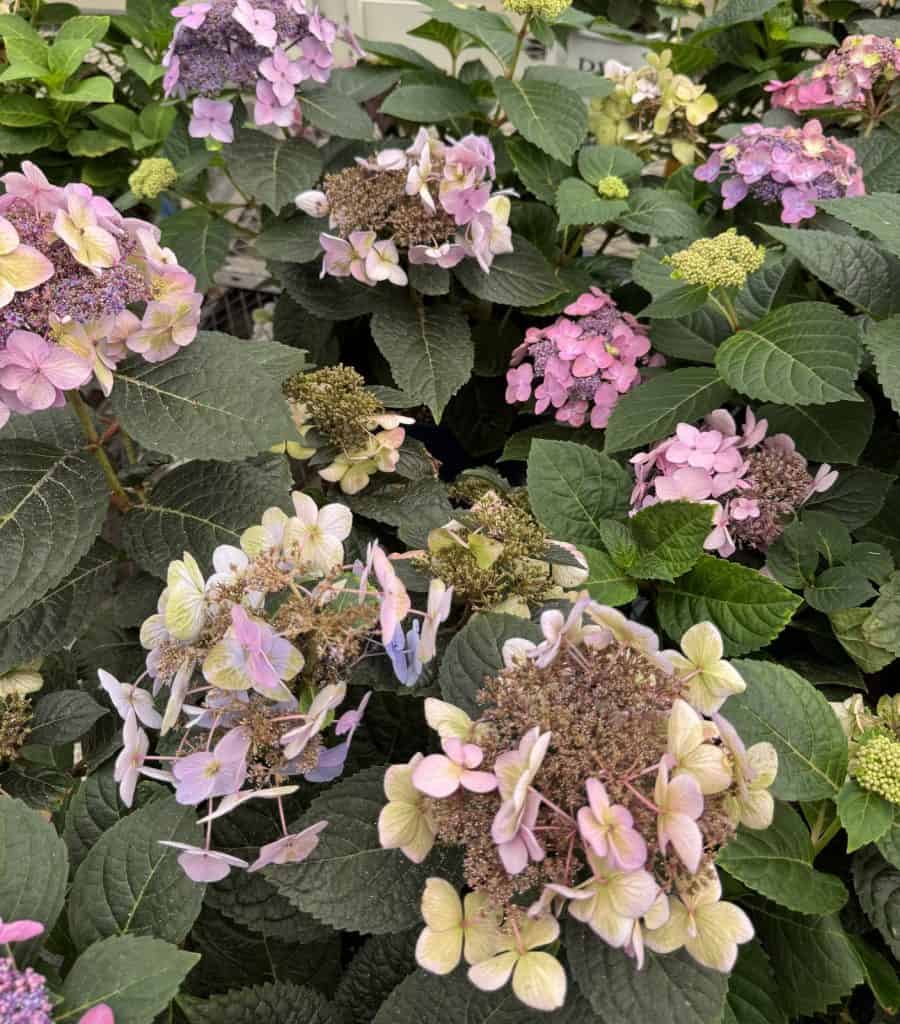
Every year, somebody tidies their bigleaf hydrangea in October and then spends next summer wondering why it produced nothing but leaves.
Macrophylla and serrata types bloom on old wood. The fat flower buds for next June are already sitting on the stem, right below those spent brown mopheads — and the dried heads act as a small shield over them.
Cut the heads off, cut the buds off. Same motion.
Snow settling in those dried domes is also one of the best things a winter yard has going for it. Leave them and prune in spring once you can see which buds swelled.
14. The last real feeding of a cool-season lawn
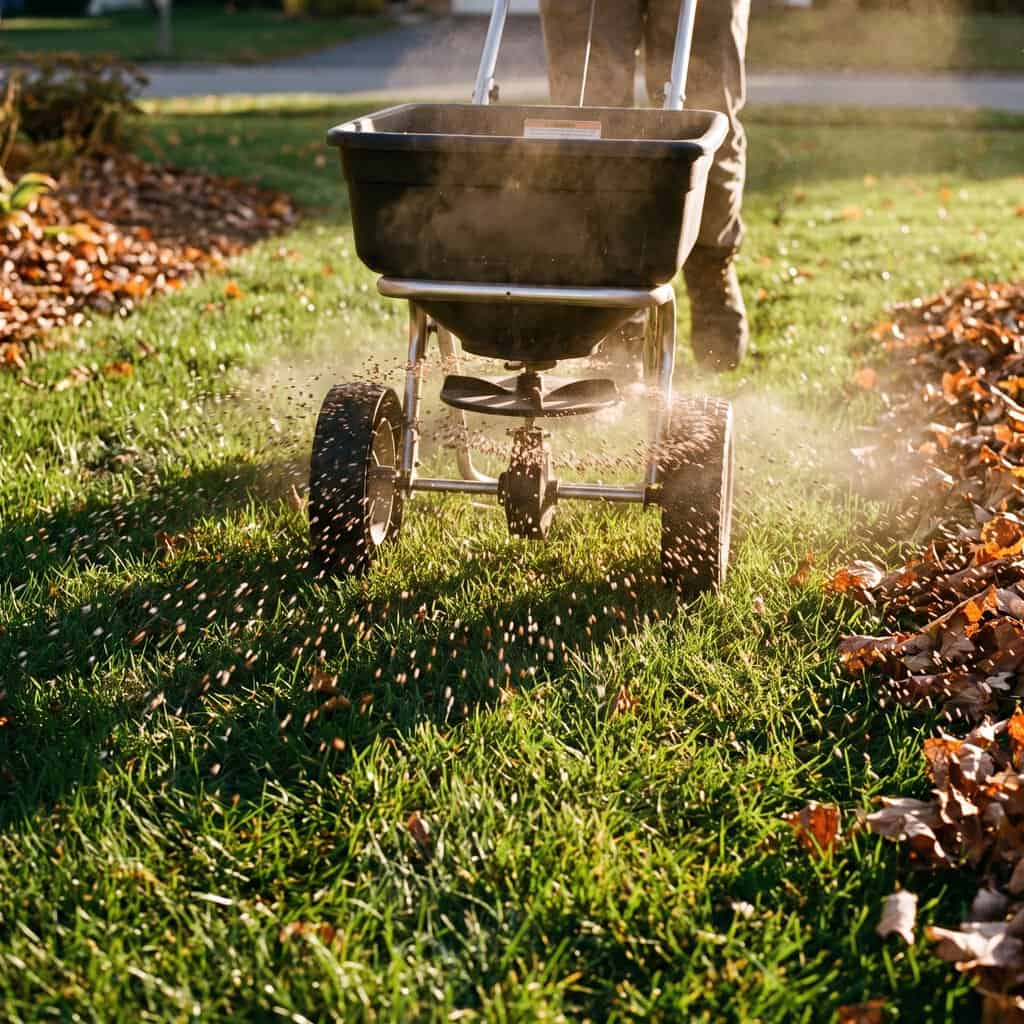
Ask a turf manager which single fertilizer application matters most and you’ll get the fall one.
Once soil cools, the grass stops pushing blade growth and starts moving everything into roots and stored carbohydrate. Nitrogen applied then goes into the part of the plant that has to survive winter and explode in April.
Timing matters more than product. Early-to-mid fall while the lawn is still actively growing — not a Thanksgiving-weekend dump, which just leaves lush, unhardened tissue sitting under snow.
That’s a snow mold invitation. Get it down while you’re still mowing, and use a rate around 0.75 to 1 pound of nitrogen per 1,000 square feet.
15. Dead, cracked, and overhanging limbs
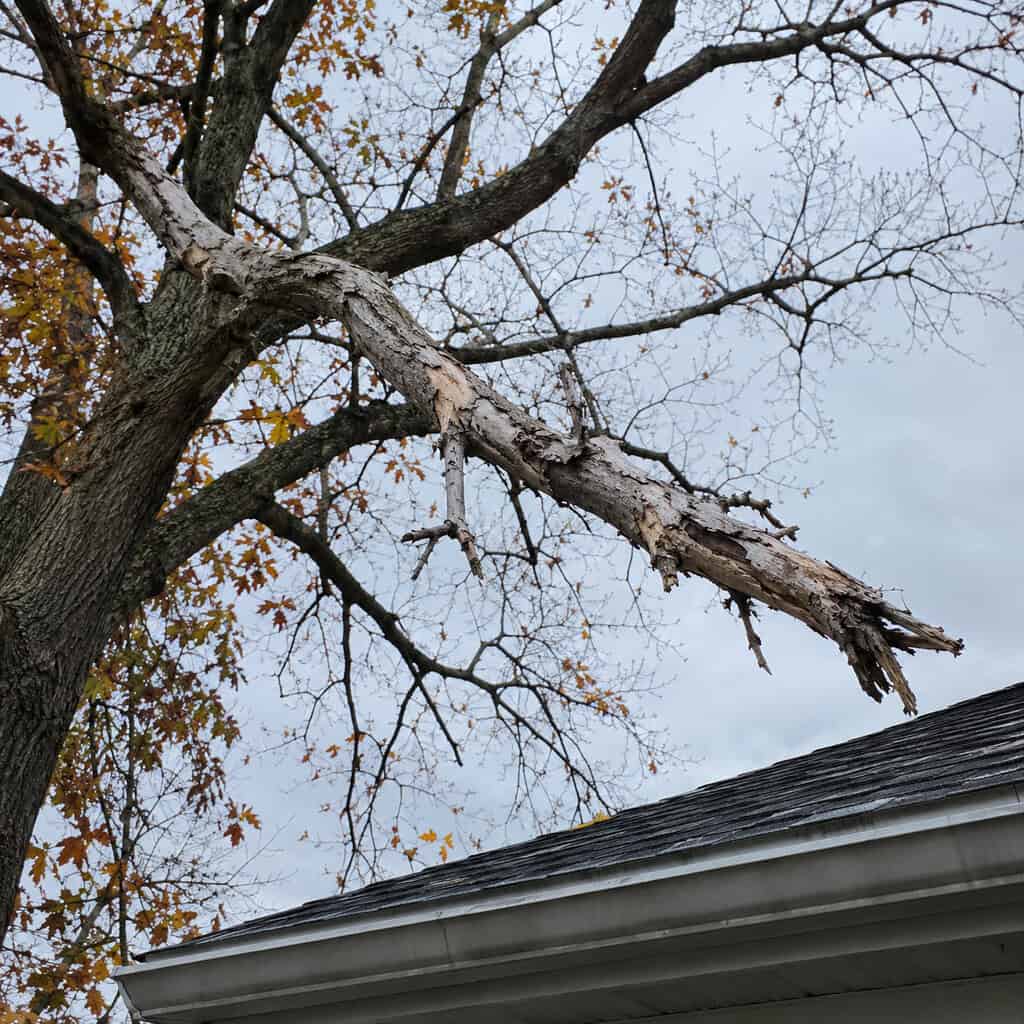
Every fall, pros walk their own trees with binoculars once the canopy is bare. It’s the only month of the year you can actually read a tree.
With leaves gone, deadwood shows up instantly — no buds, peeling bark, a different color and texture than live wood. Cracks, hangers caught in the crown, and included bark at tight V-shaped unions are all suddenly visible from the ground.
Then comes the load math. A half-inch of ice coating can add enormous weight to a limb’s surface area — enough that branches routinely fail under ice that would shrug off any summer storm. Wet snow does the same thing with less warning.
The limbs that matter most are the ones over the roof, the driveway, the power drop, and the neighbor’s fence. A failed limb that lands on your own roof is typically a claim with a deductible. A failed limb that a homeowner was told about and ignored can turn into a negligence conversation with a neighbor’s insurer.
Know the line on DIY. Anything you can reach with both feet on the ground and a pole saw is yours. Anything requiring a ladder, a chainsaw above shoulder height, or work within ten feet of a service line belongs to a certified arborist — ISA certification, proof of liability insurance, and workers’ comp, verified before the truck shows up.
Storm-chaser crews knock on doors after the first ice event. The ones who did the work in October didn’t answer.
16. The fresh mulch top-dress
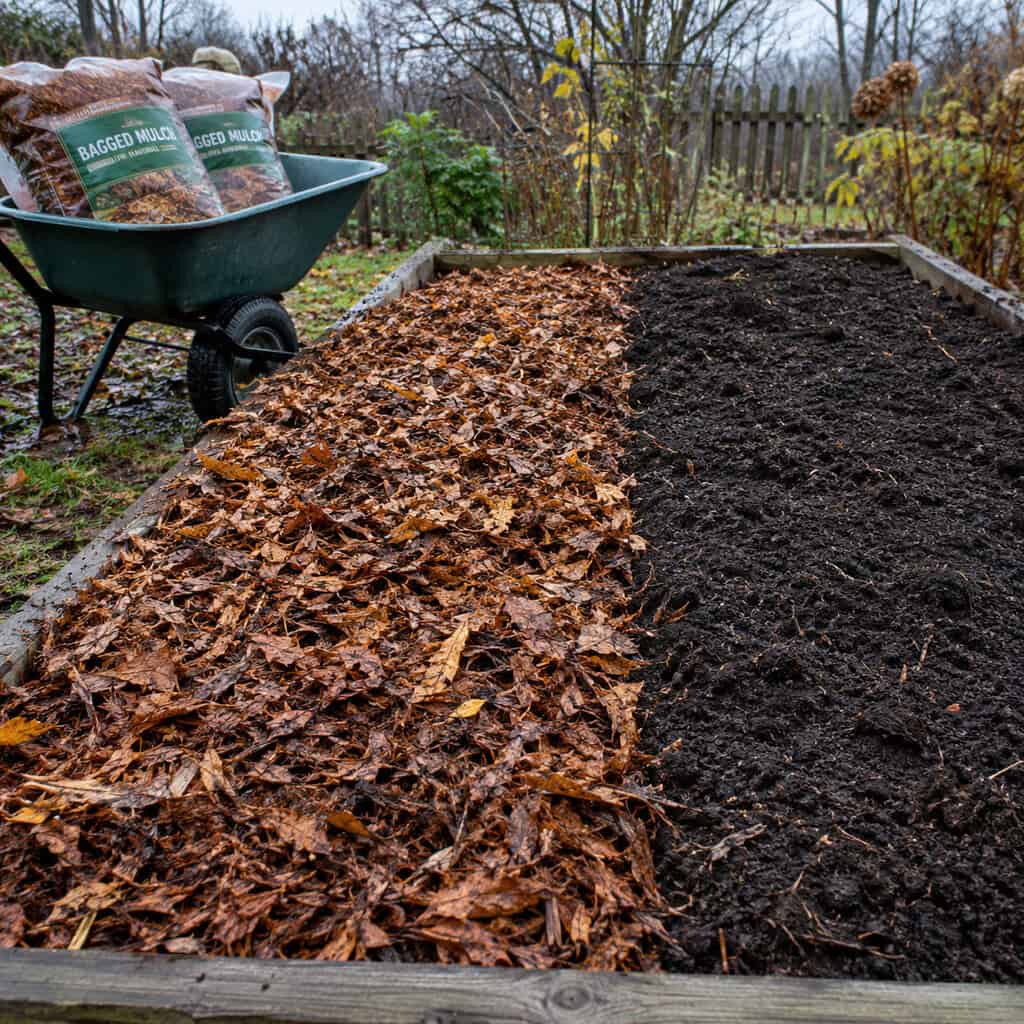
Crews lay fresh dark mulch in October because it photographs beautifully and clients pay for it on sight.
At home it’s a pass. New mulch over cold, wet soil holds that moisture against crowns, gives voles a plush tunneling layer, and delays soil warming by weeks in spring.
What goes down instead costs nothing: a two-inch layer of shredded leaves, run over with the mower first so they knit instead of blowing away.
Save the mulch budget for April. It’ll look better then anyway.
17. Blowing the leaves off patios, walks, and steps
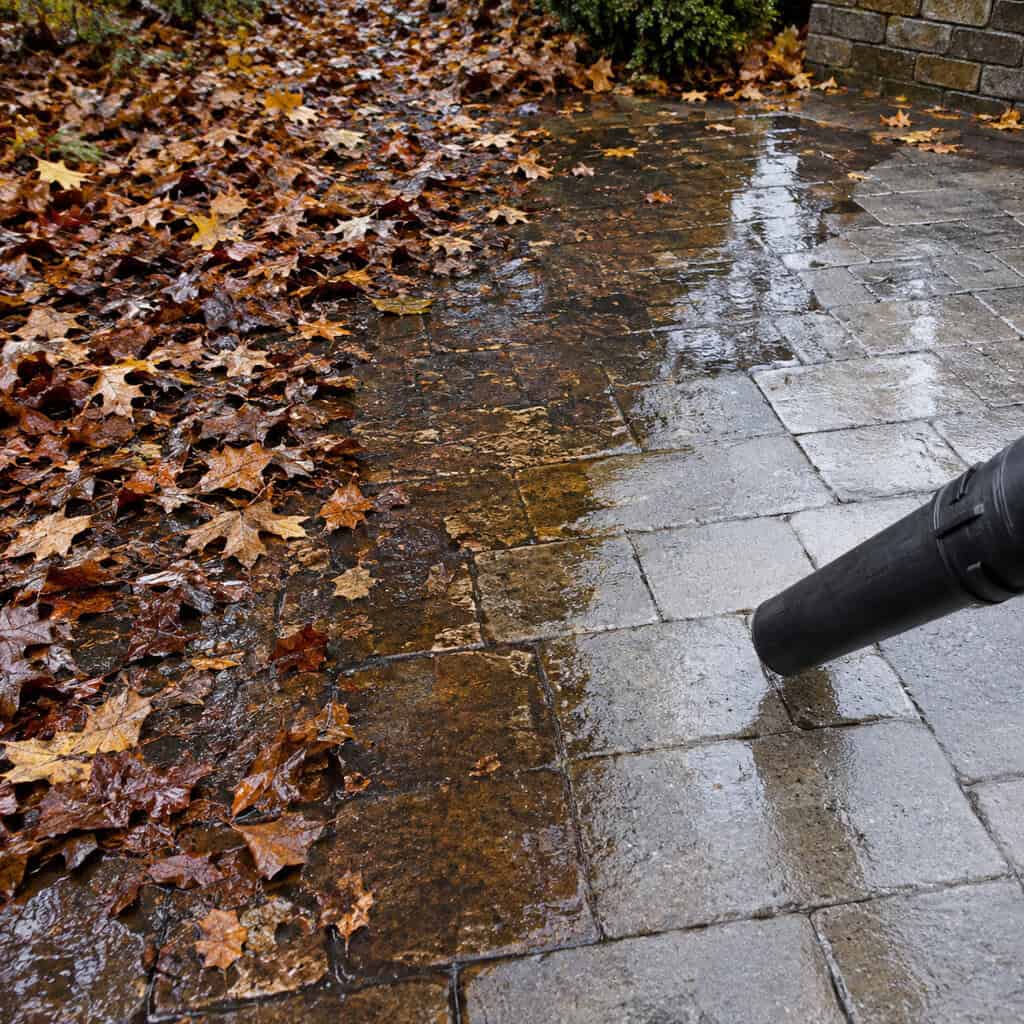
This one’s not about plants at all.
Wet leaves sitting on concrete, pavers, or a wood deck leach tannins that stain — and on unsealed pavers that stain is permanent enough to need chemical cleaning.
The bigger issue arrives with the first freeze. A layer of wet leaves under a skim of ice is a sheet of grease you can’t see, right where you carry groceries.
Never skipped. Every few days through peak drop, even if the lawn goes untouched.
18. Emptying, scrubbing, and flipping the pots

Terracotta and glazed ceramic don’t crack from cold. They crack from the wet soil inside them freezing and pushing outward.
Dump the soil into the compost or a bed, scrub the interior with a stiff brush, and rinse. A quick wipe with diluted bleach kills any fungal leftovers if something died in there.
Then stack them upside down under cover so nothing collects water. Saucers left outside full of rain become mosquito nurseries — Culex eggs overwinter just fine in them.
Do this and you lose zero pots a year. Skip it and you lose two.
19. Tilling the vegetable garden
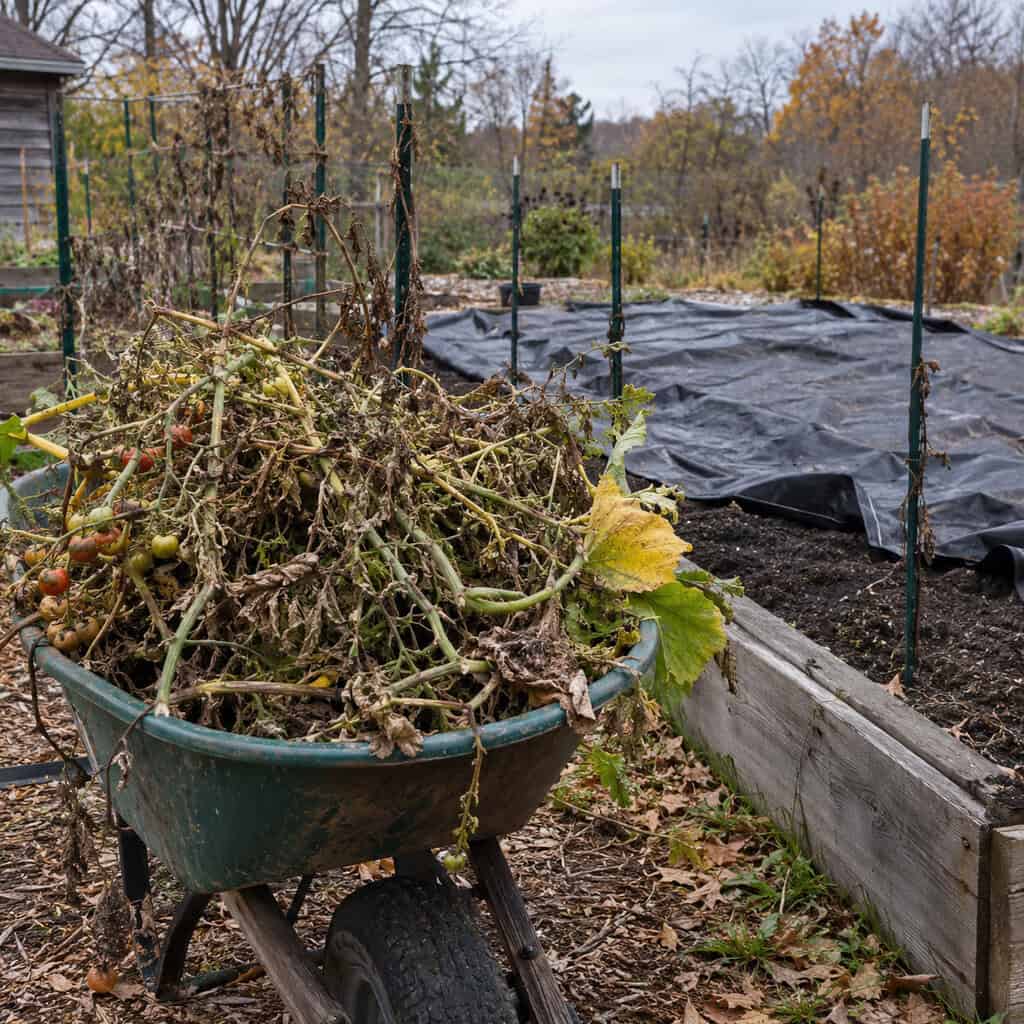
The fall till is a habit inherited from people who were farming, not gardening.
Turning soil shreds fungal networks, collapses the pore structure that holds air and water, and lifts thousands of dormant weed seeds up into the light where they’ll happily germinate. Bare tilled ground also erodes all winter.
Tarp it, sheet-mulch it, or sow a cover crop of cereal rye instead.
But the debris comes out, no exceptions. Tomato, squash, cucumber, and pepper vines carry blight, powdery mildew, and squash bug eggs directly into next season — Iowa State University Extension treats this as the central reason fall garden cleanup exists at all.
20. Broadleaf weed control on the lawn
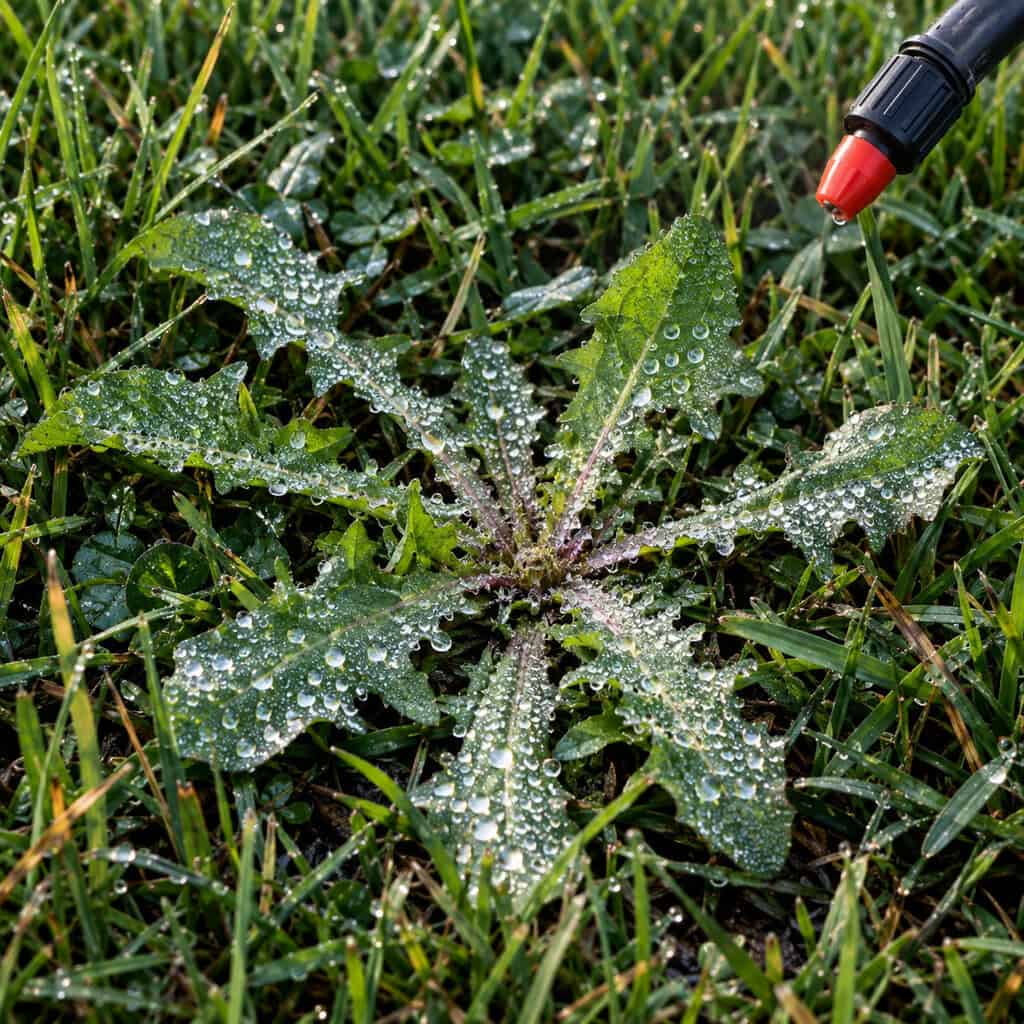
Here’s why a pro’s lawn looks clean in April while everyone else is spraying dandelions in a panic.
In fall, perennial broadleaf weeds reverse their plumbing. Dandelion, clover, plantain, and creeping Charlie stop pushing energy up into leaves and start pulling sugars down into the root and crown to overwinter.
Spray them then and the herbicide rides along on that downward flow, straight into the tissue that would otherwise regrow. The same product at the same rate is dramatically more effective in October than in May.
Mid-September through late October, on a day above 50°F with no frost in the previous 24 hours. Creeping Charlie in particular is almost untouchable in spring and very beatable now.
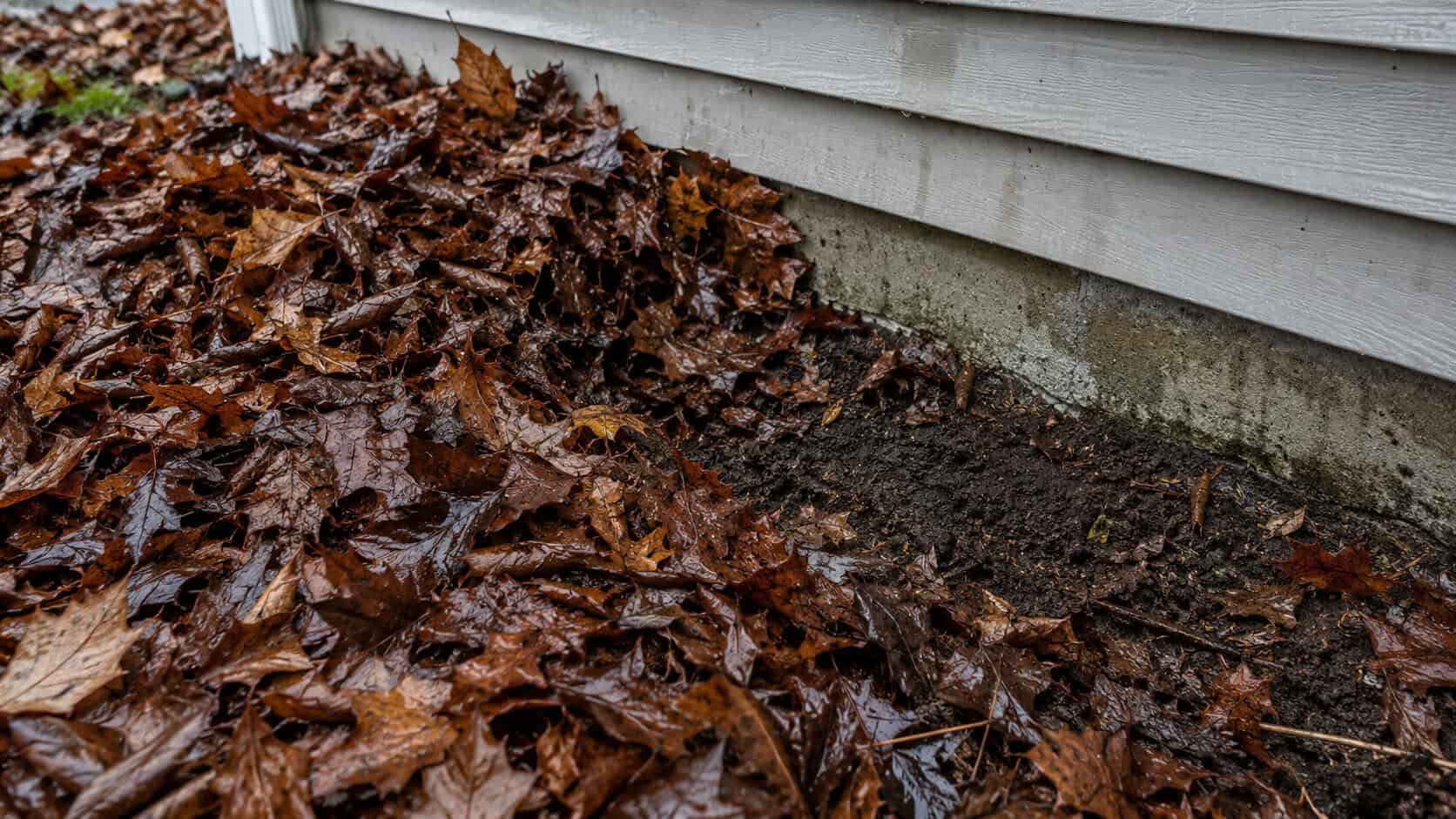
21. Clearing the three-foot zone against the foundation
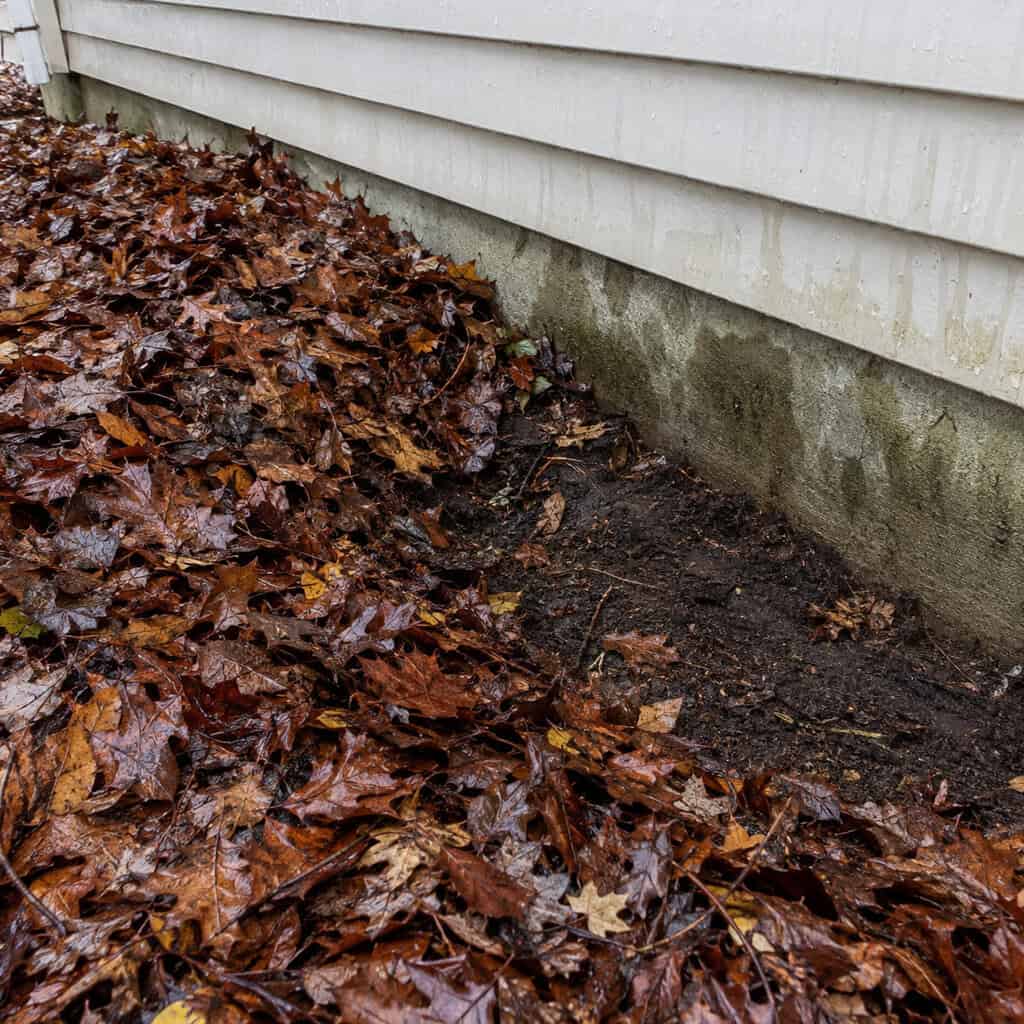
Leaves in the garden beds: good. Leaves packed eighteen inches deep against the siding: an entry ticket.
Pros keep a deliberate clean strip — roughly three feet — all the way around the house, and it’s one of the last jobs they do after the final leaf drop.
Start with moisture. A drift of wet leaves against the wall stays damp for weeks, wicking into the bottom courses of siding and holding humidity against the sill plate and rim joist. That’s the wood that sits directly on the foundation, and it’s the single most common place in a house to find hidden rot and mold — behind insulation, invisible until a remodel opens the wall.
Then pests. A leaf berm is a heated, humid, predator-free corridor pressed right against your house. Mice use it to reach the gaps where the siding meets the foundation, and a mouse needs an opening about the diameter of a dime. Ticks overwinter in leaf litter and are one of the reasons deer ticks show up on a dog that never left the yard. Carpenter ants and termites both want damp wood and a covered approach — the leaf pile provides both.
Clearing it takes ten minutes with a blower. While you’re down there, check a few things:
- Soil or mulch stacked higher than the bottom edge of the siding
- Gaps where the dryer vent or hose bib penetrates the wall
- Shrubs planted tight enough to touch the house
- Damp or soft spots on the rim joist, checked from inside the basement
Rake the leaves you pull out of that strip straight into the beds four feet away. Same leaves, completely different outcome.
22. Blowing leaves into the street, the creek, or a burn pile
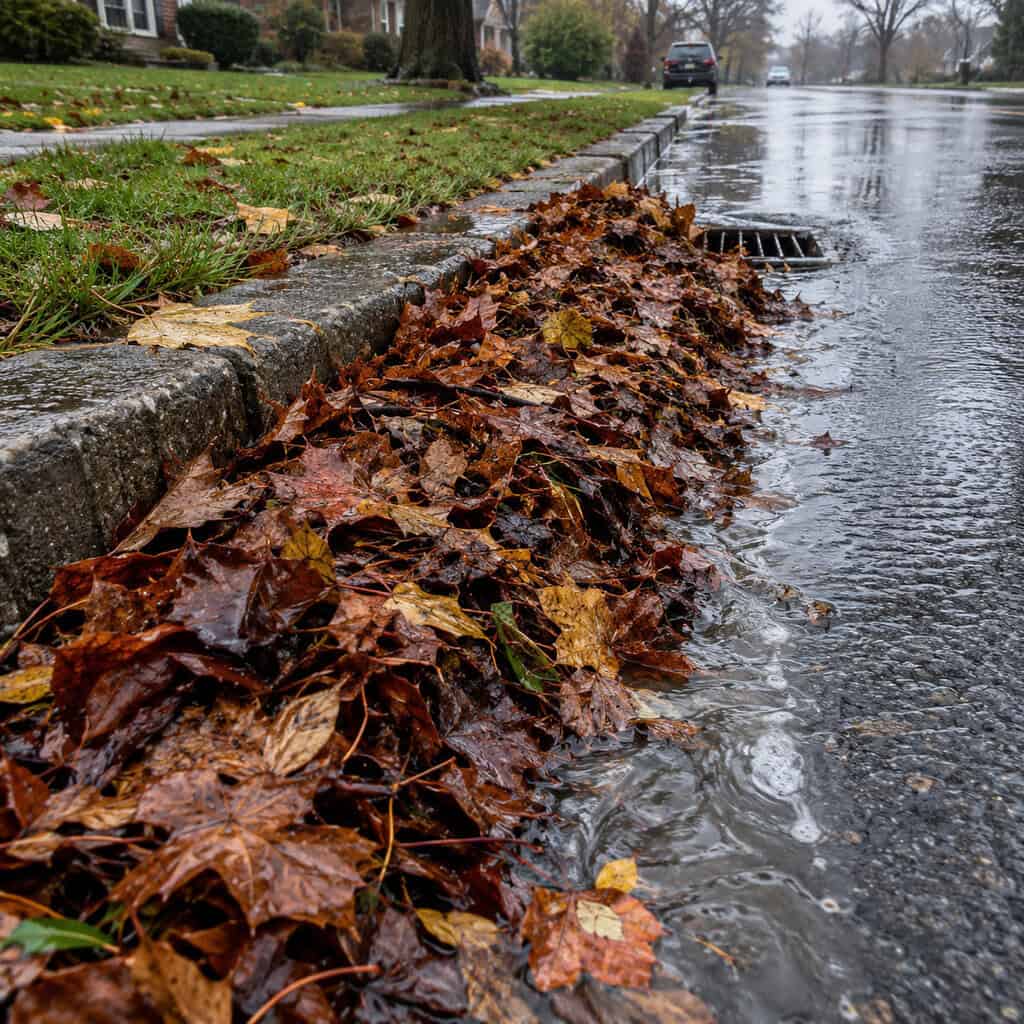
Three disposal methods, three different problems.
Leaves piled in the street wash into storm drains, and decomposing leaf litter is a significant phosphorus source in urban watersheds — research in Wisconsin found street leaf removal alone cut phosphorus in stormwater runoff by a large margin. That phosphorus feeds algae blooms downstream.
Dumping them in a creek or ravine does the same thing faster, plus it smothers streambank vegetation.
And burning is illegal in a growing number of municipalities, throws fine particulate that’s genuinely rough on asthmatic neighbors, and a smoldering pile against a wooden fence is how a Saturday ends with a fire truck.
Skip all three. The leaves have better work to do on your own property.
23. Deep-watering the evergreens (and burlapping the road side)
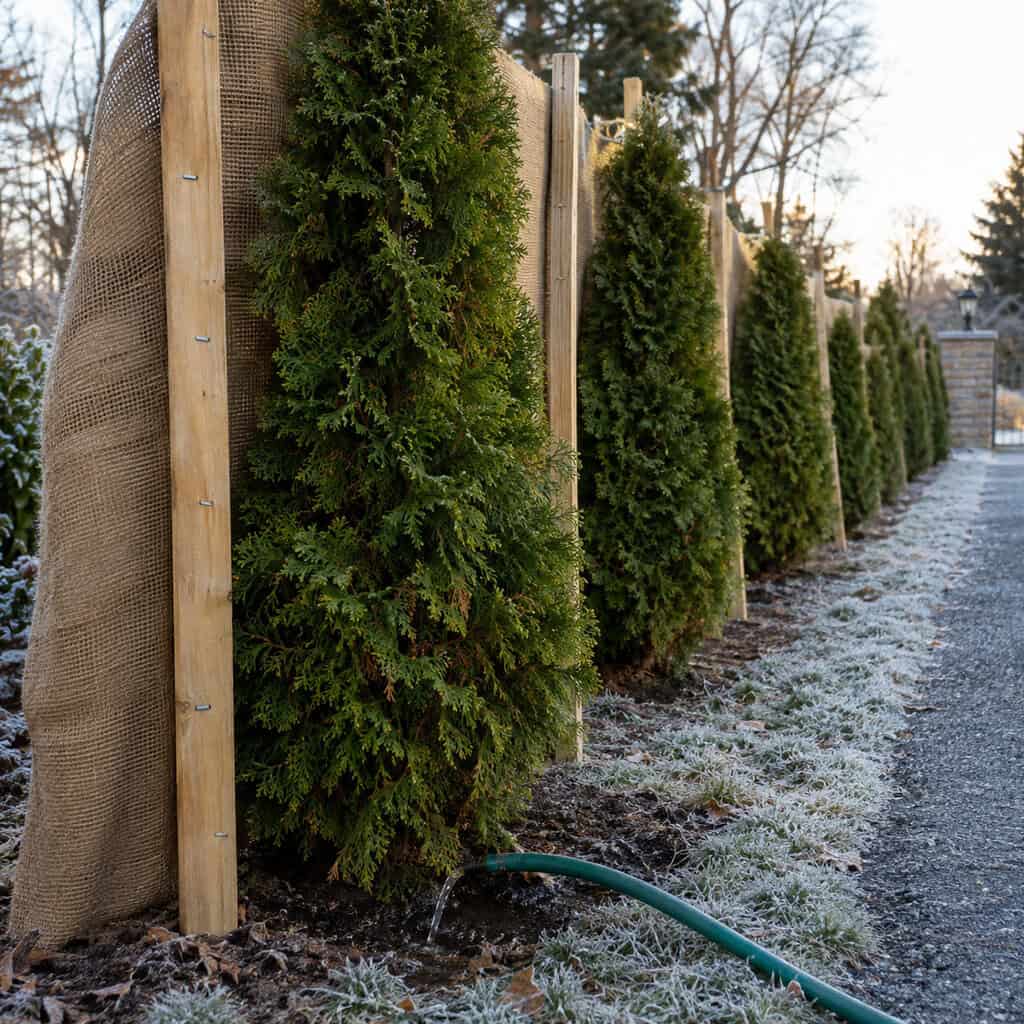
Most of what people call winter kill on arborvitae, boxwood, and holly isn’t cold damage at all.
It’s desiccation. Evergreen foliage keeps transpiring on bright, windy winter days while the roots sit in frozen soil and can’t resupply. The plant dries out from the top down.
One long, slow soak in November — a hose trickling at the root zone for an hour per shrub — gives it a full tank going in.
For anything along a road or driveway, staple burlap to stakes on the salt-spray side. Don’t wrap the plant tight; build a screen an inch or two off the foliage. The brown side of an arborvitae never fills back in.
24. Scraping egg masses off trunks, fences, and furniture
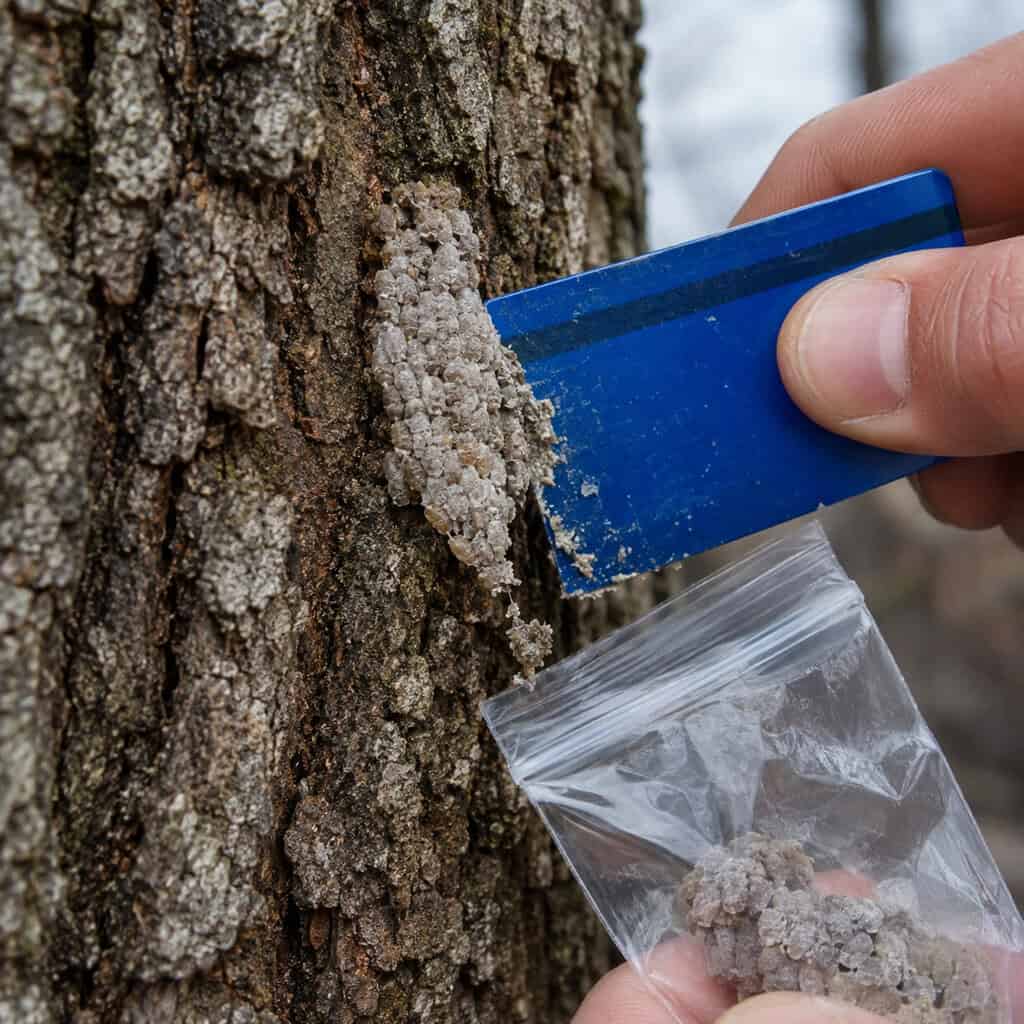
The cheapest pest control available all year takes place in November with a plastic card and a ziplock bag.
Fall is when overwintering egg masses are laid, visible, and completely defenseless. Nothing hatches for months. Everything you destroy now is an insect that simply never exists.
Spotted lanternfly masses look like a smear of grayish putty or dried mud, roughly an inch long, and a single one holds 30 to 50 eggs. They go on tree trunks — especially tree of heaven and black walnut — but also on fence posts, grill covers, patio furniture, firewood stacks, wheel wells, and the underside of anything flat. Scrape them into a bag with hand sanitizer or alcohol, seal it, and throw it out. Smashing works too, but smearing them on the bark doesn’t kill the eggs underneath.
Bagworms are the brown, cone-shaped, quarter-to-two-inch bags hanging off arborvitae, juniper, and spruce, and they’re often mistaken for cones. Each one can hold 500 to 1,000 eggs. Clip and bag them.
Eastern tent caterpillar egg masses show up as a hard, shiny black band wrapped completely around a pencil-thin twig on cherry, crabapple, and apple. Prune the twig, toss it.
Gypsy moth — spongy moth — masses are tan, fuzzy patches on trunks, under eaves, and inside firewood stacks.
Twenty minutes of scraping beats any spray you’d buy in June, and it costs nothing.
25. Re-cutting crisp bed edges
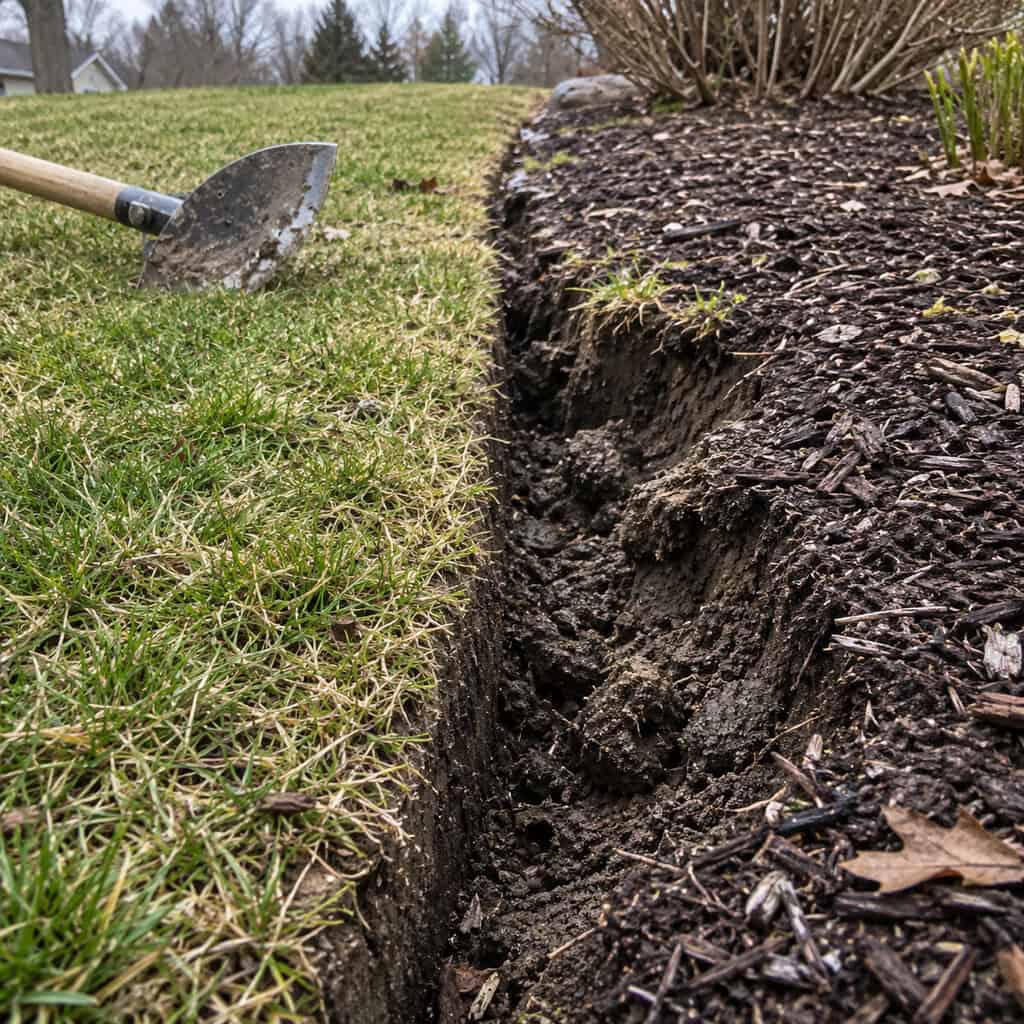
That knife-edge trench between lawn and bed is the detail that sells a fall cleanup. It’s also gone by March.
Freeze-thaw heaves the soil wall, slumps the shoulder, and washes the trench half full. You’ll be re-cutting it in spring no matter what you do now.
So pros cut edges once a year, in spring, when the work actually holds through a season.
Two hours saved on a task that expires in eight weeks.
26. Pulling a soil test (and liming if it calls for it)
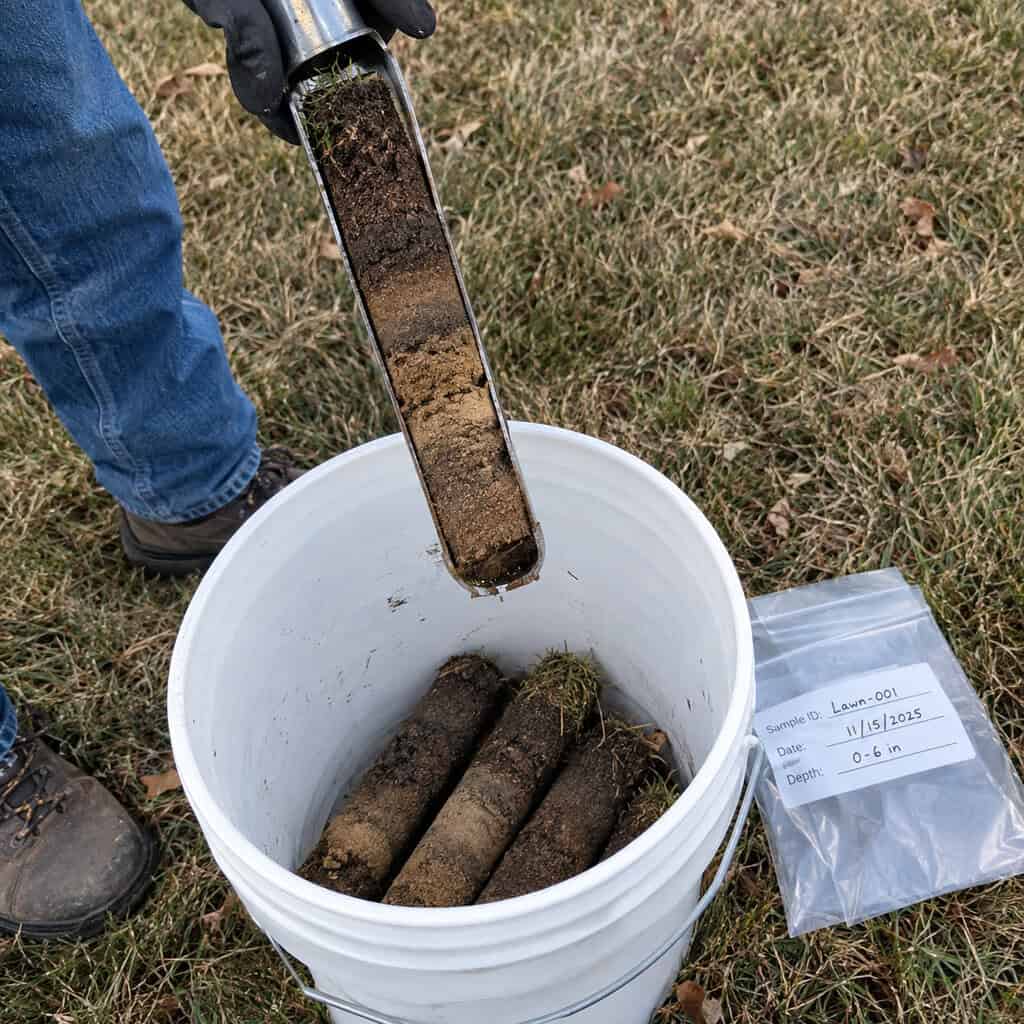
Extension labs are jammed in April and wide open in November. Same test, faster turnaround.
Fall is also the right time agronomically. Lime is slow — pelletized or not, it needs months of moisture and freeze-thaw action to move through the soil profile and actually shift pH before the spring feeding.
And pH is the gate on everything else. Below about 5.5, a cool-season lawn can’t take up a meaningful share of the nitrogen and phosphorus you’re applying, which means years of fertilizer running past a lawn that physically can’t use it.
A test runs $15 to $25 in most states. Guessing at lime costs a lot more than that.
27. Lifting dahlias, cannas, elephant ears, and gladiolus

In zone 7 and colder, these are annuals whether you like it or not — unless you dig them.
Wait for the first frost that blackens the foliage, then cut stalks to four inches and lift the clumps with a fork, well outside the crown. Knock off loose soil but don’t scrub dahlias clean.
Cure them about a week somewhere dry and frost-free, then pack in barely damp peat, vermiculite, or wood shavings at 40 to 50°F.
Twenty minutes of digging. A few hundred dollars of tubers you don’t rebuy in May.
28. Dethatching in the fall
Power raking looks dramatic and produces satisfying piles. It’s also a spring or early-summer job, done in fall for no good reason.
A dethatcher tears the turf open at the exact moment the grass has no growing season left to knit back together. You spend winter with a wounded, thinned lawn.
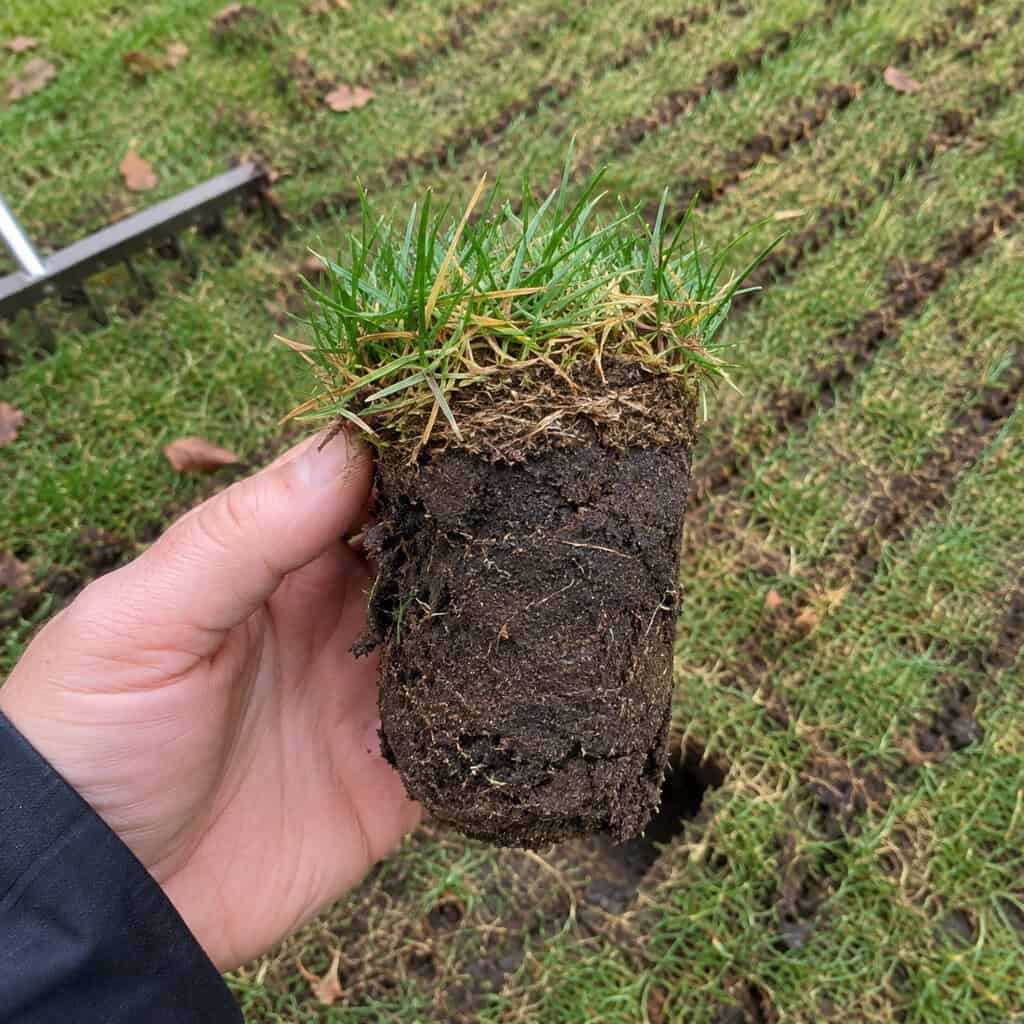
And most lawns diagnosed as thatchy aren’t. Pull a plug — if the spongy organic layer between green blades and soil is under half an inch, you don’t have a thatch problem, you have compaction.
Core aeration fixes compaction and gradually reduces real thatch without shredding crowns. Use that instead.
29. The last mow, cut a notch shorter
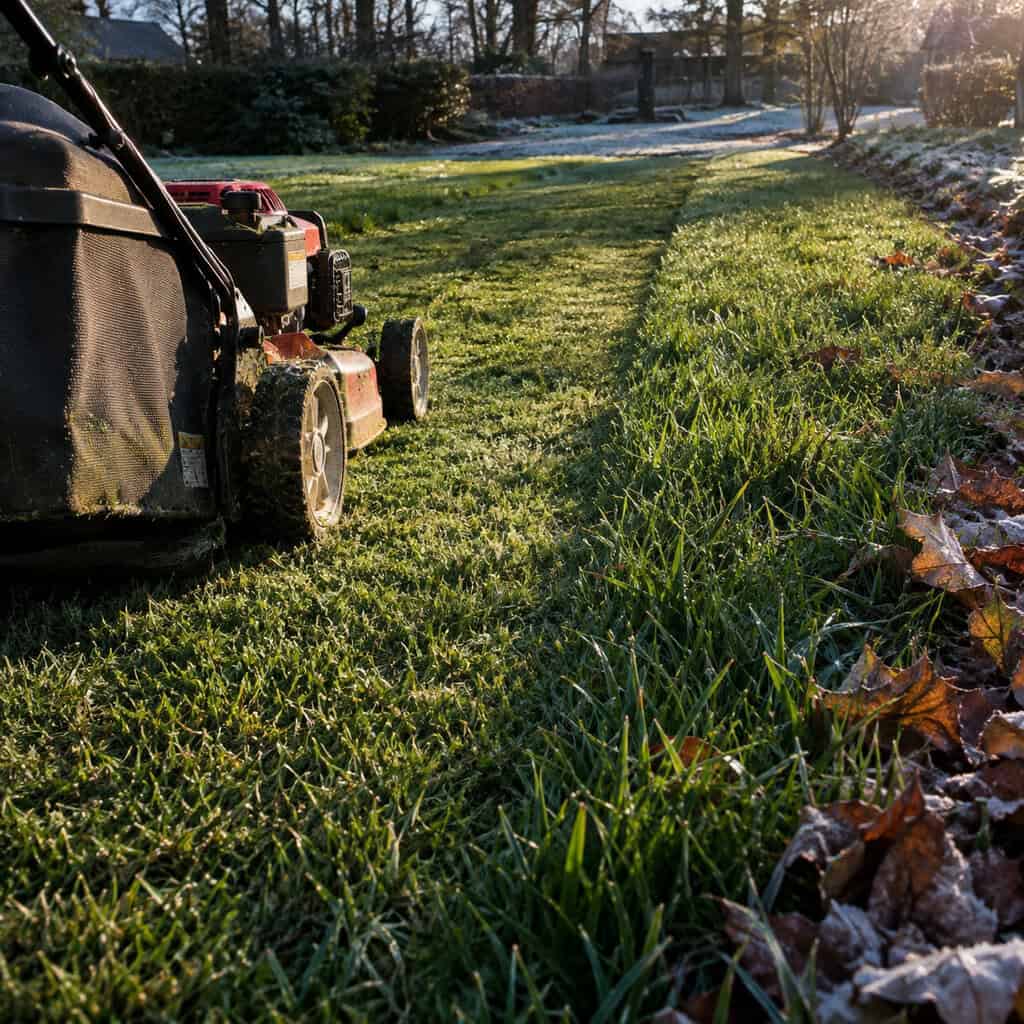
Tall grass going into winter lies down under the first heavy snow and forms a wet, matted blanket.
That blanket is ideal habitat for gray and pink snow mold, which shows up as matted straw-colored patches the day the snow melts. Iowa State Extension ties the severity directly to turf height going into snow cover. It’s also a covered highway system for voles.
So the final cuts come down gradually — drop a notch on each of the last two or three mows until you finish around 2 to 2.5 inches for most cool-season lawns.
Gradually is the key word. A one-pass scalp in November strips the plant’s food factory right before it needs stored energy most.
30. Winterizing the mower — and evicting whatever moved into it

The number one reason a mower won’t start in April isn’t the carburetor. It’s a mouse.
A warm, dry air filter housing is prime real estate, and once they’re in, they shred the filter for bedding and chew insulation off the wire harness. Repair shops see it every single spring.
The ritual: run the tank dry or fill it and add stabilizer, pull and sharpen the blade, scrape the deck clean of packed clippings, change the oil, pull the plug and check it.
Then stuff coarse steel wool loosely in the exhaust outlet and cover the air intake. Set a couple of snap traps nearby. Store the machine off a concrete floor if you can.
Twenty minutes in November against a two-week shop backlog in spring.
31. Dormant seeding the thin spots
This is the pro move for anyone who blew the September overseeding window — and plenty do.
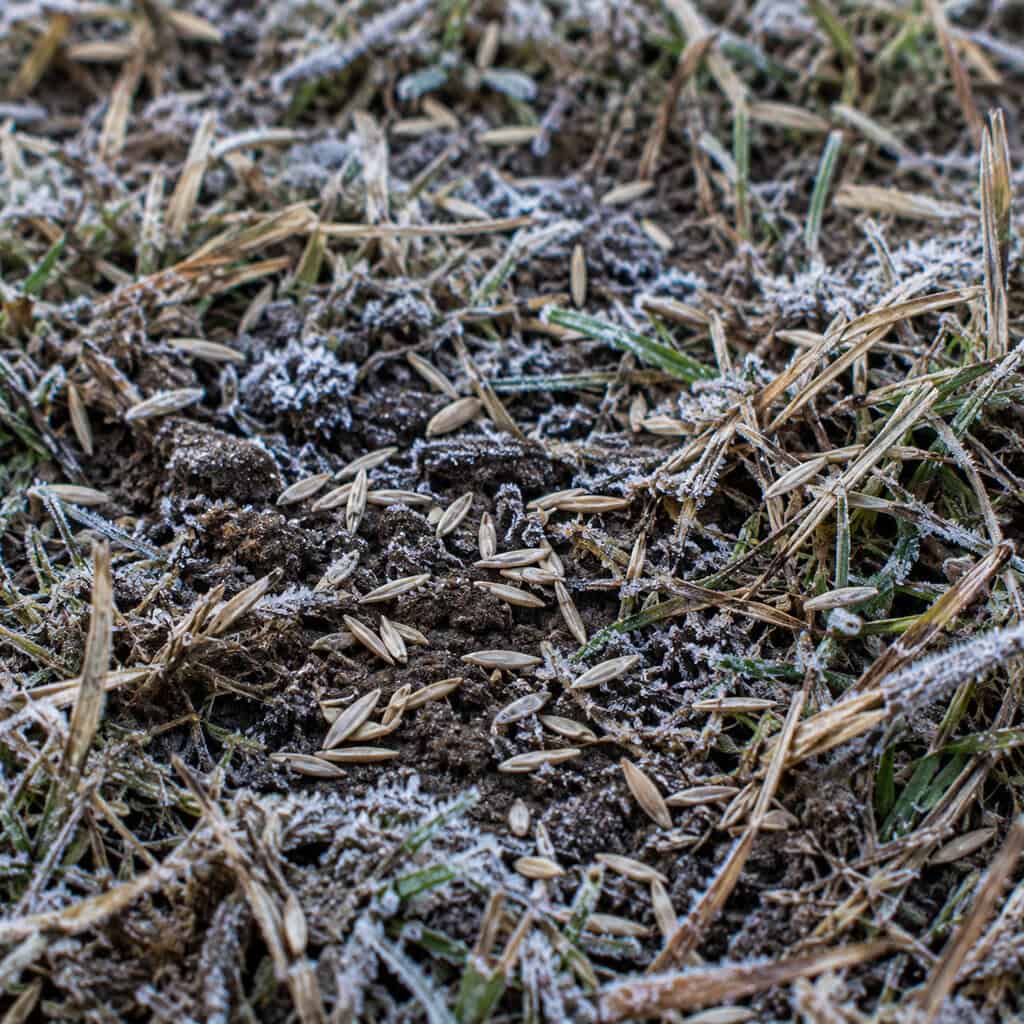
Late November into early December, once soil temperature is consistently below 50°F, broadcast seed onto the thin areas. It won’t germinate. That’s the entire point.
The seed sits through winter while freeze-thaw cycles open and close tiny fissures in the soil, working it down into the contact it needs. When soil warms in late March, it’s already positioned and germinates ahead of anything you could sow by hand.
Rake lightly for contact, use a higher rate to account for losses, and don’t apply spring pre-emergent over those areas.
It’s why a pro’s lawn fills in two weeks before the neighbor even starts thinking about reseeding.
32. The leaf pile they build instead
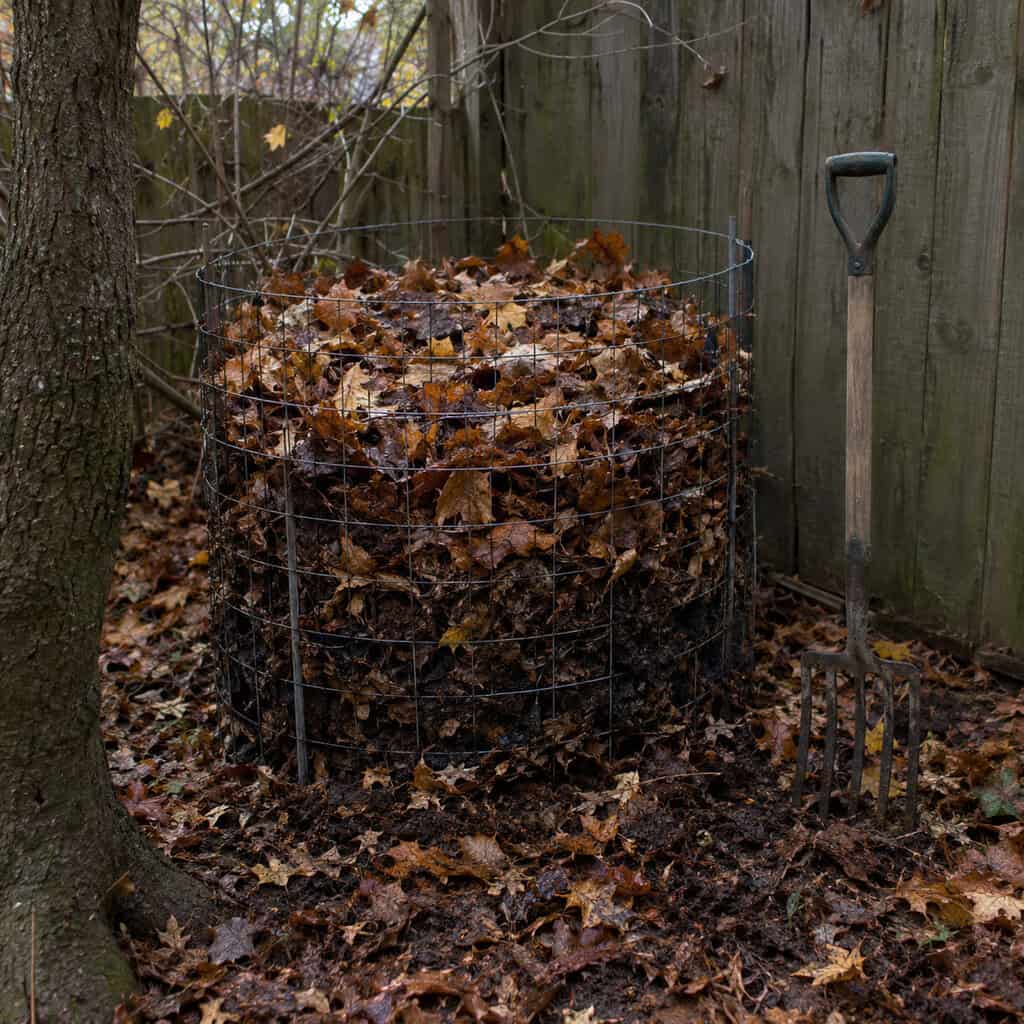
Back corner of the yard, behind the shed, out of the sight lines. A four-foot ring of welded wire fencing, filled with every leaf that didn’t get mulched into the lawn.
Nothing else. No turning, no layering, no additives.
In twelve to eighteen months that pile becomes leaf mold — dark, crumbly, spongy stuff that holds several times its weight in water and outperforms anything sold in a plastic bag. Colorado State University Extension covers the process in its composting notes, and the process is mostly patience.
Meanwhile it’s full of life. Firefly larvae spend up to two years in damp leaf litter before they ever glow. Luna and swallowtail pupae, bumblebee queens, toads, ground beetles — all of them overwinter in exactly this.
It’s the only cleanup job that leaves you with more than you started with.
33. Sealing the deck or fence in late fall
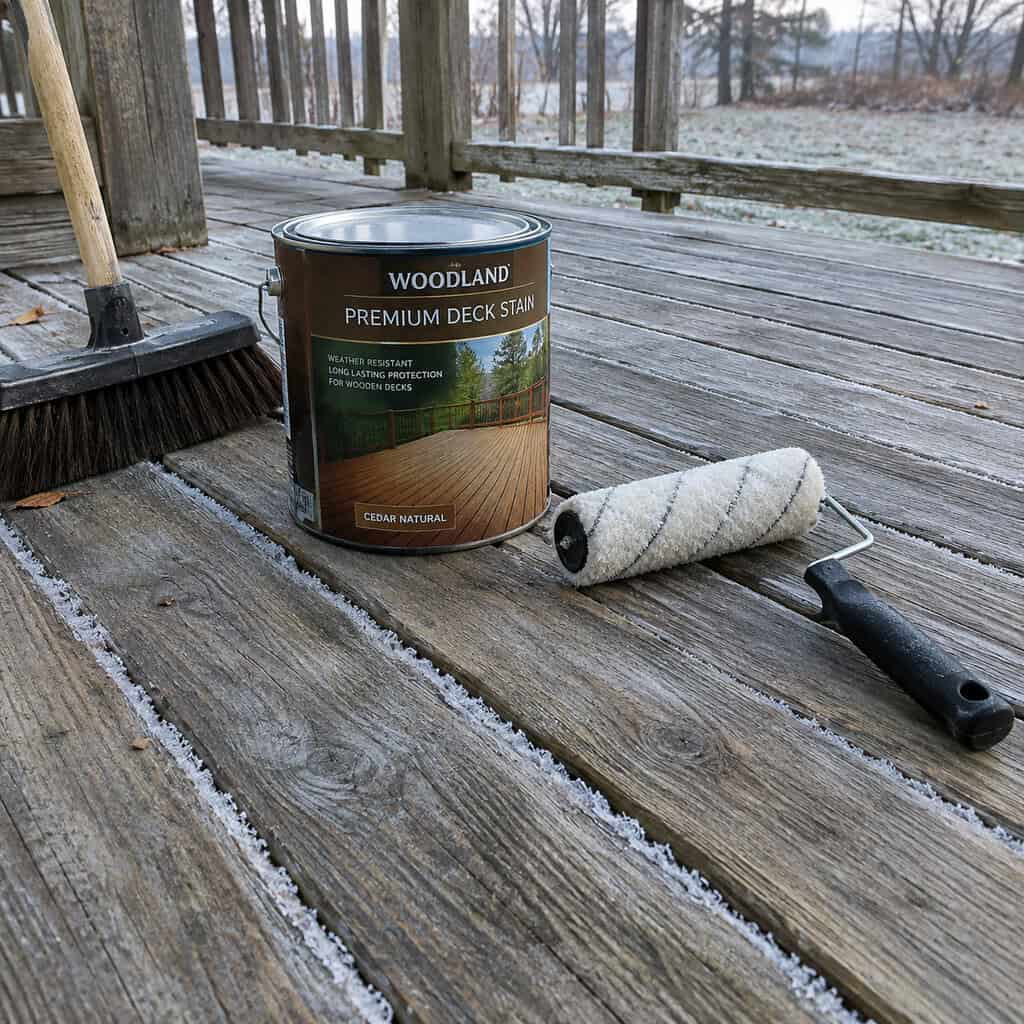
Every October somebody buys a five-gallon pail of deck stain because the yard finally looks clean and the deck suddenly looks terrible by comparison.
Check the can. Most film-forming and oil-based sealers specify application above 50°F with overnight lows staying above 40, and many need 24 to 48 hours of that range to cure.
Apply below it and the finish doesn’t bond. You get a milky haze, a tacky surface that traps dirt, and peeling sheets by March — plus the miserable job of stripping it all off before you can do it right.
Skip it. Sweep the deck, clear the leaves out of the gaps between boards so they don’t rot the joists underneath, and put seal on the May list.
Almost none of this is harder than what most people already do every fall. It’s just aimed differently.
The raking, the shearing, the trenched edges, the fresh mulch — that’s effort spent on how a yard looks from the road in the third week of October. The gutters, the spigots, the egg masses, the seed on frozen ground — that’s effort spent on what the yard does in April.
Pros know which column the paycheck comes from, and which column they’d rather live in.
Do less this fall. Just do the right less.