


The generator sat under a tarp for three years. Then the ice storm hit, and it wouldn’t start.
That story repeats itself every winter in driveways across the country. Stale fuel, gummed carburetor, a pull cord yanked until a shoulder gives out.
Something quieter has been replacing those machines. Big lithium boxes with outlets on the front, sitting in hallway closets instead of sheds.
Five years ago they were toys for van-lifers. The chemistry changed, the prices collapsed, and suddenly the math stopped favoring gasoline for most households.
Here are 24 reasons homeowners are making the switch — including a few nobody mentions until after they’ve bought one.
1. You Can’t Poison Your Family With a Battery

This is the one that ends most arguments.
Portable generators kill roughly 80 people a year in the United States through carbon monoxide poisoning, and the deaths cluster in ordinary houses, not remote job sites. The Consumer Product Safety Commission has tracked the pattern for decades and it barely changes from year to year.
The circumstances are almost always the same. Someone put the generator in an attached garage with the door open. Someone set it on a covered porch during rain. Someone parked it six feet from a bedroom window because the extension cord wouldn’t reach any farther.
A single portable generator can produce as much carbon monoxide as hundreds of idling cars. That’s not a slow buildup you notice and walk away from — in an enclosed space it can reach lethal concentrations in minutes, and the early symptoms read exactly like the flu you’d expect after a cold night without heat.
Headache. Dizziness. Nausea. People lie down.
Then there’s the timing problem. CO incidents spike during exactly the events that make people buy generators in the first place — hurricanes, ice storms, multi-day blackouts — when houses are sealed tight against the cold and nobody’s thinking clearly at hour thirty of no power.
A lithium power station has no engine, no exhaust, no combustion of any kind. It can run on the kitchen counter next to the coffee maker while a toddler sleeps upstairs.
No detector required. No twenty-foot rule to remember at 3 a.m. in a sleet storm.
For a lot of families, that alone closed the case.

⭐ Full Disclosure: I Own This One
I have this exact unit at home. No exhaust, no fumes, no twenty-foot rule — it runs right inside the house, silently, and it has never blinked at a compressor start. If safety is what’s pushing you off gas, this is the one I’d tell a friend to buy without thinking twice.
Affiliate link. We earn a small commission if you buy through it, and the price you pay is the same.
2. The 2 A.M. Silence Test

Mid-size portable generators run somewhere between 75 and 85 dBA at working distance. That’s a gas lawn mower, parked outside your neighbor’s bedroom, for eleven hours.
Plenty of municipalities cap property-line noise around 65 dB during the day and 55 dB at night. An engine running through a blackout blows past both numbers easily.
A power station makes a soft fan hum under heavy load and nothing at all under light load.
Ask anyone who’s spent an outage in a neighborhood where four generators were running. The relief isn’t the lights. It’s the quiet.
3. It Starts on the First Try After Sitting All Year

Gasoline starts breaking down in about thirty days. Generac’s own storage guidance tells owners to drain the tank and run the carburetor dry if the unit will sit longer than a month.
Nobody does this.
So the machine sits eleven months with varnish forming in the jets, and then it’s asked to perform on the worst night of the year. Roughly the same story as a leaf blower that won’t start every fall, just with higher stakes.
A power station holds most of its charge for a year on a shelf. You press a button and it works.
4. No More Gas Cans Lined Up in the Garage

Running an engine through a three-day outage means storing 10 to 20 gallons of gasoline somewhere on your property.
Usually that somewhere is the garage. Often within a few feet of the water heater’s pilot light.
Then there’s the rotation schedule — dumping stale fuel into the car every few months so the cans stay fresh, hauling them to the station, spilling some on the concrete.
Switch to a battery and the entire hazmat depot leaves with the engine.
5. The Fridge Never Even Blinks

Most people don’t realize a quality power station can run in UPS mode — grid power passes straight through the unit, and when the grid drops, the battery picks up the load in milliseconds.
The refrigerator doesn’t cycle off. The router stays online. A CPAP keeps running while its owner sleeps through the whole thing.
Compare that with a generator: wake up, find a flashlight, go outside in the weather, start it, run cords, re-plug everything. Fifteen to twenty minutes on a good night.
The freezer has already started warming.
6. Sunlight Is a Fuel You Don’t Have to Buy
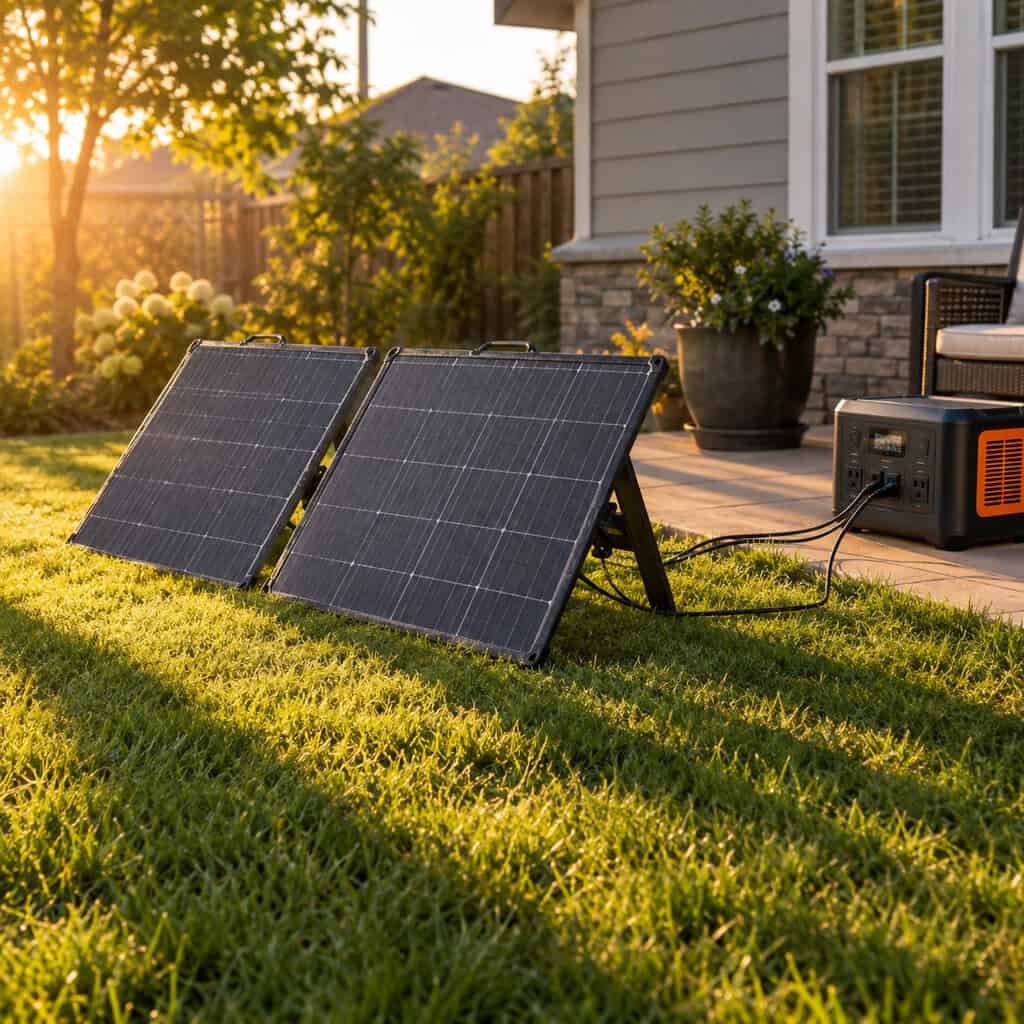
Add a few hundred watts of folding panels and the runtime equation changes shape entirely.
A station that would empty in a day instead recharges partway every afternoon. Three days of outage becomes survivable without leaving the driveway.
No engine on earth refuels itself from the front lawn.
7. No Pre-Storm Gas Station Scramble

Regional outages break the fuel supply along with everything else. Pumps need electricity. Card readers need networks.
What you get is a forty-car line at the one station running on its own generator, cash only, two-can limit, and a sign going up before you reach the front.
Battery owners plugged into a wall outlet two days earlier, while the storm was still a maybe on the forecast.
8. It Grows With You Instead of Being Replaced

Buy a 7,500-watt generator and you own a 7,500-watt generator forever. Outgrow it and you’re buying a second machine.
Stations stack. The Pecron F3000LFP puts out 3,600W from a 3,072Wh pack and expands to 10,752Wh with add-on battery modules.
⭐ Full Disclosure: I Own This One
I have this exact unit at home, and it’s a big part of why I’m comfortable writing this list. It has never blinked at a compressor start, it makes no noise, and it lives indoors where a generator never could. If you’re making the switch, it’s the one I’d tell a friend to buy without thinking twice.
Affiliate link. We earn a small commission if you buy through it, and the price you pay is the same.
That means the unit you bought to keep the fridge cold can become a real multi-day backup system two years later, without replacing the part you already paid for.
9. There Is No Maintenance Calendar

Oil changes. Spark plugs. Air filters. Valve lash. Fuel stabilizer. Monthly exercise runs. Winterizing.
That’s the honest ownership cost of an engine you hope never to use, and it’s the reason so many generators fail on night one.
The power station version of maintenance is keep it charged and don’t store it in a hot car.
10. Clean Power That Won’t Chew Up Electronics

Budget open-frame generators produce electricity that wanders — voltage sags, frequency drift, harmonic distortion well above what sensitive gear wants to see.
Laptops tolerate it. Furnace control boards, smart TVs, and modern appliance circuit boards sometimes don’t, and the damage shows up weeks later as a mystery failure.
Every decent power station is inverter-based by design and outputs pure sine wave power. Frequently cleaner than what comes out of your wall.
11. Your Cordless Mower and Trimmer Now Run Off-Grid
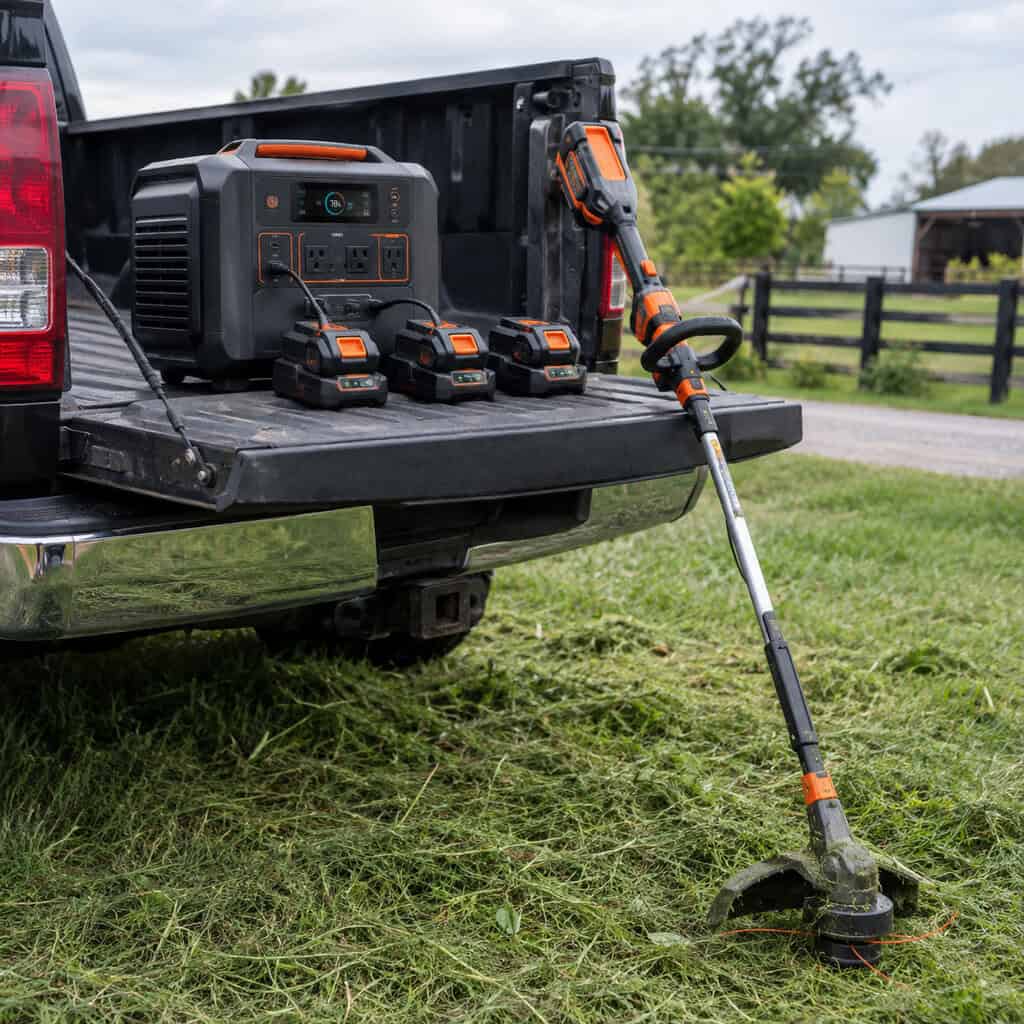
Here’s the use most buyers never planned on and end up relying on weekly.
Set a station on the tailgate and you can cycle mower, blower, trimmer, and chainsaw batteries all day at a property with no service hooked up yet. Same trick on a back patio far from any outlet.
If you’ve moved toward cordless outdoor tools, the charging bottleneck disappears.
Emergency gear that gets used in April is gear that still works in December.
12. Rain, Snow, and Ice Don’t Sideline It
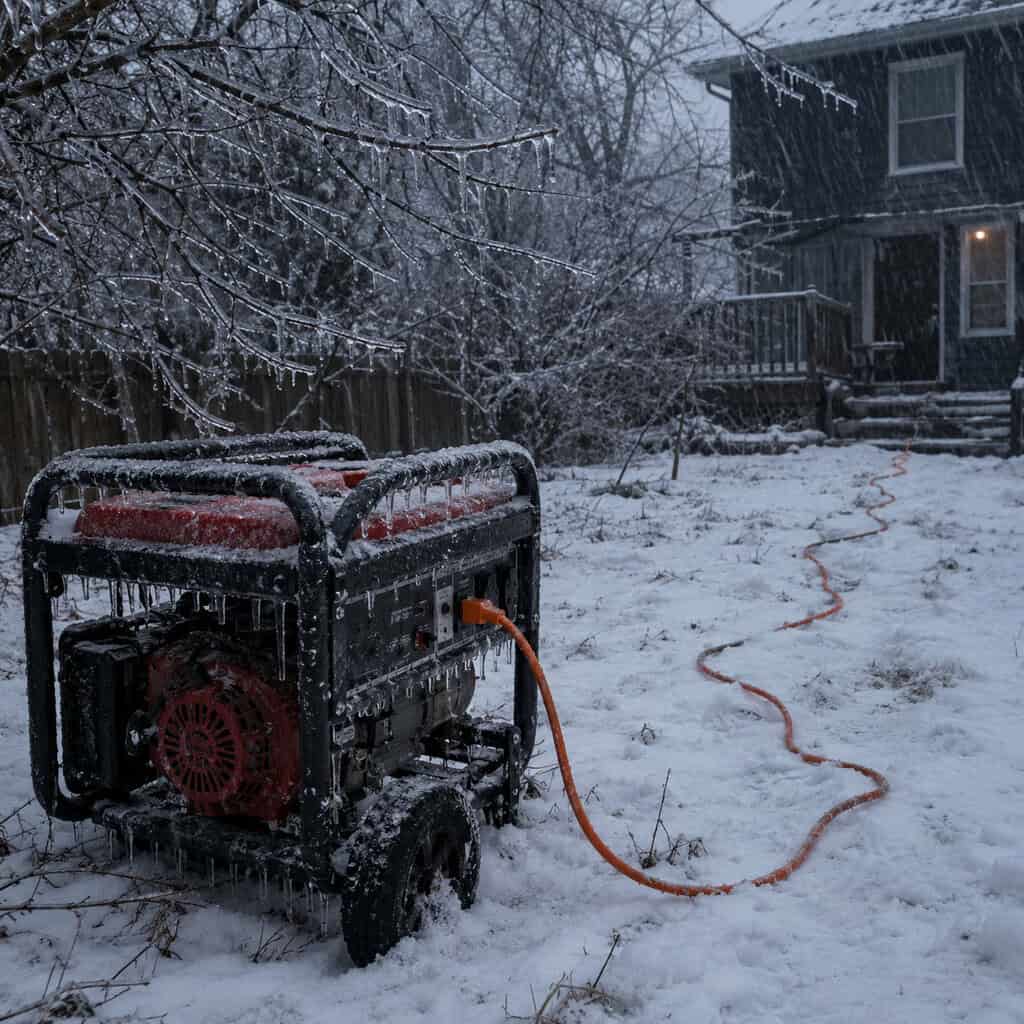
Generators must run outside, in open air, at least twenty feet from the house — and they don’t love getting wet.
So the machine designed for storms has to operate uncovered, in the storm, at the far end of the yard. The CPSC keeps flagging winter incidents that start with someone trying to solve that contradiction with a tarp or a garage door.
A power station sits dry in the hallway doing its job. The weather is irrelevant to it.
13. LiFePO4 Changed the Lifespan Math

This is the technical shift that flipped the whole category, and it happened quietly around 2021.
Older lithium-ion packs gave you 500 to 800 cycles before dropping to 80% capacity. Lithium iron phosphate cells run 3,000 to 4,000-plus.
At one full cycle a week, that’s a decade and change of real service life instead of three or four years.
Any advice you read about power stations before 2020 was written about a fundamentally different product.
14. The Well Pump Gap Is Closing Fast

For years this was the legitimate reason to keep an engine, and pretending otherwise was dishonest.
A 240V submersible well pump doesn’t care about your opinions. A typical 1/2 to 1 HP unit draws 800 to 1,200 running watts but can spike to 2,000 to 4,000 watts on startup, and that surge is what kills undersized inverters.
Two things changed. Surge ratings on high-end stations climbed past 6,000W, and manufacturers started shipping 240V kits that link two units in series to feed a well or a deep-well pressure system directly.
Then there’s the runtime reality nobody does the math on. A well pump doesn’t run continuously — it runs in short bursts to refill a pressure tank. A family of four using 200 gallons a day might put fifteen or twenty minutes of actual pump time on the system.
At roughly 1,000 watts running, that’s well under 500Wh a day. A 3,000Wh station covers several days of flushing toilets, washing hands, and filling pots.
Sump pumps tell an even better story. A 1/3 HP sump draws around 800 watts and cycles maybe a minute at a time during heavy rain, which a battery handles without breathing hard — and critically, it does it automatically while you’re asleep or at work, which a gas generator never will.
Central air is still out of reach for most stations. A well and a sump aren’t.
15. No Scalding Exhaust Where Kids and Pets Play

A running muffler hits temperatures that cause a contact burn instantly. It’s at ankle height, on a deck or patio, during the week the whole family is home and bored.
Refueling makes it worse. Gasoline splashed onto a hot engine is how a backyard fire starts, which is why the instructions say to shut down and wait — and why almost nobody does after hour six of an outage.
A sealed battery box stays at room temperature. The dog can sleep against it.
16. It Refills in About an Hour Before the Storm Lands

Forgot to charge it? Not a crisis anymore.
The Pecron F3000LFP accepts 1,800W of AC fast charging, and up to 3,200W combining AC and solar input — meaning a mostly empty 3kWh pack tops off in roughly an hour and a half.
You can start that when the radar band shows up on your phone.
Try catching up on two years of skipped generator maintenance in ninety minutes.
17. You Can Watch the Battery From the Couch

App control sounds like a gimmick until the second night of an outage.
Wi-Fi and Bluetooth apps show remaining watt-hours, live draw in real time, and estimated runtime at your current load. Turn off the AC outlets and leave USB running, from bed.
Checking a generator’s fuel level means boots, a coat, and a flashlight.
18. Nobody Steals It Off the Lawn

Generator theft during outages is common enough that police departments issue press releases about it every storm season.
Think about what a running generator advertises. It’s outside, unattended, unlit, and it makes a loud continuous noise that tells anyone within two blocks exactly where it is and that it’s currently valuable to someone.
It also rolls. Most portables have wheels and a folding handle, which is a nice feature right up until it becomes a getaway design.
People chain them to porch posts, run cables through the frame, sleep on couches near a window. Some of them lose the unit anyway, mid-outage, along with the extension cords.
A power station lives inside a locked house the entire time it’s working. Nobody outside knows you have one.
Insurance claims for stolen generators are a real line item. There’s no equivalent for a battery in a closet.
19. No Transfer Switch, No Permit, No Electrician

Doing the gas route properly is more expensive than the generator.
Powering circuits — not just extension-cord appliances — requires a manual transfer switch or a breaker interlock kit, installed by a licensed electrician, usually with a permit and an inspection. Budget $500 to $2,000 on top of the machine, more if your panel needs work.
Skip that step and people improvise. The dangerous version is a double-male “suicide cord” plugged into a dryer outlet, which energizes the panel and backfeeds power onto the utility line outside.
That line is what a lineman is holding while trying to restore your neighborhood. Backfeed has killed utility workers, and it can also fry your own appliances the second the grid comes back and the two sources fight each other.
There’s also the ongoing part nobody mentions. Permits, inspections, and in some jurisdictions a noise or setback variance before you can legally run the thing at all.
A power station has zero of this. It arrives in a box, you plug it into a wall outlet, and it’s operational within the hour.
No inspector. No scheduling window. No line crew depending on you doing it right.
20. The Price Gap Basically Evaporated

In 2019, a 3kWh lithium station cost well north of $2,000 and people called it an expensive novelty. Fair enough.
That same capacity now routinely lands under $1,000 during sales, which puts it directly alongside a quality quiet inverter generator — before you add fuel, oil, a transfer switch, and a decade of maintenance.
Once the sticker prices met, the rest of the debate stopped being close.
21. Renters and Apartment Dwellers Finally Get Backup Power

For an enormous number of households, gas generators weren’t a bad option. They were an impossible one.
No yard. No twenty-foot setback from a window. No legal place to store five gallons of gasoline. Most leases ban it outright, and most fire codes agree.
A battery station is the first backup power millions of renters have ever been permitted to own.
22. It Earns Its Keep the Other Fifty-One Weeks

A generator under a tarp is a chore waiting for a disaster to justify it.
A power station goes camping. It runs the tailgate, the string lights over the patio, the projector for backyard movie night, the shop vac in a garage with one working outlet, the space heater in a detached workshop.
By the time the grid fails, the family already knows how it works.
That familiarity is worth more than a spec sheet during hour two of a blackout.
23. You Can Carry It Inside By Yourself

Some honesty here: a 3kWh station weighs 70 to 100 pounds. That is not light, and marketing photos of someone carrying one with two fingers are lying to you.
But the comparison isn’t to a suitcase. It’s to a 250-pound wheeled generator that takes two adults to get down porch steps and never comes indoors at all.
One person can move a station from the closet to the kitchen. Awkwardly, but alone.
24. Wildfire Smoke Days Without Opening a Window

In the West, the outage and the air quality emergency now arrive together. Utilities cut power preemptively during high-wind red flag conditions, and those same winds are pushing smoke.
The response is to seal the house and run air purifiers — which is exactly what you cannot do with a generator, because running one requires an open pathway to outside air.
Air purifiers pull very little power. A single station can keep two of them going for days with the windows shut tight.
None of this means gas engines are finished. A whole-house standby unit tied to natural gas is still the right answer for a big house in an ice-storm state, and a big open-frame portable still wins on a construction site.
But for the ordinary outage — the fridge, the furnace fan, the phones, the router, three days in October — the calculation quietly flipped while most people weren’t looking.
The best backup power is the kind you’ll actually have charged, can actually operate at 2 a.m., and won’t kill anyone in the house.