


Drive through any subdivision built before 2005 and you can date the houses without looking at the houses.
The yards do it for you. A row of green spheres against the brick. A ring of red mulch under a pear tree. One circle of flowers floating in the middle of the grass like an island nobody visits.
None of it looks bad, exactly. It looks like a decision somebody made a long time ago and never revisited.


What’s strange is how little of this is about money. Most of the features that age a yard the hardest were expensive when they went in — the fountain, the vinyl fence, the deck around the pool. And most of the fixes cost less than a weekend of mulch.
Here are 31 things people do to their yards that quietly add twenty years to the whole property.
1. Shrubs Sheared Into Meatballs Across the Front of the House
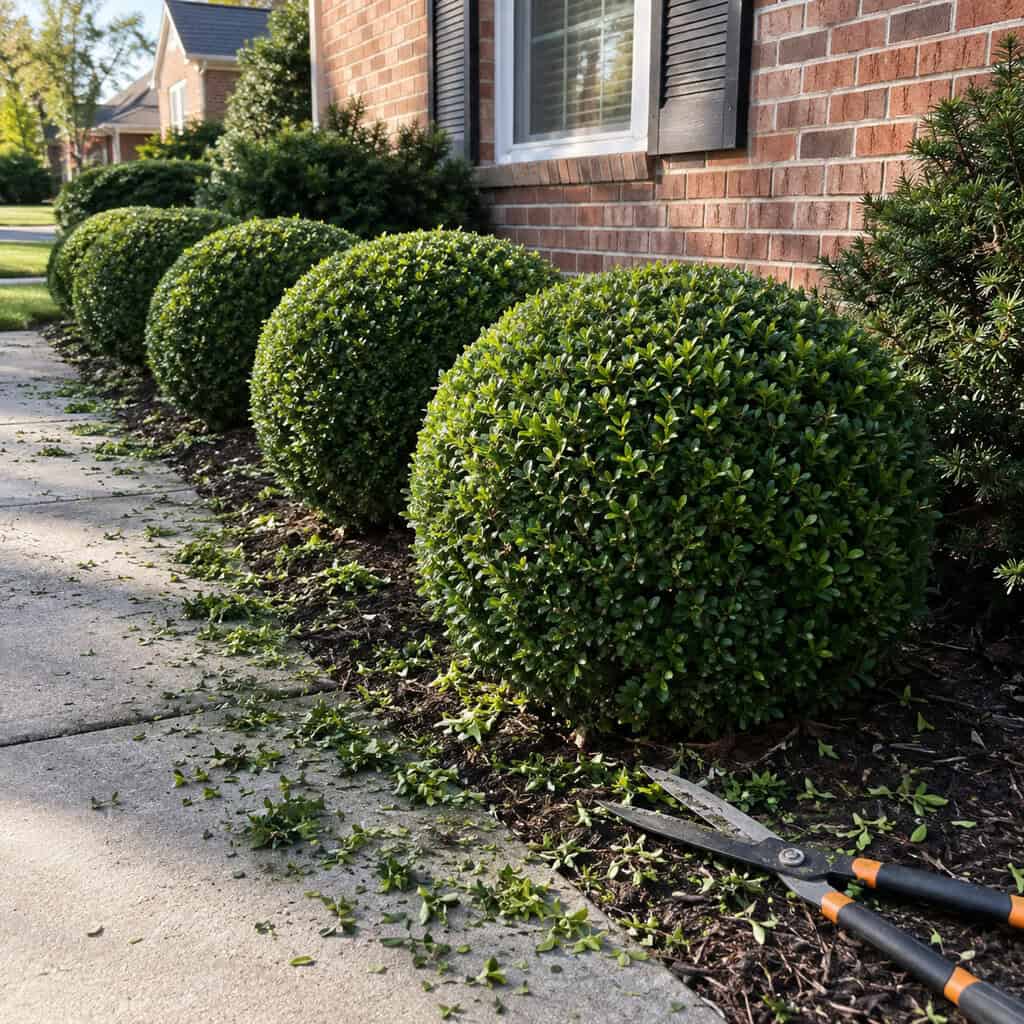
The plants aren’t the problem. The control is.
A crew shows up twice a year with gas hedge shears and turns every yew, boxwood, and holly into the same tight green ball. Clemson’s Home & Garden Information Center points out what that repetition does: shearing forces a dense shell of outer growth, light never reaches the interior, and the inside of the shrub goes bare and woody. Eventually you’ve got a hollow lampshade on a stick.
Cut one open sometime. It’s all dead twigs in there.
Thin instead. Reach inside with hand pruners, take out a few of the oldest stems at the base, and let the shrub keep its own outline. It takes twenty minutes per plant and it stops looking like a parking lot.
2. Bright Red Dyed Mulch, Refreshed Every Spring
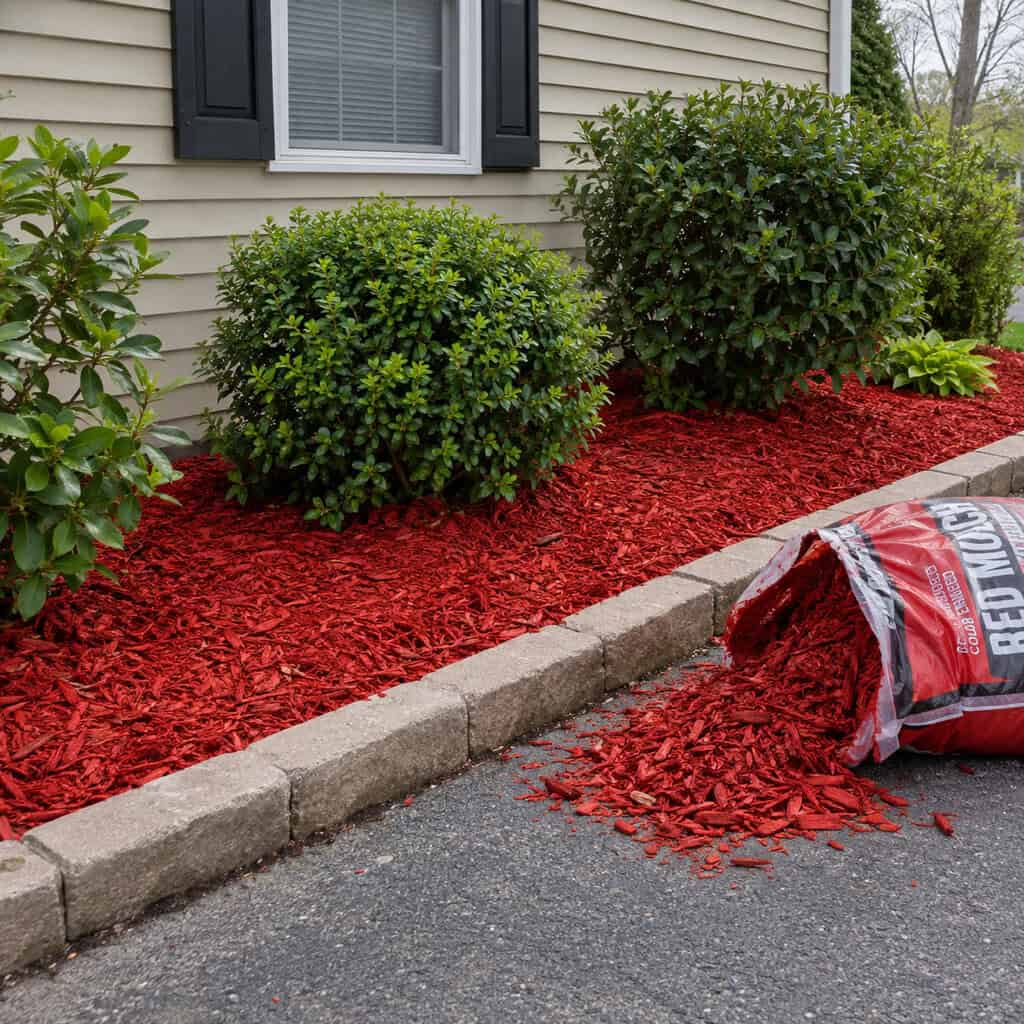
Nothing in a landscape is fire-engine red. Not soil, not bark, not stone.
That’s the whole reason dyed mulch time-stamps a bed so hard — the color exists nowhere in nature, so the eye reads it as a product sitting on top of the garden rather than part of it. Jet black does the same thing from the other direction.
Undyed shredded hardwood or pine bark fades to a soft brown-gray in one season and then disappears behind the plants, which is exactly what mulch is supposed to do.
3. The Perfectly Striped, Chemically Perfect Lawn

For fifty years, an emerald lawn with mower stripes and razor-cut borders meant you had your life together.
That signal has flipped. Designers now read the wall-to-wall monoculture as sterile — a lot of inputs for a surface nobody sits on. British designer Charlotte Harris has put it bluntly that the era of the central lawn ringed by tidy edged borders is finished.
You don’t have to rip out your turf. Shrink it. Keep the part you actually walk on, widen the beds around it, and let something else happen at the edges.
4. Red Lava Rock and White Marble Chip Beds
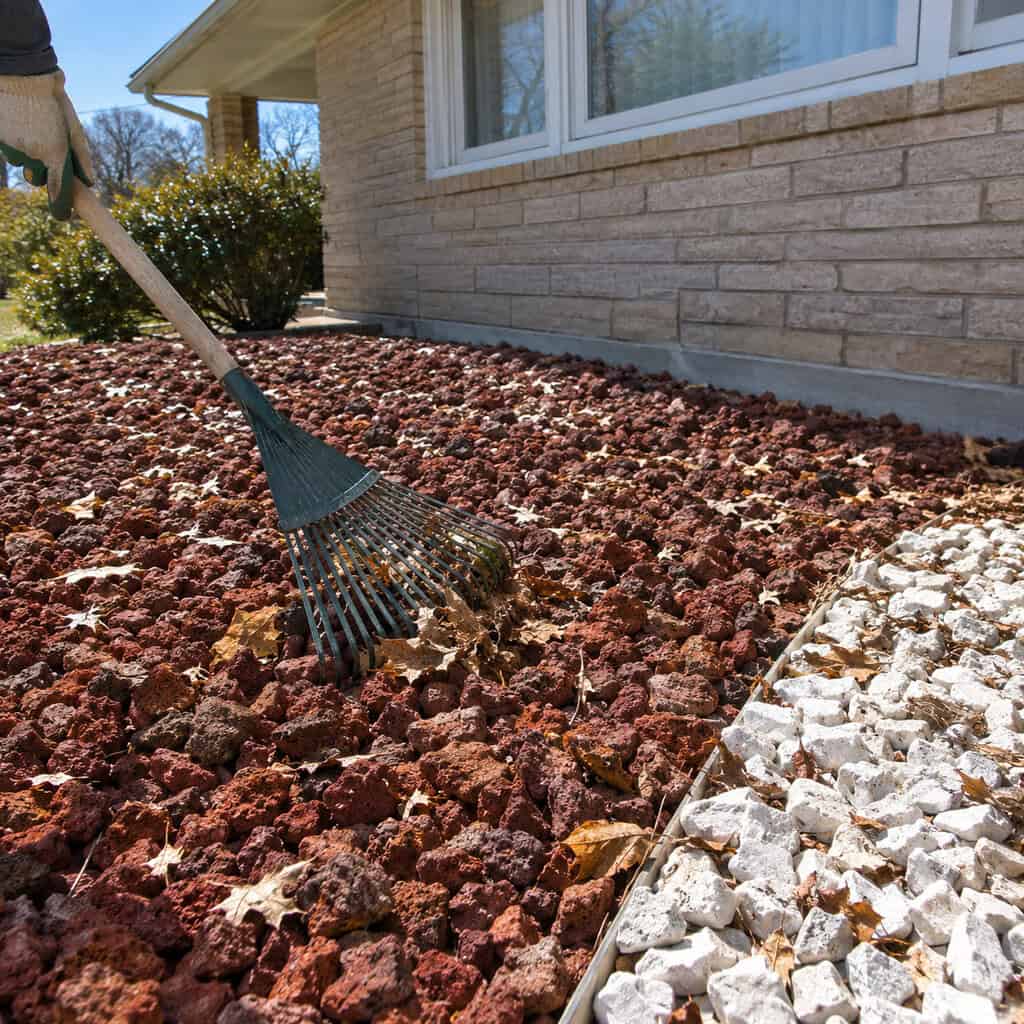
Colored decorative rock was the low-maintenance promise of the ranch-house era, and it kept none of it.
Lava rock bakes. Marble chips glare white for two years, then go dingy and catch every leaf that blows past. Both of them work down into the soil until removal means sifting dirt by hand.
If you’ve ever tried to get old gravel out of a lawn, you know why these beds outlive the people who installed them.
5. Concrete Geese, Gnomes, and a Gazing Ball on a Pedestal

The dressed concrete goose. The mirrored globe on a fluted column. American yard decor has no more recognizable fossils.
Quantity is the tell, not taste. One deliberate object beside a doorway reads as collected. Six of them scattered across open lawn reads as 1987, because that scattered placement is itself the dated part.
Pick your favorite. Give it a spot that makes sense. Retire the rest.
6. Mulch Volcanoes Piled Against Tree Trunks
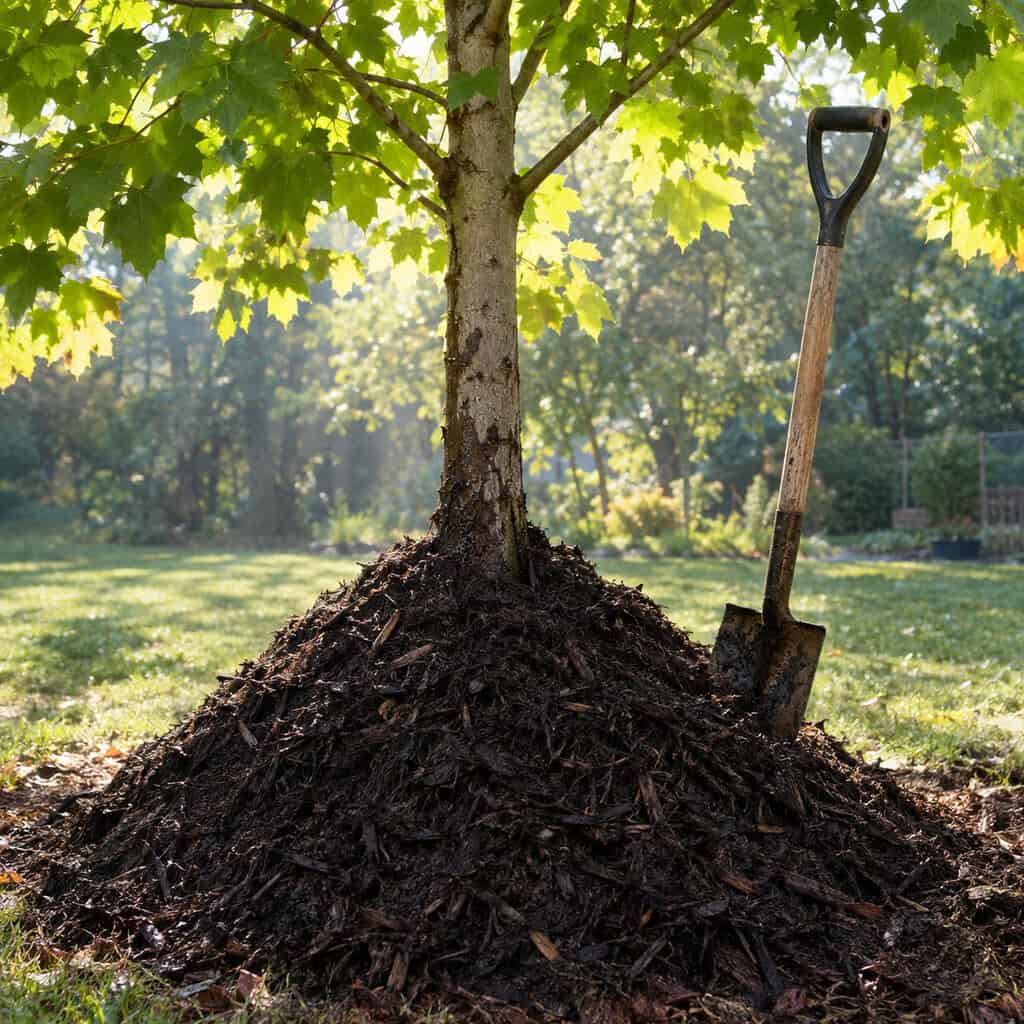
Ohio State Extension calls them exactly what they look like — mulch volcanoes.
Mulch heaped against bark holds moisture where bark was never meant to stay wet, invites decay, and hands voles a covered tunnel right up to the trunk. They chew the cambium through the winter and the tree dies in spring for no visible reason.
It also looks awful. A young tree cone-shaped into the ground looks like it’s sinking.
Flat doughnut, two to three inches deep, bare bark showing in the middle. Pull the pile back this weekend.
7. Chain-Link Fence Around the Front Yard
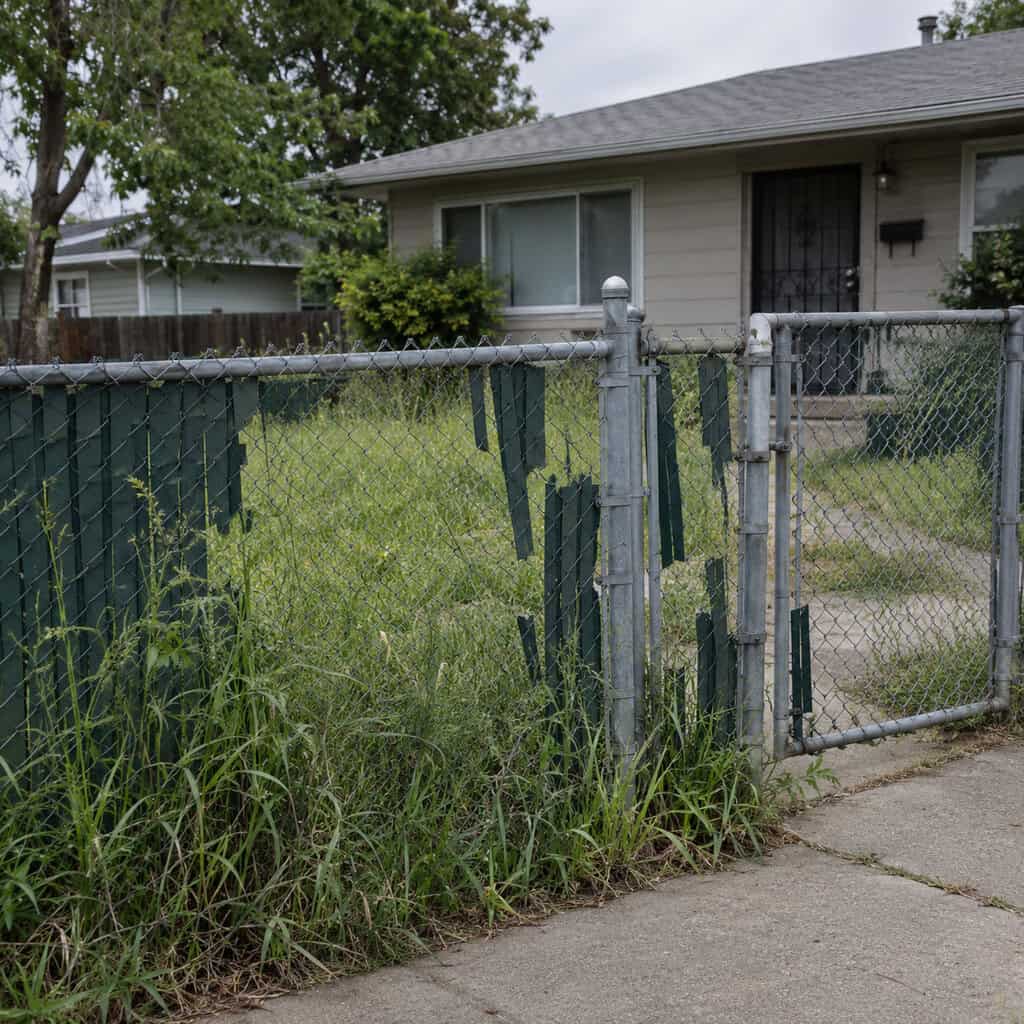
Galvanized chain-link was the affordable postwar fence, and in the front yard it dates a house to a specific decade of subdivision building.
The common fix makes it worse. Plastic privacy slats woven through the mesh add a second dated layer and start snapping off in five years.
Black vinyl-coated mesh visually recedes until you almost stop seeing the fence. A hedge planted a foot in front of it does the same job for less money.
8. One Round Island Bed Floating in the Middle of the Lawn

A circle cut into the turf. A tree in the center, a mulch ring, a skirt of annuals around the edge.
It connects to nothing, and that’s the flaw. Beds that float in open lawn read as add-ons, and they force you to trim a full circle by hand every week.
Current design pulls planting into continuous curving masses that tie the house to the property line. Extend that island toward the nearest bed and the whole yard starts to feel composed.
9. A Bradford Pear as the Front-Yard Specimen Tree
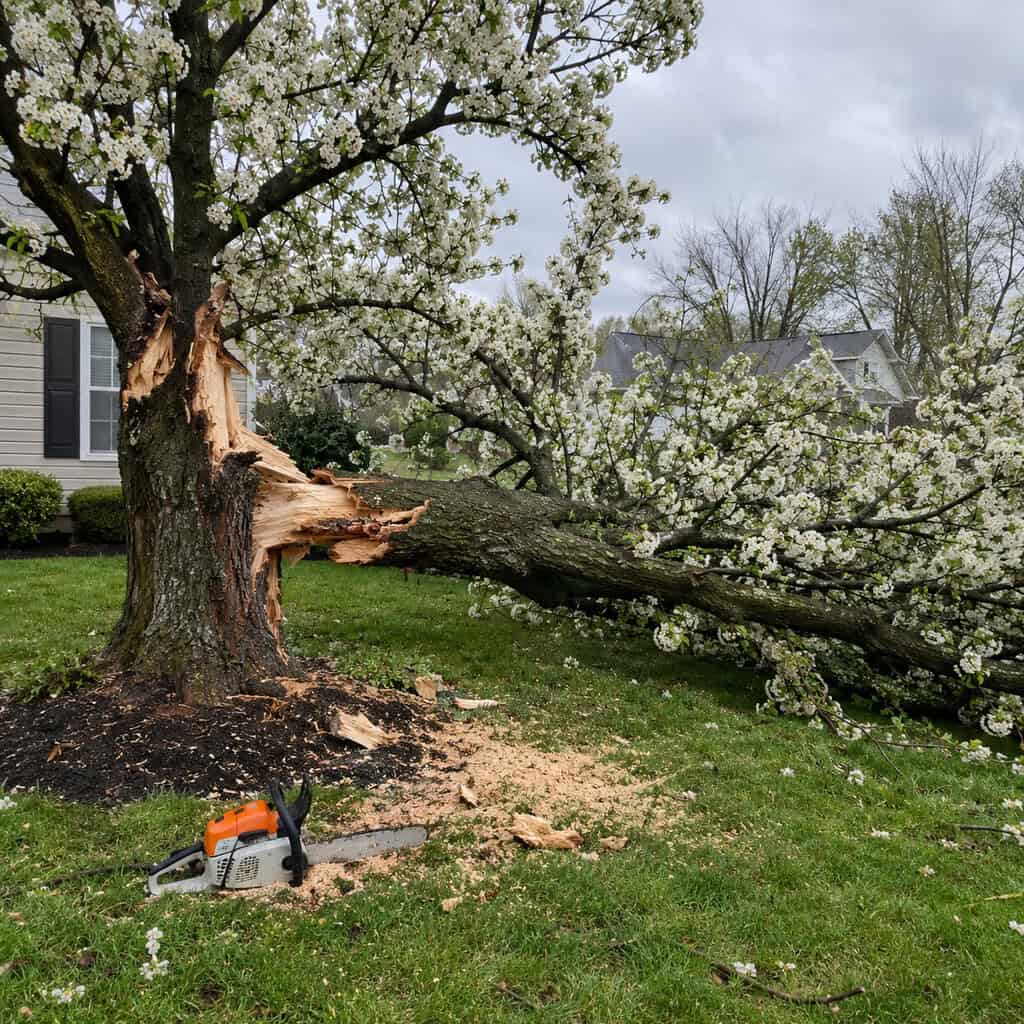
Every street in a late-1980s development got the same tree. Same lollipop shape, same white flowers in March, same faint sour smell if you stood under it.
The Bradford pear was sold as the perfect street tree — fast, tidy, tolerant of bad soil. The flaw took twenty years to show. Its branches all leave the trunk at the same height and at narrow angles, so bark gets pinched between them instead of wood knitting together. Around year 18 to 20, one ice storm or one summer squall splits the whole crown in half down the middle.
Then there’s the invasive problem. Bradfords were supposed to be sterile, but they cross-pollinate with other ornamental pear cultivars and produce fertile fruit that birds spread into fencerows and woodland edges. Ohio banned the sale of callery pear outright, with the rule fully in effect as of January 2023. South Carolina followed with its own nursery ban. Check your own state before you replace one with another pear.
If yours is mature, get an arborist to look at the union of the main limbs. Included bark, seams, or an existing crack means the tree is not a pruning candidate — it’s a removal candidate, and it’s cheaper to take down standing than to clear off a roof. Expect $800 to $2,500 depending on size and access.
Replace it with serviceberry, a good tupelo, a Kentucky coffeetree, or a redbud. None of them will ever look like the neighbor’s.
Before you plant anything, it’s worth knowing what that tree becomes in five years.
10. Scalloped Concrete Edging Blocks
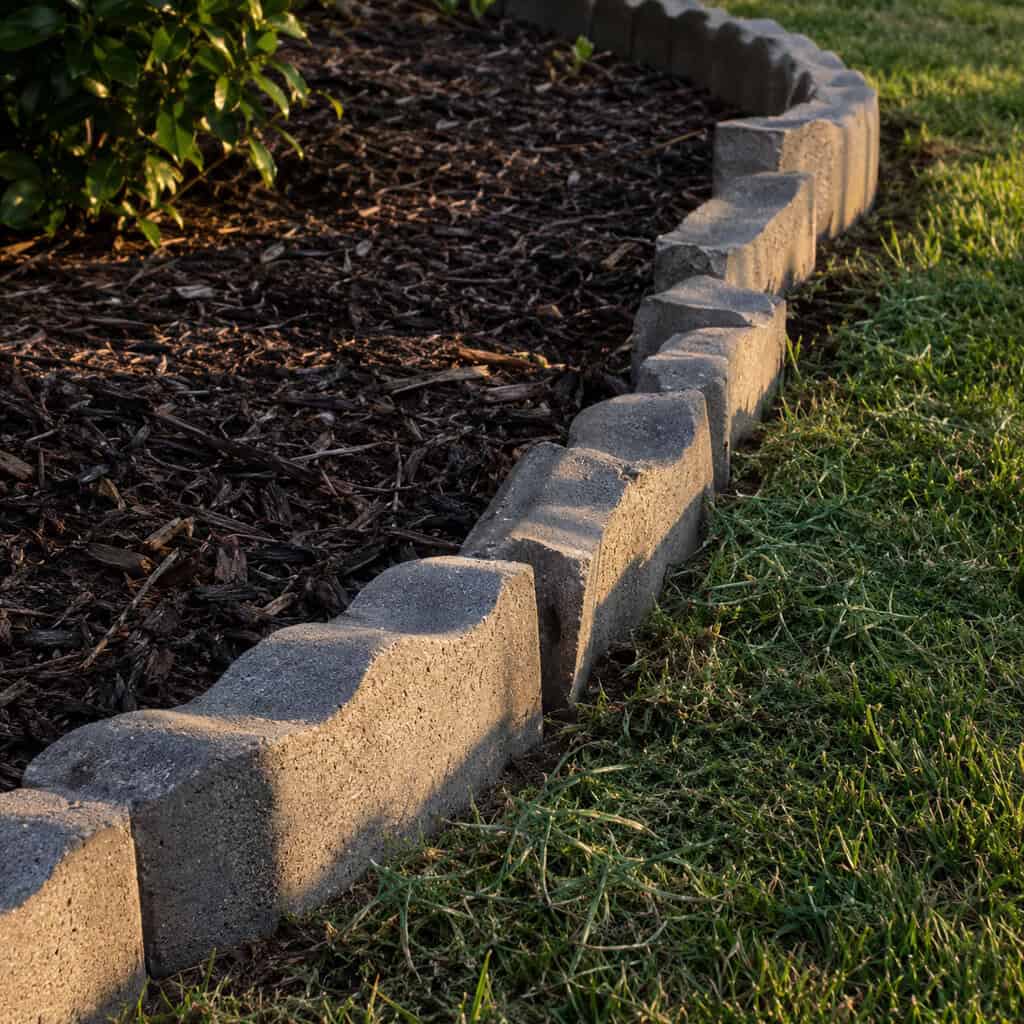
The wavy-topped gray block. Its black plastic cousin that heaves an inch out of the ground every winter.
Both put a hard decorative frame around something soft, which is backwards. Worse, the mower can’t ride over either one, so a ragged strip of string-trimmed grass builds up along the whole edge. That fringe is what actually makes the bed look tired.
A cut spade edge costs nothing and looks better. Flush steel edging costs more and lasts thirty years.
11. A Mass of Spreading Junipers Along the Foundation
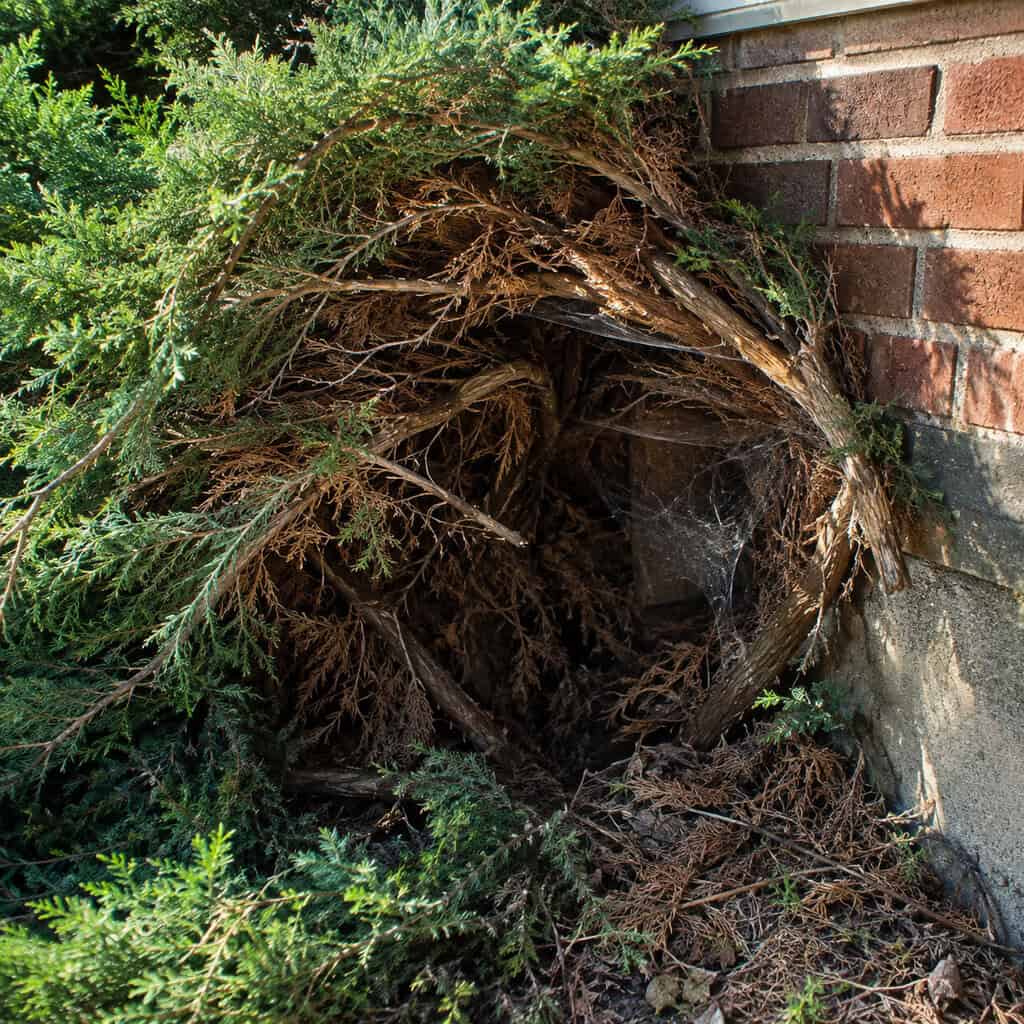
Blue rug, Andorra, Bar Harbor. Sold as maintenance-free groundcover in the ranch-house years and planted by the dozen across the front of every brick split-level in the country.
Thirty years in, the truth of a spreading juniper is a brown hollow mat with six inches of green on top. The interior is dead needles, spiderwebs, and whatever the wind brought in. Nobody reaches into it, which means nobody notices what’s living there.
And things live there. That dry dense layer against a warm foundation is prime harborage — mice and voles nest in it, chipmunks tunnel under it, and wasps build inside the dead zone where you’ll never see them until you’re pruning. Pest control operators treat overgrown foundation junipers as a standing complaint, because the plant creates a covered highway from the yard to your siding and weep holes.
Junipers also don’t come back from hard pruning. Cut into old bare wood and it stays bare — there are no latent buds to push new needles. That’s the part people learn too late.
Which means the honest answer is removal. Cut them at the base, pull the root plates with a mattock, and you’ll gain a bed you can actually plant. Low sedge, dwarf fothergilla, itea, inkberry — anything that keeps a see-through base.
12. Railroad Ties and Stacked Landscape Timbers
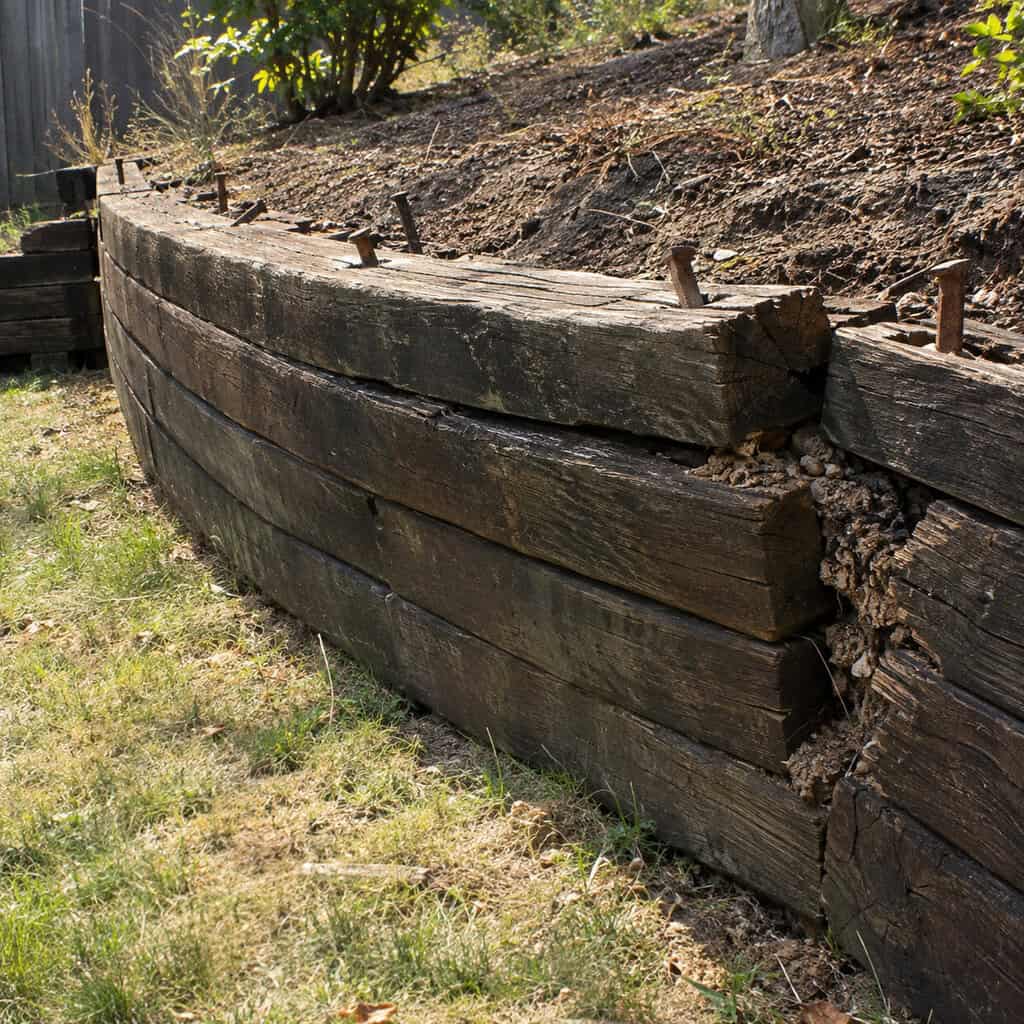
Creosote ties built every terraced bed of the 1970s. Spike-pinned 4×4 timbers built the raised planters of the 1980s.
They announce their own age as they go. Wood rots unevenly, so the wall bows out in the middle, the top course leans, and the spikes work loose until the corners separate.
Old reclaimed ties come with handling concerns modern wall block doesn’t have — creosote-treated wood isn’t something you want kids sitting on or vegetables growing against. Segmented block or dry-stacked stone fixes the look and the chemistry in one weekend.
13. A Ring of Annuals Around the Mailbox Post
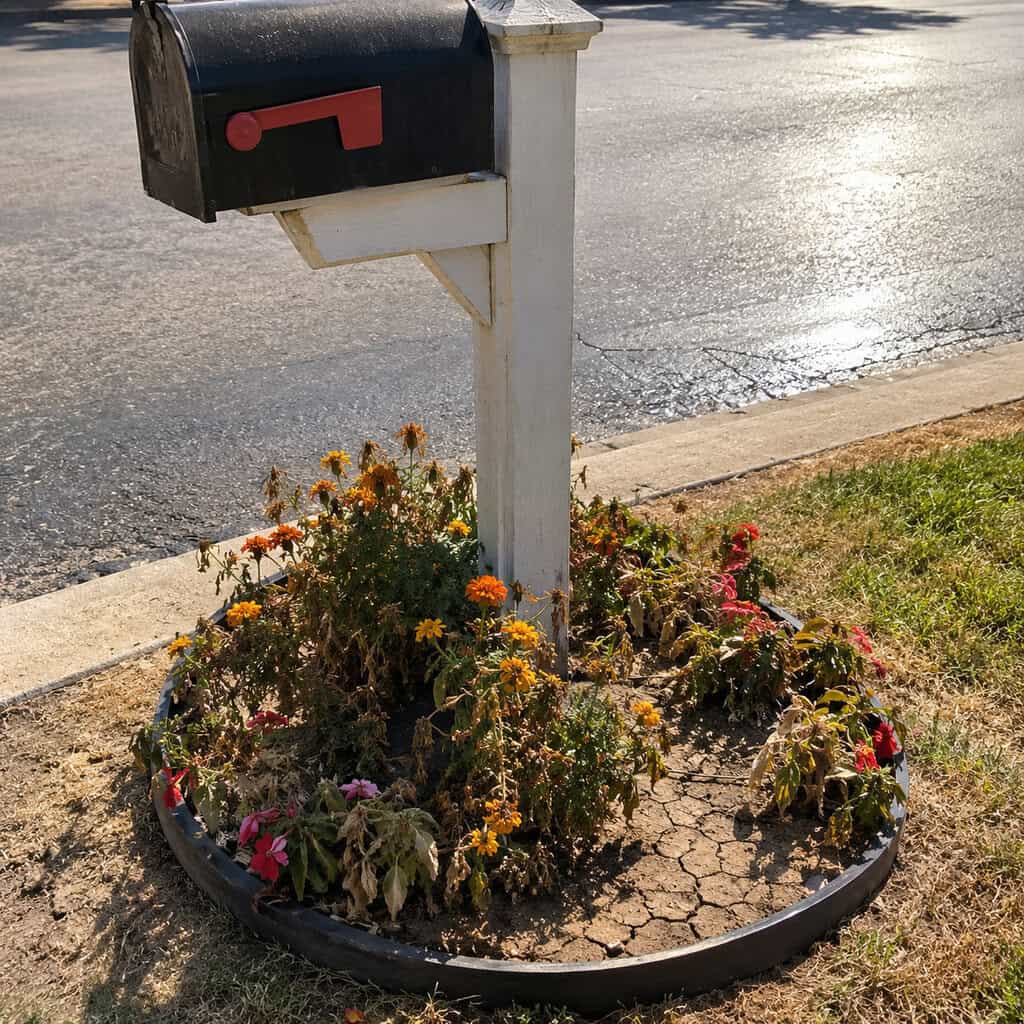
Marigolds and impatiens circling the post, edged with a coil of black plastic. It’s the 1990s curb-appeal ritual in miniature, and it’s the first thing anyone sees from the street.
It also dies every August, and there’s a reason. That spot is the hottest, most reflective, most compacted, most road-salted square foot on the property.
Plant something that likes abuse — sedum, catmint, dwarf ornamental grass, daylily if you must — and quit replanting in June.
14. A Soldier Row of Matching Arborvitae

Fifteen identical Green Giants, three feet apart, planted the year the neighbors put in a pool.
Spacing is the mistake. Crowded arborvitae shade each other out at the base and thin from the bottom, so you end up with a wall on stilts. Then bagworms or deer or root rot take two of them, and the gap never fills — arborvitae won’t regrow from bare wood either.
Stagger a mix instead: a few evergreens, a couple of large deciduous shrubs, something with winter texture. You get screening that survives losing a plant. Several of the fastest options come with problems that show up years later, so it’s worth picking slowly.
15. Wagon Wheels, Wishing Wells, and Little Dutch Windmills
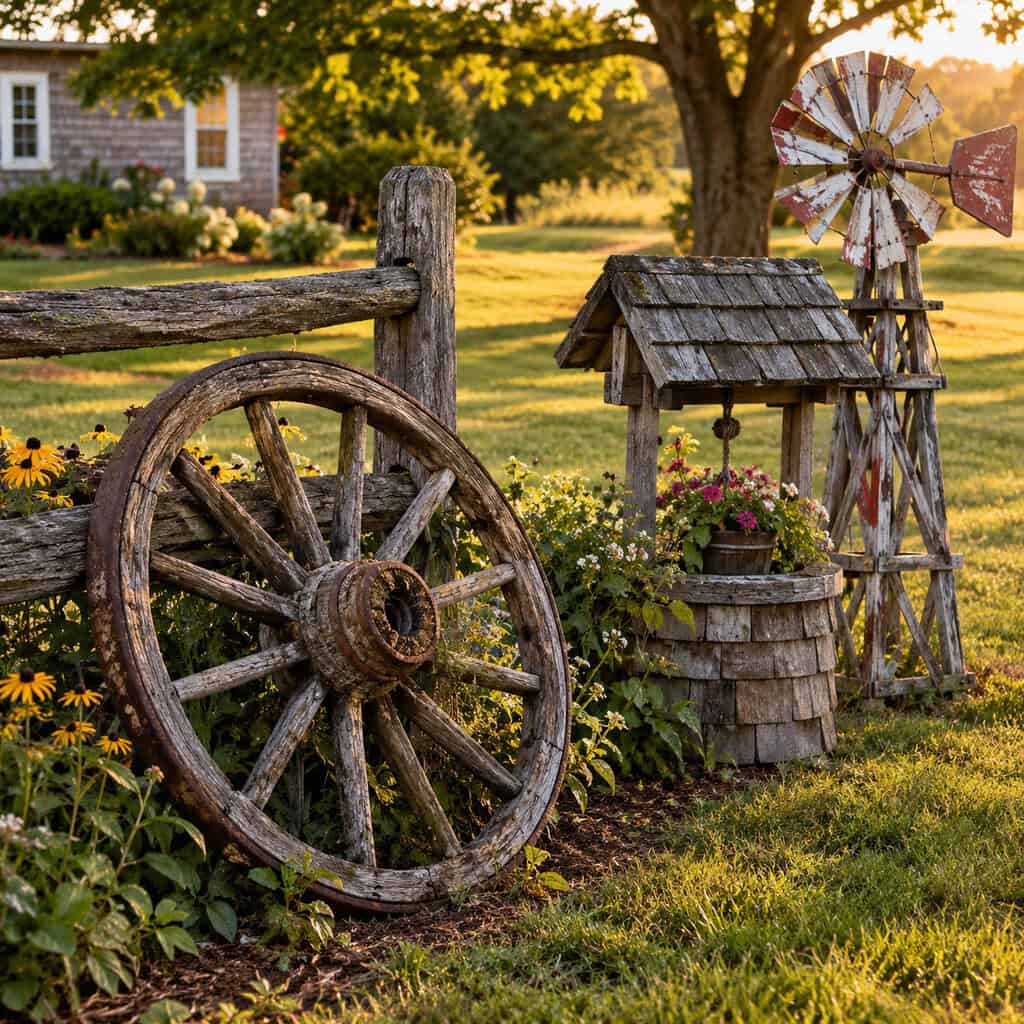
Different decor language from the concrete critters. This is the rustic-Americana kit.
Half a wagon wheel leaning on the mailbox. A wishing well planter with a shingled roof. A section of split-rail fence that fences nothing and goes nowhere.
It dates a yard to the exact years when “country” was a national decorating movement, roughly 1976 to 1991. The split-rail-to-nowhere is the strongest single tell.
16. Landscape Fabric Under a Rock Bed
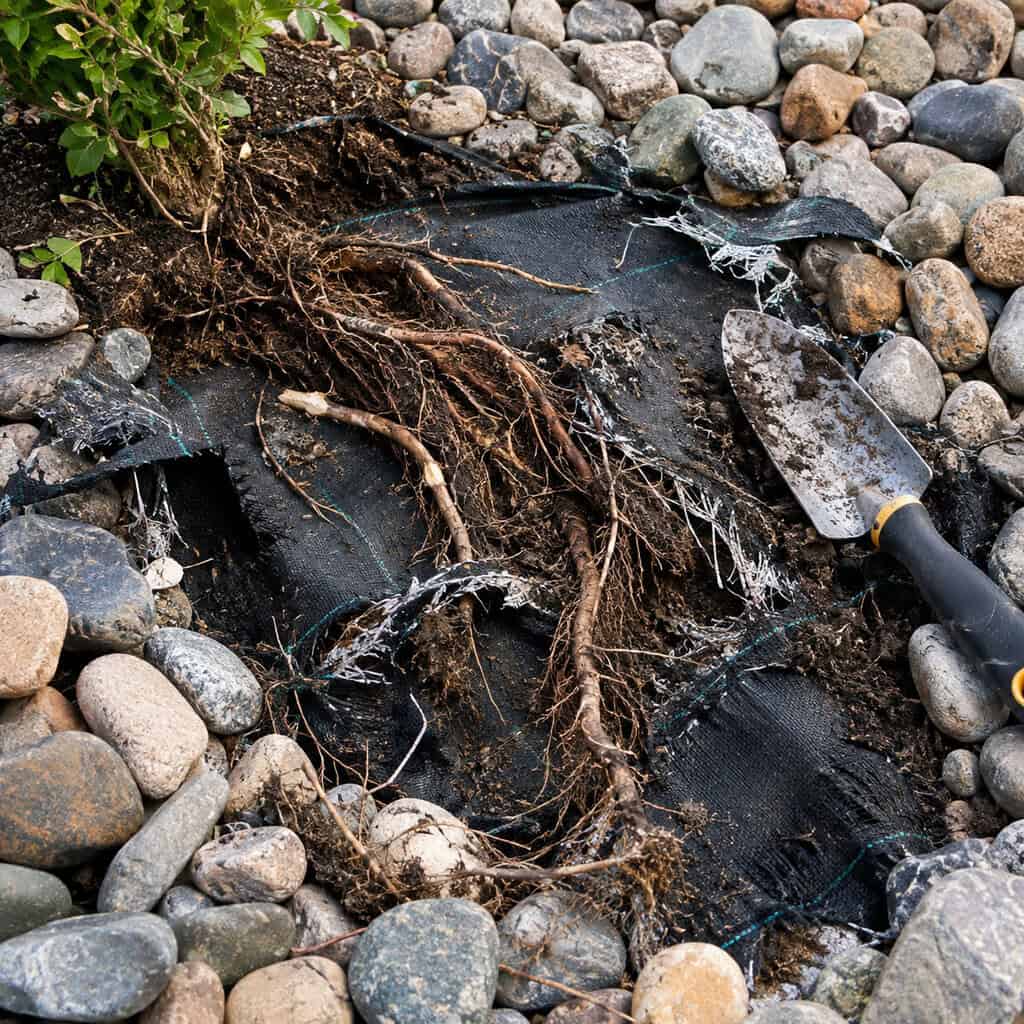
Sold as permanent. It isn’t.
University of Illinois Extension is direct about it — fabric buys you a couple of clean years, then weed seed blows in and germinates in the debris on top, and the tough perennials root straight through the weave from below.
Now the fabric is the problem. Pull a weed and you tear up a strip of shredded polypropylene with it. Under rock, the only real fix is shoveling the entire bed off to get at it.
That’s why old fabric beds look neglected rather than tidy. Three inches of mulch on bare soil does the same job and improves the dirt while it breaks down.
17. A Tiered Fountain in the Front Yard
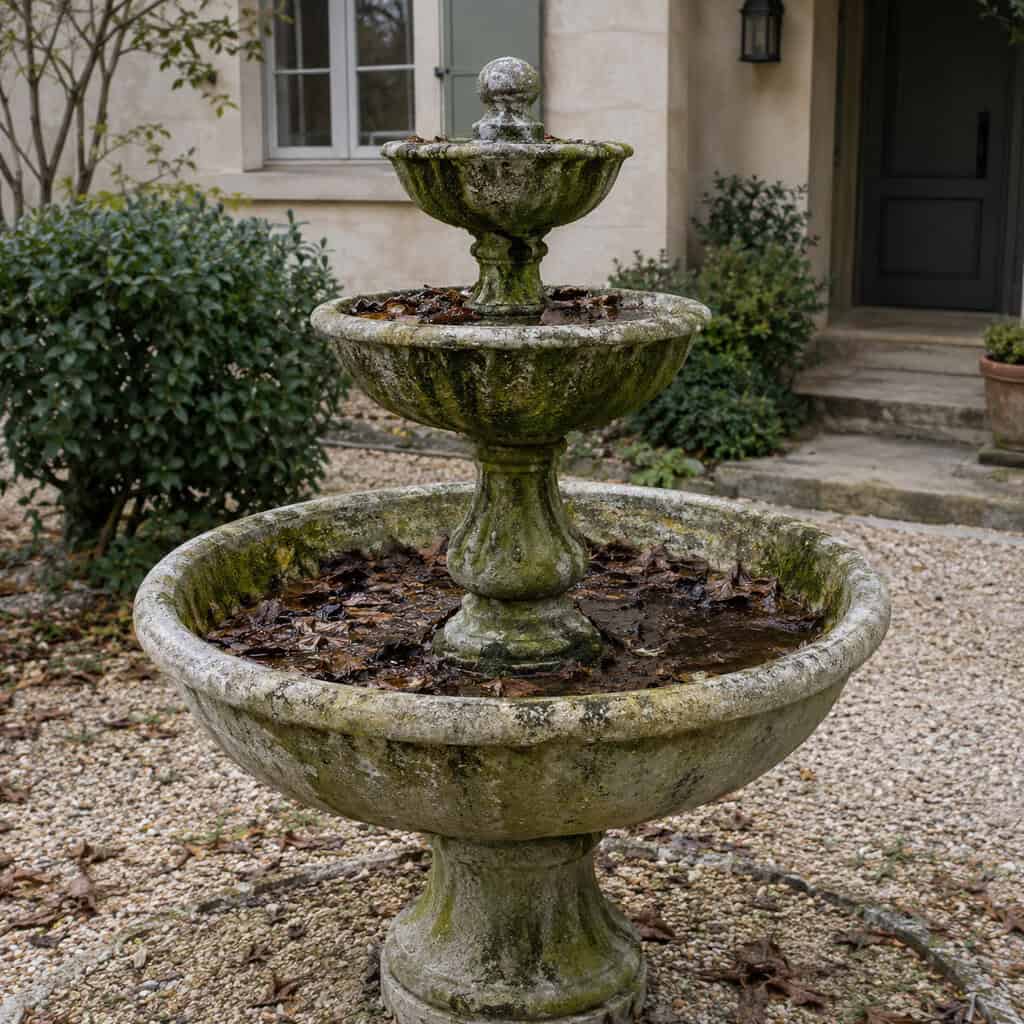
The three-tier cast-concrete fountain was the centerpiece of the Tuscan-everything years, and it was never cheap.
The dating compounds. Most of them are switched off now, stained green at the waterline, holding a slurry of leaves and one drowned tennis ball. The feature installed to signal luxury ends up signaling that nobody’s tending the yard.
Run it or remove it. A dry fountain is worse than no fountain.
18. A Single-File Line of Shrubs Tight Against the House

Builder default for thirty years: an 18-inch strip of mulch against the foundation with one row of shrubs jammed into it.
The design flaw is depth. One row at one height in a narrow band gives the front of a house nothing to stand in, so the whole facade reads flat from the street. University of Illinois Extension makes the case for pulling foundation beds out and layering them in tiers instead.
The building problem is worse. As those shrubs mature they press branches against siding, and that contact keeps the wall wet for hours after rain or irrigation. Wet siding means rot behind vinyl, blistered paint on wood, and a highway for ants and termites that skips your soil treatment entirely. Pest inspectors call it a bridge, and a failed inspection over it is a real thing.
Bed depth also decides where water goes. A narrow strip against the wall tends to hold mulch above grade and trap runoff right at the foundation — which is how you get a damp basement corner nobody can explain.
Pull the bed line out four to six feet. Keep 18 inches of clear air between mature branches and the wall. Slope the soil away from the house at roughly an inch per foot for the first six feet, and keep mulch below the siding line. Then plant in three depths: something low at the front edge, mid-height in the middle, one taller anchor at the corners.
It costs a spade and an afternoon, and it’s the single biggest visual upgrade on this list.
19. Solar Path Lights Lining the Walk Like a Runway

Stake lights every two feet, both sides, all the way to the door. It’s an airstrip, not a landscape.
Within two seasons the aesthetic collapses on its own: a third are dim, a couple lean, one got clipped by the mower, and the plastic lenses have fogged to the color of old Tupperware.
Fewer and warmer wins. Three or four good fixtures aimed down at the paving surface — not out at eye level — does more than twenty stakes.
20. Hostas and Daylilies as the Entire Shade Plan

Neither plant is the issue. The combination is a decade signature.
A bed of nothing but hostas and orange ditch lilies peaks in June and goes flat by early August — hosta leaves get slug-chewed and tired, daylily foliage flops brown at the base.
Keep the easy-care spirit, add texture: autumn fern, Pennsylvania sedge, heuchera for color that holds, epimedium for dry shade under maples. Plants that thrive where grass refuses to grow will do more for a dim corner than another row of hostas.
21. Vinyl Lattice Skirting Around the Deck
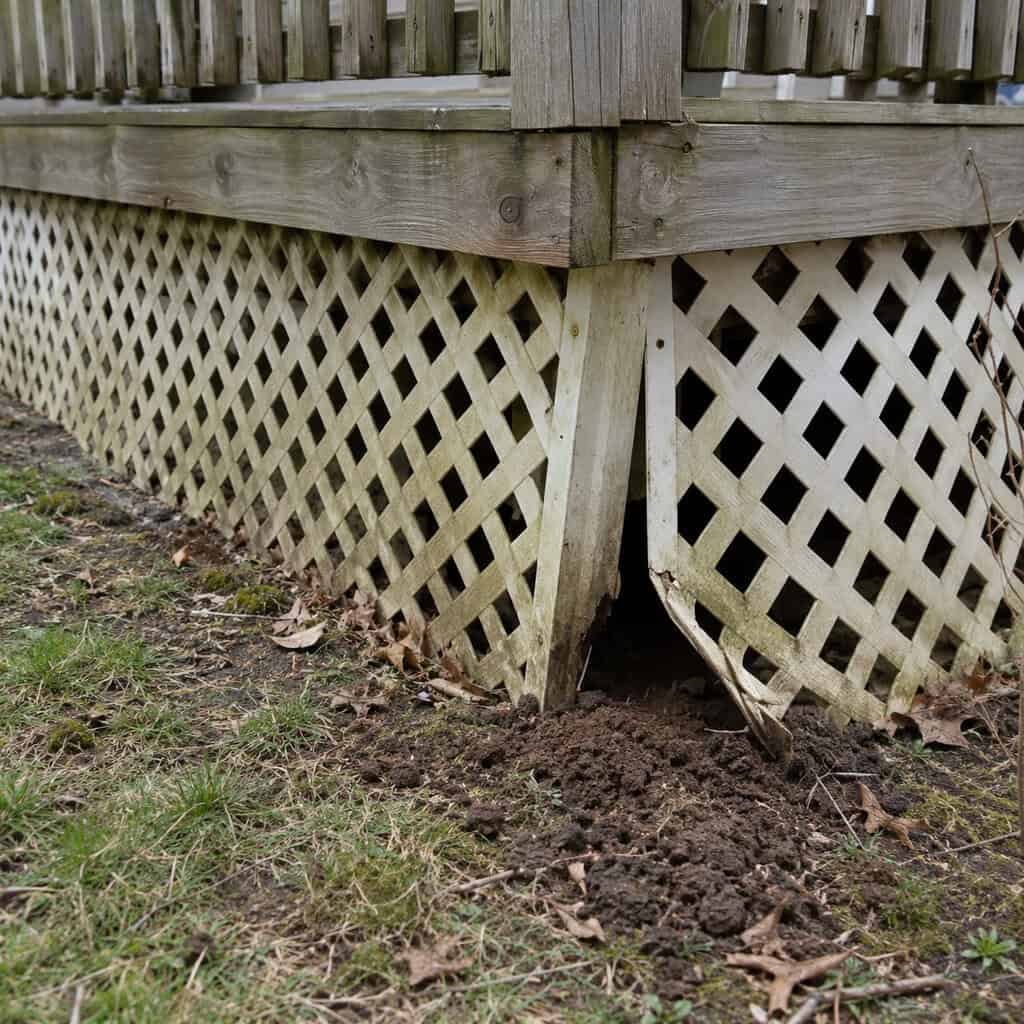
Criss-cross plastic panels were the standard way to hide deck framing, and they fail in a predictable order.
First they yellow. Then they sag between the nailers. Then something moves in — skunks, groundhogs, feral cats — because lattice is a doorway, not a barrier.
Horizontal slat skirting in a dark stain reads current and lets air move. Dark metal screen panels do it with less maintenance.
22. Knock Out Roses Used as a Hedge Everywhere
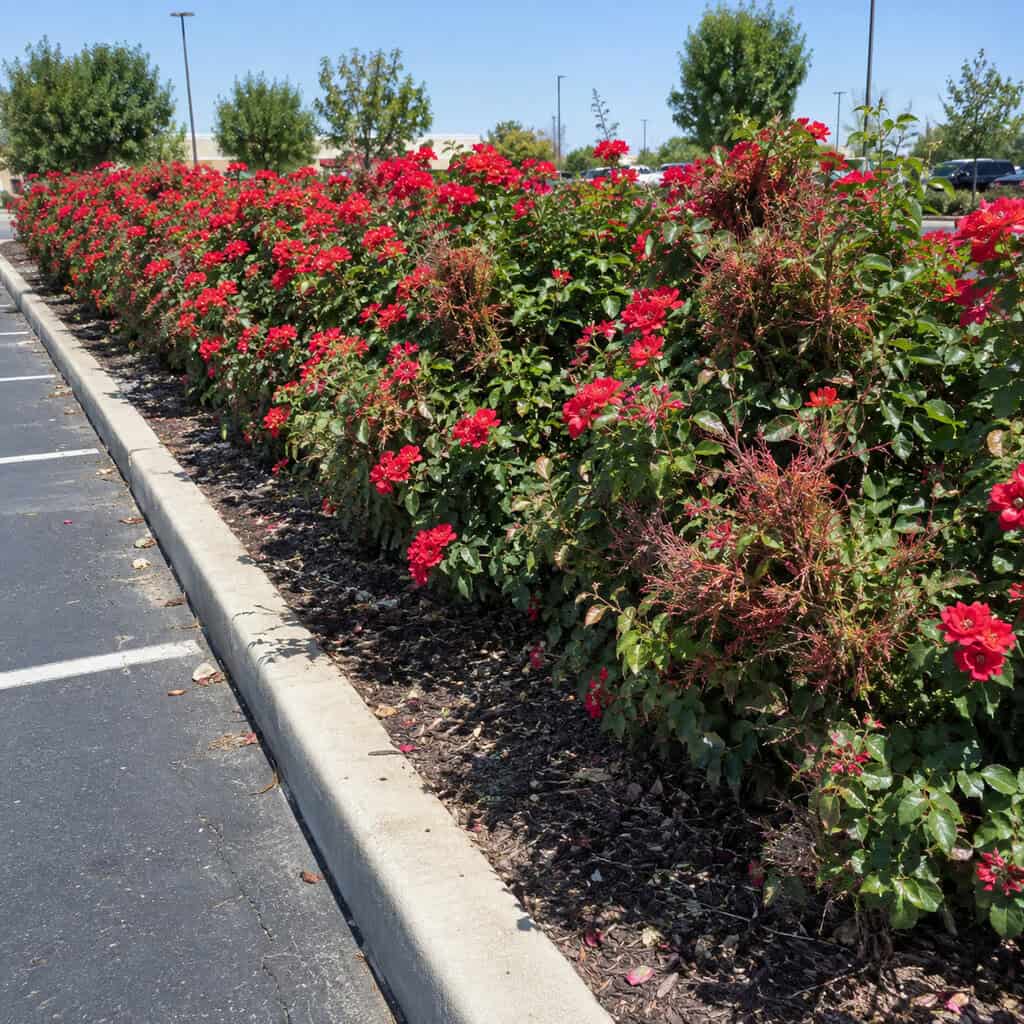
Introduced in 2000, and within a decade it was in every bank median and apartment entrance in America.
That ubiquity is the problem. A row of Knock Outs no longer reads as a garden — it reads as commercial landscaping, because that’s where most of us see them. Rose rosette disease has thinned a lot of those hedges since, leaving witch’s-broom clusters and red distorted growth nobody can cure.
Use three, not thirty. Put something with different foliage between them.
23. A Corrugated Fiberglass or Aluminum Patio Awning

Translucent green or amber panels over a back patio, casting everyone underneath in aquarium light.
You can hear the era, too — rain on corrugated fiberglass has a sound nothing else makes.
Sun-brittled panels that crack when you touch them and chalky white support posts are the giveaway. A simple cedar pergola or a dark-framed cantilever awning does the same job in the current century.
24. A 36-Inch Concrete Walk Straight to the Front Door

Postwar builders poured a three-foot ribbon of scored concrete from the driveway to the stoop, and plenty of builders kept pouring it into the 2000s.
Three feet is single file. Two people can’t walk it side by side, which means every arrival at your house starts with somebody falling behind.
Widen it to four or five feet — even a paver or flagstone border added along one edge does it — and the whole front of the house scales up. It’s the cheapest instantly-modern move on this list.
25. A Solid White Vinyl Privacy Fence

Bright white vinyl was the maintenance-free upgrade of the late 1990s, and it dates a yard the way white vinyl shutters date a facade.
It also doesn’t stay bright. The shaded side greens up with algae, panels bow in August heat, and the rails hold a grimy drip line under every cap.
Dark stain on cedar, black metal, or horizontal fence boards all read current. Dark fencing has a second advantage: it visually disappears, so a small yard stops feeling like a box.
26. Paving the Whole Backyard
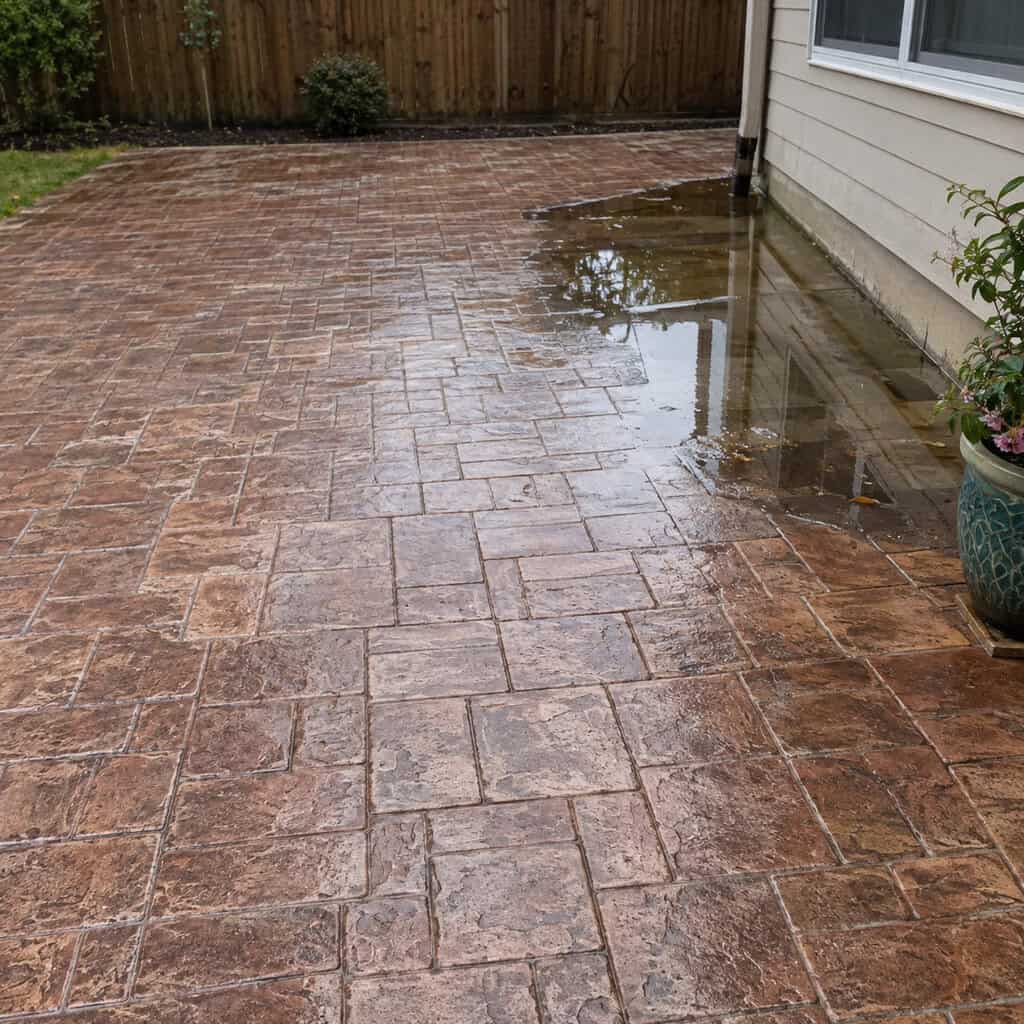
The outdoor-living boom talked a lot of people into replacing their entire backyard with a surface.
Designers now single out majority-hardscape yards as the trend most clearly on the way out. A patio sized for a party you host twice a year reads uninviting the other 363 days, and stamped concrete pressed to imitate brick or slate is the most dated version — the pattern repeats every four feet and the color coat wears off the traffic path first.
There’s a drainage bill, too. Every square foot of impermeable surface sheds roughly 0.6 gallons per inch of rain, and it all has to go somewhere. Usually that’s the low corner of the lot or straight back at the foundation, which is how a nice patio turns into a yard that floods every time it rains.
You don’t always have to tear it out. Here’s the decision most people are actually facing:
| Resurface | Partial Tear-Out | |
|---|---|---|
| Typical cost | $4-$9 per sq ft | $8-$20 per sq ft |
| Best when | Slab is sound, looks dated | Cracked, heaved, or drains wrong |
| Fixes drainage | No | Yes |
| Timeline | 2-3 days | 1-2 weeks |
| Result | Same footprint, better finish | Smaller patio, planted edges |
If the slab is solid and simply ugly, resurfacing with large-format pavers over a bond coat is the cheap win. If it’s cracked or pitched toward the house, take out the outer three or four feet, put in permeable pavers or a gravel-and-plant border, and let water infiltrate instead of run.
Aim for roughly a third hardscape, two-thirds planted and soft. That ratio is what separates a patio from a parking pad.
27. Wall-to-Wall Artificial Turf

Turf was pitched as the forever lawn. A decade in, the pitch has cracks in it.
Even people in the industry concede that a full-coverage install can give off more of a commercial-plaza feeling than a livable yard — partly because the color never changes and nothing in it ever moves.
Heat is the bigger surprise. Synthetic turf in full sun runs far hotter than the air, and surface readings 40 to 70 degrees above ambient are routine on infilled fields. On a 95-degree July afternoon that’s a surface a dog won’t cross and a kid won’t sit on. Shade cloth doesn’t fix it. Rinsing cools it for about twenty minutes.
Then there’s pet odor. Urine drains through the backing but the solids and the ammonia salts stay in the infill, and the smell builds in humid weather. Owners end up on a rinse-and-enzyme-treat schedule that looks a lot like maintenance for a thing they bought to avoid maintenance. Crumb rubber infill is the worst offender; silica sand with an antimicrobial coating is better.
Check the base before you blame the turf. Most odor and puddling problems trace to compacted fines under the pad, not the grass itself.
If you want less lawn, there are better routes. A smaller real lawn with wider beds, or ground covers that replace grass entirely, get you out of mowing without installing a rug outdoors.
28. An Above-Ground Pool Ringed by a Wooden Deck
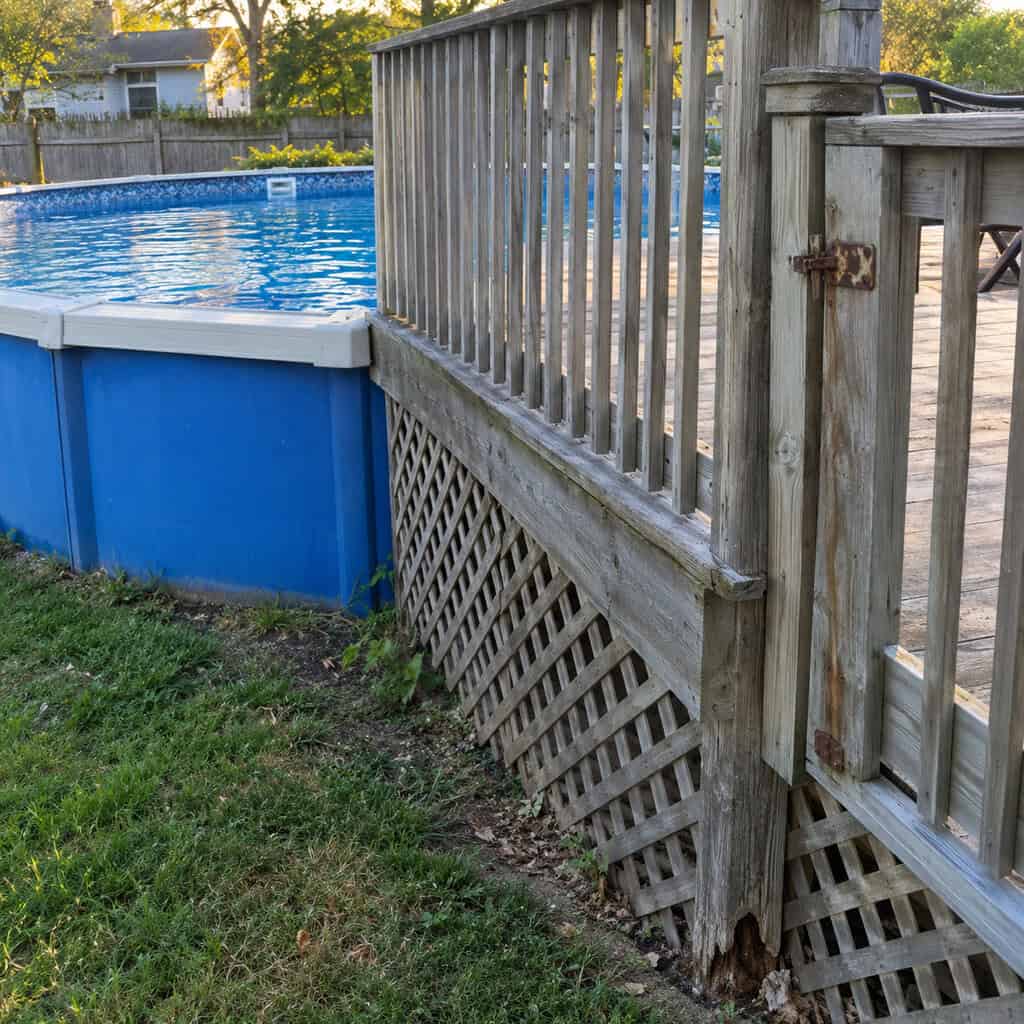
No structure in an older backyard is more era-specific: the blue-sided ring, the graying pressure-treated deck wrapped around one side, the ladder gate with a latch from 1991.
It dominates. From every back window of the house, it’s the thing you see.
Even a well-kept one dates the yard through deck detailing — 2×2 balusters, lattice skirting, a top rail wide enough to set a drink on. Those details read 1994 the way avocado appliances read 1973.
The part worth taking seriously is the deck itself. Pressure-treated framing built in the 1990s is often at or past design life, and the failure point is almost never the decking you can see. It’s the ledger, the post bases sitting in soil or in a puddle on a footing, and the joist hangers where galvanized nails have corroded against ACQ-treated lumber. Push a screwdriver into the post bottoms and the joist ends near the pool. If it sinks a quarter inch, you’re done inspecting.
Insurance cares, too. Many homeowners policies require a self-latching, self-closing gate and a specific barrier height around pool access, and a rotting deck that doubles as the barrier is a claim waiting to happen. Some carriers exclude diving boards and slides outright, and a few won’t write a policy with an unfenced pool at all. Call your agent before you rebuild, not after.
If the pool still gets used, rebuild the deck in a dark composite with cable or black metal rail and skip the lattice. If it hasn’t held water in three summers, removal is usually a one-day job and you get a third of your backyard back.
29. The Swing Set Nobody Has Played On in Ten Years

The cedar fort with the canvas canopy bleached from green to bone. The rusted A-frame that squeaks. The hoop with the shredded net.
This is the one dated feature people keep on purpose, and everybody knows which house has it.
The grass under it never came back. The slide has a wasp nest. The kid it was built for is 24.
Take it down when you’re ready. A yard should look like the life you have now, not the one you had in 2006.
30. Matching Urn Planters Flanking the Front Door

Honest split decision on this one.
A matched pair on a formal symmetrical facade still reads as intentional — that’s just classical composition, and it works. Where it goes wrong is on an asymmetrical house, or when the urns are fiberglass faux-stone with a molded acanthus leaf and three dead mums in them.
Judge by the house, not the rule. If your entry isn’t symmetrical, one larger planter set off-center looks better than two.
31. Green Indoor-Outdoor Carpet on the Porch Steps
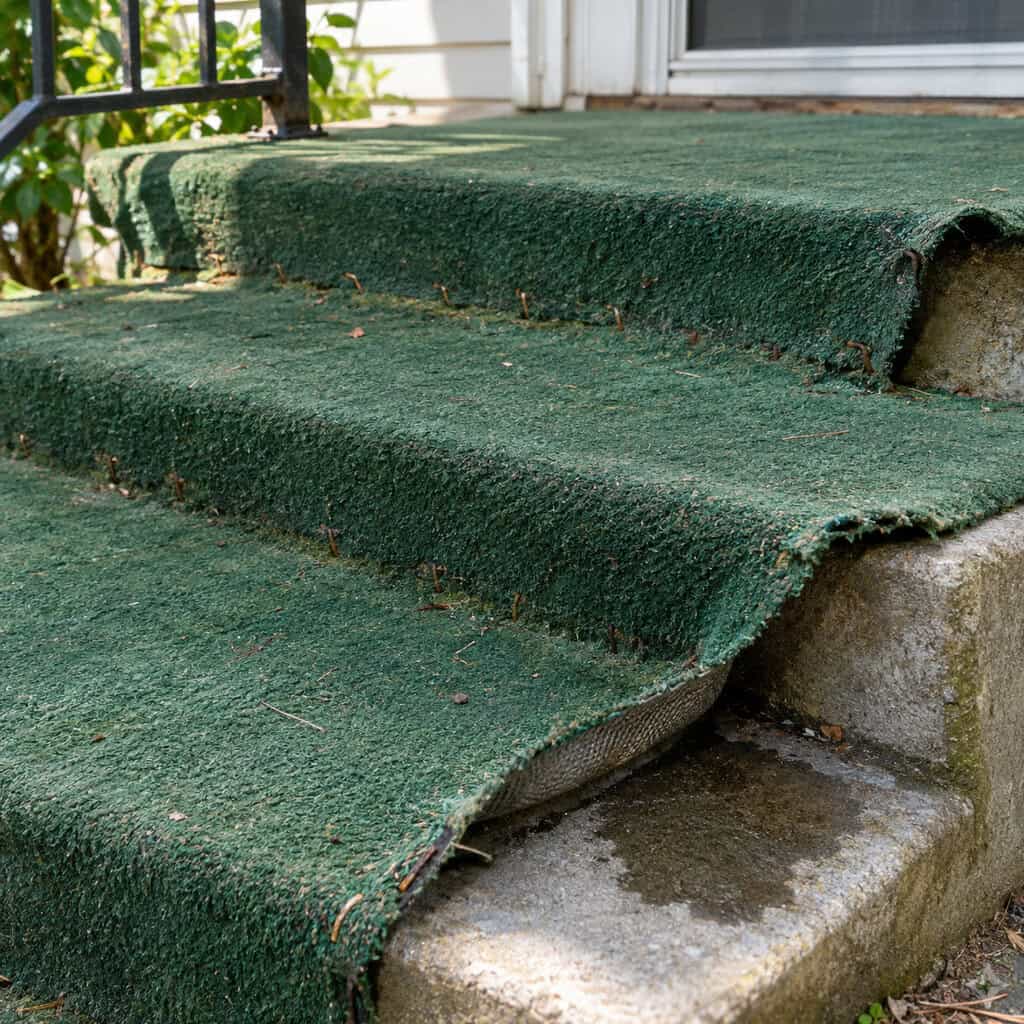
Stapled down over concrete, that specific shade of AstroTurf green, curling at the nose of every step.
It traps water against the concrete underneath, which is how you get spalling and a permanently damp step. In winter it holds ice you can’t see.
Pull it up. You’ll find decent concrete under there most of the time, and a coat of tinted concrete stain or a couple of slate treads finishes the job for under $200.
The through-line in all 31 of these is the same: somebody solved a problem once, correctly for the time, and then stopped looking at it.
Dated isn’t about taste. It’s about a yard that stopped being edited.
Walk yours this weekend with a coffee and no plan. The thing that catches your eye first — the crooked stake light, the hollow juniper, the dry fountain — that’s where to start.