


Walk past an old house in June and you’ll smell it before you see it. Lilac, or mock orange, or something sweeter you can’t name.
Then you walk past a new build and smell nothing at all.
That’s not an accident. Decades of breeding chased bigger blooms, tighter plants, and flowers that could survive a truck ride from a greenhouse in Michigan to a big-box parking lot in Texas. Fragrance went first. Then grace. Then the seed strains themselves quietly went out of catalogs.
They’re coming back. Small seed houses, cut-flower farmers, and a generation of gardeners raised on their grandmothers’ yards have dragged these plants out of the archive, and the odd thing is how modern they look now — loose, airy, unmatched, nothing like a flat of petunias.
Here are 33 old-fashioned flowers worth putting back in the ground.
1. Sweet Peas

Start here, because sweet peas explain the whole list.
In the 1880s and 90s, a Scottish nurseryman named Henry Eckford transformed the sweet pea from a scruffy cottage vine into the flower of the Edwardian era. Then came the Spencer types with their frilly, ruffled petals, and the trade fell in love with the frills. The perfume thinned out generation by generation.
The old grandifloras kept the scent. Smaller flowers, fewer per stem, and a fragrance that fills a room from one jam jar on the counter. The Garden History Blog tells the Eckford story well if you want the full arc.
Sow them cold — fall in mild climates, late winter under lights everywhere else. They want a trellis, rich soil, and constant picking. Stop cutting and they stop blooming.
2. Dahlias

No flower has climbed further. Dahlias were a Victorian and Edwardian show obsession, judged in halls by men with calipers, and that competitive breeding is exactly where today’s dinnerplate and ball forms came from.
Then they were a county-fair plant for eighty years. Now ‘Café au Lait’ sells out by January and has caused genuine tuber shortages, and wedding florists pay a premium for stems.
Plant tubers after the soil warms, stake anything over three feet, and cut deep and often. In zone 7 and colder you dig them in fall; store them in a box of shavings somewhere that stays around 45 degrees.
One clump becomes five in three years. That’s the part nobody mentions.
3. Hollyhocks

Everybody remembers these. Against the garage, along the alley fence, behind the outhouse in the old photos — seven feet of pink and maroon and near-black, leaning slightly, always leaning.
And everybody remembers the rust. Orange pustules on the undersides of the leaves, spreading up until the bottom three feet look scorched by August. It’s the single reason hollyhocks fell out of favor, and it’s manageable if you stop treating them like permanent perennials.
Most old-fashioned hollyhocks are biennials or short-lived perennials. They flower hard in year two, then decline. So treat them that way: let them bloom, collect seed, then pull the entire plant and get it out of the yard. Don’t compost the foliage. Rust spores overwinter on dead leaves and stems sitting at the base of the plant, and next spring’s rain splashes them right back up onto the new growth.
The other half of the fix is air. Space plants at least two feet apart, plant them where morning sun dries the leaves early, and water at the soil line instead of overhead. Strip off the lowest leaves as they yellow rather than letting them rot in place. The RHS guidance on hollyhock rust is worth reading once — it also notes that common mallow growing nearby acts as a host reservoir, so pull that weed too.
Sow fresh seed every year so you always have a young generation coming. Do that and you get the wall of bloom without the crisped-brown bottom half.
Figs, fig-leaved types, and the black ‘Nigra’ strain from Thomas Jefferson’s garden lists all still exist. Somebody kept them going.
4. Nicotiana (Flowering Tobacco)

At noon it looks like nothing. Sprawling leaves, a few limp tubular flowers hanging like they gave up.
Then the sun drops and the whole patio smells like jasmine.
The tall species are the ones you want — Nicotiana alata in its old unimproved form, or N. sylvestris, which throws a five-foot candelabra of white trumpets. Buy carefully. The compact bedding strains bred for garden-center flats have had the fragrance bred clean out of them in exchange for tidy habit and daytime color.
Plant them by a door you use at night. That’s the whole trick.
5. Peonies

There’s a decent chance a peony you didn’t plant is blooming in your yard right now.
These plants routinely outlive the people who put them in. Hundred-year-old clumps still flower on abandoned farmsteads, and old cemetery plantings are often the last living thing on the plot.
The ants aren’t hurting anything. They’re after the sugary nectar on the outside of the bud, and they leave once it opens. Nobody needs to spray.
Two rules: plant the eyes no more than two inches deep, and give them full sun. Buried too deep, a peony will produce leaves for twenty years and never bloom once.
6. Four O’Clocks

A flower that tells time.
Buds stay furled all day, then crack open in the late afternoon and stay open through the evening, throwing a heavy sweet scent right when you’re finally sitting outside with a drink. Single plants carry pink, yellow, white, and streaked flowers at the same time.
They form a fat tuber underground that overwinters through zone 7, getting bigger and bushier every year. Farther north, they self-sow so reliably you’ll never buy seed twice.
Southern dooryards ran on these for eighty years. Hummingbird moths find them within days.
7. Bearded Iris

Nobody bought these. That’s the point.
Bearded iris were the great pass-along plant of the twentieth century — somebody divided a clump in August, handed you a paper sack of rhizomes over the fence, and you had iris. Deer won’t touch them. They’ll take drought that flattens everything else in the bed.
The knock was the season: two glorious weeks, then a mound of tired leaves until frost. Modern rebloomers fixed that. ‘Immortality’ and ‘Feed Back’ put up a second flush in late summer or fall.
Plant the rhizome half-exposed, like a duck on water. Bury it and it rots.
8. Zinnias

The cutting row behind the garage was mostly zinnias, and there was a reason. Cut one stem and the plant answers with three.
The flat, stiff bedding zinnias of the 1990s did the genus real damage. Heirloom mixes look like a different plant entirely — Renee’s Garden sells ‘Granny’s Bouquet’ in dusty antique tones, and the cactus-flowered types have shaggy, quilled petals that look almost like a chrysanthemum.
Direct sow after the last frost. They germinate in four days and hate cold feet.
Give them room and morning sun to keep mildew off the lower leaves. If you want a summer of free bouquets from a three-dollar seed packet, this is where you start.
9. Foxgloves

Nothing else does what a foxglove does. Four-foot spires of speckled thimbles, all leaning slightly toward the light, giving a flat modern border an instant storybook vertical.
They’re also seriously poisonous, and that has to shape where you put them.
Every part of the plant — leaves, flowers, seeds, roots, and the water in a vase they’ve been standing in — contains cardiac glycosides. This is the plant digoxin came from. In dogs and cats, ingestion can cause vomiting, drooling, weakness, a dangerously slow or irregular heartbeat, and collapse. Dried leaves in fall cleanup debris stay toxic. So does the seed, and seed is what a curious puppy tends to find.
Practical placement: keep foxgloves out of any bed that borders a dog run, a fence line where a dog patrols, or a play area. Put them at the back of a border behind a shrub, in a raised bed, or in a fenced front garden the animals never enter. Bag spent stalks instead of dropping them on the mulch, and never leave the cut stems in a bucket of water on the porch where a dog might drink.
Foxglove is not the only pretty thing in the average yard that can hurt an animal — it’s worth knowing which common garden plants are toxic to pets before you plant, not after.
If you have a dog that eats things, skip it. If you don’t, plant nine.
10. Bleeding Heart

The shady side yard defeats most people. Bleeding heart wins there.
Arching stems hung with pink lockets, blooming in April and May under a maple where grass won’t even try. Old Victorian shade gardens leaned on it for a century.
Here’s the part gardeners misread as failure: by July the whole plant yellows, collapses, and disappears. That’s dormancy, not death. Plant hosta or fern nearby to fill the hole and forget about it until spring.
It’ll come back in the same spot for thirty years. Pair it with the rest of your shade plants for spots where grass refuses to grow.
11. Cosmos

Designers charge real money for movement — that loose, hazy layer that makes a border look like it happened instead of getting installed.
Cosmos does it for the price of a seed packet.
Newer strains keep it from reading dated. ‘Rubenza’ opens deep ruby and fades to antique rose; the cupcake types have fused, cup-shaped petals that look nothing like the roadside pink of 1965. Gardening Know How has a good rundown of the vintage strains still in circulation.
Never fertilize them. Rich soil gives you six feet of foliage and almost no flowers.
12. Lilacs

Drive an old county road in May and you’ll spot lilacs standing in an empty field. No house, no barn, no foundation you can see from the car. The lilac is what’s left.
Immigrant families brought them over as slips wrapped in wet burlap and planted them by the door of every homestead from Maine to Nebraska.
Two complaints pushed them out of small yards: a twelve-foot shrub and a ten-day season. Both got solved. Dwarf types like ‘Miss Kim’ stay around five feet, and reblooming series such as Bloomerang flower again in late summer.
Prune within two weeks of bloom. Wait until August and you cut off next spring.
13. Snapdragons

Pinch the sides of the flower and the dragon’s mouth opens. Every kid in 1955 knew that.
The squat six-packs at the garden center aren’t what’s driving the comeback. Cut-flower growers went back to the tall florist strains — Chantilly, Madame Butterfly, the four-foot Rocket types — and started treating them as a cool-season crop.
Sow in fall in the South, or start indoors in January up north and set them out while frost is still possible. Snapdragons don’t mind cold. They mind July.
Pinch the first center spike and you’ll get five side stems instead of one.
14. Old Garden Phlox

Powdery mildew exiled phlox. By the 1990s, every plant guide warned you off it, and a whole generation of gardeners never planted one.
Then breeders got serious about resistance. ‘David’ — white, four feet, clean leaves into September — became one of the most-sold perennials in the country. ‘Jeana’ turned out to be something better than tidy: trial gardens tracking pollinator visits found it drawing more butterflies than nearly anything else in the plot.
Space clumps for airflow, thin the weakest stems in spring, and water the soil rather than the leaves.
Late July, five feet of fragrance, swallowtails all over it.
15. ‘Grandpa Ott’s’ Morning Glory

Deep purple flowers with a red star in the throat. Bavarian, brought to Iowa by a man named Ott in the 1870s.
His great-granddaughter Diane Ott Whealy inherited the seeds along with a German pink tomato, and those two seeds became the reason Seed Savers Exchange exists. A whole preservation movement grew out of one family refusing to lose a flower.
It self-sows freely — which is either a gift or a chore, depending on your fence line. Pull the volunteers you don’t want in May while they’re two inches tall.
You’re not growing a vine. You’re keeping somebody’s family history alive on a trellis.
16. Larkspur

Everyone wants delphiniums. Almost nobody can grow them.
Annual larkspur gives you the same blue vertical spikes with a fraction of the fuss. Direct sow in fall or the dead of late winter — the seed actually needs cold to break dormancy — and then largely leave it alone. It’ll self-sow in the same bed for years and come up thicker each spring.
It’s also poisonous, and worth being specific about. Larkspur and its delphinium relatives contain diterpenoid alkaloids that are toxic to dogs, cats, horses, and cattle. Larkspur poisoning is a genuine problem for ranchers in the mountain West — cattle losses from wild larkspur on rangeland run into real money every year, which tells you the plant is not merely mildly irritating.
The seeds and young foliage carry the highest concentration. Signs in a dog can include drooling, vomiting, weakness, muscle tremors, and an irregular heartbeat. Call a vet on suspicion, not on symptoms.
So plant it where livestock can’t graze and where a dog isn’t chewing. Bag the spent stalks rather than tossing them over the fence into a pasture, and don’t add larkspur trimmings to anything a goat or horse can reach. Cut stems in a vase are still toxic; keep the vase where a cat won’t drink from it.
Handled sensibly, it’s the easiest blue in the garden.
17. Cannas
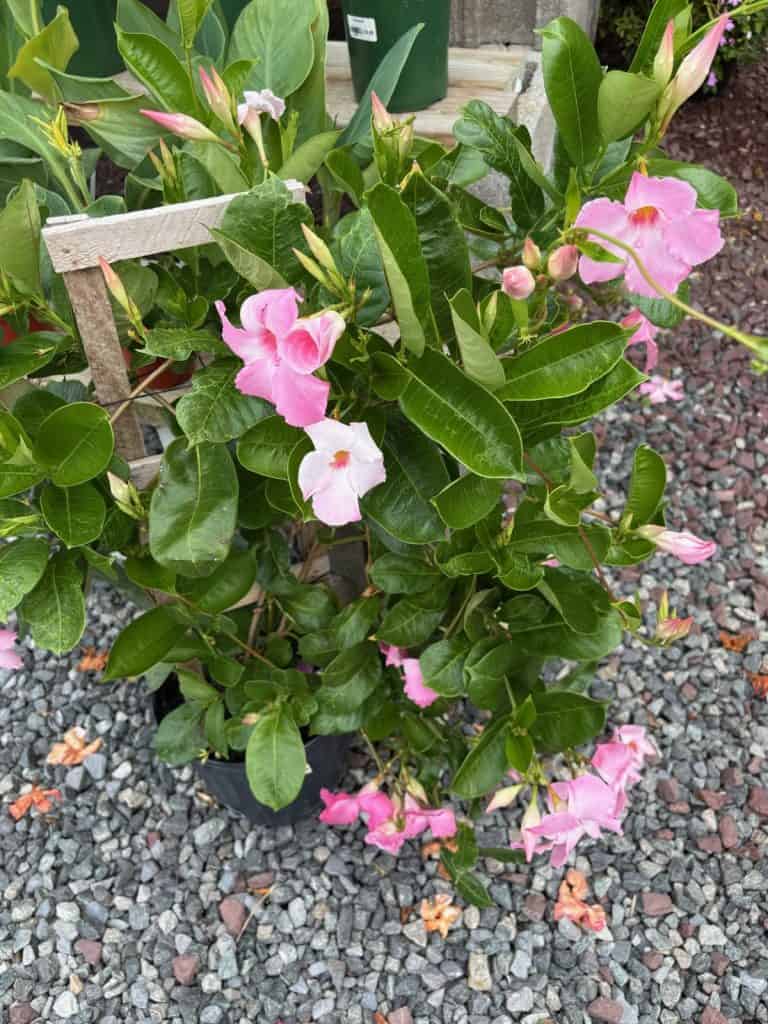
Cannas went from the height of Victorian formality — massed in strict rings in park bedding-out schemes — to a plant you mostly saw beside a gas station sign.
Now they’re the cheapest way to make a temperate yard look tropical. Six-foot banana leaves in bronze, cream stripes, and near-black, for about four dollars a rhizome.
They want heat, sun, and more water than you think. Dig the rhizomes after frost blackens the tops, or in zone 7b and south, mulch heavily and leave them.
They pair well with the other plants that make a yard look tropical even where it snows.
18. Love-in-a-Mist (Nigella)

You get two plants for one packet.
First the flowers: sky blue, wrapped in a haze of thread-fine foliage that looks like green smoke. Then the pods, striped maroon and cream and inflated like tiny balloons, which dry hard and keep their pattern for years.
The dried-flower revival runs on those pods.
Nigella self-sows into gravel driveways, wall cracks, and the dead strip along a walkway where nothing else takes. Scatter seed in fall and never plant it again.
19. Old Garden Roses and Rugosas

Hybrid tea roses taught two generations that roses mean a spray schedule.
The pre-1867 antiques never needed one. Gallicas, albas, damasks, and centifolias were bred for cold winters and neglect, and they carry the old heavy rose perfume that modern florist roses lost entirely. Many are still alive on abandoned homesteads with nobody to prune them.
Rugosas are tougher still. Crinkled disease-proof leaves, clove-scented flowers all summer, fat orange hips in fall, and enough salt tolerance to grow in a beach dune or along a road that gets plowed and salted every January.
Prune once-bloomers right after flowering. Prune rugosas whenever you feel like it.
20. Columbine

Granny’s bonnets. Nodding spurred flowers on wiry stems in May and June, holding the shade border after bleeding heart calls it a season.
Columbine cross-pollinates freely and self-sows, so a planting slowly invents colors you never bought. Plant three named varieties and in four years you’ll have a dozen shades that exist nowhere else.
Leaf miners scribble white trails across the foliage most summers. Cut the whole plant to the ground after bloom; fresh clean leaves come back in weeks.
A garden that changes without you is rarer than it sounds.
21. Gladiolus

Funerals killed the gladiolus. For fifty years they were the flower you saw beside a casket, and that association was enough to end them as a garden plant.
Florists are rehabilitating them now, using single stems as bold architecture instead of massing them in a sympathy arrangement. Stripped down to three or four blooms in a tall vase, a glad looks severe and expensive.
Corms cost pennies. Plant a handful every two weeks from spring through early summer and you’ll cut stems from July to frost.
Stake them or the first thunderstorm lays the row flat.
22. Sweet William

June has a gap. The tulips are done, the annuals haven’t filled in, and the border looks like it’s between jobs.
Sweet William was built for that gap. Dense flat heads of fringed pink and crimson and bicolor, smelling strongly of clove, lasting well over a week in a vase.
It’s a biennial, which means the old rhythm: sow in early summer, grow a rosette of leaves, overwinter, bloom the following June. Modern gardeners forgot how to plan a year ahead.
Sow a small patch every summer and you’ll never miss a season again.
23. Cockscomb (Celosia)

Nothing else in the garden looks like this. Fused velvet crests, wavy and folded like coral or a brain, in fuchsia and rust and burnt orange, sometimes the size of a dinner plate.
Victorians loved a botanical oddity and grew these hard. Then they vanished for eighty years.
They’re back on the strength of two things: they photograph like nothing else, and they dry with the color almost fully intact. Cut a stem, hang it upside down in a dark closet for two weeks, and it holds through winter.
Heat, sun, poor soil. They don’t want your compost.
24. Shirley and Breadseed Poppies

Petals like crumpled tissue paper, so thin you can see the light through them. A single flower lasts three or four days and then the petals drop all at once.
What’s left is the reason to grow them anyway — blue-green seed pods on straight stems, sculptural enough to carry a bed into September.
Poppies hate transplanting, which is exactly why nurseries stopped stocking them in flats. There’s no product to sell. Scatter the seed on bare soil in late fall or on top of the last snow, press it down, and don’t cover it.
They come up when the ground says so, not when you do.
25. Mock Orange

The forgotten one.
For two weeks in June, a mature Philadelphus throws orange-blossom scent across an entire yard — over a fence, through open windows, into the neighbor’s driveway. Then it’s a plain green shrub for eleven months, which is precisely why the nursery trade dropped it.
Old varieties like ‘Belle Etoile’ and the Lemoine hybrids carry the strongest perfume. Some newer compact selections have almost none, so buy in bloom or buy by name.
Plant it where you walk, not where you look.
26. Love-Lies-Bleeding (Amaranth)

Pure Victorian melodrama. Thick crimson ropes of bloom, two feet long, dripping straight down off a five-foot plant like something out of a mourning portrait.
You will not find this at a big-box nursery. That’s most of the appeal.
It’s also a grain. The seed heads produce edible amaranth, which lands well with anyone already growing food, and the young leaves cook like spinach.
Sow after the soil warms, give it room, and don’t bother fertilizing. Poor dry soil makes the color deeper.
27. Moss Rose (Portulaca)

There was always a strip along the driveway where nothing lived. Full sun, four inches of soil over gravel, baked all afternoon.
Moss rose lived there.
It’s a succulent annual with needle-like leaves that store water, and it flowers harder the drier and hotter it gets. Water it well and you get lush growth and fewer blooms.
In a decade of hose restrictions and brutal Augusts, a plant that punishes you for kindness is suddenly the right answer for hot edges, wall tops, and the sun-blasted strip between the sidewalk and the street.
28. Honesty (Money Plant)

Purple four-petaled flowers in spring, nothing special. Then the pods.
By late summer the seed pods dry to flat translucent discs the color of old nickels, and you can rub the papery skin off between your fingers to reveal a silver coin that catches light. People kept bunches in a vase on the mantel all winter — no water, no fuss, just there until March.
Being honest about honesty: it self-sows aggressively. One plant becomes forty. Pull the seedlings you don’t want or plant it where spreading is fine.
Biennial, like Sweet William. Sow this year, coins next year.
29. Heliotrope

The cherry pie plant. Victorians grew it in conservatories and porch pots for one reason: the smell.
Vanilla, almond, something baked. Warm afternoons intensify it, and a single pot beside a chair scents a whole porch.
Variety choice is the entire story here. Most modern seed-grown strains were selected for compact habit and deep purple color, and the fragrance was collateral damage. Look for ‘Marine’ or the old named heirlooms sold as cuttings, and smell before you buy — a scentless heliotrope is just a mound of dark leaves.
It sulks in heat and drought. Keep it moist and out of afternoon blast.
30. Zonal Geraniums

The red geraniums on your grandmother’s porch steps may have been the same plants for a decade.
That was ordinary practice. In October she cut them back, knocked off the soil, and either potted them in the basement by a window or hung them bare-root in a paper bag in the cellar. In April they came back out, got a haircut, and started over.
Try it. A geranium can go three months nearly dry in a dark 50-degree basement and still leaf out in spring.
Fancy-leaf types with bronze and cream markings and the scented-leaf heirlooms — rose, lemon, nutmeg — make the whole thing look deliberate instead of leftover.
31. Marigolds

Marigolds got branded. School fundraiser flats, gas station beds, the orange-and-yellow ring around a municipal sign — the plant became shorthand for lazy landscaping.
Two things brought them back.
First, the tall heirlooms. African types like ‘Crackerjack’ hit three or four feet with blooms the size of a fist, and the old signet types have lacy foliage and small edible flowers that taste faintly citrusy. Neither looks anything like a bedding six-pack. Flower Magazine covers the heirloom side well.
Second, the vegetable garden. Marigolds — specifically Tagetes patula, French marigolds — release compounds from their roots that suppress certain root-knot nematodes in the soil. That effect is real, but it’s specific, and it gets oversold at the garden center. It works best as a cover crop: a solid block of marigolds grown in an infested bed for two to three months, then turned under, rather than a few plants tucked between tomatoes as a decoration.
For above-ground pests, treat marigolds as part of a system, not a shield. They pull in hoverflies, parasitic wasps, and other beneficials that eat aphids, and the strong scent seems to confuse some egg-laying insects. They will not stop a squash vine borer. They may also draw spider mites in a dry August, so keep an eye on the undersides of the leaves.
Worth planning properly if you’re already working out what pairs and what fights in a vegetable bed.
Deadhead them and they bloom until hard frost. Nothing else in the garden works that long for that little.
32. Hardy Garden Mums

This is the most fixable mistake on the list.
Every September, garden centers stack pallets of florist mums — perfect domes, already in full bloom, bred for a six-week display and no root system to speak of. People buy them, enjoy them, and throw them out in November. Millions of them.
The old garden mums were nothing like that. True hardy perennials, grown from divisions passed between neighbors, coming back in the same border for twenty or thirty years. The Minnesota and Nebraska breeding programs produced cultivars that survive zone 4 winters without protection.
Plant hardy mums in spring, not fall, so the roots have a full season. Pinch them back twice before July 4th for a dense, self-supporting plant.
Then stop buying the disposable ones.
33. Lily of the Valley

For a lot of people this is the earliest memory in the whole yard. Not a picture of it — the smell. Cool, sweet, a little green, coming off a patch of white bells under a lilac at a grandmother’s house, in a shaded strip along the north foundation where nothing else grew.
It was in wedding bouquets for a century, and it’s still one of the great fragrances in gardening. Nothing else smells like it.
And it deserves an honest ending, because two things about it are serious.
It’s aggressively invasive. Lily of the valley spreads by underground rhizomes called pips, and it does not stop at the edge of the bed. It runs under walkways, comes up through lawn, and forms a dense mat that shades out everything native in a woodland edge. Digging it out means getting every fragment; leave an inch of rhizome and it returns. If you plant it, plant it somewhere physically contained — a bed ringed with buried edging, a strip between a foundation and a concrete walk, or a large pot.
It’s also genuinely poisonous, not mildly so. Every part of the plant — leaves, flowers, the bright red-orange berries, and the water in a vase of cut stems — contains cardiac glycosides that affect heart rhythm. In dogs and cats, ingestion can cause vomiting, diarrhea, a dropping heart rate, arrhythmia, seizures, and death. The berries are the biggest risk with children and puppies, because they’re red and they look like food.
So handle it with rules. Don’t plant it in a fenced dog yard or where a toddler plays unsupervised. Don’t leave cut stems in a low vase a cat can reach, and dump that vase water outside rather than down a bowl. Bag the foliage in fall instead of leaving it in reach. Wash your hands after dividing pips. If a pet chews any part of it, that’s an emergency call to a vet or poison control the same hour — not a wait-and-see.
None of that makes it a bad plant. It makes it a plant that needs the right spot, which is true of half the list.
Put it along the shaded north side of the garage, behind a fence, where you’ll walk past it in early May and stop for a second without meaning to.
What all of these have in common is that the market stopped selling them, not that gardeners stopped wanting them. Fragrance doesn’t survive shipping. Self-sowing annuals don’t generate repeat sales. Biennials require a customer willing to wait a year.
So the plants went to the margins — seed exchanges, church plant sales, a coffee can of seed in somebody’s garage — and waited.
Most of them are still there, still cheap, still ridiculously easy. Somebody kept them going on purpose so you could plant them again.