

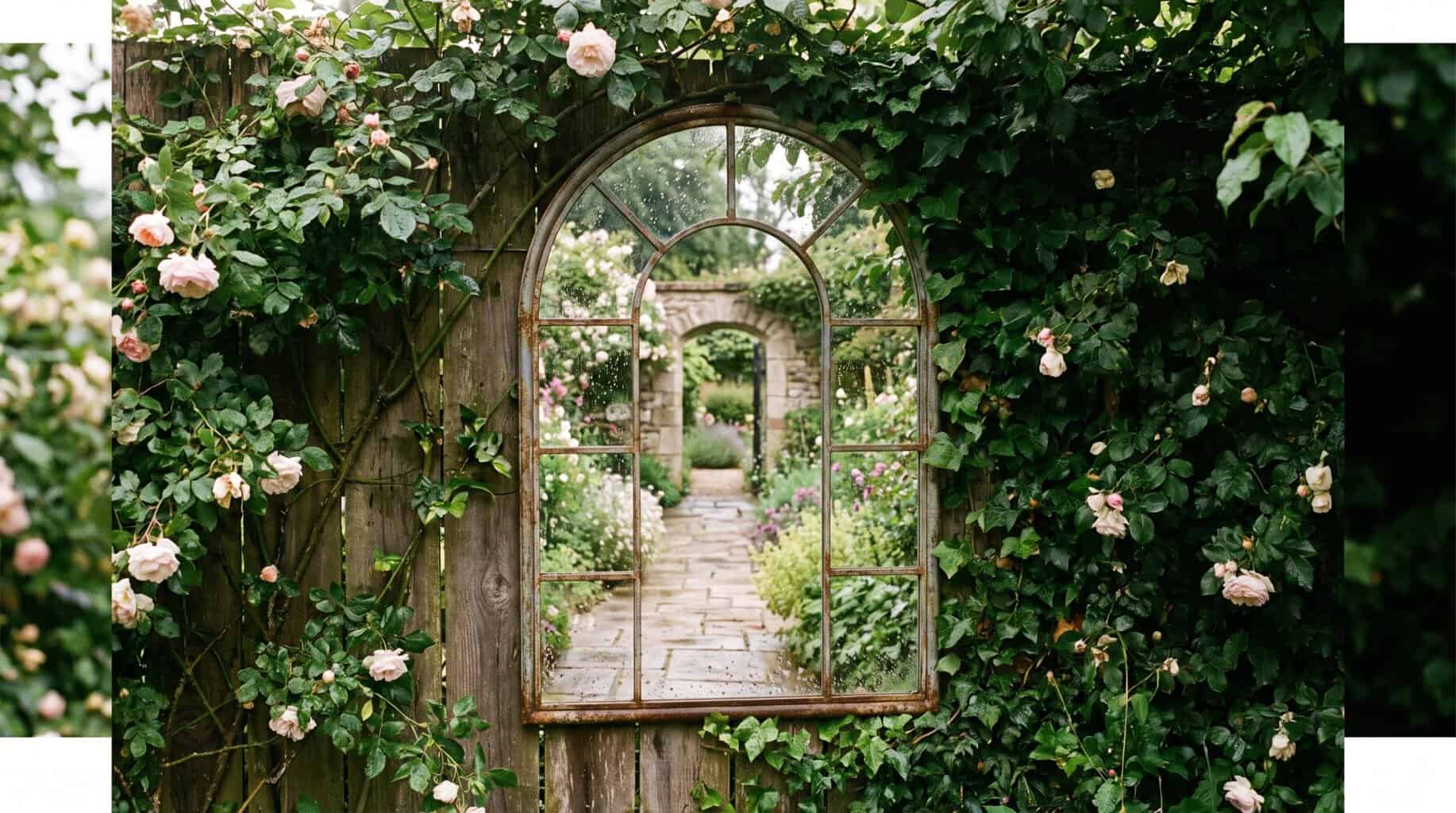
You step out the back door and the fence is right there. The whole yard reveals itself in one glance — every edge, every corner, every limit.
That’s the problem with a small yard. Nothing about it stays hidden.
But size and the feeling of size aren’t the same thing. Landscape designers have been faking depth for centuries, borrowing tricks from painters and interior designers who learned to stretch a cramped room without knocking down a wall.
Most of it comes down to geometry, sight lines, and one or two counterintuitive moves that feel wrong until you see them work. A dark fence that pushes backward. A diagonal that adds forty percent. A mirror that opens a second garden that isn’t there.
None of this requires buying an inch of land. Here are 27 ways to make a small backyard feel twice as big.
1. Lay the Paving on the Diagonal
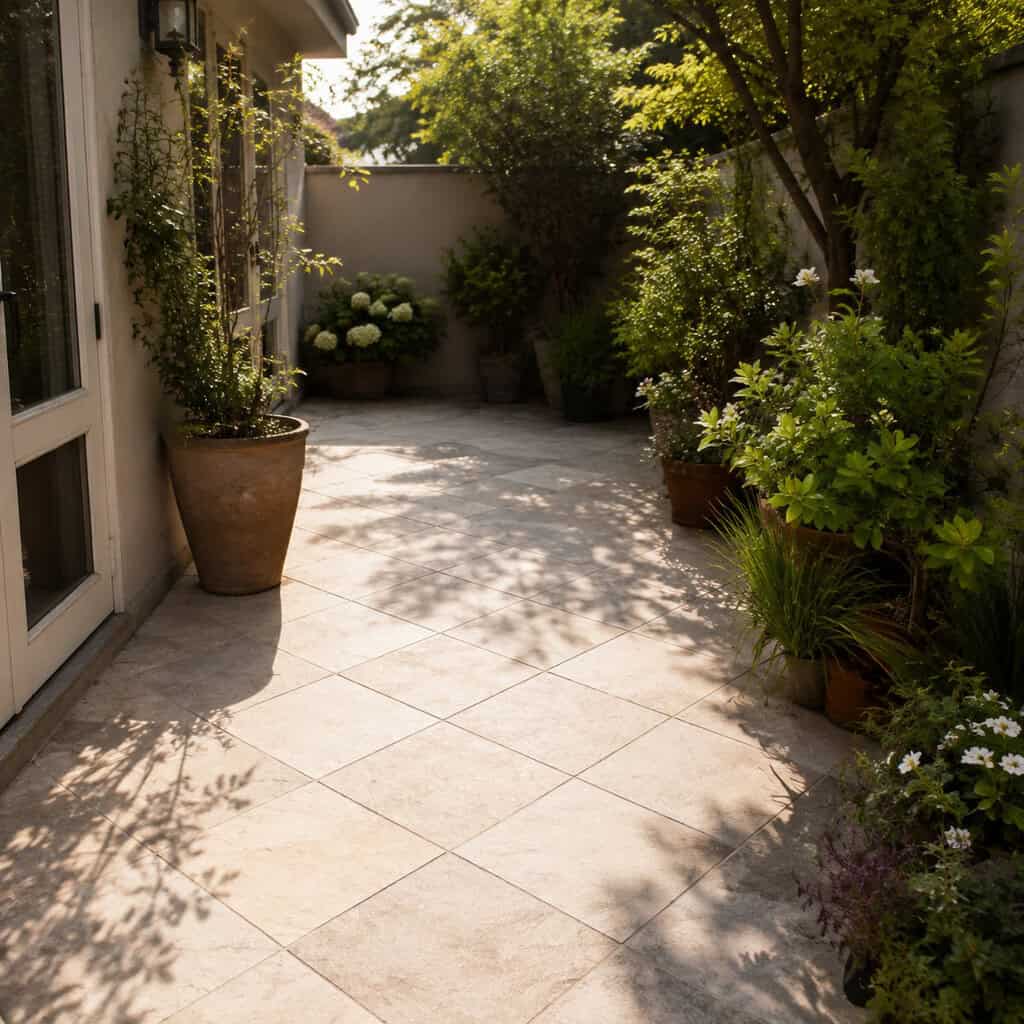
Decide this before you build anything. It’s pure geometry, and it’s the biggest free win on the list.
Run your pavers or deck boards at 45 degrees to the house instead of squaring them to the walls. A rectangle’s diagonal is always longer than its sides — that’s just math.
Your eye follows those lines to the far corner, tracking the longest possible dimension. A cramped 12-by-16-foot yard can read as roughly 40% deeper this way, according to the folks at Hadaa.
Nothing was added. The stone just points somewhere farther.
2. Add a Curving Path
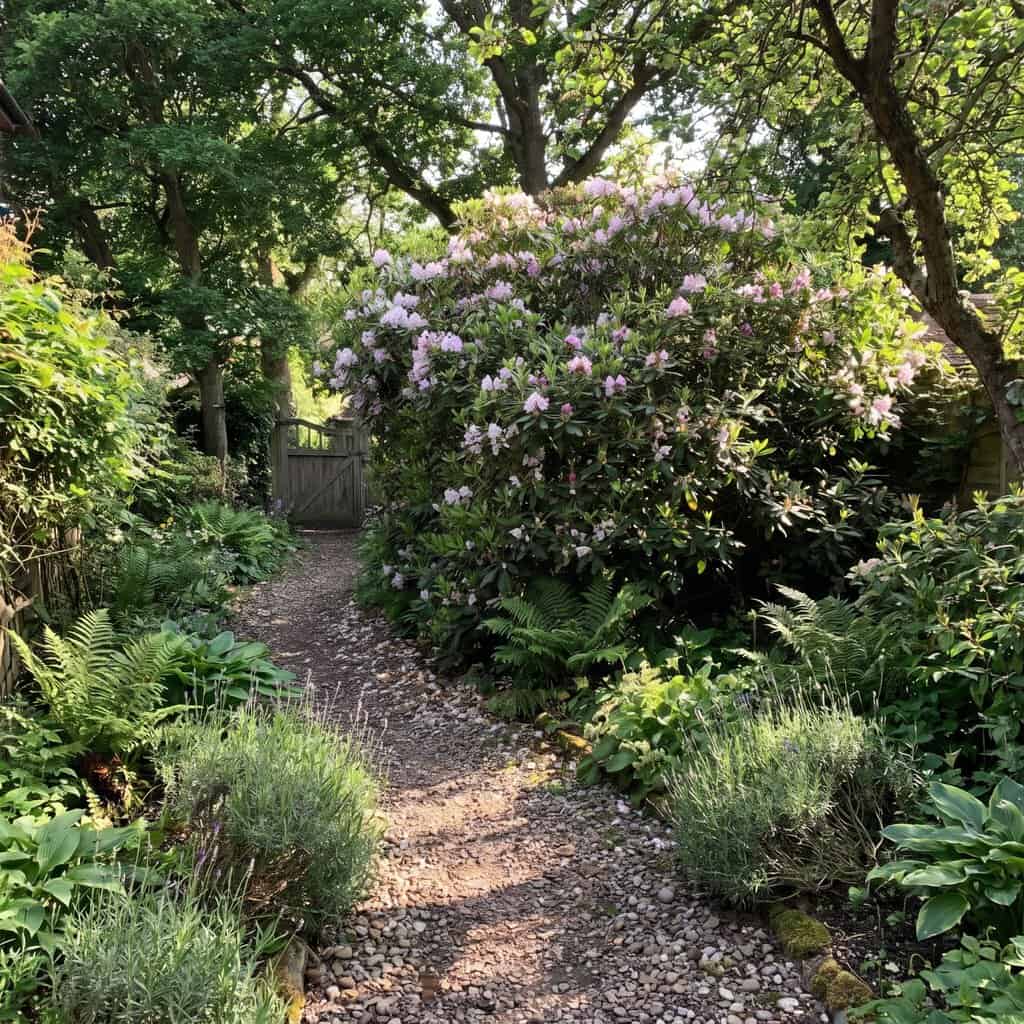
A straight path shows you the back fence in one shot. A curving one refuses to.
Wind the walkway so it bends out of sight behind a shrub or a pot. The eye tracks the full arc, and an arc is physically longer than a straight run.
Curves also pull your gaze side to side instead of firing it at the boundary. That widens a narrow, bowling-alley yard as much as it deepens it.
Hide the destination. The brain fills in more garden than exists.
3. Carve the Yard Into Outdoor “Rooms”
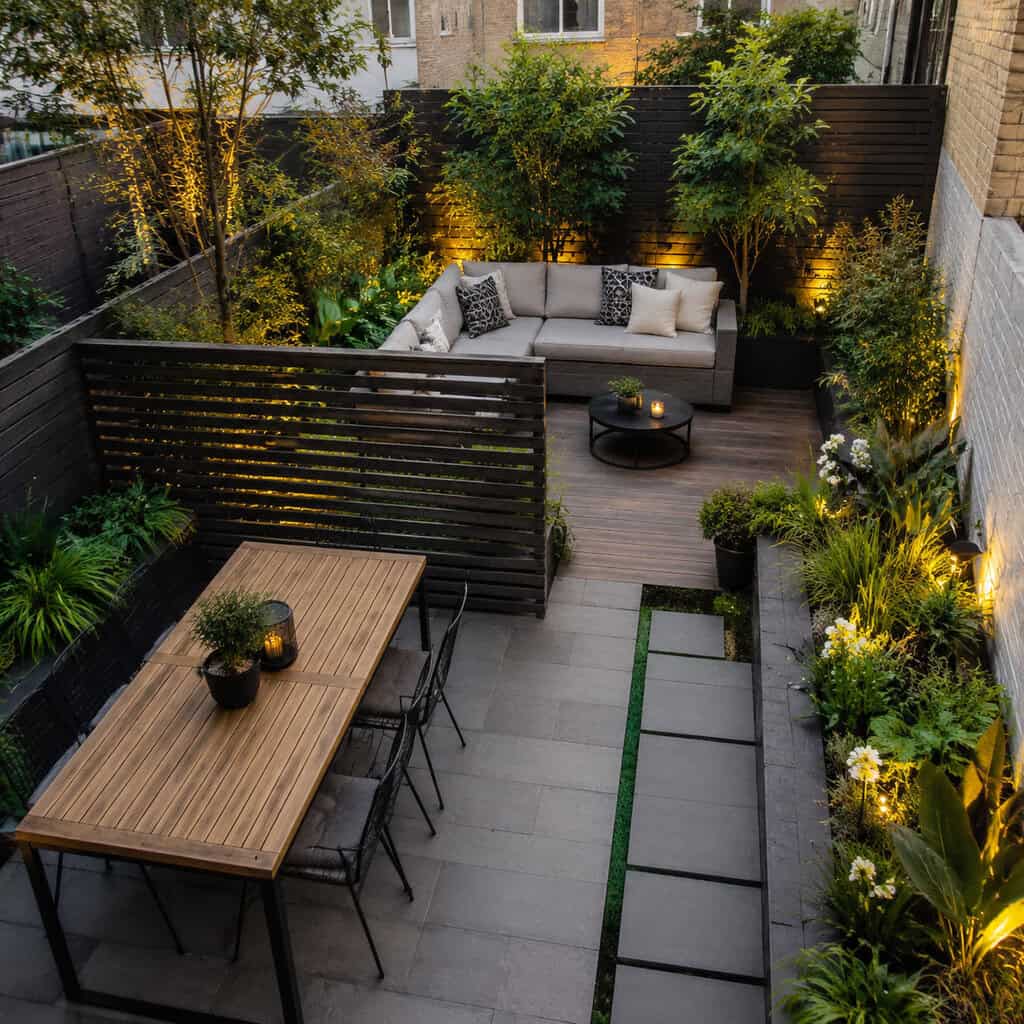
Here’s the move most homeowners get backwards. They keep the yard open, thinking empty space feels larger.
It doesn’t. An undivided yard shows you every limit at once.
Split it instead — a dining zone, a lounge corner, a planted border. Each one reads as a separate destination, and the brain counts destinations as space. Bob Vila calls this the “don’t reveal it all at once” rule, and it’s the principle behind half of everything else on this list. There’s a longer breakdown of the idea in this guide to turning a backyard into a real outdoor room.
4. Work in One Level Change
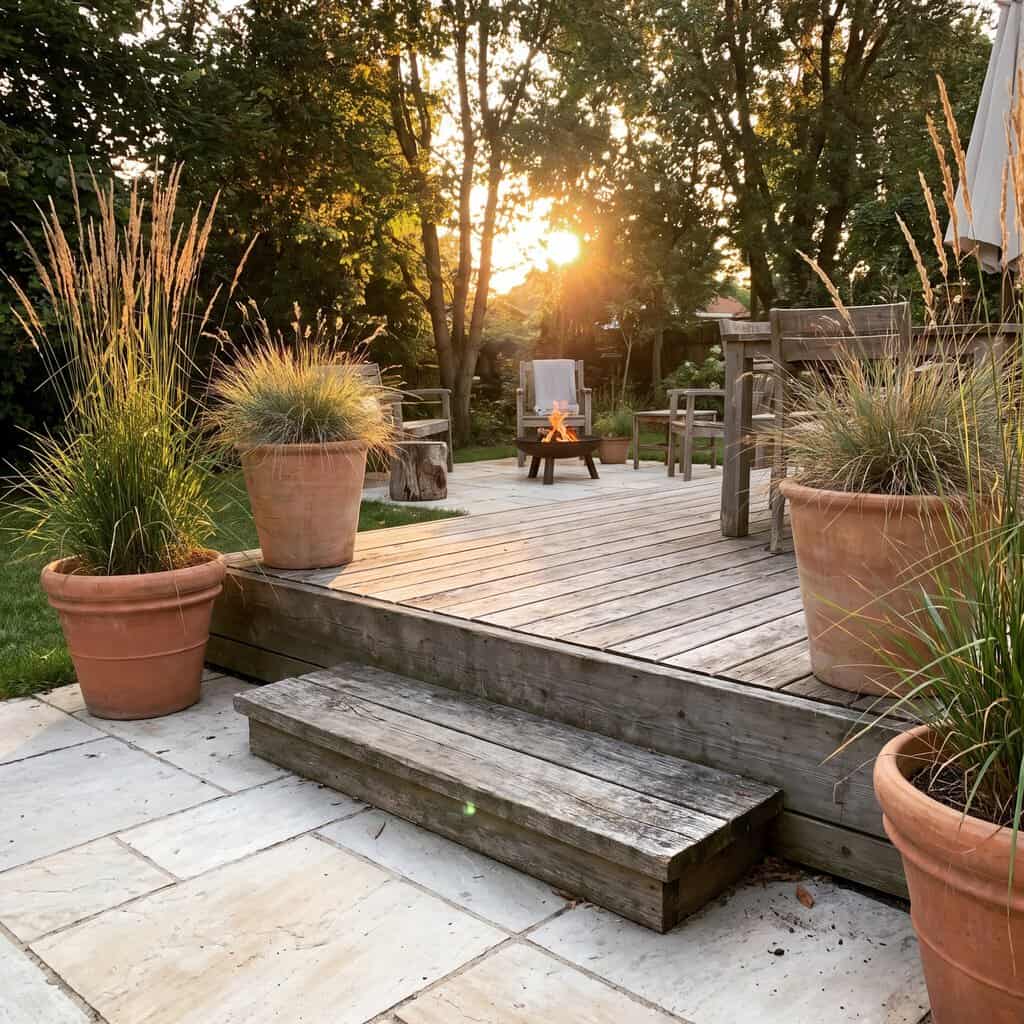
A single step does what a wall does, without eating the floor space a wall would.
Drop a 6-to-8-inch step between a raised deck and a lower patio. Suddenly you’ve got two perceived rooms where there was one flat rectangle.
One caveat, and it matters. Keep it to a single level change in anything under 400 square feet.
Multiple steps devour a tiny yard. One is a design feature. Three is a staircase.
5. Shrink the Lawn (or Lose It)
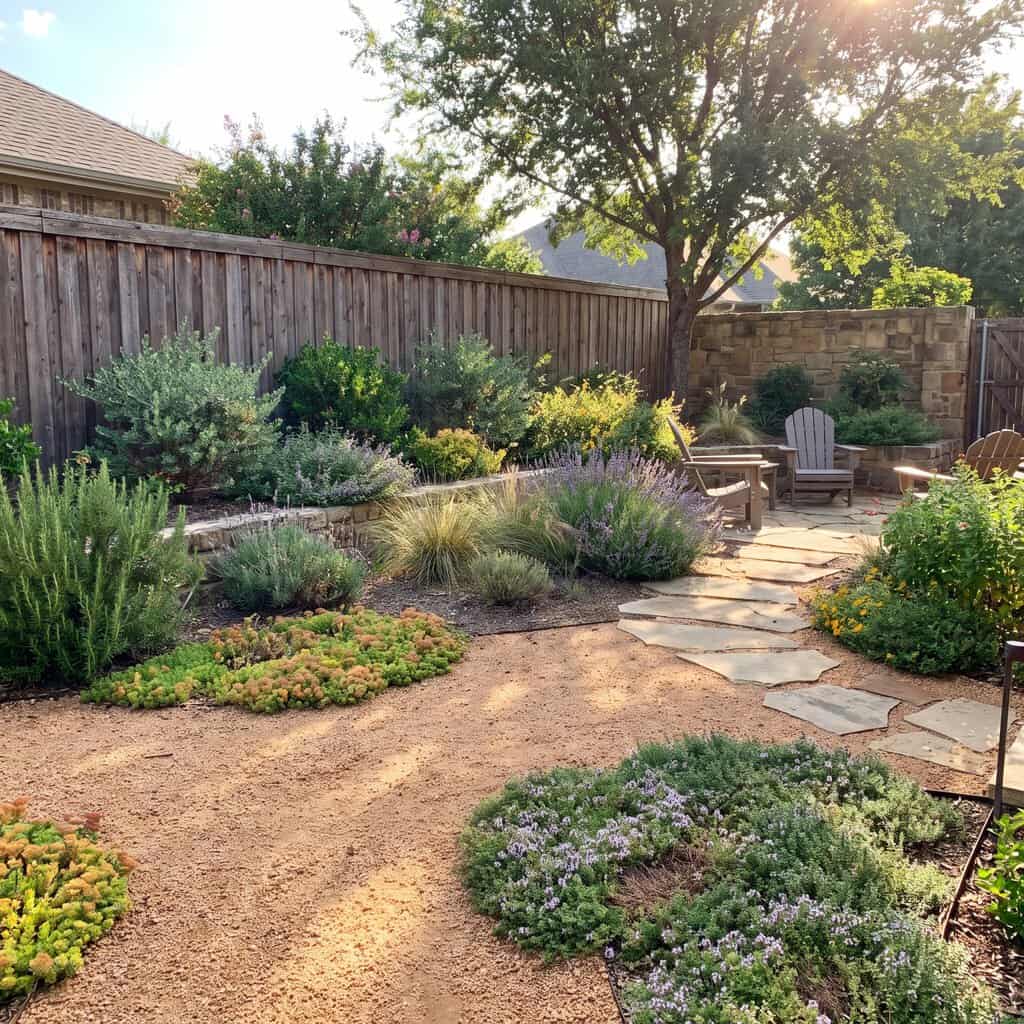
A small lawn is often the thing making your yard feel small. It sits there as a flat green rectangle that announces exactly how much ground you’ve got.
Swap it for gravel, ground cover, or paving with layered planting around the edges. That adds depth the lawn never could, and cuts the mowing to zero.
If you’d rather keep something soft underfoot, a low ground cover that replaces grass gives you green without the boundaries screaming back at you.
Lose it, or shrink it hard.
6. Choose See-Through Furniture
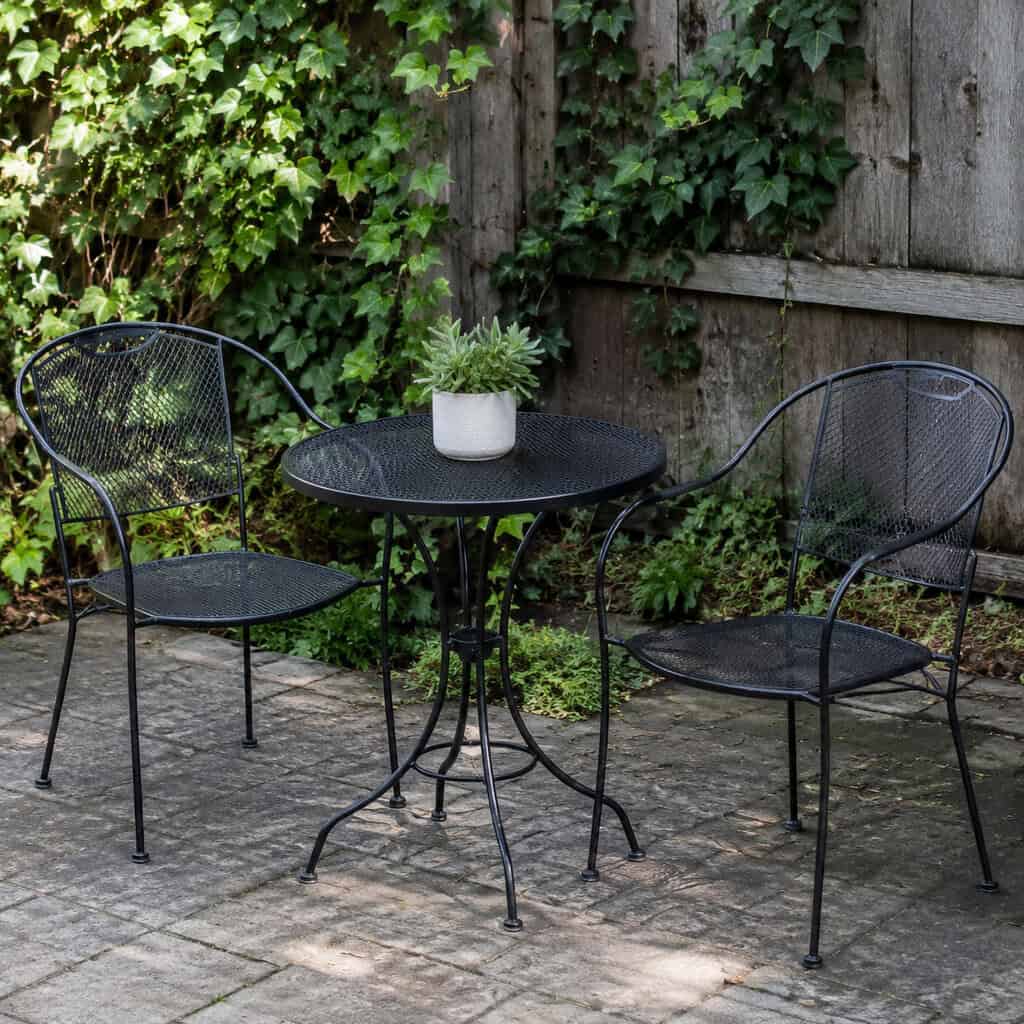
Solid, boxy furniture chops a small yard in half. Your eye hits it and stops.
Open-frame bistro sets, slim wicker, mesh chairs — the eye travels straight through them to the paving beyond. The seating area practically disappears.
Gardening Know How notes it’s the same logic interior designers use for cramped rooms. Glass tables, acrylic chairs, legs you can see under.
If you can see the floor through it, the space stays open.
7. Scale the Furniture Down to Fit
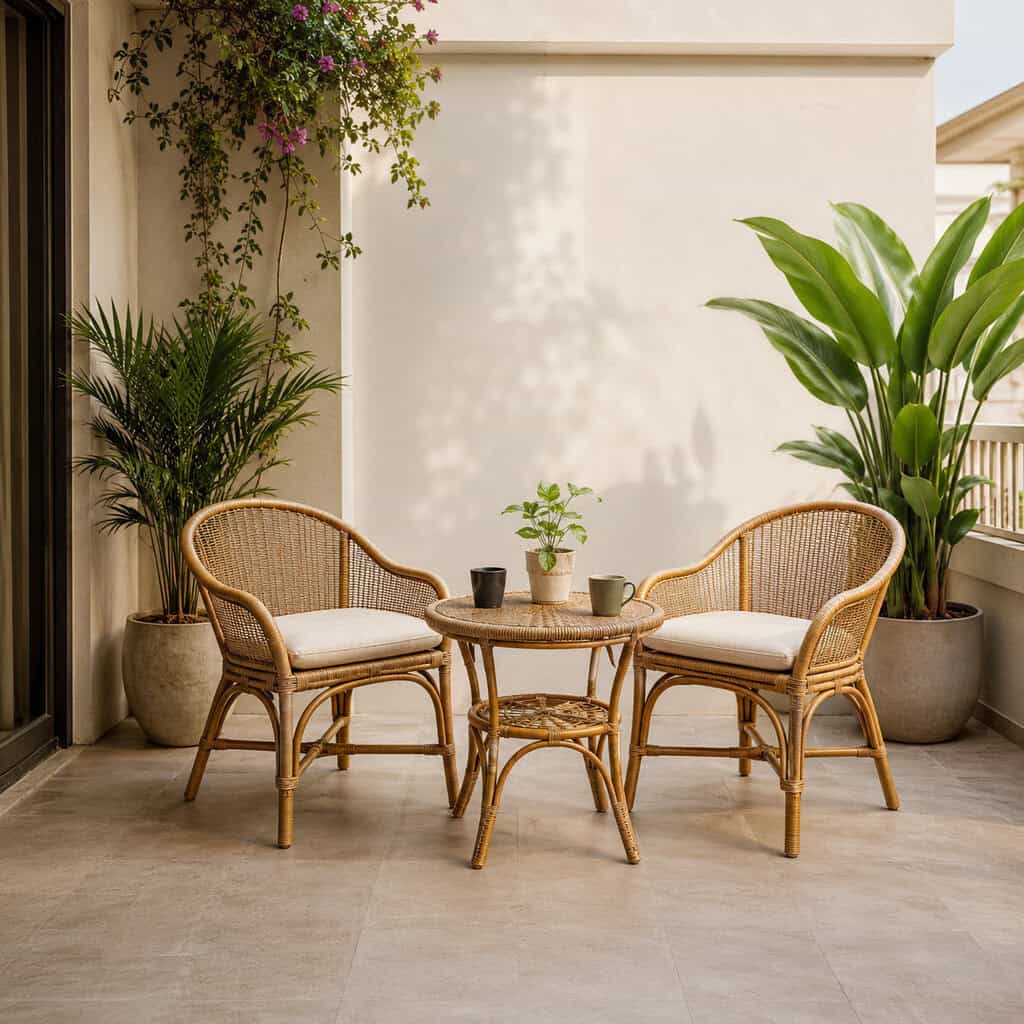
This is the fastest fix here, and it’s free.
A sectional built for an 800-square-foot patio will swallow 30 to 40% of a 200-square-foot yard. It turns your outdoor space into a storage room for cushions.
Two right-sized chairs beat one oversized sofa every time. Before you buy, plant, or paint anything — go drag out the biggest piece you own and see how the yard breathes without it.
8. Pick Double-Duty and Built-In Seating
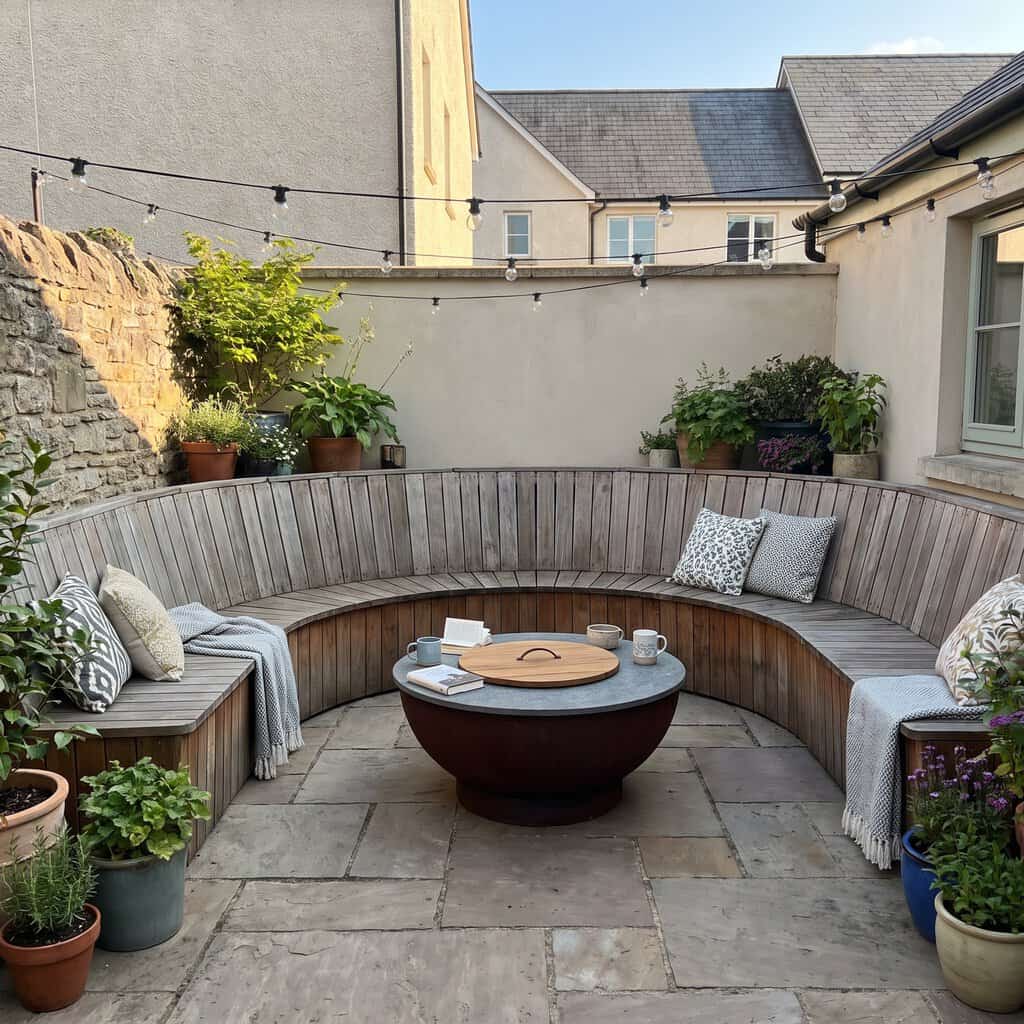
Every piece in a small yard should earn its footprint. If it only does one thing, it’s probably too big.
A bench with hidden storage. A fire feature that doubles as a low table. Built-in seats that hug the perimeter instead of floating in the middle.
Built-ins along the edges are the real trick. They keep the center open and walkable, which is exactly where a small yard needs to breathe.
9. Garden Straight Up
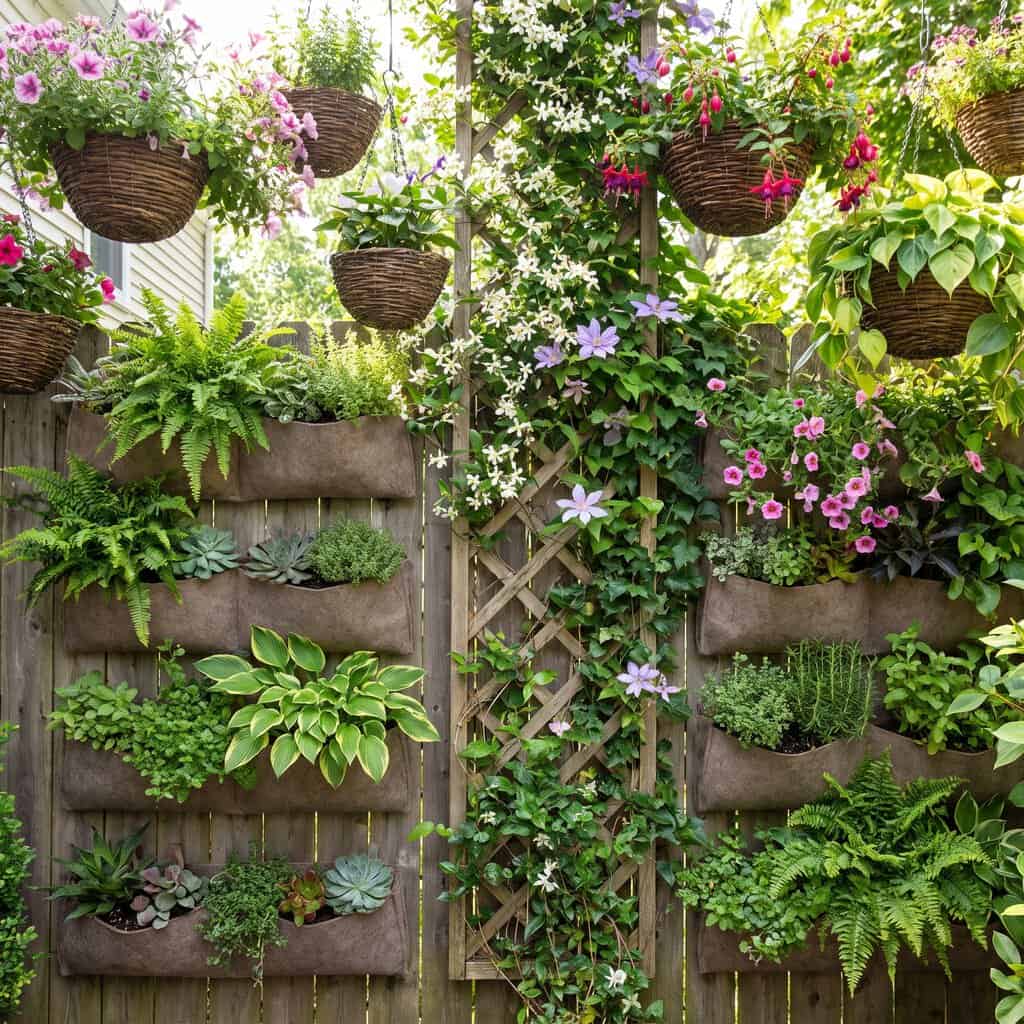
When you can’t grow out, grow up.
Wall planters, trellises, and hanging baskets add 20 to 40 square feet of greenery without touching a single square foot of floor. That’s real planting space you didn’t have.
Vertical elements also break up the flat horizontal field. The yard stops reading as a two-dimensional floor and starts reading as a three-dimensional volume.
A bare fence is wasted space. Cover it with a container garden that survives neglect and the whole wall pulls its weight.
10. Swap the Solid Fence for See-Through Screening
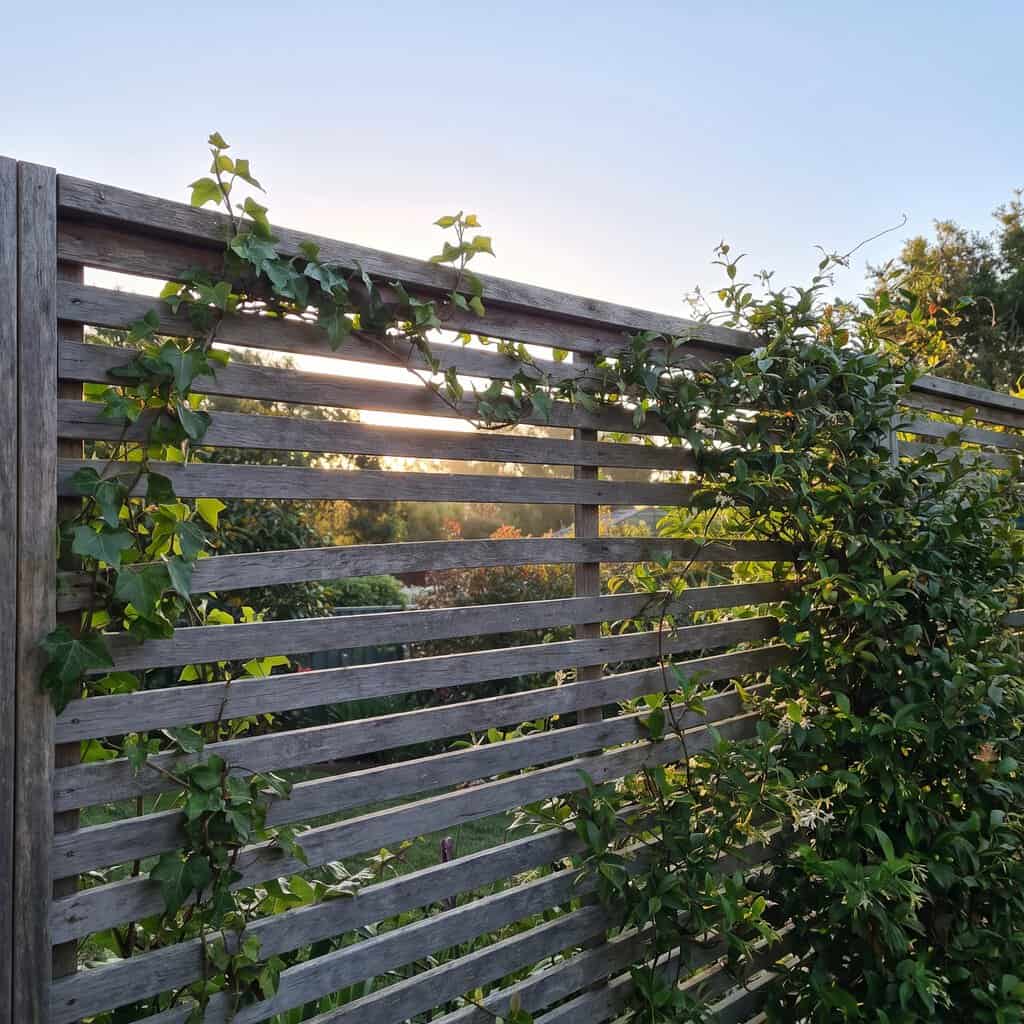
A solid 6-foot fence ends your yard dead at the property line. There’s nothing past it, as far as the eye can tell.
Slatted panels or a trellis with climbers, set at eye level, block the neighbors but leak glimpses of borrowed greenery and sky. Your space visually bleeds past its legal boundary.
The Japanese call this shakkei — borrowed scenery. You’re annexing the view next door without owning it.
11. Hang an Outdoor Mirror
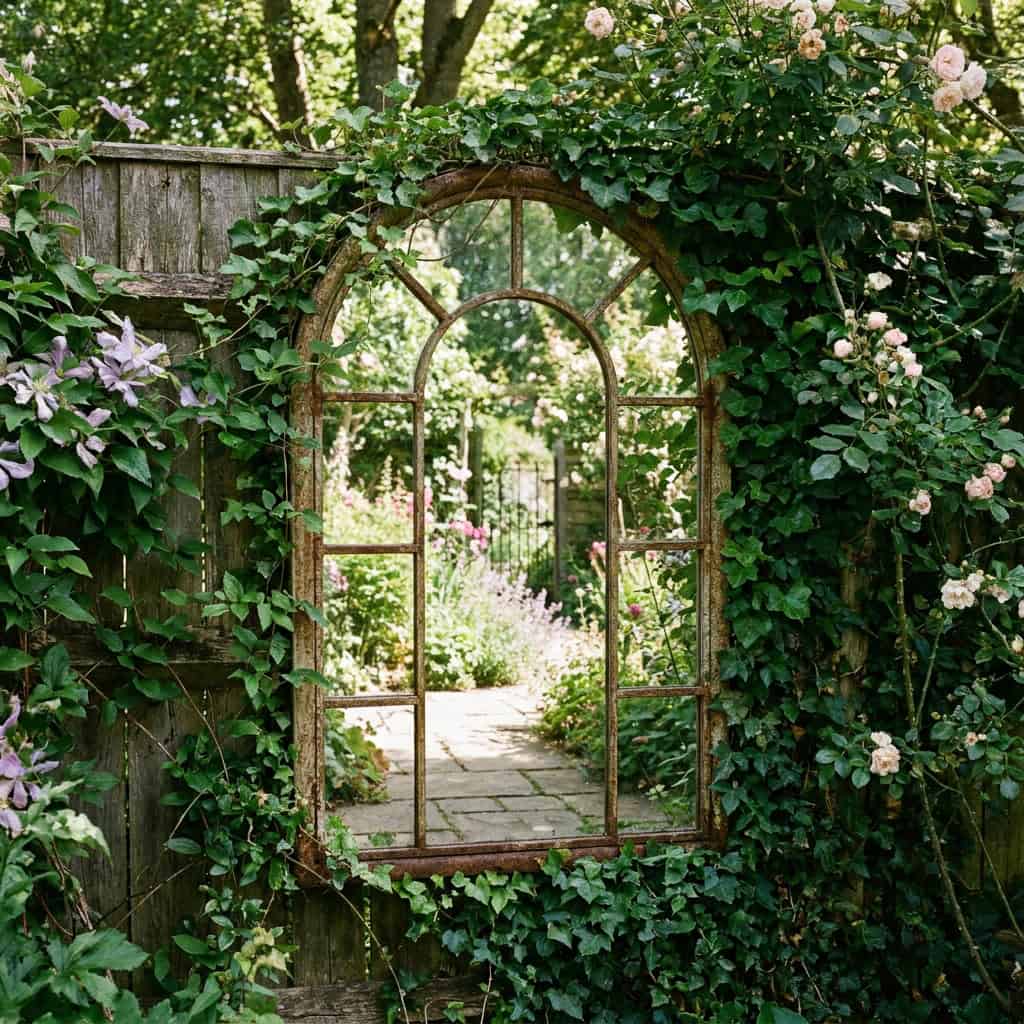
This is the classic depth-doubler, and it works better than almost anything else on this list. It also carries the most risk, so read the whole thing.
A weatherproof mirror at eye level on a fence reads as a window into a second garden. Frame the edges with climbing plants so the frame disappears, and the illusion holds — the space can feel up to twice its actual depth.
Now the safety part, which is not optional.
Never mount a mirror where direct sun hits it for hours. A mirror focuses sunlight the way a magnifying glass does, and aimed at dry timber decking, a wooden fence, or a bin store, it’s a genuine fire risk. Lazy Susan flags this as the number-one mistake people make. Put it in shade, or somewhere the sun only grazes it.
Then there’s the birds. A mirror reflecting open sky and greenery looks like clear flight path to a bird, and they’ll fly into it — sometimes fatally.
Keep mirrors off obvious flight lines, break up the reflection with planting across the surface, and angle it slightly downward toward the ground rather than straight out into the yard. Angling down also happens to reflect more paving and less sky, which reads as more garden anyway.
Done right, it’s magic. Done carelessly, it’s a hazard. Respect both.
12. Keep the Flooring Continuous and Pale
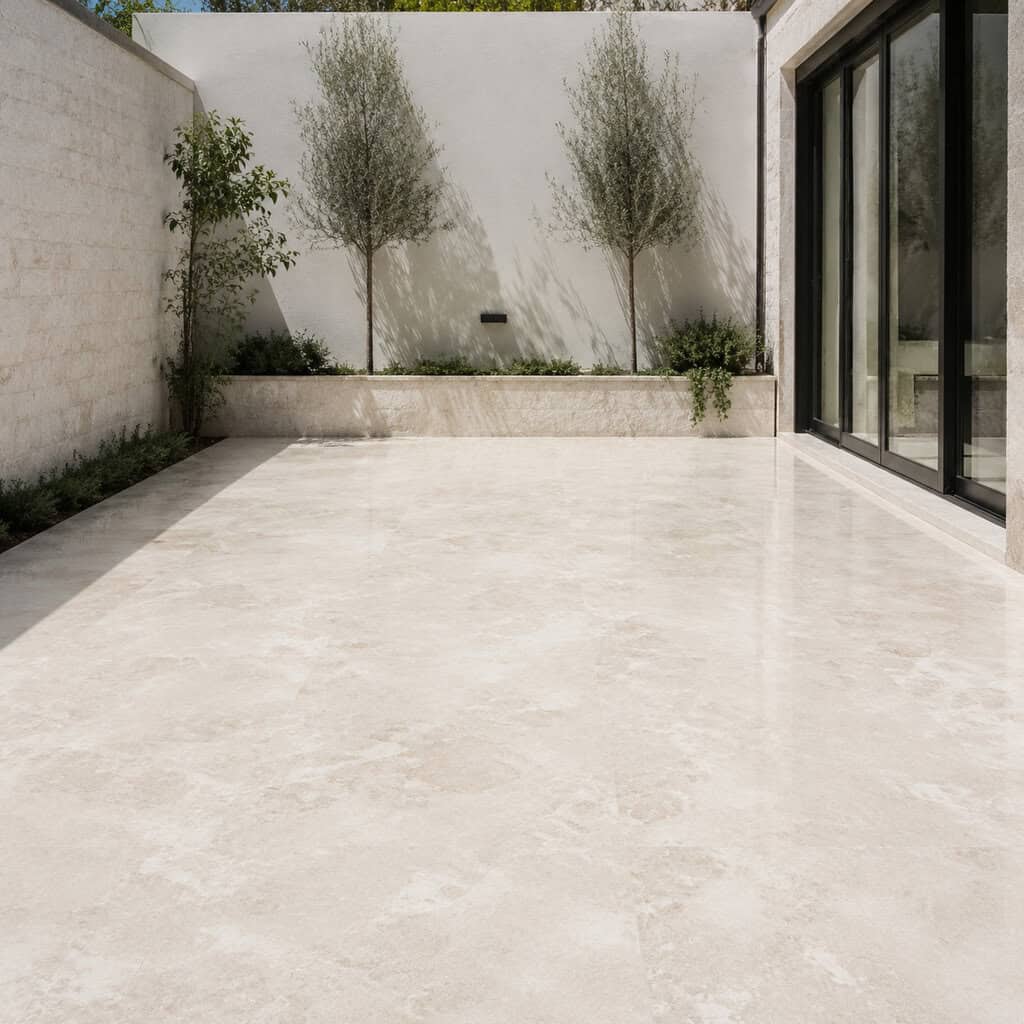
Three mixed materials chop a small yard into three small pieces. One continuous surface reads as one bigger space.
Pick a single flooring and run it wall to wall. Fewer seams, fewer visual walls.
Go pale while you’re at it. Light-colored pavers bounce far more light than dark finishes, throwing brightness into the shaded corners that usually feel cramped and dead.
A washed-out limestone or pale concrete makes the whole yard feel open and airy.
13. Paint the Back Fence a Dark, Receding Shade
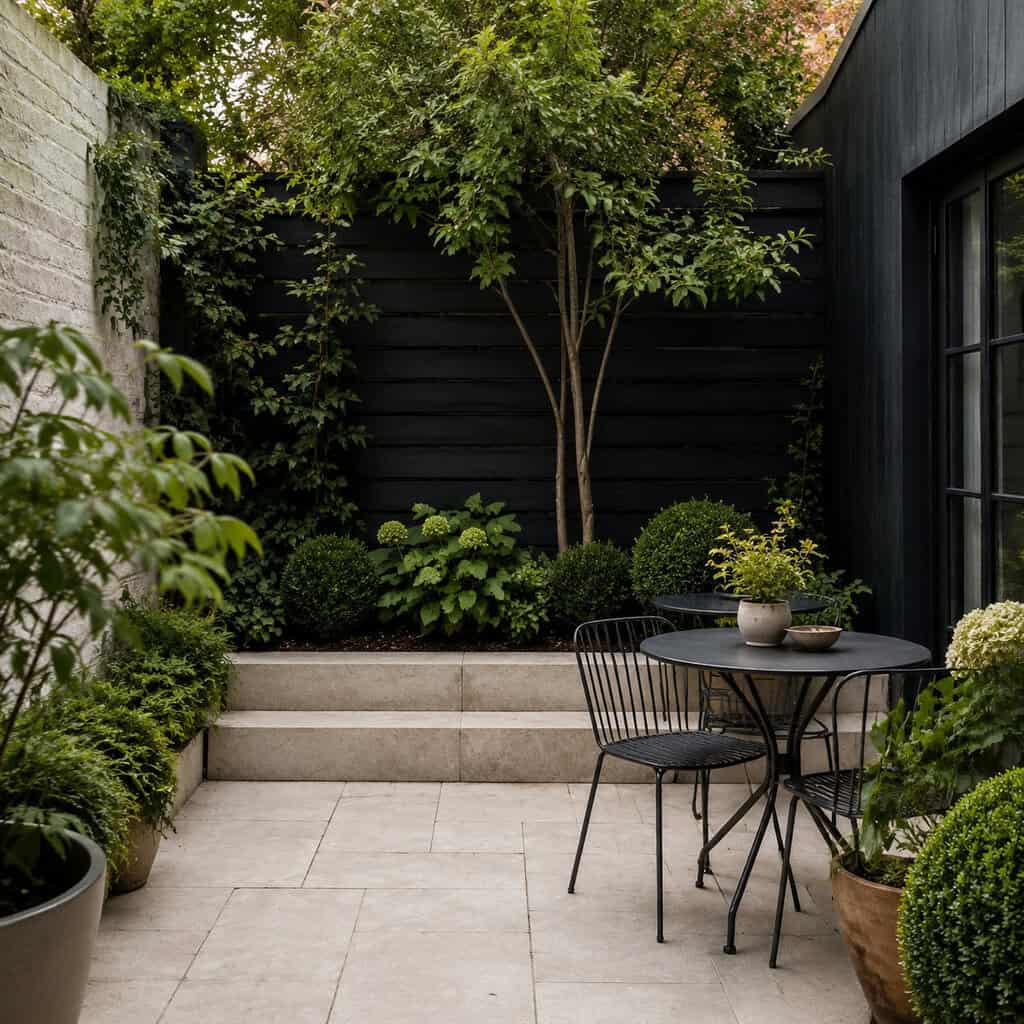
The floor goes pale. The back fence goes the opposite direction.
Paint the rear boundary a deep charcoal, near-black, or dark green, and it appears to recede. Dark colors read as distance — the wall seems to step back, and the yard gains depth it doesn’t have.
It feels wrong until you do it. A dark fence vanishes into shadow instead of hemming you in.
Save the pale tones for the side walls and the ground. The back one wants to disappear.
14. Layer Planting in Three Heights
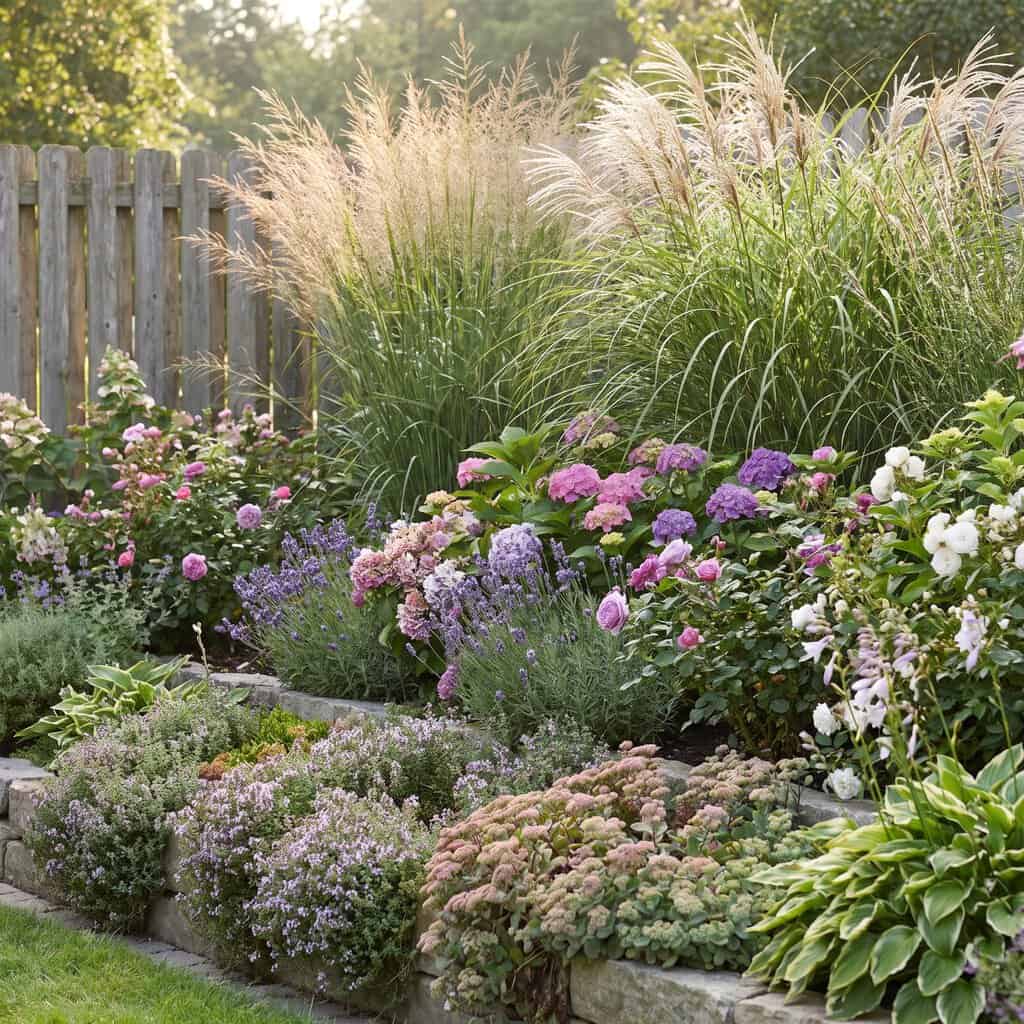
Flat beds keep the eye moving in two dimensions. Layered ones send it up.
Build every border in three tiers — something tall at the back, something medium in the middle, something low at the front. Never two the same height side by side.
That vertical journey makes the space feel more expansive, per the designers at Fine Gardening. It also softens and hides the fence line, which stops the yard feeling boxed in.
For a border that carries all three tiers year-round, lean on flowering shrubs that bloom for months.
15. Plant Bold in the Foreground
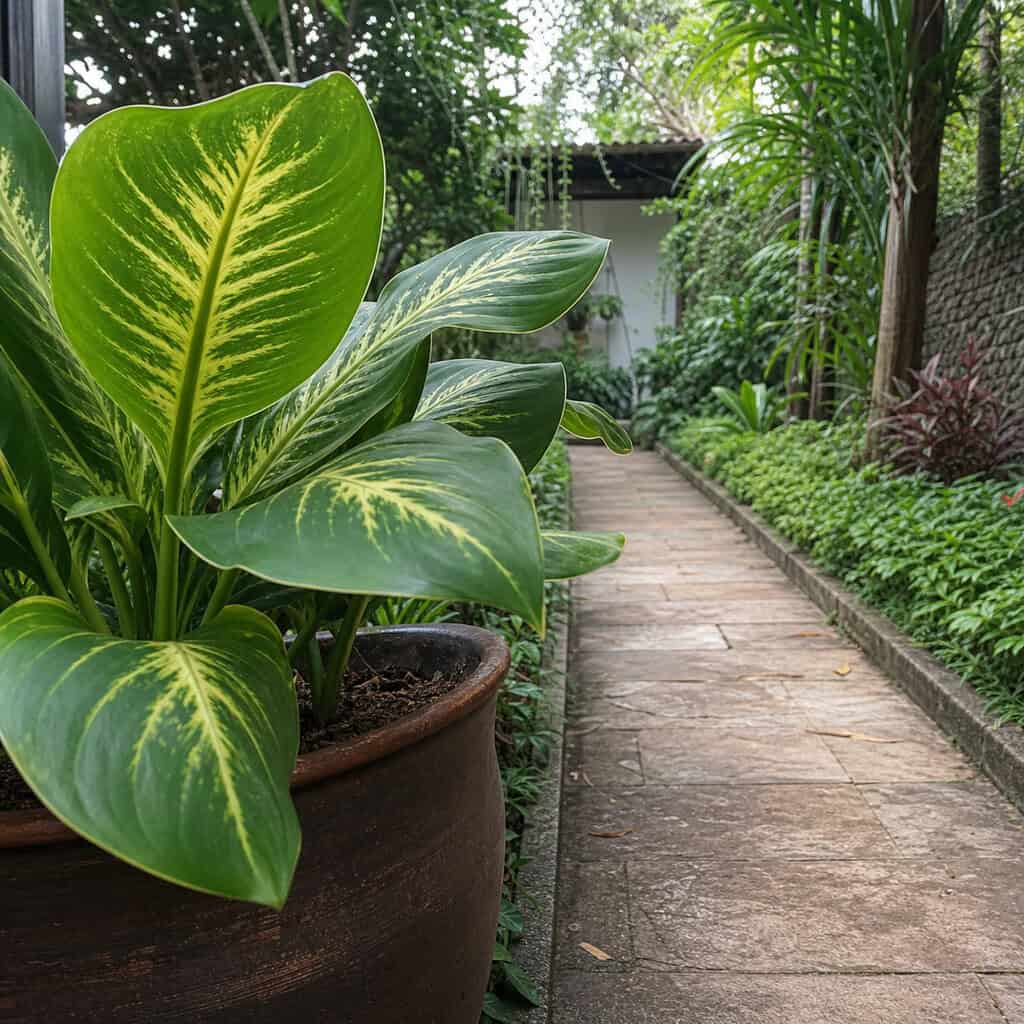
Landscape painters have faked distance for centuries with one trick. Big things up front, fine things at the back.
Put a large shrub, a bold pot, or a small tree close to the house. It stops the eye from racing straight to the boundary and gives it a foreground to measure everything against.
Then keep the planting at the far end finer and more uniform. The contrast exaggerates the depth between them — forced perspective, straight off a canvas.
Big and near. Small and far. That’s the whole illusion.
16. Give It One Strong Focal Point
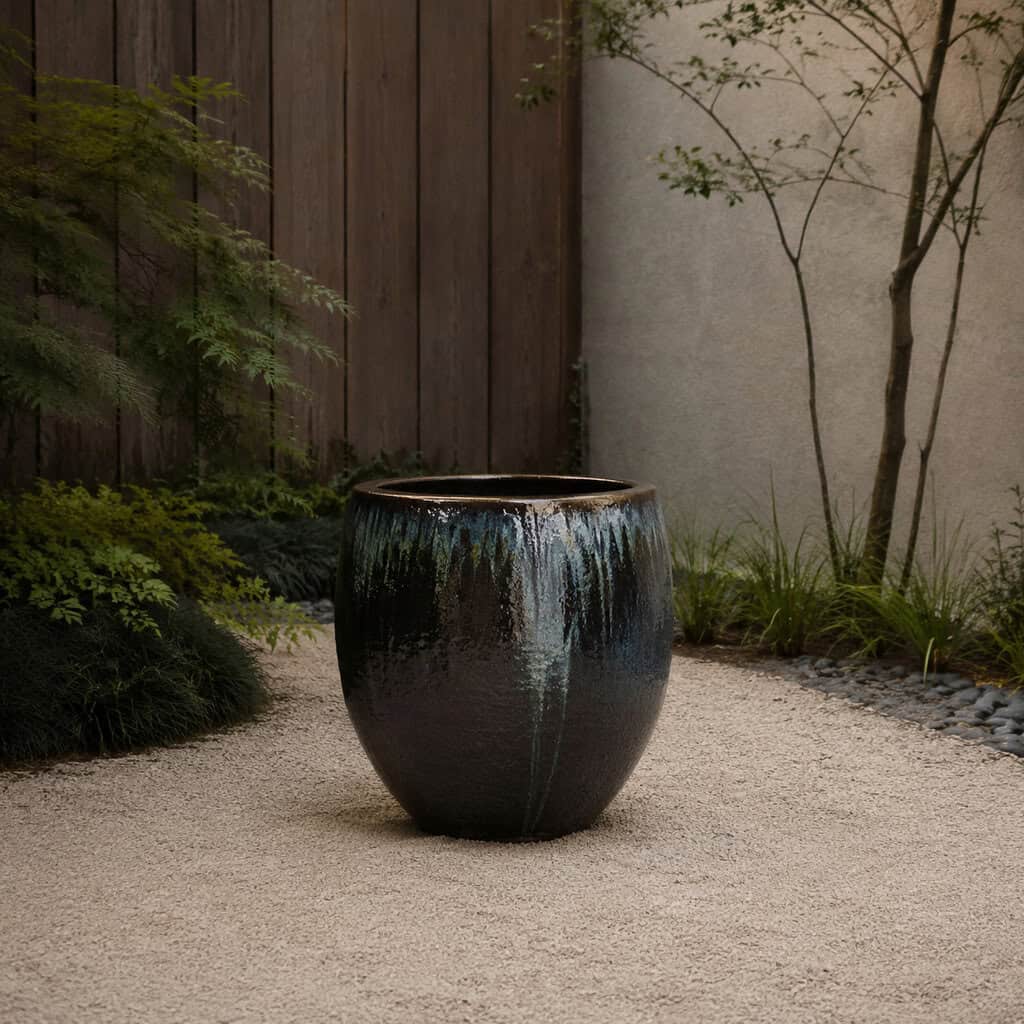
Five features fighting for attention make a yard feel busy and cramped. One hero pulls the whole thing together.
A single standout — a sculptural pot, a specimen tree, a water bowl — anchors the space and pulls your eye off the cramped edges. The corners stop mattering.
Gardening Know How calls it the “one hero” rule. Pick your one thing. Let everything else support it.
More features, less space. Fewer features, more room to breathe.
17. Add a Water Feature or Container Pond
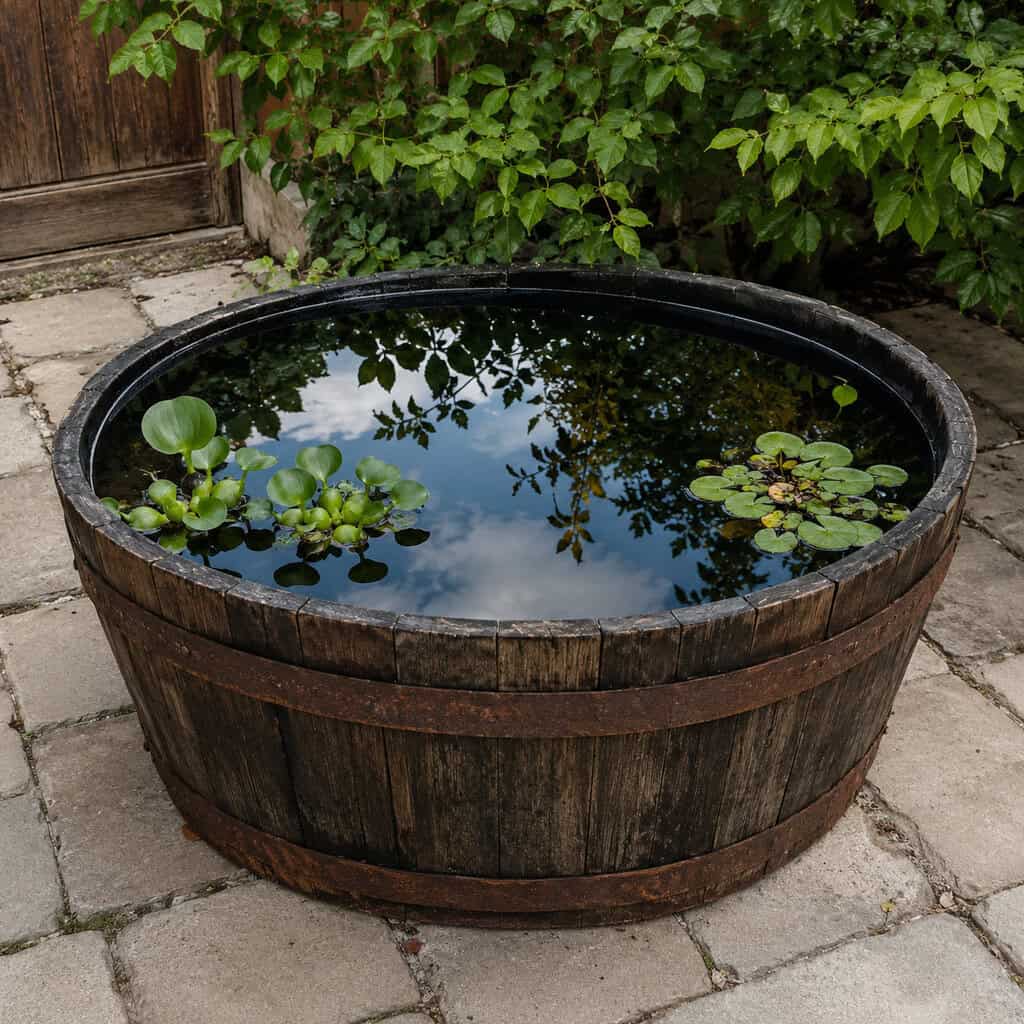
Still water is a horizontal mirror. It reflects sky and greenery straight up, doubling the sense of space the same way a wall mirror does.
It also gives you a focal point and a soft sound at once — the trickle covers traffic and neighbors.
You don’t need to excavate. A container pond in a half-barrel or a glazed pot delivers the whole effect on a paved courtyard, which makes it perfect for the smallest, most hardscaped yards.
Sky in a bowl. That’s a lot of reflected space for a barrel.
18. Choose Trees That Grow Up, Not Out
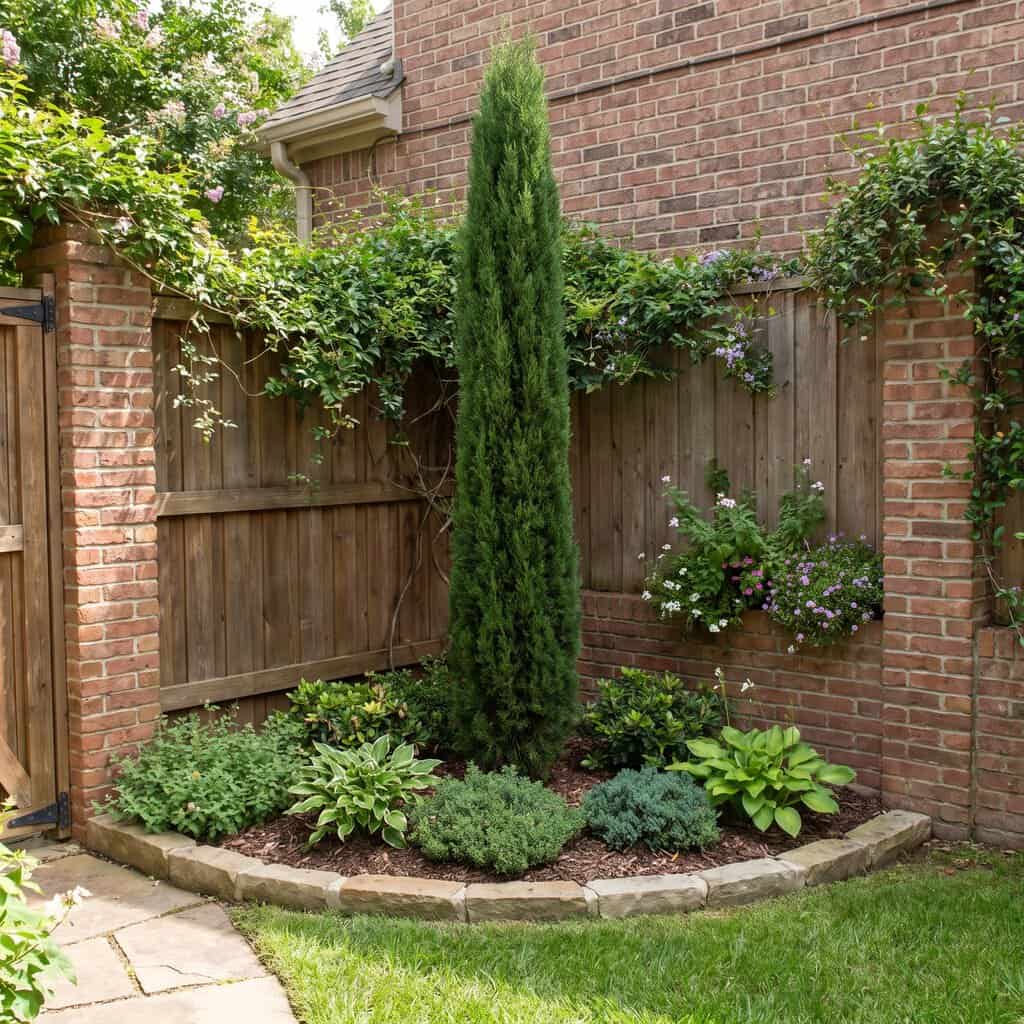
The instinct in a small yard is to skip the tree entirely. Nearly every designer says that instinct is wrong.
A small yard needs a tree more than a big one does — it’s the vertical anchor everything else hangs off. The trick is picking one that grows up, not out.
Columnar evergreens, multi-stem specimens, and dwarf varieties like a ‘Little Gem’ magnolia give you lush height without a spreading canopy that eats the footprint. Just check the mature size first, because what that tree becomes in five years is what actually matters.
19. String the Lights High, Layer the Glow
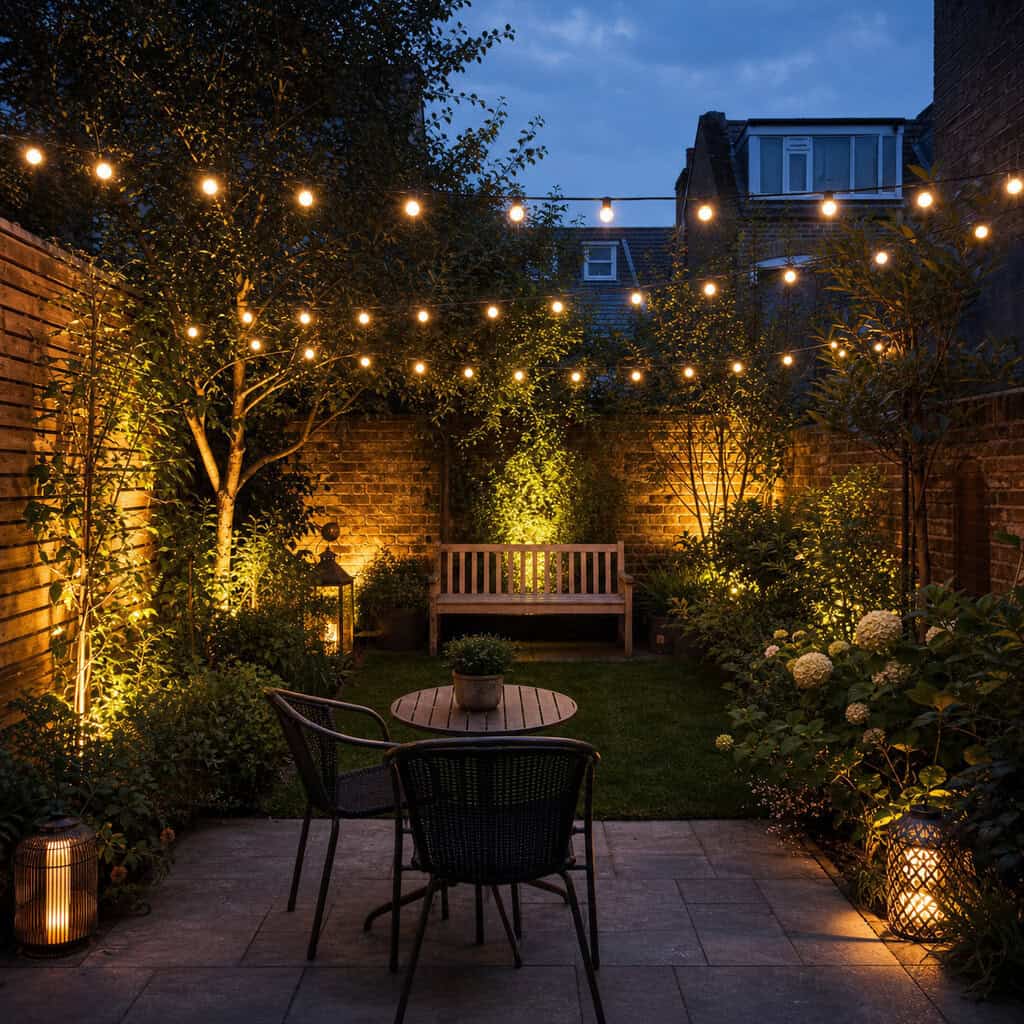
Festoon lights strung as high as you can reach make the yard feel taller. Up close, the eye reads the boundary as higher than it is, and the whole space stretches upward.
Then layer three sources of light — the high strings, a couple of lanterns at seat level, a low glow in the beds. The eye travels between the pools of brightness, and that journey reads as distance.
It also buys you hours. A yard you can use after dark feels bigger simply because you’re in it more.
20. Go Bold, Not Busy
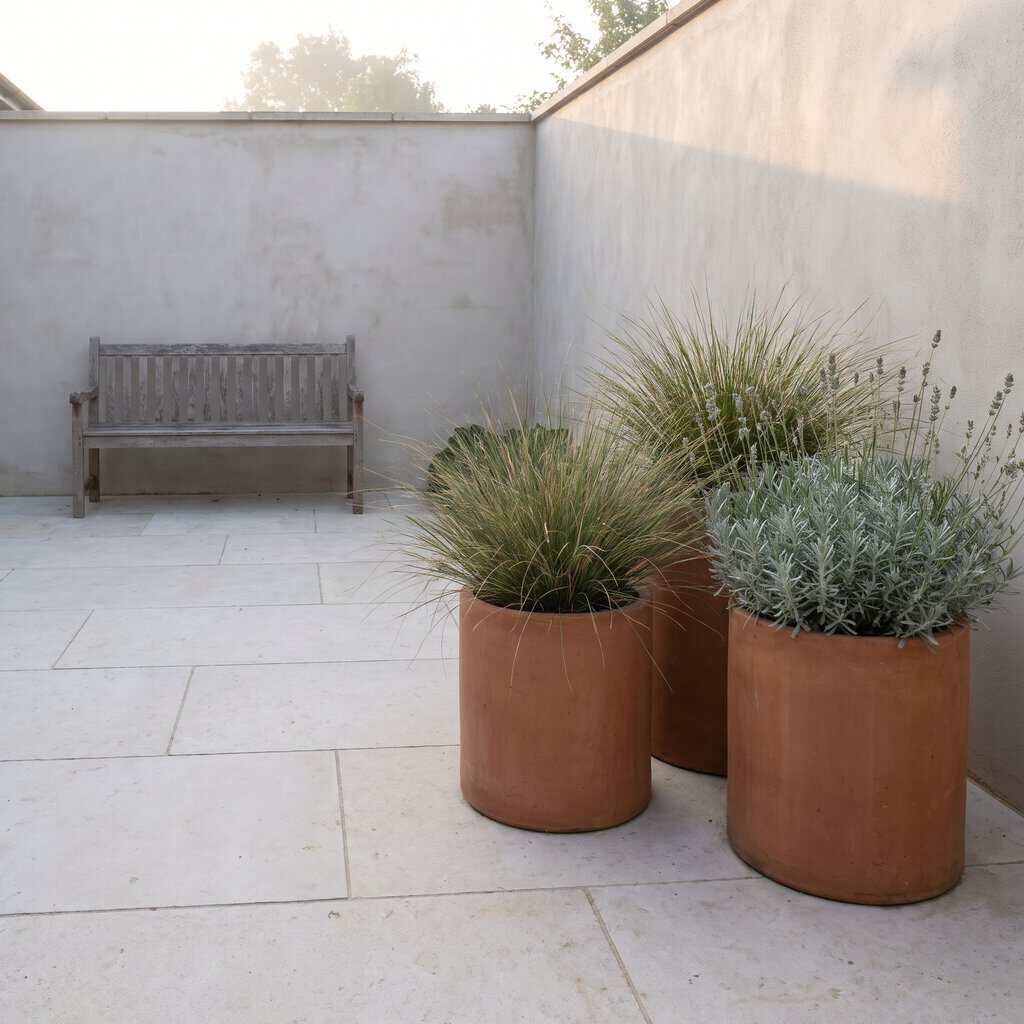
Twenty little pots and a dozen fussy plants clutter a small yard into chaos. The eye can’t rest, and clutter always reads as smaller.
Limit the palette. Five to ten plants, repeated throughout, plus big pots and large-format paving.
Repetition calms the whole thing down and ties it into one cohesive space instead of a jumble of unrelated bits. As Gardens Illustrated puts it, fewer and bigger wins.
Bold, not busy. Repeat, don’t collect.
21. Round Off the 90-Degree Corners
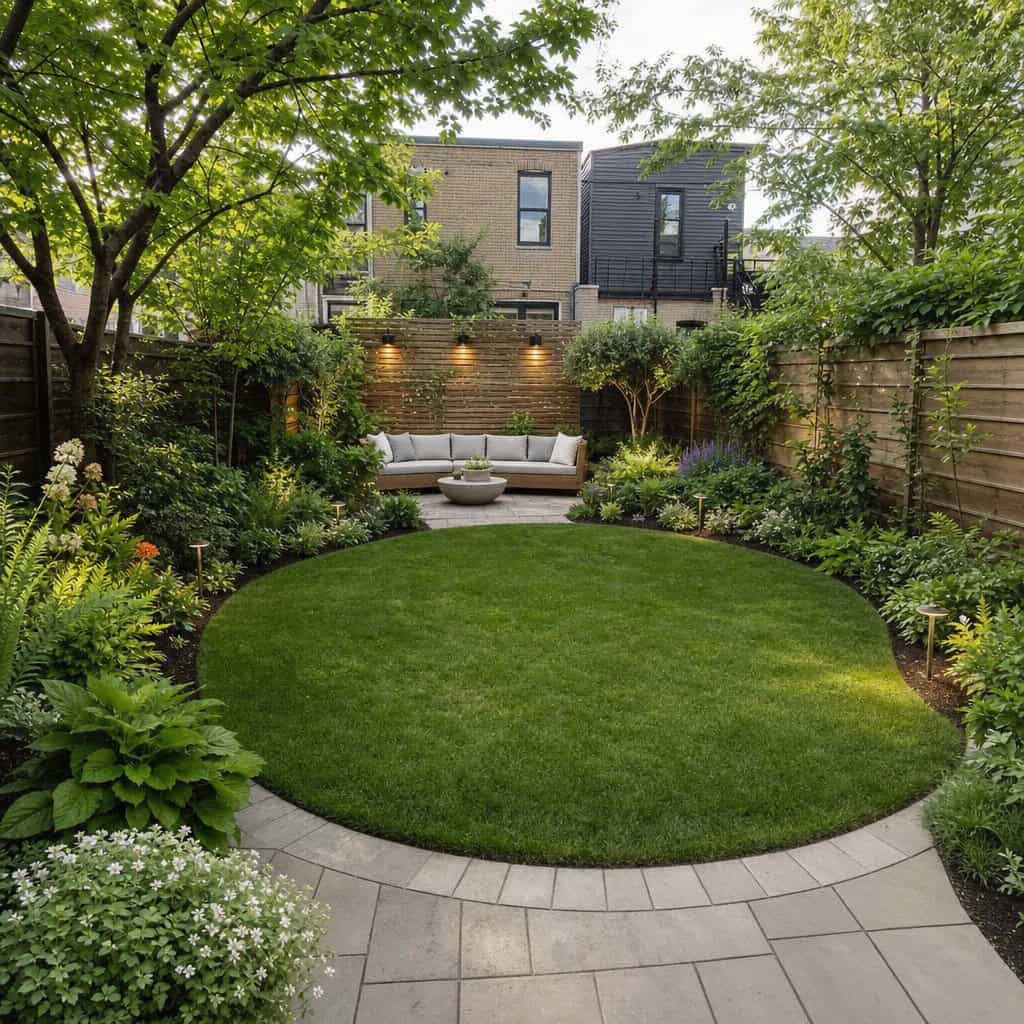
A boxy yard is a stack of right angles, and every one of them broadcasts the exact dimensions of your plot.
Soften them. Swap sharp corners for obtuse angles, a circular lawn, or curved bed edges.
A curved line is longer than a 90-degree corner, and it blurs the hard boundaries the box relies on. The plot suddenly feels more generous and a lot more relaxed.
Straight lines confess the size. Curves keep the secret.
22. Blur the Line Between Indoors and Out
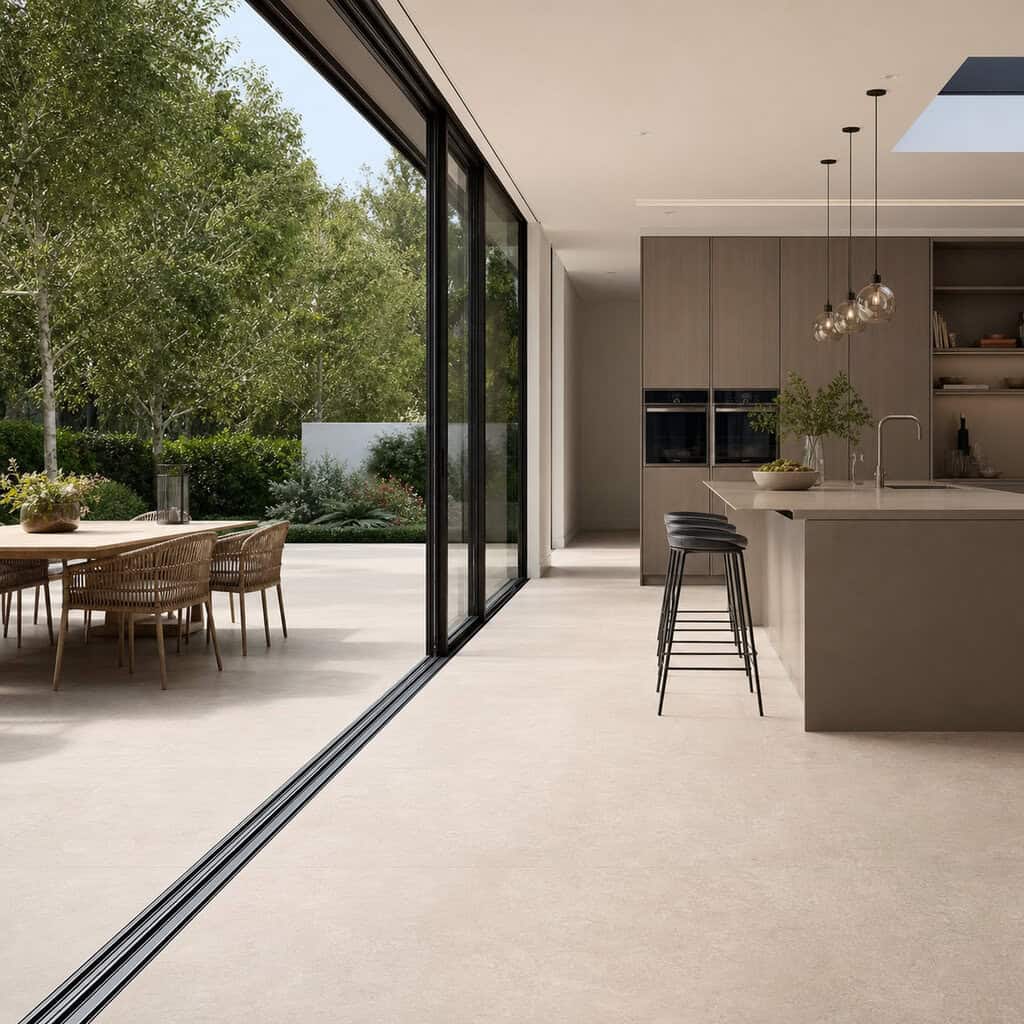
The cheapest square footage you’ll ever add is the room you already have inside.
French doors, big glass sliders, and the same flooring running from the kitchen straight out to a level threshold — all of it makes the yard read as an extension of the house. Both spaces borrow from each other and feel larger for it.
It started as a warm-climate trick. It works anywhere the door opens.
When inside and outside share a floor, the eye stops registering where one ends.
23. Put the Side Yard to Work
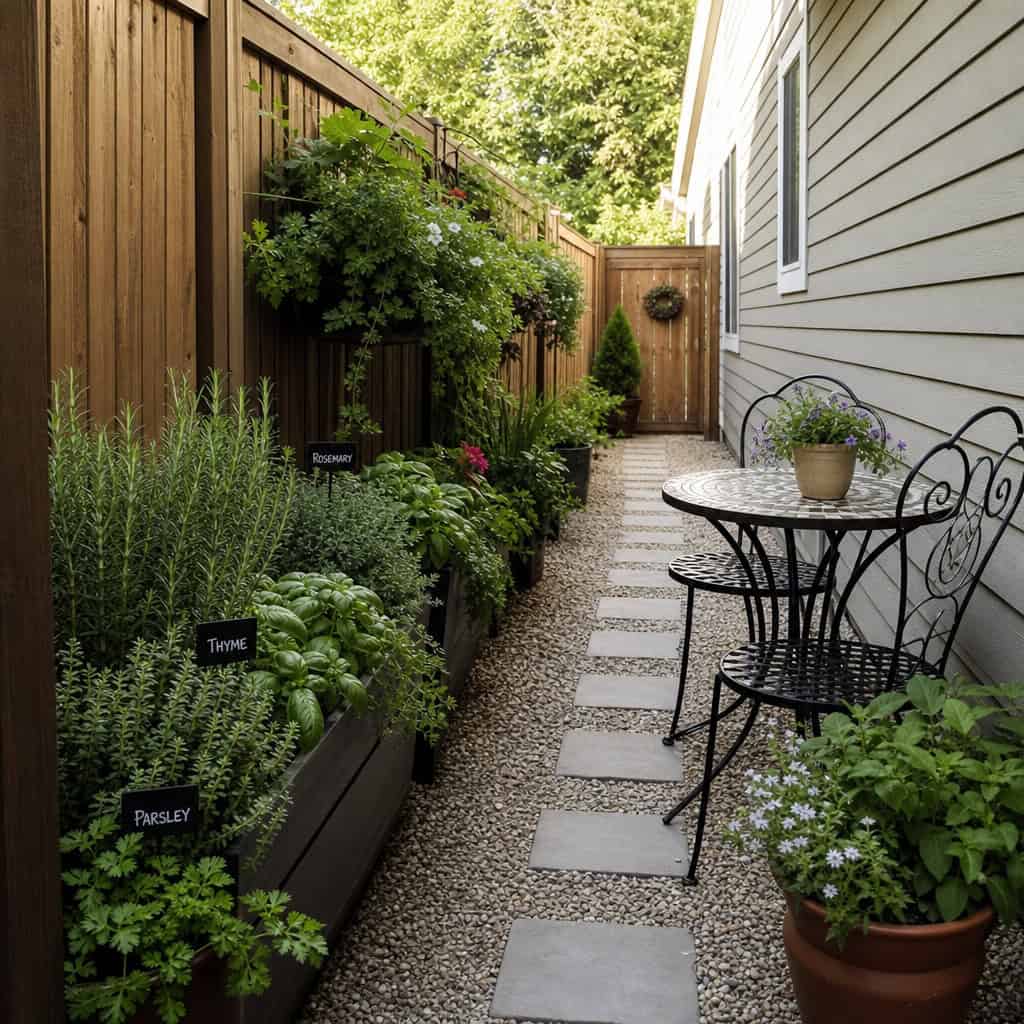
The most wasted square footage you own is that narrow strip down the side. Right now it holds the garbage cans and a coil of hose.
Reclaim it. A slim herb garden, a single café table, a gravel path connecting front to back.
Suddenly that dead strip is part of the design, stitched into the rest of the property. The whole place feels bigger because you’re finally using all of it.
Before you dress it up, check that the strip isn’t a drainage channel in disguise — a soggy side yard needs the flooding sorted first.
24. Add a Gate, Door, or Mural to “Somewhere Beyond”
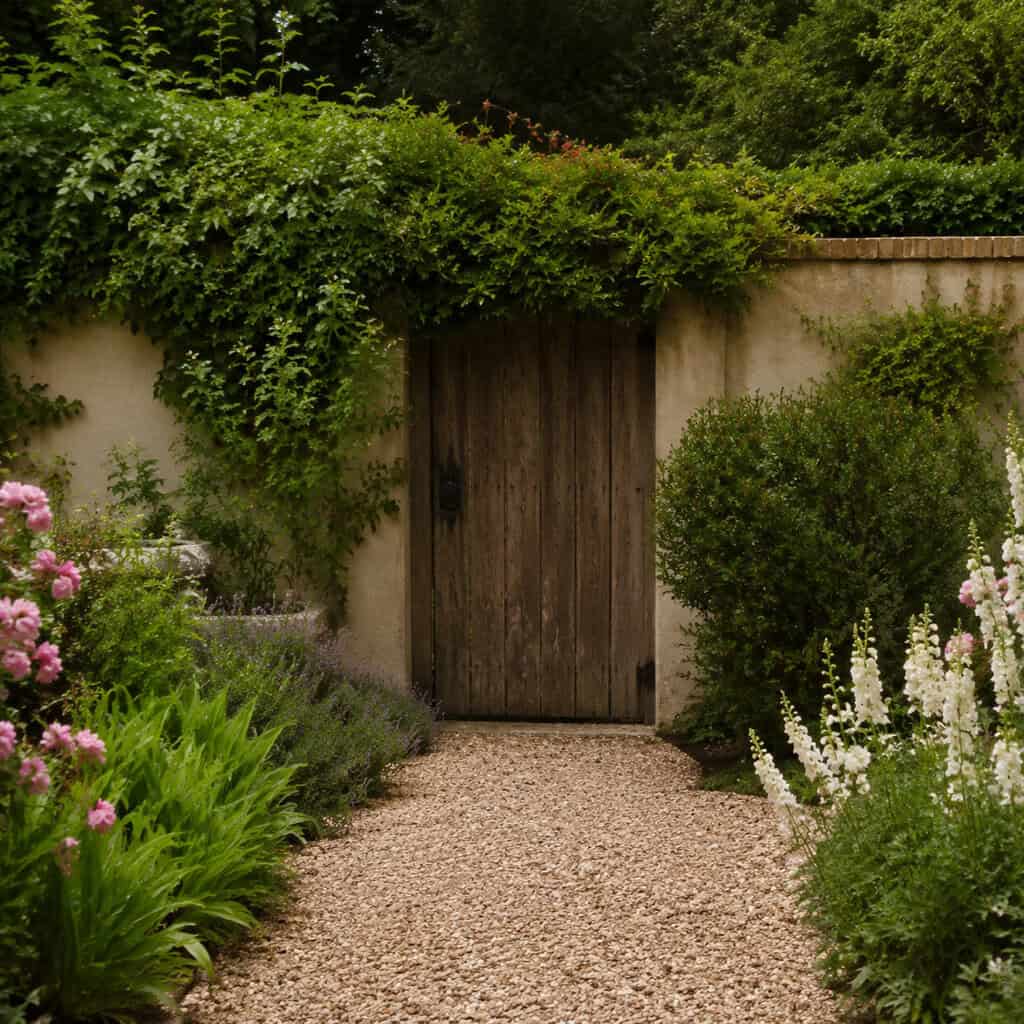
A path that leads to a closed gate makes everyone assume there’s more garden behind it. There isn’t. That’s the point.
Set a door or a gate into a boundary wall, aim a walkway at it, and the mind invents a whole second space you don’t have.
No wall to spare? A painted mural or a light trompe-l’oeil scene of an archway does the same job, and the pale paint bounces extra light around while it fools you.
It’s playful, it’s cheap, and it works on everyone who walks in.
25. Edge Your Garden Beds Cleanly
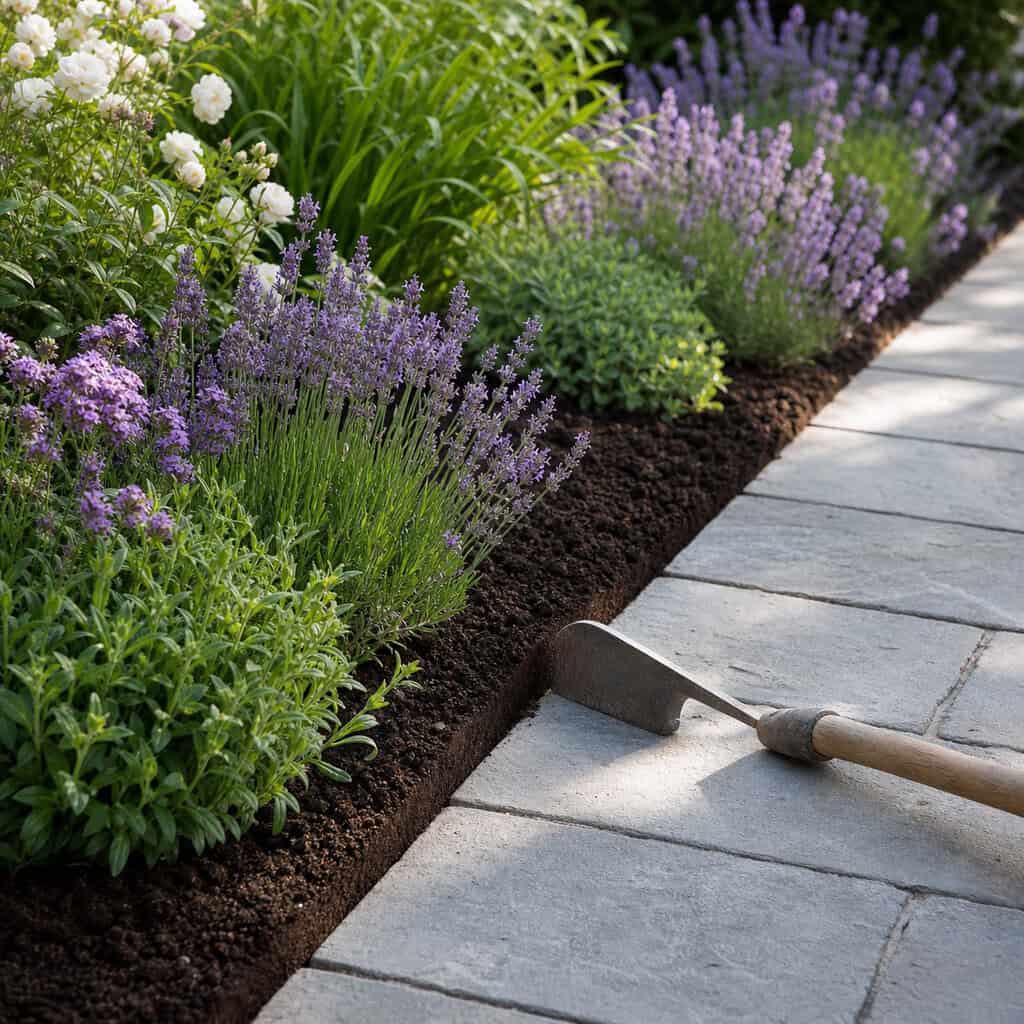
This one takes five minutes and costs nothing. Cut a crisp line between bed and paving.
A sharp edge makes a yard read as organized and deliberate instead of chaotic. The eye interprets order as roominess — messy borders make any space feel smaller and more cluttered.
It’s minor next to laying paving on the diagonal. But it’s the fastest way to make everything else you did look intentional.
Edge it. Then step back and see how much tidier the whole yard reads.
26. Ditch the Deck Railing Where You Can
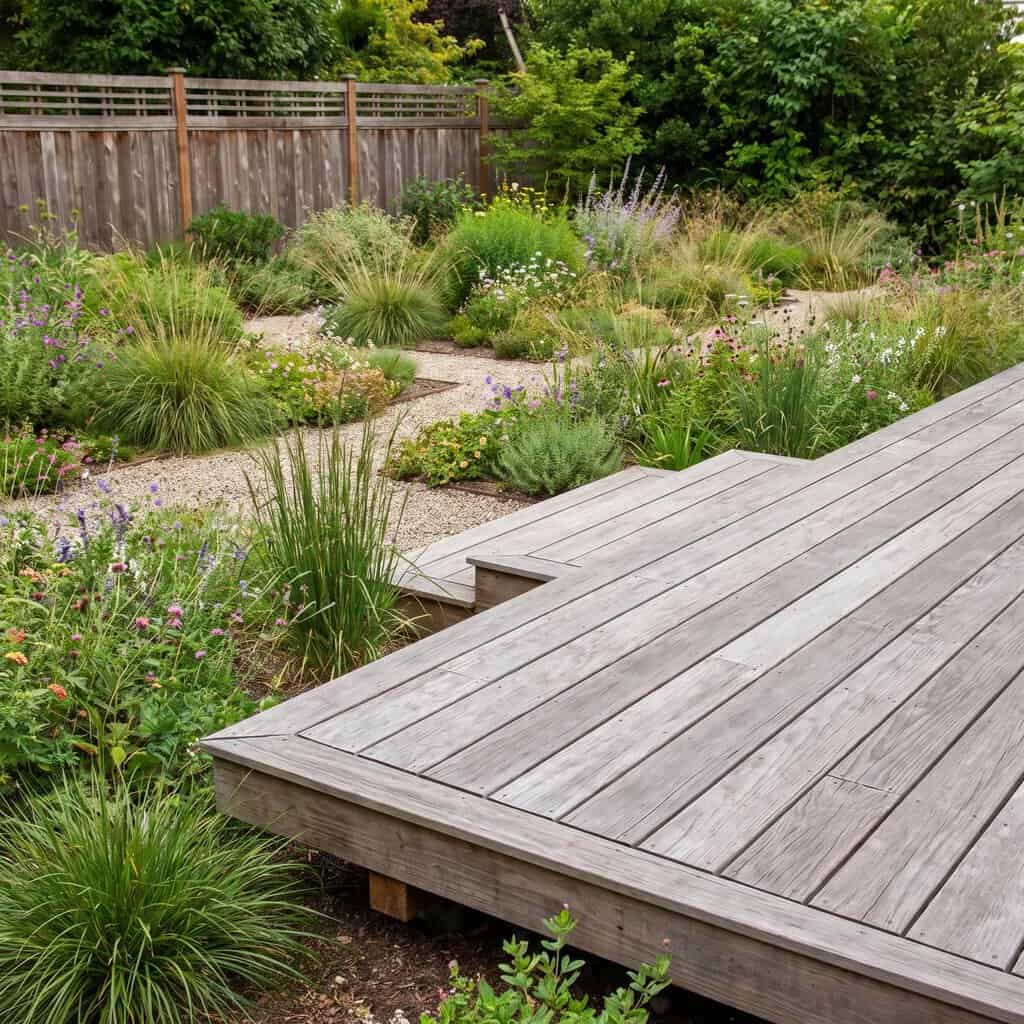
A railing can slice a small deck clean in half, visually. Your sight line hits the balusters and dies there.
Where a low platform makes it safe — and only where code allows — leave the railing off. The view runs unobstructed to the planting and the fence beyond, and the deck merges into the yard.
Read the caveat twice. This is situational, not universal.
On anything raised more than a step or two, code and gravity both win. Keep the rail.
27. Skip the Heavy Pergola or Gazebo
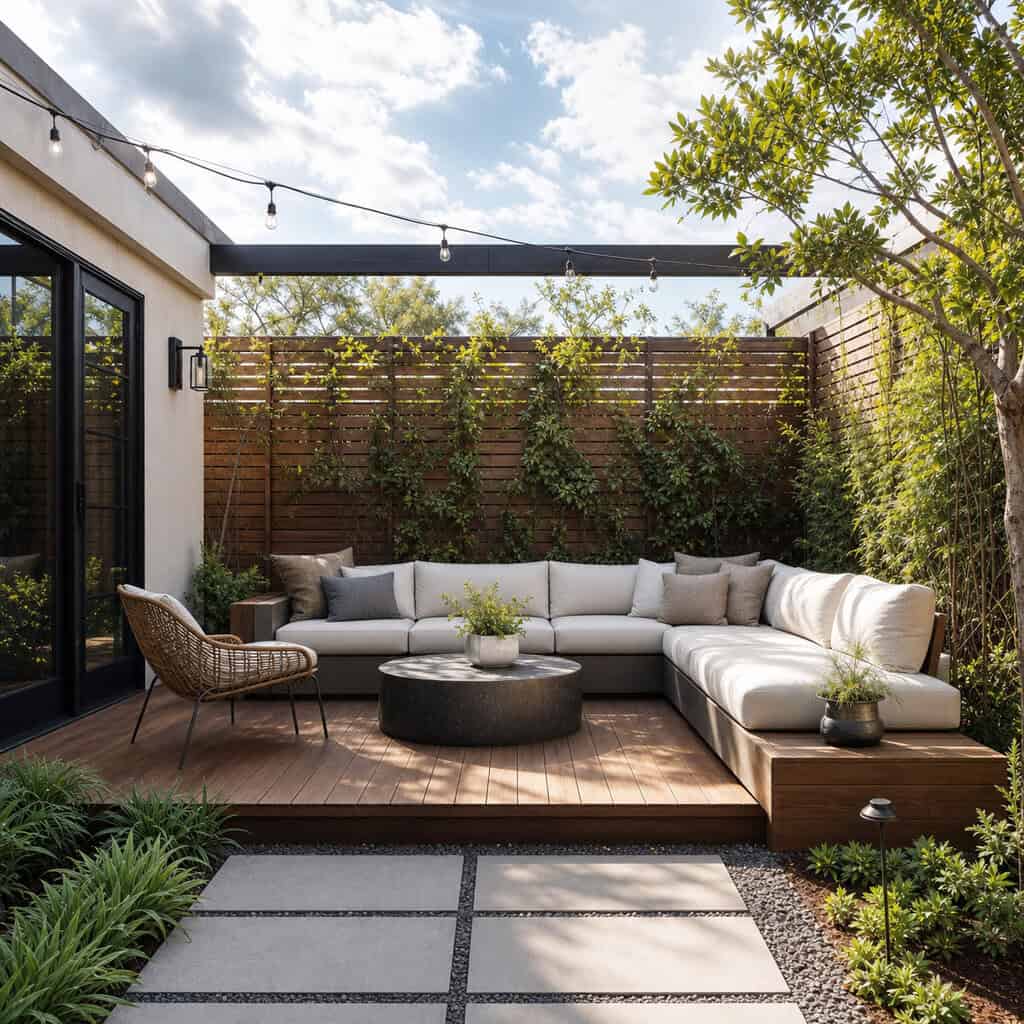
This one’s a genuine judgment call, and the designers don’t agree.
Some argue an overhead structure adds framing, vertical interest, and a sense of an outdoor room. Others say a heavy pergola or gazebo encloses a tiny yard, blocks the open sky, and shrinks the very space it’s supposed to define.
Both are right, depending on your yard. A slim, open-frame structure over a seating nook can lift the eye. A bulky, roofed gazebo plopped in the middle will crush a courtyard.
If you’re on the fence, skip it and let the sky do the work. Open air is the one thing a small yard has plenty of.
The Takeaway
None of these tricks add a single inch of land. They add depth, sight lines, and the feeling of somewhere else to go.
If you only do three, make them the structural ones — diagonal paving, dividing the space into rooms, and a dark back fence. Those move the needle more than any pot ever will. The pared-down principles behind all of it come straight from the extension experts, like this rundown of landscape design basics from University of Florida IFAS.
The best small yards don’t feel small. They feel like they’re hiding something around the corner.
Give yours a corner worth turning.
Quick Reference: Which Trick Fits Your Yard
Not every move suits every plot. Here’s the fastest way to match the fix to the problem.
| Narrow & Long | Boxy & Square | |
|---|---|---|
| Best layout move | Curving path | Diagonal paving |
| Corner fix | Side-to-side planting | Round off angles |
| Depth trick | Dark back fence | Outdoor mirror |
| Focal point | Bold foreground pot | Water feature center |
Narrow yards need widening — pull the eye sideways. Boxy yards need depth and softened corners. Start there, then layer the rest.